
How Many Calories Are in Sunflower Oil? The Quick Answer
Sunflower oil has about 120 calories per tablespoon (13.6 grams), 40 per teaspoon (4.5 grams), 240 per two tablespoons, about 480 per quarter cup, and about 1,927 per cup (218 grams). Per 100 grams it has about 884 calories, and per 100 milliliters about 814, since oil is lighter than water. Butter has about 102 calories per tablespoon (14 grams), 34 per teaspoon and 717 per 100 grams. So sunflower oil has about 18 percent more calories than butter per tablespoon and 23 percent more per 100 grams.
Many people assume that oil and butter have the same calories, or that oil has fewer. In fact oil is the more concentrated of the two. Sunflower oil is 100 percent fat, which has 9 calories per gram, and butter is about 81 percent fat, 16 percent water and 2 percent milk solids. Water has no calories, so butter has fewer calories per gram. That is why, when you replace a tablespoon of butter with a tablespoon of oil in cooking, you add about 18 calories, and why the standard conversion in baking is 3/4 of the amount of oil for the butter.
The difference between oil and butter is more significant in the type of fat. Sunflower oil has about 10 percent saturated fat, while butter has about 51 percent, so a tablespoon of oil has about 1.4 grams of saturated fat compared with 7.3 grams for butter. Sunflower oil has no cholesterol, while butter has 31 milligrams per tablespoon. This guide gives the calories in sunflower oil by teaspoon, tablespoon, cup and bottle, compares it with butter and other fats, and covers high oleic and regular sunflower oil, frying and oil absorption, cooking sprays, baking swaps, health effects, smoke point and storage. There are three comparison tables and an FAQ.
A tablespoon of sunflower oil has about 120 calories and no carbohydrate or protein
How Many Calories Are in Sunflower Oil by Spoon, Cup and Bottle?
| Portion | Weight | Calories | Fat | Saturated fat |
|---|---|---|---|---|
| 1 spray (cooking spray, 1 second) | about 1 g | 7 kcal | 0.8 g | 0.1 g |
| 1/2 teaspoon | 2.3 g | 20 kcal | 2.3 g | 0.2 g |
| 1 teaspoon | 4.5 g | 40 kcal | 4.5 g | 0.5 g |
| 1 tablespoon | 13.6 g | 120 kcal | 13.6 g | 1.4 g |
| 2 tablespoons | 27 g | 240 kcal | 27 g | 2.8 g |
| 1/4 cup | 54.5 g | 482 kcal | 54.5 g | 5.6 g |
| 1/2 cup | 109 g | 964 kcal | 109 g | 11.2 g |
| 1 cup | 218 g | 1,927 kcal | 218 g | 22.5 g |
| 100 ml | 92 g | 814 kcal | 92 g | 9.5 g |
| 250 ml bottle | 230 g | 2,033 kcal | 230 g | 23.7 g |
| 500 ml bottle | 460 g | 4,066 kcal | 460 g | 47.4 g |
| 1 liter bottle | 920 g | 8,133 kcal | 920 g | 94.8 g |
| 100 g | 100 g | 884 kcal | 100 g | 10.3 g |
A one liter bottle of sunflower oil contains over 8,000 calories, which is about four days of food for an average adult. In a family kitchen that uses a bottle in a month, the oil provides around 270 calories a day in total, spread over all the household's meals.
Sunflower Oil vs Butter: Calories Compared
| Fat | Portion | Weight | Calories | Fat | Saturated fat | Cholesterol |
|---|---|---|---|---|---|---|
| Sunflower oil | 1 teaspoon | 4.5 g | 40 kcal | 4.5 g | 0.5 g | 0 mg |
| Sunflower oil | 1 tablespoon | 13.6 g | 120 kcal | 13.6 g | 1.4 g | 0 mg |
| Sunflower oil | 100 g | 100 g | 884 kcal | 100 g | 10.3 g | 0 mg |
| Butter | 1 teaspoon | 4.7 g | 34 kcal | 3.8 g | 2.4 g | 10 mg |
| Butter | 1 tablespoon | 14 g | 102 kcal | 11.5 g | 7.3 g | 31 mg |
| Butter | 100 g | 100 g | 717 kcal | 81 g | 51 g | 215 mg |
| Butter | 1 stick (113 g) | 113 g | 810 kcal | 91.6 g | 57.5 g | 244 mg |
| Margarine, tub | 1 tablespoon | 14 g | 70 kcal | 8.0 g | 1.5 g | 0 mg |
| Ghee | 1 tablespoon | 13 g | 112 kcal | 12.7 g | 8.0 g | 33 mg |
| Olive oil | 1 tablespoon | 13.5 g | 119 kcal | 13.5 g | 1.9 g | 0 mg |
Sunflower oil has 18 more calories per tablespoon than butter but about one fifth of the saturated fat and no cholesterol. For heart health, replacing saturated fat with unsaturated fat is often advised, but for weight, the calories still matter. Light spreads and margarines that are about half fat have even fewer calories, at about 35 to 70 per tablespoon.
Sunflower Oil vs Butter: Nutrition Compared
| Per 100 g | Regular sunflower oil | High oleic sunflower oil | Butter |
|---|---|---|---|
| Calories | 884 kcal | 884 kcal | 717 kcal |
| Total fat | 100 g | 100 g | 81 g |
| Saturated fat | 10.3 g | 8.6 g | 51 g |
| Monounsaturated fat | 19.5 g | 83 g | 21 g |
| Polyunsaturated fat | 65.7 g | 4.5 g | 3.0 g |
| Cholesterol | 0 mg | 0 mg | 215 mg |
| Vitamin E | 41 mg | 15 mg | 2.3 mg |
| Vitamin K | 5.4 mcg | 5.4 mcg | 7 mcg |
| Vitamin A | 0 mcg | 0 mcg | 684 mcg |
| Water | 0 g | 0 g | 16 g |
| Sodium | 0 mg | 0 mg | 643 mg (salted) |
Regular sunflower oil is very high in polyunsaturated fat, mostly omega-6 linoleic acid, and in vitamin E, with a tablespoon providing about 5.6 milligrams, about 37 percent of the daily need. High oleic sunflower oil is rich in monounsaturated fat like olive oil, and is more stable for frying. Butter provides vitamin A and a rich flavor, but much more saturated fat.
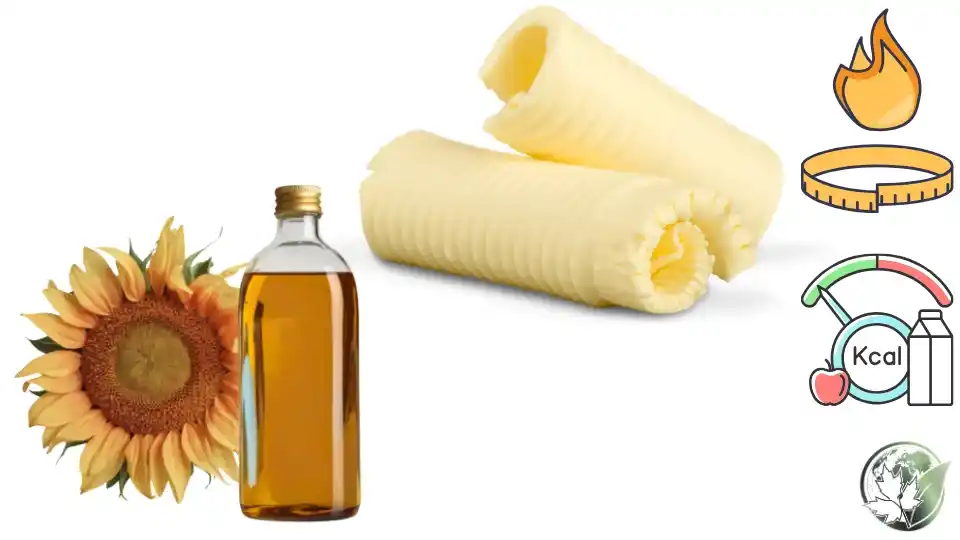
A tablespoon of sunflower oil has about 18 more calories than a tablespoon of butter
How Does Frying in Sunflower Oil Change the Calories of Food?
Sunflower oil is popular for frying because of its mild taste and high smoke point, about 230 degrees Celsius for refined oil. When you fry, food takes up some of the oil, and the calories rise accordingly. The amount depends on the surface area, the batter, the temperature and the time. As a rule, deep fried potatoes absorb about 10 to 15 percent of their weight in oil, and battered foods more.
| Food (100 g) | Raw or boiled | Pan fried in 1 tsp oil | Deep fried |
|---|---|---|---|
| Potato slices | 77 kcal | 115 kcal | 312 kcal (chips) |
| Chicken breast | 120 kcal | 165 kcal | 260 kcal (battered) |
| Egg (1 large, 50 g) | 72 kcal | 112 kcal | 130 kcal |
| Fish fillet (white) | 90 kcal | 130 kcal | 230 kcal (battered) |
| Onion slices | 40 kcal | 80 kcal | 410 kcal (rings) |
| Eggplant slices | 25 kcal | 105 kcal | 200 kcal |
| Zucchini slices | 17 kcal | 57 kcal | 150 kcal |
| Mushrooms | 22 kcal | 62 kcal | 180 kcal |
A fried egg in a teaspoon of oil has about 40 more calories than a boiled one. An aubergine slice can absorb a surprising amount of oil, up to a third of its weight, which is why it is often salted and baked or grilled instead.
How Many Calories Are in Cooking Spray and How Can You Use Less Oil?
Many cooking sprays are labeled as zero calories because the serving size is tiny, often a quarter second of spray, which delivers about 0.3 gram. A real-world one second spray has about 7 calories, and a three second spray used to coat a pan has about 20. This is still much less than the 120 calories in a tablespoon of oil. Using a spray, a brush or an oil mister helps cover a surface with a thin film. Good non-stick pans also reduce the amount of oil needed. A teaspoon of oil is enough for a stir-fry for two, and an oven-baked recipe on parchment needs none.
| Method | Oil used | Calories added |
|---|---|---|
| Pour from the bottle, by eye | 2 tablespoons | 240 kcal |
| Measured tablespoon | 1 tablespoon | 120 kcal |
| Measured teaspoon | 1 teaspoon | 40 kcal |
| Brush a thin coat | 1/2 teaspoon | 20 kcal |
| Spray, 3 seconds | about 3 g | 20 kcal |
| Non-stick pan, no oil | 0 | 0 kcal |
| Oven bake on parchment | 0 | 0 kcal |
| Air fry with spray | about 1 g | 7 kcal |
Can You Replace Butter With Sunflower Oil in Baking?
Yes, in many recipes. Because butter is only about 80 percent fat, use about 3/4 the amount of oil, by volume or weight, in place of butter. A tablespoon of butter equals about 3/4 tablespoon (2 1/4 teaspoons) of oil. If a cake calls for 1/2 cup of butter, use 6 tablespoons of oil. The result is a cake that is moister and softer with a more tender crumb, but it will lack the flavor and the rise that comes from creaming butter and sugar. For cookies, oil makes a flatter, chewier cookie. For pastry and pie crusts, solid fats work better.
| Recipe (per cup of fat) | Butter | Sunflower oil | Difference |
|---|---|---|---|
| Butter 1 cup (227 g) | 1,627 kcal | 3/4 cup oil: 1,445 kcal | 182 kcal fewer |
| Butter 1/2 cup | 813 kcal | 6 tbsp oil: 723 kcal | 90 kcal fewer |
| Butter 1 tbsp | 102 kcal | 2 1/4 tsp oil: 90 kcal | 12 kcal fewer |
With the 3/4 conversion, swapping butter for oil saves about 11 percent of the fat calories in a recipe, though the recipe changes in texture and flavor.
Is Sunflower Oil Healthy?
Sunflower oil is a good source of vitamin E and unsaturated fats, and it contains no cholesterol or trans fat. Replacing saturated fat, such as butter, with polyunsaturated fat is associated with lower LDL cholesterol and a lower risk of heart disease in many studies. High oleic sunflower oil is similar to olive oil in fatty acid profile and is more stable at high temperatures.
Regular sunflower oil is high in omega-6 linoleic acid. While omega-6 fats are essential, a diet that is very high in them relative to omega-3 fats has been debated. Most health authorities consider omega-6 intake in typical amounts to be safe and beneficial for the heart. When oil is heated for a long time at high temperature, as in deep frying, polyunsaturated oils can form oxidation products such as aldehydes, so avoid reusing oil many times and avoid smoking. As with all oils, calories are the main concern for weight.
Is Sunflower Oil Good for Weight Loss?
No oil is a weight loss food, since all have about 120 calories per tablespoon, but a modest amount is part of a healthy diet and helps the absorption of fat-soluble vitamins. The key is measuring. People often pour two or three tablespoons into a pan without noticing, adding 240 to 360 calories. Cutting your usual oil by half in the dishes you cook every day could save 100 to 200 calories a day. Use a spoon rather than the bottle, and use non-stick cookware, a spray or a steaming or oven method.
Measuring oil with a spoon instead of pouring can save 100 calories or more a day
How Does Sunflower Oil Compare with Other Cooking Oils?
| Oil (1 tablespoon) | Calories | Saturated fat | Monounsaturated | Polyunsaturated | Smoke point |
|---|---|---|---|---|---|
| Sunflower oil | 120 kcal | 1.4 g | 2.7 g | 8.9 g | 230 C refined |
| High oleic sunflower oil | 120 kcal | 1.2 g | 11.3 g | 0.6 g | 230 C |
| Olive oil | 119 kcal | 1.9 g | 9.9 g | 1.4 g | 190 C |
| Canola oil | 124 kcal | 1.0 g | 8.9 g | 3.9 g | 205 C |
| Corn oil | 122 kcal | 1.8 g | 3.8 g | 7.4 g | 230 C |
| Soybean oil | 120 kcal | 2.1 g | 3.1 g | 7.9 g | 230 C |
| Coconut oil | 121 kcal | 11.2 g | 0.8 g | 0.2 g | 175 C |
| Avocado oil | 124 kcal | 1.6 g | 9.9 g | 1.9 g | 270 C |
| Butter | 102 kcal | 7.3 g | 3.0 g | 0.4 g | 150 C |
| Ghee | 112 kcal | 8.0 g | 3.7 g | 0.5 g | 250 C |
Every oil has about 120 calories per tablespoon, so the choice is about fat type, flavor and cooking method. Butter has fewer calories only because of its water content.
How to Choose and Store Sunflower Oil
Choose oil in dark glass or opaque containers, since light speeds up oxidation, and check the date. Refined sunflower oil is clear and mild, and cold-pressed or unrefined oil has a nutty flavor and lower smoke point. Store it in a cool, dark cupboard, away from the stove, with the cap tightly closed. An unopened bottle lasts one to two years, and an opened bottle about six months. Rancid oil smells like paint or old crayons and should be discarded. Rancidity does not change the calories but can produce unhealthy compounds.
Sunflower oil keeps for about six months after opening when stored away from light and heat
How to Count Sunflower Oil Calories Accurately
Measure the oil with a spoon, and use 120 calories per tablespoon and 40 per teaspoon. For frying, you can measure the oil before and after cooking, and subtract the amount left in the pan. In deep frying, count about 10 to 15 percent of the weight of the food as oil absorbed, though it can be more for batters. For sprays, count 7 calories for each second.
How Is Sunflower Oil Made and What Is the Difference Between Refined and Cold Pressed?
Sunflower oil is extracted from the seeds of the sunflower plant, Helianthus annuus. The seeds are cleaned, hulled and pressed or treated with a solvent to extract the oil. Refined oil is then degummed, neutralized, bleached and deodorized, which gives it a light color, mild taste and high smoke point, and removes some of the minor compounds. Cold pressed or unrefined oil is pressed without heat or chemicals and filtered, keeping a nutty flavor and more vitamin E and phytonutrients, but it has a lower smoke point and is better for dressings and low heat cooking. Both have the same calories, about 120 per tablespoon, because they are both pure fat.
Seeds usually contain 40 to 50 percent oil by weight, so 1 kilogram of seed yields about 400 to 450 grams of oil, or about 3,500 to 4,000 calories of oil. In regular varieties, about two thirds of the fat is linoleic acid. High oleic varieties, bred for stability, have more than 80 percent oleic acid, which is the same fatty acid that makes up most of olive oil. Mid-oleic oil is a blend, with about 65 percent oleic acid.
What Is the Smoke Point of Sunflower Oil and Why Does It Matter?
The smoke point is the temperature at which an oil begins to break down and produce visible smoke and unpleasant compounds. Refined sunflower oil has a smoke point of about 230 degrees Celsius (450 degrees Fahrenheit), which makes it suitable for deep frying, stir-frying and searing. Unrefined oil smokes at about 107 degrees Celsius, so it is best used cold. Butter smokes at about 150 to 175 degrees Celsius because of its milk solids, which is why it browns and burns quickly in a hot pan. If you cook with butter at high heat, you might add a little oil to raise the smoke point. Heating oil past its smoke point does not change the calories, but it creates acrid smoke, a bitter flavor and potentially harmful compounds.
How Do You Reduce the Oil in Everyday Persian and Middle Eastern Cooking?
Many traditional dishes begin with a generous amount of oil to fry onions, brown meat or fry vegetables, and many families use more than they need. A few changes can cut the calories without changing the flavor much. Fry onions in half the oil, or begin with a splash of water and let them soften and then brown. Brown meat in a dry non-stick pan, since it releases its own fat. Roast or grill eggplant, instead of frying it, and then add it to the stew. Use a tablespoon of oil for rice, with the rest of the fat as butter for flavor in a thin layer on top. Skim the oil that rises to the top of stews and soups. In Iranian stews, it is common to see oil floating at the top, and skimming a tablespoon or two from a pot can reduce each serving by 30 to 60 calories.
What Is the Best Way to Drink or Eat Less Oil at Restaurants?
Restaurant dishes often have more oil than home cooking, and a single meal can have 500 calories of oil or butter. Ask for dressings on the side, order grilled or steamed dishes instead of fried, and choose tomato-based sauces over cream or butter sauces. Pat fried foods with a napkin to remove surface oil, which can reduce calories by 5 to 10 percent. Share fried appetizers. Choose a small portion of rice or pasta, because it is often cooked with butter or oil. If a dish seems greasy, leave the pooled oil on the plate rather than mopping it with bread.
Can Children and Older Adults Eat Foods Cooked in Sunflower Oil?
Oil is a necessary part of a child's diet, since fat supplies concentrated energy and essential fatty acids for growth and brain development. A modest amount of sunflower oil in meals is appropriate. Children under two should not follow low-fat diets. For older adults, a small amount of oil helps with energy intake when appetite is low, and a spoonful of oil added to soup or vegetables is a simple way to add calories if needed. The concern is deep fried foods, which are high in calories and may be a source of oxidation products, so they should be occasional. People with gallbladder problems or pancreatitis may need to limit fat, according to their doctor.
How Many Calories Does a Salad Dressing Made With Sunflower Oil Have?
A classic vinaigrette uses three parts oil to one part vinegar. Two tablespoons of dressing with 1 1/2 tablespoons of sunflower oil have about 180 calories, almost entirely from the oil. To reduce this, use a ratio of one part oil to two parts lemon juice or vinegar, and add mustard, which helps keep the mixture together. A tablespoon of oil with two tablespoons of lemon juice and a teaspoon of mustard makes about 3 portions of dressing at 45 calories each. Using a spray bottle to mist salad with oil is another way to coat leaves with only 20 calories.
| Dressing | Serving | Calories |
|---|---|---|
| Classic vinaigrette, 3:1 oil to vinegar | 2 tbsp | 180 kcal |
| Light vinaigrette, 1:2 oil to lemon | 2 tbsp | 60 kcal |
| Oil spray mist, 3 sprays | 1 salad | 20 kcal |
| Lemon juice only | 2 tbsp | 8 kcal |
| Yogurt dressing | 2 tbsp | 25 kcal |
| Ranch dressing | 2 tbsp | 129 kcal |
What Are the Most Common Mistakes When Counting Oil Calories?
The first mistake is ignoring oil entirely, since a splash of it in a pan seems small but it can be a few hundred calories a day. The second is using the label of a spray at face value, which may read 0 calories per serving, when a normal coating uses several seconds of spray. The third is not accounting for the oil that remains in the pan, which may lead to counting too many calories, while the oil absorbed by food is what matters, so you can pour off excess oil and subtract. The fourth is confusing the oil's calories by volume and weight: a tablespoon of oil weighs 13.6 grams, so 100 grams of oil is 7.4 tablespoons, not 6. Weigh the bottle before and after cooking for greater precision.
Key Takeaways: Sunflower Oil Calories vs Butter
Sunflower oil has about 120 calories per tablespoon and 884 per 100 grams, about 18 to 23 percent more than butter at 102 and 717, because butter contains water. Oil has much less saturated fat and no cholesterol. Measure your spoon, use a spray or brush, and use three quarters as much oil when replacing butter in baking.
Frequently Asked Questions
6 questions answered
How many calories are in a tablespoon of sunflower oil?
About 120.
Does sunflower oil have fewer calories than butter?
No, it has about 18 percent more per tablespoon.
How many calories are in 100 ml of sunflower oil?
About 814.
Is sunflower oil healthier than butter?
It has less saturated fat, but the calories are higher.
How much oil should I use instead of butter?
About three quarters of the amount.
Does frying add calories?
Yes, food absorbs some of the oil.




