Apple Juice Calories at a Glance
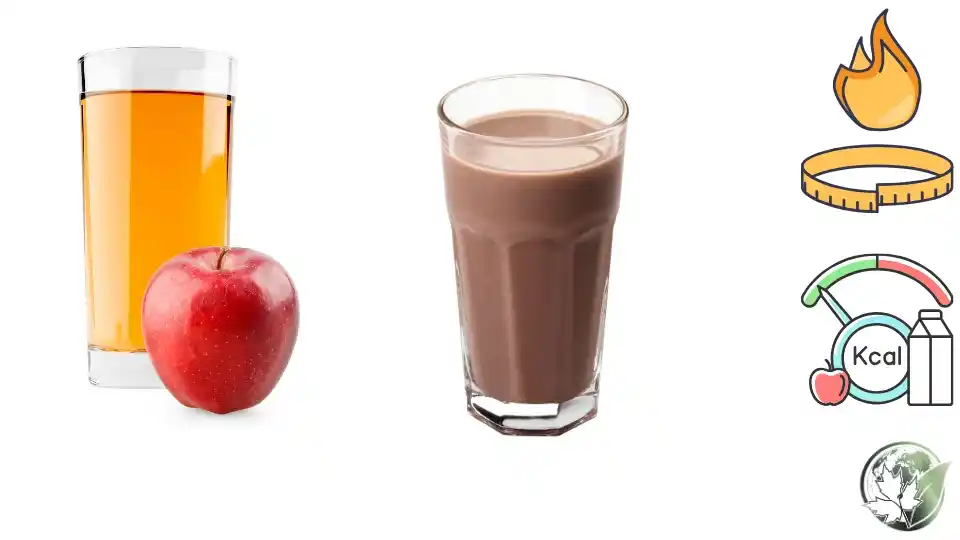
Apple juice vs milk chocolate calories start with one number: apple juice has about 46 calories per 100 milliliters for a typical unsweetened, filtered juice. A standard 250 milliliter glass therefore holds roughly 115 calories, and a small 200 milliliter box holds about 92. Milk chocolate sits in a completely different calorie class: about 535 calories per 100 grams, or roughly 53 calories in a single 10 gram square. On a per-weight basis, chocolate is more than eleven times as calorie dense as apple juice.
That comparison can be misleading in practice, because nobody drinks 100 grams of juice the way they might eat 100 grams of chocolate. The fairer question is what a normal serving costs. A glass of apple juice has around 115 calories, which is the same as about two and a quarter squares of chocolate. A 43 gram milk chocolate bar contains about 230 calories, equal to two full glasses of juice.
This guide compares apple juice and milk chocolate by serving, by 100 grams and by sugar content. It explains why juice can feel "free" while chocolate feels indulgent, even though the sugar amounts are closer than most people expect. You will find three comparison tables, practical swap ideas and an FAQ at the end.
A 250 ml glass of apple juice contains about 115 calories and 25 grams of sugar
How Many Calories Are in Apple Juice per 100 ml, Cup and Glass?
Calories in apple juice come almost entirely from natural sugars, mainly fructose, glucose and sucrose. Pressed and filtered juice contains no meaningful fat or protein, so the numbers scale directly with volume. Cloudy, unfiltered juice is almost identical, though it may contain a little more fiber and polyphenols.
| Serving | Volume | Calories | Sugar |
|---|---|---|---|
| Small sip | 50 ml | 23 kcal | 5 g |
| Juice box | 200 ml | 92 kcal | 20 g |
| Standard glass | 250 ml | 115 kcal | 25 g |
| 1 US cup | 240 ml | 110 kcal | 24 g |
| Large bottle serving | 330 ml | 152 kcal | 33 g |
| 100 ml reference | 100 ml | 46 kcal | 10 g |
Concentrated juice made from reconstituted concentrate is about the same as fresh pressed juice when diluted correctly. Sweetened juice drinks and "apple flavored" beverages can reach 55 to 60 calories per 100 milliliters, so always read the label to see whether you are buying 100 percent juice or a drink.
How Many Calories Are in Milk Chocolate?
Milk chocolate is made from cocoa, sugar, milk solids and cocoa butter. The fat and sugar combination makes it a dense source of energy. A typical reference value is 535 calories per 100 grams, with about 30 grams of fat, 59 grams of carbohydrate (52 of them sugar) and 7.7 grams of protein.
| Chocolate portion | Weight | Calories | Sugar |
|---|---|---|---|
| 1 square | 10 g | 54 kcal | 5.2 g |
| 2 squares | 20 g | 107 kcal | 10.4 g |
| Fun-size bar | 17 g | 91 kcal | 8.8 g |
| Standard bar | 43 g | 230 kcal | 22 g |
| Large bar | 100 g | 535 kcal | 52 g |
| 1 chocolate kiss | 5 g | 27 kcal | 2.6 g |
Brands differ. Premium milk chocolate with higher cocoa content may reach 550 to 560 calories per 100 grams, while lighter, aerated chocolate can be around 500. Chocolate with nuts, caramel or wafer pieces usually adds more calories per bar.
Apple Juice vs Milk Chocolate: Which Has More Calories?
By weight, milk chocolate has about 11.6 times more calories than apple juice. By serving, the picture is closer. A 250 milliliter glass of juice has about the same calories as a 21 gram portion of chocolate, which is about two squares.
| Comparison | Apple juice | Milk chocolate |
|---|---|---|
| Per 100 g or 100 ml | 46 kcal | 535 kcal |
| Typical single serving | 115 kcal (250 ml glass) | 230 kcal (43 g bar) |
| Sugar per 100 | 10 g | 52 g |
| Sugar per typical serving | 25 g | 22 g |
| Fat per serving | 0 g | 13 g |
| Protein per serving | 0.3 g | 3.3 g |
| Fiber per serving | 0.2 g | 1.5 g |
The surprising line is the sugar per typical serving: a glass of juice contains more sugar than an entire standard chocolate bar. The calories are lower because chocolate's fat adds energy, yet the sugar load is comparable, and juice delivers it as a liquid that is absorbed quickly.
A glass of apple juice can contain more sugar than a standard milk chocolate bar
How to Compare Apple Juice and Chocolate Fairly
Comparing a liquid and a solid takes some care. Three methods work well. The first is calories per serving, which compares what people actually consume. The second is calories per gram of sugar, which shows how much energy comes with each gram of sugar. Juice has about 4.6 calories per gram of sugar, while chocolate has about 10.3, because of its fat content. The third is satiety, or how long each food keeps you full.
On satiety, chocolate has the advantage. Fat and a little protein slow stomach emptying, so a few squares can calm a craving for an hour or two. Juice is quickly absorbed and does not displace much hunger, so many people drink a glass and are hungry again soon. This is why nutrition guidelines suggest eating whole apples instead of drinking juice most of the time.
Choose the method that matches your goal. If you are managing weight, calories per serving and satiety matter most. If you are managing blood sugar, sugar per serving and speed of absorption matter more.
How Does Apple Juice Compare with Whole Apple?
A medium apple weighing 182 grams has about 95 calories and 19 grams of sugar, along with 4.4 grams of fiber. A 250 milliliter glass of juice has about 115 calories and 25 grams of sugar, but almost no fiber. The juice from two to three apples is needed to fill that glass, so it is easy to consume the calories of three apples in half a minute.
| Item | Calories | Sugar | Fiber | Time to consume |
|---|---|---|---|---|
| 1 medium apple | 95 kcal | 19 g | 4.4 g | 5 to 10 minutes |
| 250 ml apple juice | 115 kcal | 25 g | 0.2 g | 1 to 2 minutes |
| 2 squares milk chocolate | 107 kcal | 10 g | 0.7 g | 2 to 3 minutes |
An apple is clearly the better choice for fullness. Chocolate, in small amounts, is satisfying for a different reason. Juice is the least filling of the three, which is why it works best as an occasional drink or as a source of quick energy, not as an all-day beverage.
How Much Sugar Is in Apple Juice Compared with Chocolate?
Because sugar drives much of the health discussion, it helps to count cubes. A sugar cube weighs about 4 grams. A 250 milliliter glass of apple juice has about 25 grams of sugar, or 6.2 cubes. A standard 43 gram chocolate bar has about 22 grams of sugar, or 5.6 cubes.
The World Health Organization advises keeping free sugars below 10 percent of daily calories, which equals about 50 grams for a 2000 calorie diet. Fruit juice counts as free sugar even though it is natural, because the structure of the fruit has been broken down. One glass of apple juice therefore uses about half your daily allowance. A bar of chocolate does the same.
Eating both in the same day can exceed the limit without any other added sugar. This is not a reason to avoid them forever, but it is a good reason to treat them as occasional foods and to keep portions small.
How to Cut Calories When You Drink Apple Juice
You do not have to give up juice to reduce calories. A few simple habits make a big difference.
Pour smaller glasses, such as 150 ml, which has about 69 calories
Dilute juice 1 to 1 with sparkling or plain water for 58 calories per 250 ml glass
Choose cloudy, unfiltered juice, which may have a little more fiber
Avoid sweetened juice drinks and cocktails
Pair juice with food that has protein or fat, such as nuts or cheese
Keep juice for mealtimes instead of sipping it all day
Diluting juice cuts calories and sugar by half while keeping the flavor. A 250 milliliter spritzer made with 125 milliliters of juice and 125 milliliters of sparkling water has only about 58 calories and 12.5 grams of sugar, far less than a plain glass.
Diluting apple juice with sparkling water halves the calories and sugar per glass
How to Enjoy Milk Chocolate Without Overeating
Chocolate is easier to portion when it is already divided. Buy bars with marked squares, and break off a set amount before you start. Two squares, about 20 grams, give you 107 calories and a satisfying flavor. Eating slowly and letting the chocolate melt helps your brain register the pleasure with fewer bites.
If you want more cocoa and less sugar, try a 55 to 70 percent dark chocolate. It has similar calories, around 540 to 600 per 100 grams, but less sugar and more fiber and antioxidants. Pairing chocolate with fruit, nuts or yogurt can make a small piece feel like a bigger dessert.
Avoid eating chocolate straight from a large bag while watching television. Studies show people eat 30 to 40 percent more when snacking from larger packages. Pour a portion into a bowl and put the rest away.
Can Apple Juice or Chocolate Fit in a Weight Loss Diet?
Both can fit if they are counted. A 2000 calorie plan has room for about 200 calories of "extras," meaning foods that are not essential nutrition. That can be one glass of apple juice and half a chocolate bar, or one chocolate bar alone, or a glass of juice and a few squares of chocolate on a different day.
The key is awareness. Liquid calories are easy to forget, and studies show that people do not compensate by eating less later. If you are trying to lose weight, replacing a daily glass of juice with water or a whole fruit can save about 800 calories a week. That equals roughly a quarter of a pound of body fat over a month, on that one change alone.
For people who need to gain weight, juice and chocolate are both easy sources of extra calories, though neither provides much protein. Adding milk, yogurt, nuts or nut butter gives a better nutritional return.
How Apple Juice Fits Children's and Older Adults' Diets
Pediatric guidelines recommend limiting fruit juice for young children. The American Academy of Pediatrics suggests no juice for infants under 12 months, up to 4 ounces (120 ml) a day for ages 1 to 3, up to 4 to 6 ounces for ages 4 to 6 and up to 8 ounces for older children. At 120 milliliters, apple juice provides about 55 calories and 12 grams of sugar.
Chocolate is not recommended as a regular treat for toddlers because of its sugar and caffeine content, although small amounts are not harmful. For children, the more important habit is to keep sweet foods to certain times rather than constant grazing.
Older adults sometimes benefit from juice as a quick source of fluid and energy, particularly when appetite is small or when blood sugar is low. In those cases, the calories and sugar are an advantage, not a drawback, and a doctor or dietitian can advise on the right amount.
How to Read Labels on Apple Juice and Chocolate
On juice cartons, look for the words "100% juice" and "no added sugar." Check the serving size, since some cartons list 8 ounces and others 6 or 12. Convert the sugar line into cubes by dividing by four. A label showing 28 grams of sugar per serving means 7 cubes.
On chocolate bars, check the serving size in grams and the number of servings in the pack. A large bar may list three servings, so the calories on the front may refer to only a third of the bar. Check the ingredient order: sugar listed first means the chocolate is mostly sugar. Cocoa solids and cocoa butter near the top are a sign of a richer, less sweet product.
Be careful with terms like "natural," "pure" or "premium." They do not describe calories. Only the nutrition panel and ingredient list tell you what you are getting.
Reading labels helps convert grams of sugar into sugar cubes and compare servings
How to Store Apple Juice and Chocolate
Unopened shelf-stable apple juice lasts a year or more in a cool pantry. Once opened, keep it refrigerated and drink it within seven to ten days. Fresh pressed juice without preservatives lasts only two to three days and should be kept cold. If the juice smells fermented or fizzes, discard it.
Milk chocolate prefers a cool, dry spot around 15 to 18 degrees Celsius. Heat causes fat bloom, a pale film on the surface, which is harmless but unattractive. Refrigeration can cause sugar bloom if moisture condenses, so wrap chocolate tightly before chilling. Properly stored, milk chocolate stays good for six to twelve months.
For exporters and wholesale buyers, both products have different cold chain needs. Juice concentrates are shipped in drums or aseptic containers, while chocolate requires temperature-controlled transport in hot climates.
How Do Types of Apple Juice Differ in Calories?
Not every bottle labeled apple juice is the same. The main styles are clear filtered juice, cloudy pressed juice, juice from concentrate, organic juice and blended juice drinks. Their calories are close, but the label details matter.
| Type of apple juice | Calories per 100 ml | Sugar per 100 ml | Notes |
|---|---|---|---|
| Clear filtered, 100% juice | 46 kcal | 10 g | Smooth, shelf stable, most common |
| Cloudy pressed juice | 47 kcal | 10 g | Contains fine apple particles and a bit more fiber |
| From concentrate, 100% juice | 46 kcal | 10 g | Water added back to concentrate |
| Organic 100% juice | 46 kcal | 10 g | Same calories, different farming rules |
| Juice drink with added sugar | 52 to 60 kcal | 12 to 14 g | Often only 10 to 30 percent juice |
| Sparkling apple juice | 45 kcal | 10 g | Carbonation adds no calories |
If you want the lowest calories, pick a 100 percent juice and dilute it. If you want the most flavor for the calories, cloudy pressed juice is often more intense, so a smaller glass satisfies you. Avoid anything that lists sugar, glucose syrup or high fructose corn syrup in the first few ingredients.
How Do Types of Milk Chocolate Differ in Calories?
Milk chocolate also comes in styles that change the numbers more than most people expect. A plain bar sits near 535 calories per 100 grams, but fillings and add-ins push it higher, while higher cocoa or aerated structures can lower it.
| Chocolate style | Calories per 100 g | Calories in 40 g |
|---|---|---|
| Plain milk chocolate | 535 kcal | 214 kcal |
| Milk chocolate with hazelnuts | 550 kcal | 220 kcal |
| Milk chocolate with caramel | 495 kcal | 198 kcal |
| Aerated milk chocolate | 515 kcal | 206 kcal |
| Milk chocolate with wafer | 520 kcal | 208 kcal |
| White chocolate, for reference | 540 kcal | 216 kcal |
| Dark chocolate 70 percent, for reference | 598 kcal | 239 kcal |
Dark chocolate looks higher in calories per 100 grams, but because it is more bitter, most people eat less of it. Forty grams of dark chocolate has more calories than forty grams of milk chocolate, yet it has about half the sugar.
How to Swap Chocolate and Juice for Lighter Options
Small substitutions keep the pleasure while trimming calories. Here are five swaps that work in daily life.
Replace a 250 ml glass of apple juice, 115 kcal, with 150 ml of juice plus 100 ml of sparkling water, 69 kcal
Replace a 43 g milk chocolate bar, 230 kcal, with 20 g of dark chocolate and a small apple, about 200 kcal and much more fiber
Replace a chocolate dessert after dinner with warm baked apple and cinnamon, about 95 kcal
Replace a mid-afternoon juice with unsweetened iced tea and a few squares of chocolate, about 55 kcal
Replace chocolate spread on toast with mashed banana and a few chocolate chips, saving about 80 kcal
Each swap saves between 20 and 150 calories while keeping a sweet taste. Over a week, three or four such swaps can free up 500 calories, which is the equivalent of two full chocolate bars you do not have to count.
Key Takeaways: Apple Juice vs Milk Chocolate
Apple juice has about 46 calories per 100 milliliters and 115 calories per 250 milliliter glass. Milk chocolate has about 535 calories per 100 grams and 230 calories in a standard 43 gram bar. Per serving, chocolate has about twice the calories of a glass of juice, but juice contains slightly more sugar.
Neither is a daily health food, yet both can fit into a balanced diet. Use smaller glasses, dilute juice with sparkling water and keep chocolate to a few squares. For fullness and fiber, whole fruit remains the best option.
Frequently Asked Questions
8 questions answered
How many calories are in a glass of apple juice?
A 250 milliliter glass of unsweetened apple juice has about 115 calories and about 25 grams of sugar.
How many calories are in 100 ml of apple juice?
100 milliliters of apple juice has about 46 calories and 10 grams of sugar.
Does milk chocolate have more calories than apple juice?
Yes, by weight. Milk chocolate has about 535 calories per 100 grams, while apple juice has about 46 per 100 milliliters. A standard 43 gram chocolate bar has about twice the calories of a glass of juice.
Which has more sugar, apple juice or chocolate?
A 250 milliliter glass of apple juice has about 25 grams of sugar, slightly more than a standard 43 gram milk chocolate bar, which has about 22 grams.
Is apple juice healthier than chocolate?
Juice provides vitamins and no fat, while chocolate provides some protein, fiber and minerals but also saturated fat. Neither is better for every purpose, and both should be eaten in moderation.
How many squares of chocolate equal one glass of apple juice?
About two squares, or roughly 21 grams, of milk chocolate have the same calories as a 250 milliliter glass of apple juice.
Is whole apple better than apple juice?
For most people, yes. A whole apple has fiber that slows sugar absorption and keeps you full longer, while juice is quickly consumed and less filling.
Can I drink apple juice every day?
A small glass can fit into a healthy diet for many adults, but because it counts as free sugar, it is best kept to about 150 milliliters or less and balanced with whole fruit and water.