How Many Calories Are in Pistachio Kernels? The Quick Answer
Shelled, raw pistachio kernels have about 562 calories per 100 grams. An ounce (28 grams, about 49 kernels) has about 159 calories, a quarter cup (31 grams) about 174, a half cup (62 grams) about 349, and a cup (123 grams) about 690. A single kernel has about 3.2 calories. Almonds have about 579 calories per 100 grams, an ounce (28 grams, about 23 almonds) has about 164, and a single almond has about 7.
Per gram, pistachio kernels have about 3 percent fewer calories than almonds, and per ounce about 3 percent fewer. The real difference is the count. Because pistachios are smaller, a 28 gram serving has about 49 kernels against 23 almonds, so you get more than twice as many nuts for the same calories. For people who snack by the handful, this means pistachios feel more generous. A 100 calorie portion is about 31 pistachio kernels or 14 almonds.
In this guide, pistachio kernels means the shelled green nutmeats that are sold ready to eat or use in cooking, as opposed to pistachios in their shells. The calories are the same for equal weight of kernels whether raw, roasted or salted, because roasting does not change the fat or protein much. What changes is the weight when the shell is on: in-shell pistachios are about 50 to 55 percent kernel, so 100 grams of in-shell nuts have only about 290 calories of edible nut. This guide gives the calories in kernels by ounce, cup, spoon and piece, compares them with almonds in calories and nutrition, and covers raw versus roasted and salted kernels, ground and slivered kernels, uses in cooking, health effects, allergy and storage. There are three comparison tables and an FAQ.
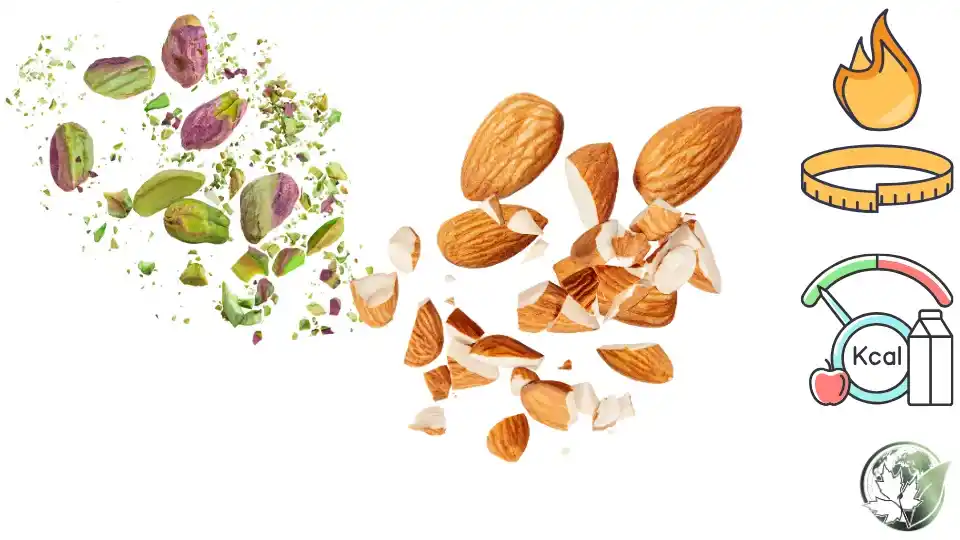
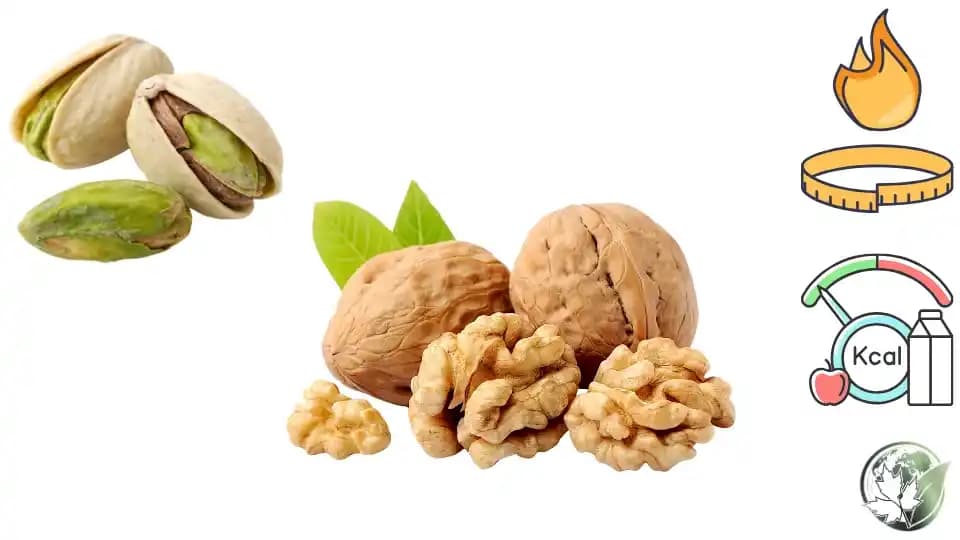
An ounce of shelled pistachio kernels has about 49 nuts and 159 calories
How Many Calories Are in Pistachio Kernels by Ounce, Cup and Piece?
The table is for shelled, unsalted kernels. One kernel weighs about 0.57 gram.
| Portion | Weight | Calories | Protein | Fat | Fiber |
|---|---|---|---|---|---|
| 1 kernel | 0.57 g | 3.2 kcal | 0.1 g | 0.3 g | 0.06 g |
| 10 kernels | 5.7 g | 32 kcal | 1.2 g | 2.6 g | 0.6 g |
| 25 kernels | 14 g | 79 kcal | 2.8 g | 6.3 g | 1.4 g |
| 1 tablespoon | 8 g | 45 kcal | 1.6 g | 3.6 g | 0.8 g |
| 1 ounce (49 kernels) | 28 g | 159 kcal | 5.7 g | 12.9 g | 2.9 g |
| 1/4 cup | 31 g | 174 kcal | 6.3 g | 14 g | 3.2 g |
| 1/2 cup | 62 g | 349 kcal | 12.5 g | 28 g | 6.4 g |
| 3/4 cup | 92 g | 517 kcal | 18.6 g | 41.4 g | 9.5 g |
| 1 cup | 123 g | 690 kcal | 24.8 g | 55.7 g | 12.7 g |
| 100 g | 100 g | 562 kcal | 20.2 g | 45.3 g | 10.3 g |
| 250 g bag | 250 g | 1,405 kcal | 50.5 g | 113 g | 25.8 g |
| 500 g bag | 500 g | 2,810 kcal | 101 g | 226 g | 51.5 g |
| 1 kg bag | 1,000 g | 5,620 kcal | 202 g | 453 g | 103 g |
A standard serving is an ounce, about 49 kernels, which is a small handful, and it has 159 calories. A typical snack, eaten from a bowl without measuring, may be two or three times larger.
How Many Calories Are in Roasted, Salted and Processed Kernels?
Roasting and salting change the taste, not the calories, if the nuts are dry roasted. Oil roasting adds a little.
| Kernel type (1 ounce, 28 g) | Calories | Fat | Sodium |
|---|---|---|---|
| Raw, unsalted | 159 kcal | 12.9 g | 0 mg |
| Dry roasted, unsalted | 162 kcal | 13.0 g | 0 mg |
| Dry roasted, salted | 162 kcal | 13.0 g | 120 mg |
| Oil roasted, salted | 170 kcal | 14.0 g | 120 mg |
| Honey roasted | 160 kcal | 11.0 g | 80 mg |
| Chocolate coated | 180 kcal | 12.0 g | 20 mg |
| Slivered or chopped, raw | 159 kcal | 12.9 g | 0 mg |
| Ground (meal) | 159 kcal | 12.9 g | 0 mg |
| Pistachio butter | 170 kcal | 14.0 g | 0 mg |
| Pistachio kernels in baklava, per 28 g of baklava | 120 kcal | 7.0 g | 20 mg |
Dry roasted kernels have about 2 percent more calories per ounce than raw ones, because roasting drives off a little water. Oil roasting and coatings add more. Salted kernels contain about 120 milligrams of sodium per ounce, which is about 5 percent of the daily limit. If you are watching sodium, choose unsalted.
Pistachio Kernels vs Almonds: Calories Compared
| Nut | Portion | Weight | Calories | Count | Calories per nut |
|---|---|---|---|---|---|
| Pistachio kernels | 1 ounce | 28 g | 159 kcal | 49 | 3.2 kcal |
| Almonds | 1 ounce | 28 g | 164 kcal | 23 | 7.1 kcal |
| Pistachio kernels | 1/4 cup | 31 g | 174 kcal | 54 | 3.2 kcal |
| Almonds | 1/4 cup whole | 36 g | 207 kcal | 29 | 7.1 kcal |
| Pistachio kernels | 1 cup | 123 g | 690 kcal | 216 | 3.2 kcal |
| Almonds | 1 cup whole | 143 g | 828 kcal | 117 | 7.1 kcal |
| Pistachio kernels | 100 g | 100 g | 562 kcal | 175 | 3.2 kcal |
| Almonds | 100 g | 100 g | 579 kcal | 82 | 7.1 kcal |
| Pistachio kernels | 100 kcal portion | 18 g | 100 kcal | 31 | 3.2 kcal |
| Almonds | 100 kcal portion | 17 g | 100 kcal | 14 | 7.1 kcal |
Pistachios have slightly fewer calories than almonds for equal weight, and over 50 percent more pieces per 100 calories. Eating 14 almonds gives the same energy as 31 pistachio kernels, which takes longer and feels like more food.
Pistachio Kernels vs Almonds: Nutrition Compared
| Per 100 g | Pistachio kernels | Almonds |
|---|---|---|
| Calories | 562 kcal | 579 kcal |
| Fat | 45.3 g | 49.9 g |
| Saturated fat | 5.5 g | 3.8 g |
| Monounsaturated fat | 23.8 g | 31.6 g |
| Polyunsaturated fat | 14.4 g | 12.3 g |
| Protein | 20.2 g | 21.2 g |
| Carbohydrate | 27.2 g | 21.6 g |
| Sugar | 7.7 g | 4.4 g |
| Fiber | 10.3 g | 12.5 g |
| Potassium | 1,025 mg | 733 mg |
| Calcium | 105 mg | 269 mg |
| Magnesium | 121 mg | 270 mg |
| Vitamin E | 2.9 mg | 25.6 mg |
| Vitamin B6 | 1.7 mg | 0.14 mg |
| Iron | 3.9 mg | 3.7 mg |
| Lutein and zeaxanthin | 1,205 mcg | 1 mcg |
| Per 100 calories | Pistachio kernels | Almonds |
|---|---|---|
| Weight | 17.8 g | 17.3 g |
| Protein | 3.6 g | 3.7 g |
| Fiber | 1.8 g | 2.2 g |
| Fat | 8.1 g | 8.6 g |
| Potassium | 182 mg | 127 mg |
| Vitamin B6 | 0.30 mg | 0.02 mg |
| Vitamin E | 0.5 mg | 4.4 mg |
| Calcium | 19 mg | 47 mg |
Pistachios are higher in potassium, vitamin B6, and the carotenoids lutein and zeaxanthin, which support eye health. Almonds are far higher in vitamin E, calcium and magnesium, and slightly higher in fiber and protein. Both are very good sources of unsaturated fat. If you can, enjoy both.
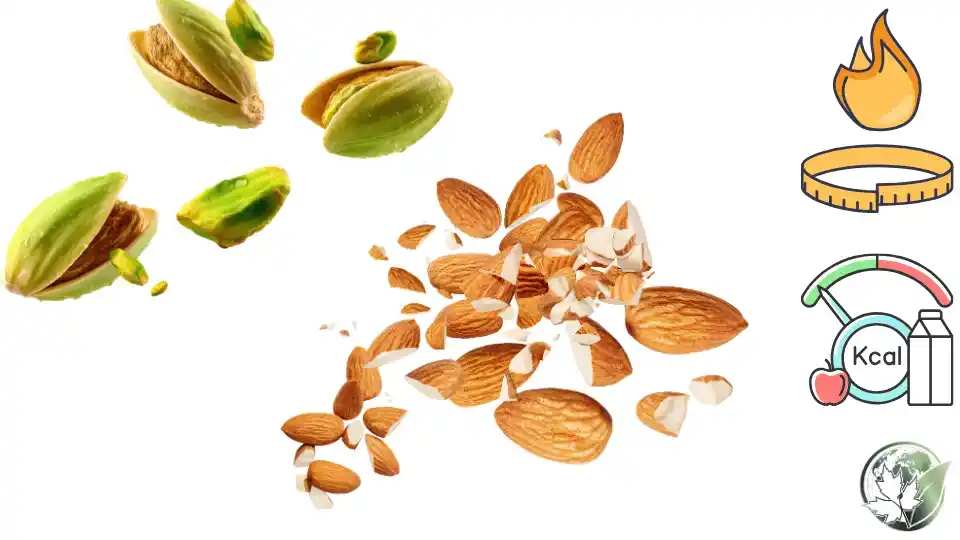
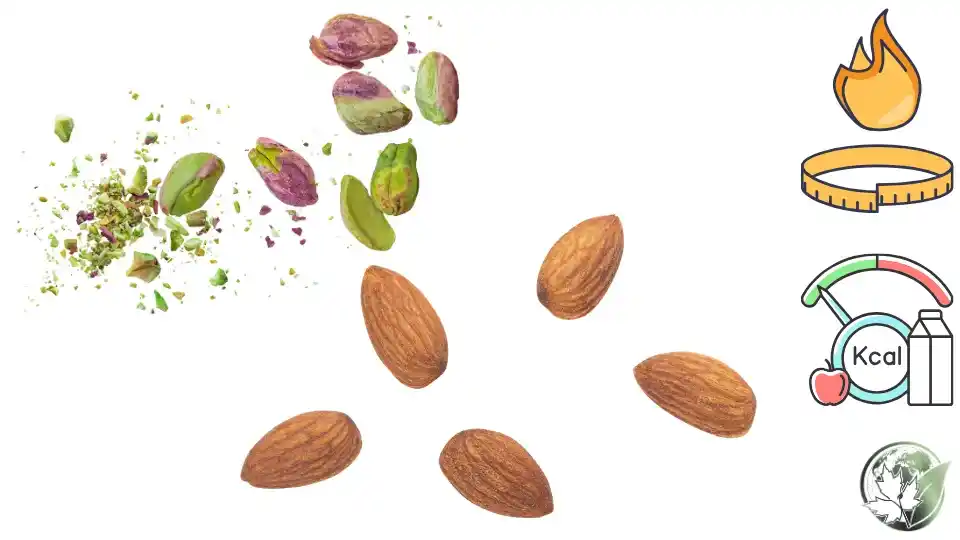
Pistachio kernels give about twice as many nuts as almonds for the same calories
Are Pistachio Kernels Healthy?
Pistachios are among the more nutritious nuts. Most of their fat is unsaturated, and they supply protein, fiber, potassium, vitamin B6 and thiamin, plus antioxidants such as gamma-tocopherol and polyphenols. Clinical studies suggest that eating pistachios daily, in amounts of 1 to 2 ounces, can improve cholesterol levels, lower blood pressure slightly and improve blood sugar control in people with prediabetes or type 2 diabetes. Their lutein and zeaxanthin content is unusually high for a nut, which may benefit the eyes.
Pistachios have a glycemic index of about 15, which is low, and a glycemic load of less than 2 per serving. They have more carbohydrate than almonds, but the fiber and fat make the blood sugar response gentle. The calories are the main reason to limit portions, since a cup has almost 700.
Are Pistachio Kernels Good for Weight Loss?
Nuts are calorie dense, but studies show that people who eat nuts regularly do not gain more weight than those who do not, and they sometimes lose a bit more. Part of the reason is that the body does not absorb all the fat from whole nuts, because some remains inside the cell walls, so the effective energy is about 5 to 10 percent lower than the label says. Nuts are also filling. Pistachios have an additional advantage: the shell-cracking effect in in-shell nuts slows you down. For kernels, you can get a similar effect by measuring a portion into a bowl.
| Snack | Calories | Protein | Fiber |
|---|---|---|---|
| 1 oz pistachio kernels (49) | 159 kcal | 5.7 g | 2.9 g |
| 1 oz almonds (23) | 164 kcal | 6.0 g | 3.5 g |
| 1 oz walnuts (14 halves) | 185 kcal | 4.3 g | 1.9 g |
| 1 oz cashews (18) | 157 kcal | 5.2 g | 0.9 g |
| 1 oz peanuts (28) | 161 kcal | 7.3 g | 2.4 g |
| 1 oz hazelnuts (21) | 178 kcal | 4.2 g | 2.7 g |
| 1 oz pecan halves (19) | 196 kcal | 2.6 g | 2.7 g |
| 1 oz macadamias (11) | 204 kcal | 2.2 g | 2.4 g |
At 159 calories per ounce, pistachios are the lowest in calories among the common nuts, along with cashews. A handful of 25 kernels has about 79 calories and is a satisfying snack.
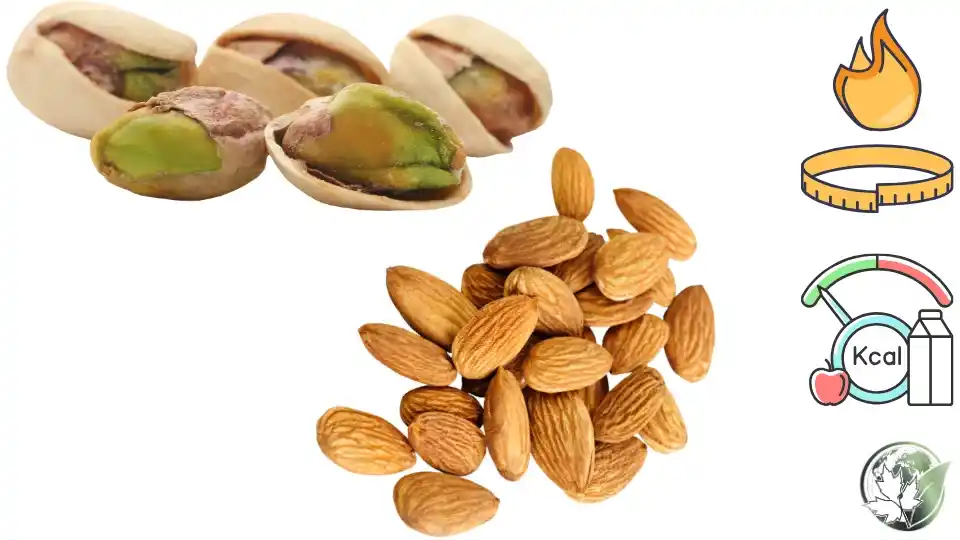
A handful of 25 pistachio kernels has about 79 calories
How Do You Use Pistachio Kernels in Cooking?
Shelled pistachios give a green color and a rich, slightly sweet flavor to both sweet and savory dishes. Persian and Middle Eastern cooking uses them in rice dishes, stews, baklava, gaz, sohan, halva and ice cream. In European cooking they are found in mortadella, pâtés and pesto. They can be ground into a crust for fish or chicken, scattered over salads, yogurt and oatmeal, or blended into a pistachio butter. The calories in a dish come mostly from the other ingredients, since a tablespoon of chopped kernels adds about 45 calories.
| Use | Pistachio kernels | Calories added |
|---|---|---|
| Sprinkle on yogurt | 1 tbsp (8 g) | 45 kcal |
| Topping on a salad | 2 tbsp (16 g) | 90 kcal |
| Crust for chicken breast | 1/4 cup (31 g) | 174 kcal |
| Persian rice garnish | 1 tbsp slivered (6 g) | 34 kcal |
| Pistachio pesto | 1/4 cup per batch | 174 kcal |
| Baklava, 1 piece | 8 g | 45 kcal |
| Ice cream scoop with pistachios | 5 g | 28 kcal |
| Pistachio cookie | 4 g | 22 kcal |
| Pistachio butter, 1 tbsp | 16 g | 90 kcal |
How Can You Choose Good Pistachio Kernels?
Look for kernels with a vivid green color on the outside and a light yellow-green interior, which suggests freshness, not brown or shriveled. Kernels should be firm and have a sweet, nutty smell, with no musty, rancid or bitter odor. Avoid kernels with dark spots or mold, as some molds can produce aflatoxins, harmful toxins that can contaminate nuts. Buy from reputable sources that test for them, and choose raw or dry roasted kernels with no added salt or oil. In stores, kernels are often graded by size and color, and the greenest ones cost the most. The calories do not depend on the grade.
How Should You Store Pistachio Kernels?
Shelled kernels go rancid faster than in-shell nuts because their fat is exposed to air. Store them in an airtight container in a cool, dark place for up to three months, in the refrigerator for up to 6 to 12 months, and in the freezer for up to two years. Keep them away from heat, light and moisture. If they smell sharp, paint-like or bitter, they have gone rancid and should be thrown away. Rancid fats do not change the calories, but they taste bad and can have adverse effects.
Shelled pistachio kernels keep for up to a year in the refrigerator in an airtight jar
Do Pistachios Cause Allergies?
Pistachios are a tree nut and one of the major food allergens. People with an allergy to cashews are commonly allergic to pistachios too, because the two come from related plants and share proteins. Symptoms can range from itching and hives to severe anaphylaxis. People with a tree nut allergy should avoid pistachios and check product labels, as they may be in ice cream, baked goods, mortadella, pesto and desserts. Cross-contamination in factories is also possible.
How to Count Pistachio Kernel Calories Accurately
For raw or dry roasted kernels, use 5.6 calories per gram. A kitchen scale is the most precise option, since volume measures vary with the size of the nut and with how tightly they are packed. If you count kernels, use about 3.2 calories each. For in-shell nuts, remember that the shell is about 45 to 50 percent of the weight, so 100 grams of in-shell nuts has about 290 calories. For nut butters and flavored kernels, use the label.
Why Do Shelled Kernels and In-Shell Pistachios Have Different Calories per Gram?
When you buy pistachios in the shell, a large part of the weight is the shell, which has no edible calories. Typically the kernel makes up 50 to 55 percent of the in-shell weight. A 100 gram handful of in-shell pistachios therefore has only about 50 to 55 grams of kernels, and about 280 to 310 calories. A full 100 grams of shelled kernels has 562. This is the main reason people are confused when they find different numbers online for the same nut. If a label reads 160 calories per ounce, check whether the ounce refers to the kernels or the unshelled nut: the standard USDA ounce is 28 grams of kernels, about 49 nuts, while a 28 gram serving of in-shell nuts is about 25 to 30 pistachios.
| Pistachio form | Weight | Edible kernel | Calories |
|---|---|---|---|
| In-shell | 100 g | 53 g | 298 kcal |
| In-shell | 1 ounce (28 g) | 15 g | 84 kcal |
| In-shell | 1 cup (125 g) | 66 g | 371 kcal |
| Shelled, raw | 100 g | 100 g | 562 kcal |
| Shelled, raw | 1 ounce (28 g) | 28 g | 159 kcal |
| Shelled, raw | 1 cup (123 g) | 123 g | 690 kcal |
| In-shell, 50 nuts | about 58 g | 31 g | 174 kcal |
What Is the Difference Between Pistachio Kernels and Pistachio Paste or Butter?
Kernels are whole nutmeats, while pistachio butter or paste is made by grinding them into a smooth spread, sometimes with oil, sugar or salt. Pure pistachio butter has the same calories as the kernels, at about 5.6 per gram, or 90 per tablespoon, but a tablespoon of butter weighs 16 grams while a tablespoon of whole kernels weighs only 8, because the whole nuts leave air gaps. Sweetened pistachio paste for pastries can have extra sugar and oil, which raises the calories to 600 or more per 100 grams. The fiber and protein remain in the paste, but it is easier to eat quickly, so portions should be watched.
How Do Pistachio Kernels Fit Different Diets?
Kernels are suitable for vegan, vegetarian, gluten-free and dairy-free diets. On a ketogenic diet, pistachios are higher in carbohydrate than almonds or pecans, with about 18 grams of net carbohydrate per 100 grams, so portions need care. On a Mediterranean diet, nuts are a recommended daily food. On a low FODMAP diet, pistachios are high in fructans and galactooligosaccharides, so only small portions of about 15 kernels are generally tolerated. For people with kidney disease who must restrict potassium, pistachios are high in it and need to be limited. For people on a low sodium diet, unsalted kernels are best.
How Many Pistachio Kernels Should You Eat a Day?
Research on heart health most often uses 1 to 2 ounces a day, or 49 to 98 kernels, which provides 159 to 318 calories. For most people, one ounce a day is a good balance between benefits and calories. It can replace less healthy snacks, such as chips or cookies, and adds protein, fiber and unsaturated fat. People who are trying to lose weight can still include nuts, but should count them in the daily calorie total. Eating a half cup (349 calories) or more in a day is generally more than needed, unless it is part of a calorie-rich meal plan for athletes or people who need to gain weight.
Where Do Pistachio Kernels Come From and Does the Origin Change the Calories?
Most of the world's pistachios come from Iran, the United States, Turkey and Syria. Iranian varieties include Ahmad Aghaei, Akbari, Fandoghi, Kalleh Ghouchi and Badami, which differ in size, shape and flavor, while American production is dominated by the Kerman variety. The calories do not differ meaningfully between origins: kernels of all varieties have about 550 to 575 calories per 100 grams, with small variations in fat and moisture. What does differ is the kernel size and the number of nuts per ounce, from about 45 for large types to about 55 for small ones. If you count by piece, use the typical weight of your variety, or weigh a sample of ten kernels and divide.
Can You Eat Too Many Pistachio Kernels?
Pistachios are easy to overeat, especially salted ones. Eating 200 kernels in an evening, which is about four ounces, would add 640 calories, as much as a main meal, and about 500 milligrams of sodium if salted. Large amounts of nuts may also cause digestive upset, because of their fiber and fat, and for some people bloating from fructans. Regularly eating a very large quantity of pistachios is not necessary to get their benefits, and it makes the weight of the nuts a significant part of your day's energy. A practical rule is to portion them into a small bowl or a bag of 25 to 49 kernels and put the rest away.
What Is the Best Way to Add Pistachio Kernels to Breakfast?
Pistachio kernels can make breakfast more filling. Stir 2 tablespoons of chopped kernels (16 grams, about 90 calories) into oatmeal or plain yogurt for protein and crunch. A bowl of Greek yogurt (150 grams, 90 calories) with a sliced fruit and 2 tablespoons of pistachios has about 250 calories and 20 grams of protein, a balanced start to the day. For a Persian-style breakfast, a few kernels alongside bread, cheese and herbs add flavor and healthy fat. Compared with a pastry at 400 calories, which has far less protein and fiber, the nut and yogurt combination fills you up longer and costs fewer calories.
Key Takeaways: Pistachio Kernels Calories vs Almonds
Pistachio kernels have about 159 calories per ounce and 562 per 100 grams, slightly less than almonds at 164 and 579. One kernel has about 3 calories, so you get more than twice as many nuts as almonds for the same energy. Pistachios provide more potassium, B6 and lutein, and almonds more vitamin E and calcium. Measure a handful of about 25 to 49 kernels and enjoy.
Frequently Asked Questions
6 questions answered
How many calories are in an ounce of pistachio kernels?
About 159 for 49 kernels.
How many calories are in one pistachio kernel?
About 3.
Do pistachio kernels have fewer calories than almonds?
Slightly, 562 against 579 per 100 grams.
How many pistachio kernels equal 100 calories?
About 31.
Are roasted pistachio kernels higher in calories?
About 2 percent higher if dry roasted.
Are pistachios healthy?
Yes, they provide protein, fiber, potassium and healthy fats.