
How Many Calories Are in Orange Juice? The Quick Answer
A cup (8 fluid ounces, 248 grams) of orange juice has about 112 calories, and 100 milliliters has about 45. A small glass of 150 milliliters has about 67 calories, a standard 200 milliliter glass about 90, and a large 300 milliliter glass about 135. A liter of orange juice has about 450 calories. Milk chocolate has about 535 calories per 100 grams, with a 10 gram square at 54 calories and a 43 gram bar at about 230.
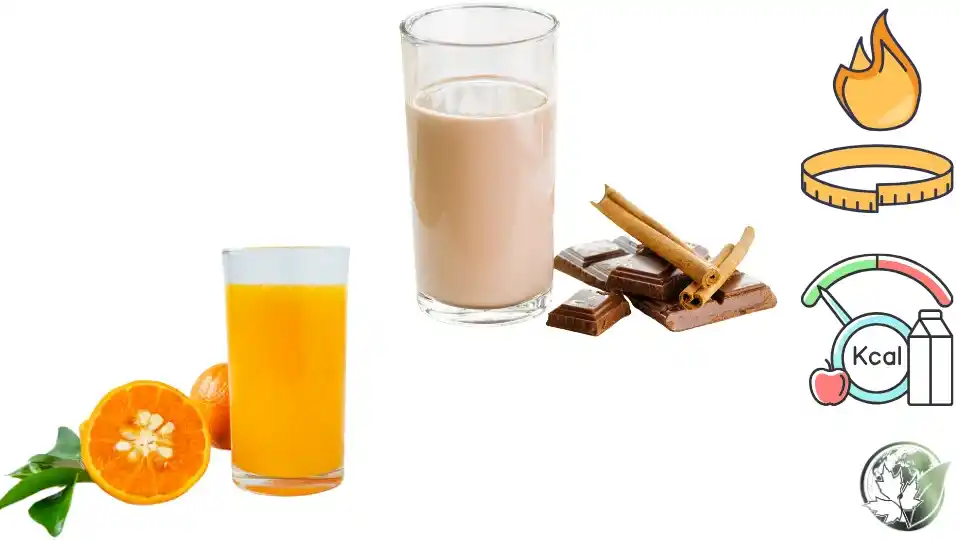
In terms of weight, orange juice has about 12 times fewer calories than milk chocolate, because it is 88 percent water. But when you look at how people actually consume them, the gap shrinks. A single cup of orange juice has the calories of two squares of milk chocolate (108), and two cups, which is what many people drink at breakfast and later in the day, equal a whole 43 gram bar. The sugar content is also similar: a cup of orange juice has about 21 grams of sugar, almost as much as a 43 gram milk chocolate bar, which has about 22 grams.
What makes juice different is that it provides nutrients that the chocolate does not, including about 124 milligrams of vitamin C per cup (about 138 percent of the daily value), 74 micrograms of folate, 496 milligrams of potassium and flavonoids such as hesperidin. Unlike chocolate it has no fat. Its weakness is that it has almost no fiber and delivers sugar in liquid form, which is easy to drink in large amounts without feeling full.
This guide gives the calories in orange juice by cup, glass, bottle and 100 milliliters, compares fresh, store-bought, concentrate and orange drinks, and measures them against milk chocolate. It explains how much juice you get from an orange, how juice affects weight and blood sugar, what to look for on labels, and how to enjoy orange juice in a healthy way. There are three comparison tables and an FAQ.
A cup of orange juice has about 112 calories, 21 grams of sugar and 124 milligrams of vitamin C
How Many Calories Are in Orange Juice by Cup, Glass and Bottle?
The table uses 100% orange juice, either fresh squeezed or not from concentrate, at 45 calories per 100 milliliters.
| Portion | Volume | Calories | Sugar | Vitamin C |
|---|---|---|---|---|
| 1 tablespoon | 15 ml | 7 kcal | 1.3 g | 7.5 mg |
| 1 shot glass | 45 ml | 20 kcal | 4 g | 22 mg |
| 1/2 cup | 120 ml | 54 kcal | 10 g | 60 mg |
| 1 small glass | 150 ml | 67 kcal | 12.5 g | 75 mg |
| 1 glass | 200 ml | 90 kcal | 17 g | 100 mg |
| 1 cup | 240 ml | 108 kcal | 20.5 g | 120 mg |
| 1 cup (USDA) | 248 g | 112 kcal | 21 g | 124 mg |
| 1 large glass | 300 ml | 135 kcal | 25.5 g | 150 mg |
| 1 small carton | 330 ml | 149 kcal | 28 g | 165 mg |
| 1 bottle | 500 ml | 225 kcal | 43 g | 250 mg |
| 1 liter | 1,000 ml | 450 kcal | 85 g | 500 mg |
| 100 ml | 100 ml | 45 kcal | 8.5 g | 50 mg |
A small carton of 330 milliliters, which is a common single serving, has about 149 calories and 28 grams of sugar, as much as seven sugar cubes. A half-liter bottle has about 225 calories.
How Many Calories Are in Different Types of Orange Juice and Orange Drinks?
The label matters. Juice, nectar, drink and concentrate may look the same but have different sugar and calories.
| Type (1 cup, 240 ml) | Calories | Sugar | Notes |
|---|---|---|---|
| Fresh squeezed orange juice | 112 kcal | 21 g | Natural sugar |
| 100% orange juice, not from concentrate | 110 kcal | 21 g | Pasteurized |
| 100% orange juice, from concentrate | 112 kcal | 21 g | Reconstituted |
| Orange juice with pulp | 110 kcal | 21 g | Slightly more fiber |
| Orange juice, calcium fortified | 114 kcal | 21 g | Added calcium |
| Reduced sugar orange juice | 50 kcal | 10 g | Diluted, sweeteners |
| Orange juice cocktail or drink | 125 kcal | 27 g | Added sugar, less juice |
| Orange nectar | 140 kcal | 30 g | Sweetened |
| Orange soda | 160 kcal | 43 g | Carbonated |
| Orange squash, diluted | 60 kcal | 14 g | 1 part squash, 4 water |
| Frozen concentrate, undiluted, 1 tbsp | 17 kcal | 4 g | Strong |
| Orange flavored powder drink (prepared) | 90 kcal | 22 g | Sweetened mix |
| Orange smoothie | 200 kcal | 36 g | With banana and yogurt |
100% orange juice has the same calories whether it is fresh, from concentrate or not from concentrate. Orange drinks and sodas have added sugar and fewer nutrients. Check the label for "100% juice" to be sure.
Orange Juice vs Milk Chocolate: Calories Compared
| Food | Portion | Weight or volume | Calories | Sugar | Fat |
|---|---|---|---|---|---|
| Orange juice | 100 ml | 100 ml | 45 kcal | 8.5 g | 0.2 g |
| Orange juice | 1 glass | 200 ml | 90 kcal | 17 g | 0.4 g |
| Orange juice | 1 cup | 248 g | 112 kcal | 21 g | 0.5 g |
| Orange juice | 2 cups | 496 g | 224 kcal | 42 g | 1.0 g |
| Milk chocolate | 1 square | 10 g | 54 kcal | 5.2 g | 3.1 g |
| Milk chocolate | 2 squares | 20 g | 108 kcal | 10.4 g | 6.2 g |
| Milk chocolate | 1 bar | 43 g | 230 kcal | 22 g | 13 g |
| Milk chocolate | 100 g | 100 g | 535 kcal | 52 g | 30 g |
| Milk chocolate | 1 king size bar | 85 g | 455 kcal | 44 g | 25 g |
A cup of orange juice has about the same calories as two squares of chocolate, and two cups about as many as one standard bar. By weight, juice is nearly twelve times lighter in calories, but a cup of juice is a much larger physical amount than a couple of squares.
Orange Juice vs Milk Chocolate: Nutrition Compared
| Per serving | Orange juice (1 cup) | Milk chocolate (43 g bar) |
|---|---|---|
| Calories | 112 kcal | 230 kcal |
| Carbohydrate | 26 g | 25.5 g |
| Sugar | 21 g | 22 g |
| Fat | 0.5 g | 13 g |
| Saturated fat | 0.1 g | 8 g |
| Protein | 1.7 g | 3.3 g |
| Fiber | 0.5 g | 1.5 g |
| Vitamin C | 124 mg | 0 mg |
| Folate | 74 mcg | 4 mcg |
| Potassium | 496 mg | 160 mg |
| Calcium | 27 mg | 81 mg |
| Caffeine | 0 mg | 9 mg |
| Per 100 calories | Orange juice | Milk chocolate |
|---|---|---|
| Amount | 223 ml | 19 g |
| Sugar | 19 g | 9.7 g |
| Vitamin C | 111 mg | 0 mg |
| Potassium | 443 mg | 70 mg |
| Fat | 0.4 g | 5.6 g |
Per 100 calories, juice has about twice as much sugar as chocolate, because the calories in juice are nearly all sugar, while chocolate gets half of its calories from fat. Juice supplies vitamin C, folate and potassium, while chocolate supplies a small amount of protein, calcium, iron and compounds such as flavanols.
A cup of juice has about as much sugar as a standard milk chocolate bar, with half the calories
How Many Oranges Are in a Glass of Orange Juice?
A medium orange (about 130 grams of flesh) yields about 1/3 to 1/2 cup (80 to 120 milliliters) of juice. A cup of juice therefore takes about two to three oranges, and a liter takes about nine to twelve. One orange has about 62 calories and 3 grams of fiber, while the juice from two oranges has about 112 calories and almost no fiber. This explains why juice is easier to overconsume: you would rarely eat three oranges in a few minutes, but you can drink their juice in a minute.
| Quantity | Oranges needed | Calories | Fiber |
|---|---|---|---|
| 1/2 cup juice | 1 to 1.5 | 54 kcal | 0.2 g |
| 1 cup juice | 2 to 3 | 112 kcal | 0.5 g |
| 2 cups juice | 4 to 6 | 224 kcal | 1.0 g |
| 1 whole orange | 1 | 62 kcal | 3.1 g |
| 3 whole oranges | 3 | 186 kcal | 9.3 g |
| 1 liter juice | 9 to 12 | 450 kcal | 2.0 g |
If you drink the juice from three oranges, you get 112 calories, but if you eat three oranges whole you get 186 calories and 9 grams of fiber. Whole fruit has more calories because it contains the pulp and flesh, but it is more filling, and people tend to stop sooner.
Is Orange Juice Healthy?
Orange juice is a good source of vitamin C, folate and potassium, and it contains hesperidin, narirutin and other flavonoids with antioxidant properties. Studies show that moderate intake of 100% orange juice, one small glass per day, does not seem to raise cardiovascular risk and might improve some markers such as blood pressure and vascular function. Pasteurized juice is safe, and calcium-fortified juice is useful for people who do not drink milk.
The drawbacks are the sugar and the missing fiber. Large studies link a high intake of sugar-sweetened beverages with weight gain and type 2 diabetes, and although 100% juice is better than soda, drinking a lot of it is also linked with higher risk in some research. Health organizations recommend limiting juice to about 120 to 180 milliliters a day for young children and no more than one cup a day for adults, with whole fruit as the main source of fruit. Orange juice is also acidic, which can erode tooth enamel and aggravate heartburn.
Does Orange Juice Raise Blood Sugar?
Orange juice has a glycemic index of about 50, which is medium, and a glycemic load of about 12 for a cup. The sugar is a mix of sucrose, glucose and fructose, and without fiber it is absorbed faster than from whole oranges, which have a glycemic index of about 40. For people with diabetes, a small glass of 120 milliliters is about 13 grams of carbohydrate and is best taken with food rather than alone. Orange juice is also used on purpose to treat low blood sugar, since it supplies about 25 grams of fast acting carbohydrate in a cup. Milk chocolate has a glycemic index of about 43, and its fat slows absorption, but a bar of it has a similar carbohydrate load, about 25 grams.
Is Orange Juice Good for Weight Loss?
Juice is not a weight loss drink. Liquid calories do not fill you up as much as solid food, and studies show that people do not compensate for the calories in drinks by eating less later. A cup of juice has 112 calories, while a whole orange has 62 and 3 grams of fiber, which fills you up more. If you drink two cups of orange juice a day, that is 224 calories, about 1,570 calories a week, which can add up to more than 2 kilograms in a year if not balanced by other changes.
That does not mean you cannot enjoy it. Drink a small glass of 120 to 150 milliliters, ideally with a meal that contains protein and fiber, and have whole fruit as your main source of fruit. Diluting juice half and half with water or sparkling water halves the calories to about 56 per cup, keeps the taste and lowers the sugar. If you like chocolate, a small piece of dark chocolate and a whole orange make a better snack than juice and a chocolate bar.
The juice of two to three oranges makes a cup with 112 calories and almost no fiber
How Many Calories Are in Drinks Made with Orange Juice?
| Drink | Serving | Calories | Sugar |
|---|---|---|---|
| Orange juice | 1 cup | 112 kcal | 21 g |
| Mimosa (champagne and orange juice) | 6 oz | 100 kcal | 8 g |
| Screwdriver (vodka and juice) | 6 oz | 180 kcal | 14 g |
| Orange smoothie with yogurt and banana | 12 oz | 250 kcal | 38 g |
| Orange Julius style drink | 16 oz | 340 kcal | 55 g |
| Sunrise (juice and grenadine) | 8 oz | 150 kcal | 32 g |
| Orange and carrot juice | 1 cup | 100 kcal | 20 g |
| Orange juice spritzer (half juice) | 1 cup | 56 kcal | 10 g |
| Orange juice popsicle | 1 piece | 45 kcal | 10 g |
| Orange soda | 12 oz | 180 kcal | 49 g |
| Breakfast juice with pulp and fiber | 1 cup | 110 kcal | 21 g |
How Can You Reduce the Calories in Your Orange Juice Habit?
You can cut the calories without giving up the taste. Pour smaller glasses, using a 120 milliliter glass instead of a tall tumbler, which saves 50 to 100 calories. Dilute with water or soda water, half and half. Use whole oranges when you can, or blend the whole fruit, including pulp, in a smoothie. Choose products labeled 100% juice with no added sugar, avoiding drinks, nectars and cocktails. Add ice and drink slowly. Drink juice with a meal to slow the absorption, and brush your teeth or rinse with water afterwards because of the acid.
How to Count Orange Juice Calories Accurately
Measure the juice in a measuring cup or the markings on a glass, and use 45 calories per 100 milliliters. Fresh juice from big, sweet oranges may have a little more sugar than juice from sour ones, but the difference is small. When you buy bottled juice, check the nutrition facts for the serving size, which is often 240 milliliters but can be less on small packs. For milk chocolate, use 54 calories per 10 grams.
How Should You Store Orange Juice?
Freshly squeezed juice loses vitamin C and flavor and should be refrigerated and drunk within 24 to 48 hours. Store-bought pasteurized juice keeps until the date on the carton, and once opened should be kept cold and used in about 7 to 10 days. Juice from concentrate can be kept frozen, and freshly squeezed juice can be frozen in ice cube trays and used within three months. Discard any juice that smells fermented, has bubbles or tastes sour.
Fresh orange juice can be frozen in ice cube trays to portion it by calories
How Does Orange Juice Compare with Other Juices and Sweet Drinks?
Orange juice sits in the middle of the juice range. Per cup, tomato juice has about 41 calories, grapefruit juice 96, orange juice 112, pineapple juice 132, apple juice 114, cranberry juice cocktail 137, grape juice 152 and pomegranate juice 134. Sodas such as cola have 100 calories per cup and sports drinks about 60. The differences between fruit juices are modest, and the nutrients differ more than the calories do.
| Drink (1 cup, 240 ml) | Calories | Sugar | Notable nutrient |
|---|---|---|---|
| Water | 0 kcal | 0 g | Hydration |
| Tomato juice | 41 kcal | 6 g | Lycopene, potassium |
| Grapefruit juice | 96 kcal | 22 g | Vitamin C |
| Orange juice | 112 kcal | 21 g | Vitamin C, folate |
| Apple juice | 114 kcal | 24 g | Little |
| Pineapple juice | 132 kcal | 25 g | Manganese |
| Pomegranate juice | 134 kcal | 32 g | Polyphenols |
| Grape juice | 152 kcal | 36 g | Polyphenols |
| Whole milk | 149 kcal | 12 g | Calcium, protein |
| Cola | 100 kcal | 26 g | None |
If you choose a juice, orange juice is one of the more nutritious ones. If the goal is to control calories, tomato juice and water are lighter, and whole fruit is a better option than any juice.
How Do Children and Adults Differ in Orange Juice Limits?
Pediatric guidelines advise that children under one year should not be given juice, that children aged 1 to 3 should have no more than 120 milliliters a day, children aged 4 to 6 up to 180 milliliters, and children aged 7 and over up to 240 milliliters. For adults, one cup a day is a reasonable upper limit, equal to about 112 calories. The reason for these limits is that juice contains sugar without fiber, which can displace more nutritious foods and contribute to dental decay and weight gain in children. Offering whole oranges, which are easy to peel and eat, is better for fiber and for chewing practice.
Does Orange Juice Have Any Effect on Medicines?
Orange juice interacts with some medicines, although it is much less known than grapefruit. Orange juice can reduce the absorption of certain drugs, such as some antibiotics, thyroid medicines and the beta blocker atenolol, when taken at the same time. Fortified juice with calcium can bind to some medicines. Seville (bitter) orange juice can interact with the same enzymes as grapefruit. If you take regular medication, read the leaflet and ask your pharmacist whether you can take it with orange juice or whether to space it a few hours apart.
How Does Orange Juice Fit Into a Balanced Breakfast?
Orange juice is traditionally part of breakfast in many countries. A balanced breakfast includes protein, fiber and healthy fat as well as a drink. A small glass of orange juice (150 milliliters, 67 calories) with scrambled eggs, whole grain toast and fruit gives vitamin C, which helps your body absorb iron from the eggs and bread. Drinking juice with food slows the rise in blood sugar compared with having it alone. The combination of juice and a chocolate pastry, in contrast, can deliver 400 calories and 50 grams of sugar before the day has begun, so the foods eaten with the juice matter as much as the juice.
Is Fresh Squeezed Juice Better Than Store-Bought Juice?
Fresh squeezed juice and pasteurized store-bought juice have about the same calories and sugar. Fresh juice tastes brighter and has slightly more vitamin C if drunk right away, but vitamin C declines within hours. Commercial juices are pasteurized, which kills microbes and extends shelf life, and are often fortified to restore nutrients. Juice sold as not from concentrate is not necessarily fresher, because it is stored in large tanks for months, and flavor packs are added to restore taste. The best juice for you is the one that fits your budget and that you drink in a modest portion, and homemade juice has the advantage that you know exactly what is in it.
Can You Drink Orange Juice on an Empty Stomach?
Many people drink orange juice first thing in the morning. For most it is fine, but the acidity can cause discomfort in people who have reflux, gastritis or an ulcer. A glass of juice alone raises blood sugar quickly, which can lead to a dip later and hunger. Having it with or after food avoids both problems. If you drink juice before a workout, it can provide quick carbohydrate energy, with about 26 grams of carbohydrate in a cup, which is a good amount for light exercise.
What Should You Look For on the Label When Buying Orange Juice?
The ingredient list of a good orange juice should say only orange juice, or orange juice from concentrate with water. Words such as "drink", "cocktail", "beverage" or "nectar" signal added sugar, water and flavors. Check the nutrition facts for sugar: 100% juice has about 21 grams per cup, all natural, and the label shows no added sugars. Compare the calories per serving and check that the serving size matches what you actually drink, since a 500 milliliter bottle is often listed as two servings. If you want more fiber, look for juice with pulp, though the difference is only about half a gram per cup.
Key Takeaways: Orange Juice Calories vs Milk Chocolate
A cup of orange juice has about 112 calories and 21 grams of sugar, and 100 milliliters has 45. That is about as many calories as two squares of milk chocolate, and two cups equal a 43 gram bar. Juice provides vitamin C and potassium but little fiber, so keep servings small, dilute if you like and choose whole oranges more often.
Frequently Asked Questions
6 questions answered
How many calories are in a glass of orange juice?
About 90 for 200 ml and 112 for a cup.
How many calories are in 100 ml of orange juice?
About 45.
Does orange juice have fewer calories than milk chocolate?
Per gram yes, but two cups equal a 43 gram bar.
Is fresh orange juice lower in calories than boxed?
No, 100% juice has about the same calories either way.
How many oranges make a cup of juice?
About two to three.
Is orange juice good for weight loss?
Not really, because it is high in sugar and low in fiber.




