
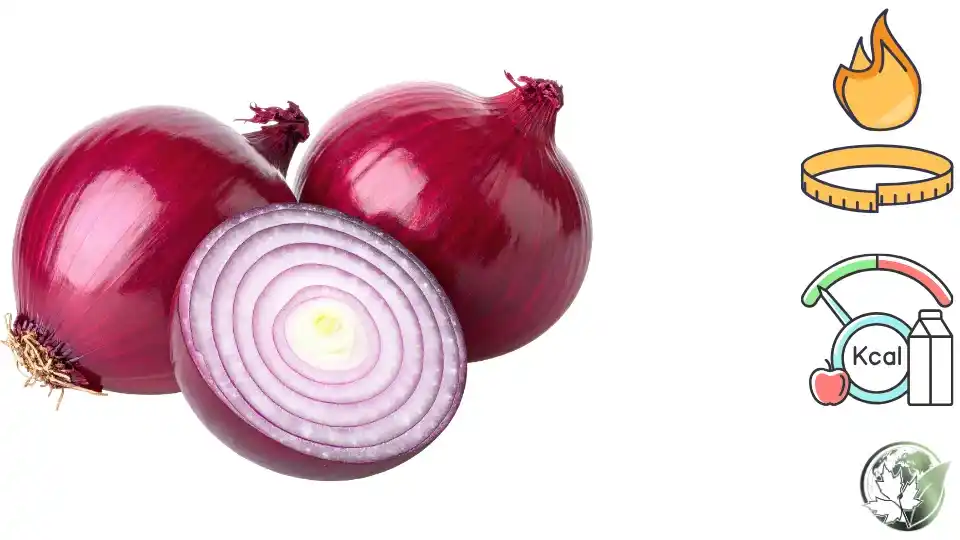
How Many Calories Are in an Onion? The Quick Answer
A medium raw onion (about 110 grams, 2 1/2 inches across) has about 44 calories. Per 100 grams, a raw onion has about 40 calories. A small onion (70 g) has about 28 calories, a large onion (150 g) about 60, a cup of chopped onion (160 g) about 64, a tablespoon of chopped onion (10 g) about 4, and a slice a quarter inch thick (38 g) about 15 calories. Carrots have about 41 calories per 100 grams, with a medium carrot (61 g) at 25 and a cup of chopped carrot (128 g) at 52.
By weight, onions and carrots are practically identical, 40 against 41 calories per 100 grams. Per piece, a medium onion has more calories than a medium carrot, simply because it is heavier, 110 grams against 61. Both are low-calorie vegetables, with about 88 to 90 percent water, and either can be eaten in generous amounts without affecting energy intake much. The calories rise sharply only when onions are cooked in oil, battered and fried, or turned into sauces and dips.
Onions are used in almost every cuisine in the world, usually as a flavor base, so most people eat them in small amounts mixed with other foods. That makes counting onion calories slightly awkward, since a handful of chopped onion in a stew is not weighed. This guide gives the calories in onions by size, cup, slice and tablespoon, compares the types of onion (yellow, white, red, sweet, green, shallot), shows how cooking changes the numbers, and lists the calories in onion dishes such as fried onions, onion rings, caramelized onions and French onion soup. It compares onions with carrots in nutrition, covers health benefits and downsides, and ends with an FAQ. There are three comparison tables.
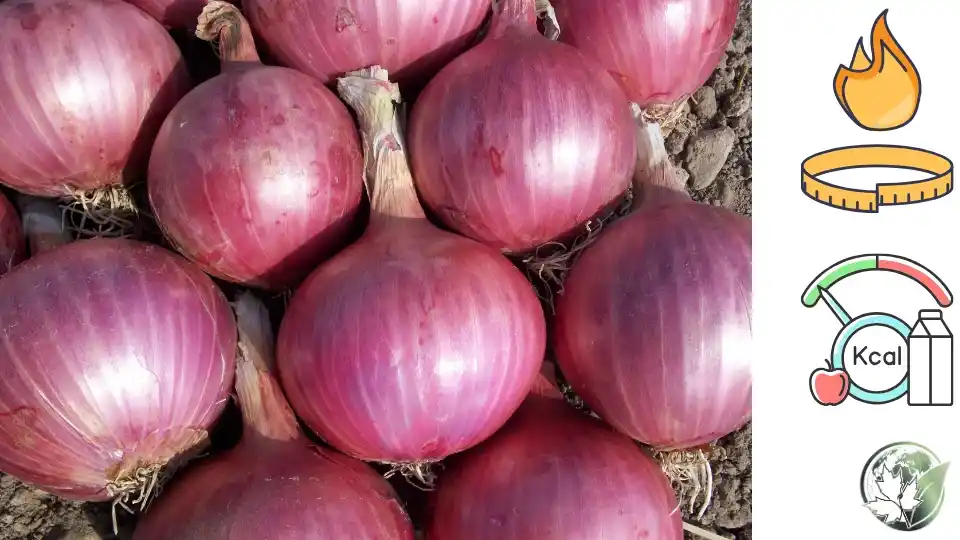
A medium raw onion has about 44 calories and almost no fat
How Many Calories Are in an Onion by Size, Cup and Slice?
| Portion | Weight | Calories | Carbs | Fiber | Sugar |
|---|---|---|---|---|---|
| 1 tablespoon chopped | 10 g | 4 kcal | 0.9 g | 0.2 g | 0.4 g |
| 1 slice (1/4 inch) | 38 g | 15 kcal | 3.6 g | 0.6 g | 1.6 g |
| 1/4 cup chopped | 40 g | 16 kcal | 3.7 g | 0.7 g | 1.7 g |
| 1/2 cup chopped | 80 g | 32 kcal | 7.5 g | 1.4 g | 3.4 g |
| 1 cup chopped | 160 g | 64 kcal | 15 g | 2.7 g | 6.8 g |
| 1 small onion | 70 g | 28 kcal | 6.5 g | 1.2 g | 2.9 g |
| 1 medium onion | 110 g | 44 kcal | 10.3 g | 1.9 g | 4.7 g |
| 1 large onion | 150 g | 60 kcal | 14 g | 2.6 g | 6.4 g |
| 1 extra large onion | 200 g | 80 kcal | 18.7 g | 3.4 g | 8.5 g |
| 1 cup sliced | 115 g | 46 kcal | 10.7 g | 1.9 g | 4.9 g |
| 100 g | 100 g | 40 kcal | 9.3 g | 1.7 g | 4.2 g |
| 1 kg bag (peeled weight) | 1,000 g | 400 kcal | 93 g | 17 g | 42 g |
A typical recipe for four people uses one medium onion, which provides 11 calories per person. In a burger or a salad, three or four thin slices of raw onion add about 15 to 20 calories.
How Many Calories Are in Different Types of Onion?
The calories vary a little with the type, mostly because of water content and sugar.
| Type (raw, 100 g) | Calories | Sugar | Fiber | Notes |
|---|---|---|---|---|
| Yellow onion | 40 kcal | 4.2 g | 1.7 g | All-purpose, strong |
| White onion | 42 kcal | 4.0 g | 1.8 g | Crisp, sharp |
| Red onion | 42 kcal | 4.2 g | 1.7 g | Mild, colorful |
| Sweet onion (Vidalia, Walla Walla) | 32 kcal | 5.0 g | 0.9 g | Very mild, juicy |
| Spring onion or scallion (white and green) | 32 kcal | 2.3 g | 2.6 g | Eaten raw or cooked |
| Green onion tops only | 27 kcal | 1.9 g | 2.5 g | Garnish |
| Shallot | 72 kcal | 7.9 g | 3.2 g | Concentrated, sweet |
| Leek | 61 kcal | 3.9 g | 1.8 g | Mild, for soups |
| Pearl onion | 40 kcal | 4.2 g | 1.7 g | Small, for stews |
| Chives | 30 kcal | 1.9 g | 2.5 g | Herb |
| Dried onion flakes | 349 kcal | 38 g | 9.2 g | Concentrated |
| Onion powder (1 tsp, 2.4 g) | 8 kcal | 0.5 g | 0.2 g | Seasoning |
Sweet onions have fewer calories per gram than regular ones because they contain more water, even though they taste sweeter. Shallots are the exception, with about 80 percent more calories than yellow onions per 100 grams, since they are more concentrated, but a shallot used in a dish weighs only about 25 to 30 grams, or 20 calories.
Onion vs Carrot: Calories Compared
| Food | Portion | Weight | Calories | Carbs | Fiber |
|---|---|---|---|---|---|
| Onion, raw | 100 g | 100 g | 40 kcal | 9.3 g | 1.7 g |
| Carrot, raw | 100 g | 100 g | 41 kcal | 9.6 g | 2.8 g |
| Onion, raw | 1 medium | 110 g | 44 kcal | 10.3 g | 1.9 g |
| Carrot, raw | 1 medium | 61 g | 25 kcal | 5.8 g | 1.7 g |
| Onion, chopped | 1 cup | 160 g | 64 kcal | 15 g | 2.7 g |
| Carrot, chopped | 1 cup | 128 g | 52 kcal | 12.3 g | 3.6 g |
| Baby carrots | 10 pieces | 100 g | 35 kcal | 8.2 g | 2.9 g |
| Onion, boiled | 1 cup | 210 g | 92 kcal | 21 g | 2.9 g |
| Carrot, boiled | 1 cup sliced | 156 g | 55 kcal | 12.8 g | 4.7 g |
| Carrot juice | 1 cup | 236 g | 94 kcal | 22 g | 1.9 g |
The two vegetables are almost equal in calories. Carrots have more fiber and far more vitamin A, while onions have a distinct set of sulfur compounds and quercetin, a flavonoid.
Onion vs Carrot: Nutrition Compared
| Per 100 g raw | Onion | Carrot |
|---|---|---|
| Calories | 40 kcal | 41 kcal |
| Carbohydrate | 9.3 g | 9.6 g |
| Sugar | 4.2 g | 4.7 g |
| Fiber | 1.7 g | 2.8 g |
| Protein | 1.1 g | 0.9 g |
| Fat | 0.1 g | 0.2 g |
| Vitamin A | 0 mcg | 835 mcg |
| Vitamin C | 7.4 mg | 5.9 mg |
| Vitamin B6 | 0.12 mg | 0.14 mg |
| Folate | 19 mcg | 19 mcg |
| Potassium | 146 mg | 320 mg |
| Quercetin | 20 mg | 0 mg |
| Water | 89 g | 88 g |
| Per 100 calories | Onion | Carrot |
|---|---|---|
| Weight | 250 g | 244 g |
| Fiber | 4.3 g | 6.8 g |
| Vitamin A | 0 mcg | 2,037 mcg |
| Vitamin C | 18.5 mg | 14.4 mg |
| Potassium | 365 mg | 780 mg |
For 100 calories, you would eat about 250 grams of either, which is a large amount. Carrots provide more fiber, potassium and vitamin A as beta carotene, with more than twice the daily need in 100 calories. Onions provide vitamin C, quercetin and organosulfur compounds, which carrots lack.
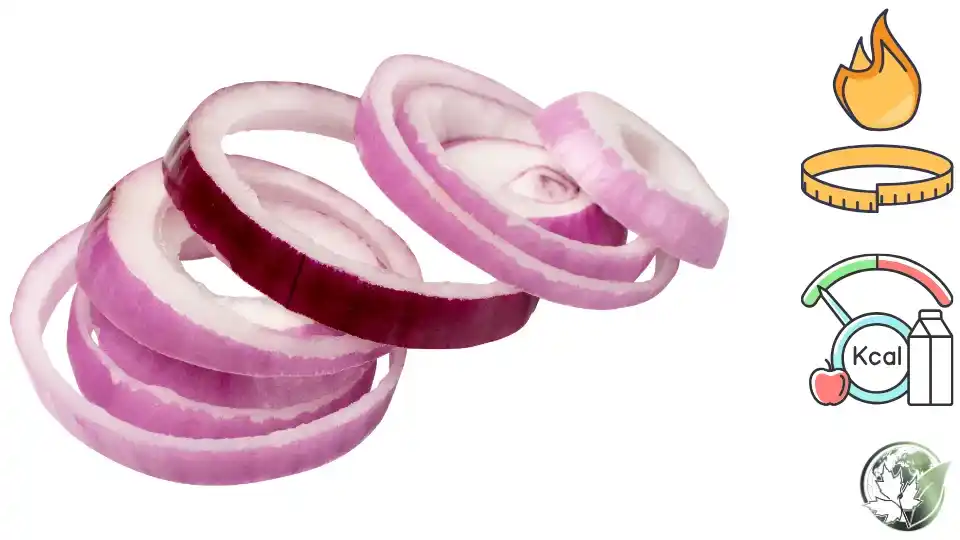
Onions and carrots have almost identical calories per 100 grams, about 40 and 41
How Does Cooking Change the Calories in Onions?
Cooking itself does not add calories, but water loss and added fat do. When onions are boiled, they absorb a little water, and their calories per gram fall slightly. When they are sautéed or fried, they lose water and absorb oil. The result is that a cup of cooked onions can contain several times the calories of a cup of raw.
| Preparation | Serving | Calories | Notes |
|---|---|---|---|
| Raw, chopped | 1 cup (160 g) | 64 kcal | Baseline |
| Boiled, drained | 1 cup (210 g) | 92 kcal | More onion per cup |
| Steamed | 1 cup (200 g) | 85 kcal | No added fat |
| Roasted, 1 tsp oil | 1/2 cup (100 g) | 85 kcal | Oil adds 40 |
| Grilled slices | 1 medium onion | 50 kcal | Light brushing of oil |
| Sautéed in 1 tsp oil | 1/2 cup (80 g) | 72 kcal | Oil adds 40 |
| Sautéed in 1 tbsp oil | 1/2 cup (80 g) | 152 kcal | Oil adds 120 |
| Caramelized, 1 tbsp butter | 1/2 cup | 170 kcal | Slow cooked |
| Pan-fried until browned (Persian style) | 1/2 cup (60 g) | 140 kcal | Fried in 1 tbsp oil |
| Crispy fried onions topping | 2 tbsp (7 g) | 40 kcal | Packaged |
| Onion rings, battered, fried | 8 to 9 rings (83 g) | 276 kcal | Restaurant |
| Onion rings, baked from frozen | 8 to 9 rings | 200 kcal | Oven |
| Blooming onion (appetizer) | 1 whole | 1,500 kcal | Fried, with sauce |
| French onion soup with cheese | 1 bowl (1.5 cups) | 370 kcal | Bread and cheese |
| Onion soup, broth based | 1 cup | 60 kcal | No bread |
The practical rule is to count the oil. A tablespoon of oil, 120 calories, is the biggest calorie contributor in a pan of sautéed onions, as much as three medium onions' worth. Cooking onions with a splash of water or stock instead of oil, or with a spray of oil, brings the calories close to the raw value.
How Many Calories Are in Fried Onions and Onion Rings?
Onion rings are the food that turns a 40-calorie vegetable into a 400-calorie one. A single raw onion ring, a slice of about 14 grams, has about 6 calories. Coated in batter and deep fried, it can have 30 to 35 calories, five times as many. A serving of 8 or 9 restaurant onion rings (83 grams) has about 276 calories and 16 grams of fat, and a large order of 15 to 20 rings can reach 600 calories. Fast food onion rings range from 300 to 500 calories per serving.
The Persian practice of frying onions until golden (piaz dagh) at the start of many dishes also adds calories. A medium onion sliced and fried in two tablespoons of oil has about 280 calories in total, 44 from the onion and 240 from the oil, although some of the oil stays in the pan. Using one tablespoon, and keeping the heat moderate, halves this.
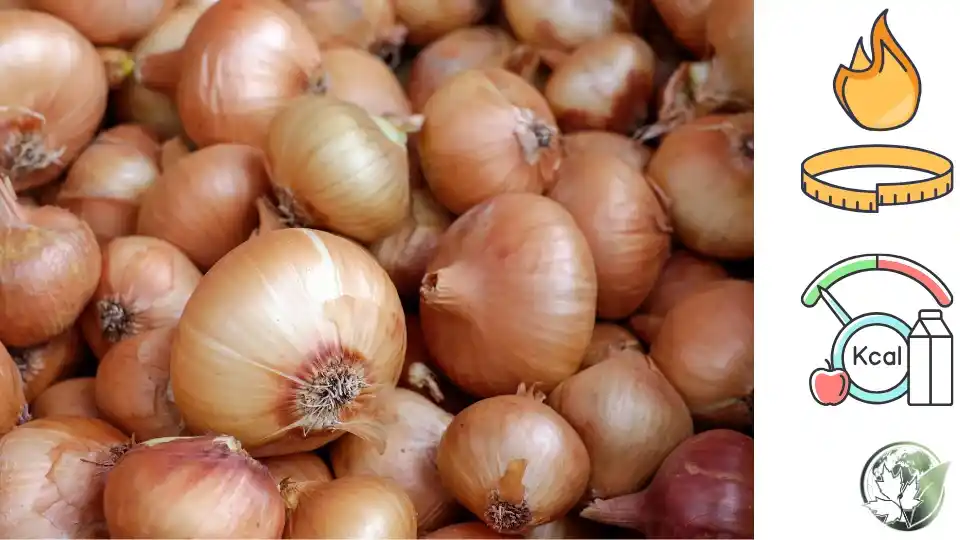
Frying a medium onion in two tablespoons of oil takes it from 44 to about 280 calories
Are Onions Good for Weight Loss?
Onions are useful in weight loss diets because they add flavor and volume for few calories. A pile of sautéed onions in an omelet, a stir-fry or a soup lets you eat a larger, more satisfying meal. They are a source of prebiotic fibers such as inulin and fructooligosaccharides, which feed beneficial gut bacteria. Some animal and small human studies show that onion extracts may help with blood fat levels and blood glucose, but the effects on body weight are modest. Onions will not melt fat, but they help you eat less of the higher calorie foods in a dish.
The strategy is to use onion as a base and bulk ingredient. Replace some of the rice, pasta or meat in a recipe with onions and other vegetables. Fill a sandwich with thin slices of raw red onion. Roast onion wedges with herbs instead of potatoes. Make a soup with broth, onions and herbs for fewer than 100 calories a bowl.
Are Onions Healthy?
Onions are rich in antioxidants, notably quercetin and anthocyanins in red onions, and organosulfur compounds that give onions their smell and have been studied for heart health. They provide vitamin C, vitamin B6, folate and potassium. Regular intake of allium vegetables, which include onions, garlic, leeks and chives, is linked in observational studies to a lower risk of certain cancers, particularly of the stomach and colon, and with better cardiovascular health. Most of the quercetin in onions is found in the outer layers, so removing only the papery skin and the first layer preserves most of it.
Onions can cause problems for some people. They are high in fermentable carbohydrates (FODMAPs), mainly fructans, which can cause gas, bloating and pain in people with irritable bowel syndrome. Raw onions can aggravate heartburn. Their smell lingers on the breath. A small number of people are allergic to onions. For those who need to avoid onion, the green tops of spring onions and chives, and garlic-infused oil, can provide flavor with fewer fructans.
Are Raw or Cooked Onions Better?
Both are healthy. Raw onions provide the most vitamin C and the pungent compounds that can be lost with heat, while cooking makes onions sweeter, softer and easier to digest for many people, and it releases some antioxidants, although boiling can leach quercetin into the water. If you boil onions in soup, you drink the broth and keep the nutrients. Light cooking such as sautéing or roasting preserves most quercetin. Eating a mix of both raw and cooked onions gives the broadest range of benefits.
How Many Calories Are in Onion Dishes?
| Dish | Serving | Calories | Onion share |
|---|---|---|---|
| Onion and tomato salad | 1 cup | 55 kcal | Most |
| Shirazi salad (cucumber, tomato, onion) | 1 bowl | 70 kcal | 20% |
| Pickled onions | 1/4 cup | 20 kcal | Most |
| Onion dip with sour cream | 2 tbsp | 60 kcal | Little |
| Onion bhaji (fried fritter) | 1 piece (50 g) | 130 kcal | 25% |
| Caramelized onion tart | 1 slice | 320 kcal | 15% |
| Onion and egg omelet | 2 eggs, 1/2 onion | 230 kcal | 10% |
| Persian kuku sabzi with onion | 1 slice | 150 kcal | 10% |
| Onion marmalade | 1 tbsp | 35 kcal | Most |
| Stuffed onions (dolma) | 2 pieces | 190 kcal | 25% |
| Cheese and onion sandwich | 1 sandwich | 420 kcal | 5% |
| Onion bread (focaccia) | 1 slice | 200 kcal | 5% |
How to Count Onion Calories Accurately
For raw onion, you can count 40 calories per 100 grams, and 64 per cup chopped. For cooking, add the calories of every teaspoon of oil or butter, which are 40 and 34 respectively. Weigh the onion after peeling and trimming, because the skin and ends make up about 10 to 15 percent of the weight. Small portions used for flavor, such as a quarter onion in a stew, can be ignored in most diets, since they add about 10 calories.
How to Choose and Store Onions
Choose onions that are firm and heavy for their size, with dry, papery skins and no soft spots, sprouts or mold. Store them in a cool, dry, dark, ventilated place, away from potatoes, which give off moisture and gases that make onions spoil faster. Whole onions keep for one to two months, sweet onions for a few weeks. Cut onions should be wrapped and refrigerated for up to a week. Peeled onions can be frozen for up to a year when chopped, although they become soft when thawed, so they are best used for cooking.
Whole onions keep for one to two months in a cool, dry and ventilated place
How to Cut Onions Without Tears
Onions release a sulfur compound, syn-propanethial-S-oxide, when cut, which irritates the eyes. To reduce tears, chill the onion for 30 minutes before cutting, use a very sharp knife that damages fewer cells, cut near an extractor fan or under running air, and leave the root end intact until last, because it has the highest concentration of the compounds. None of these tricks affects the calories, but they make it easier to include onions in your meals.
Why Do Onions Taste Sweet When Cooked If Their Calories Stay the Same?
Raw onions taste sharp because of the sulfur compounds that form when the cells are broken. Heat destroys or transforms these compounds, and the natural sugars, mostly fructose, glucose and sucrose, become more noticeable. With longer cooking at moderate heat, the sugars also brown through caramelization and the Maillard reaction, which creates deep, sweet flavors. The sugar was always there, about 4 grams per 100 grams, so the calories from sugar do not change. What changes is the water: slow caramelizing can cut a pound of onions to a quarter of its volume, concentrating the sugar, so a spoonful of caramelized onion has more calories than a spoonful of raw. Four large onions, with 240 calories in total, may reduce to a cup of jam-like onions that still have 240 calories, plus the fat used to cook them.
How Do Onions Fit Different Diets?
Onions fit almost every diet. They are vegan, gluten-free and naturally low in fat and sodium. On a low carbohydrate or ketogenic diet, onions have about 7.6 grams of net carbohydrate per 100 grams, which means a whole medium onion has about 8 grams, so they are usually used in small amounts as a flavoring. For people with diabetes, onions have a low glycemic index of about 10 to 15, and some research suggests that onion extract may modestly lower blood glucose. On a low FODMAP diet, onions are high in fructans, so people with IBS often avoid them or use the green tops of spring onions instead. On a Mediterranean diet, onions are a core ingredient, usually cooked slowly in olive oil as the base for sauces, stews and soups.
What Is the Difference Between Onion Calories and Onion Juice or Powder?
Onion juice, which is sometimes used for hair care or as a folk remedy, has about 38 calories per 100 milliliters, about the same as the onion. Onion powder is dehydrated onion and is highly concentrated: a teaspoon of 2.4 grams has about 8 calories, but 100 grams has 341, because all the water has been removed. Because the powder is used in small amounts, the calories are usually negligible, about 8 to 16 for a whole recipe. Dried onion flakes work similarly, and a tablespoon of 5 grams has about 17 calories. Both are useful when you want flavor with no chopping, but check the label for added salt and anti-caking agents.
How Much Onion Is Too Much?
For most people there is no real limit on onions from a calorie point of view. Eating one or two onions a day, at 44 to 88 calories, would be unusual but harmless for a healthy adult. The practical limits are digestive: large amounts, especially raw, can cause gas, bloating, heartburn and bad breath. Onions are not recommended in large medicinal amounts for people taking blood thinners, because compounds in onion have a mild effect on platelet function, although the amounts in food are generally fine. If you notice symptoms after eating onions, try smaller portions or cooked onions, which are easier to tolerate than raw.
Can Children Eat Onions?
Yes, children can eat onions in normal food amounts once they have started solid foods, usually cooked and mixed into dishes. Cooked onions are mild, sweet and soft, which makes them a gentle way to add flavor to purees, soups and sauces for babies and toddlers. Raw onions can be too sharp for young children and are best introduced later, in thin slices in sandwiches or salads. Onions are low in calories, so they do not replace nutrient-dense foods, but they help children accept a wider range of vegetables.
Key Takeaways: Onion Calories vs Carrot
A medium onion has about 44 calories and 100 grams has 40, almost identical to carrots at 41 per 100 grams. Onions are low in calories raw and boiled, but oil, batter and frying multiply the numbers. Count the oil, use onions to add flavor and volume, and enjoy them raw and cooked.
Frequently Asked Questions
6 questions answered
How many calories are in a medium onion?
About 44.
How many calories are in a cup of chopped onion?
About 64.
Do onions have fewer calories than carrots?
About the same, 40 against 41 per 100 grams.
How many calories are in fried onions?
About 140 per half cup when fried in a tablespoon of oil.
Which onion has the fewest calories?
Sweet onions and green onions, at about 32 per 100 grams.
How many calories are in onion rings?
About 276 for 8 to 9 fried rings.




