How Many Calories Are in Lettuce? The Quick Answer
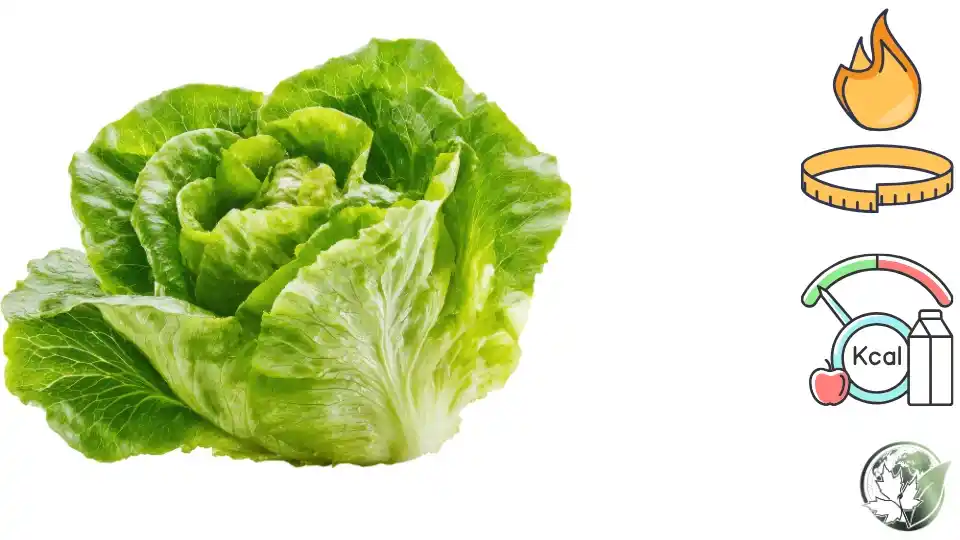
Lettuce is one of the lowest calorie foods you can eat. Iceberg lettuce has about 14 calories per 100 grams, romaine about 17, green leaf about 15, red leaf about 13 and butterhead about 13. In everyday portions, a cup of shredded iceberg (72 g) has about 10 calories, a cup of shredded romaine (47 g) has about 8, a cup of green leaf lettuce (36 g) has about 5 and a cup of butterhead (55 g) has about 7. A large salad bowl of three cups of lettuce still has only 15 to 30 calories.
Cucumber, the usual partner of lettuce in a salad, has about 15 calories per 100 grams, and a cup of sliced cucumber (104 g) has about 16. The two are almost equal per gram. Because lettuce is lighter and fluffier, a cup of lettuce weighs less than a cup of cucumber, so a cup of leaf lettuce has fewer calories than a cup of cucumber slices. Both are about 95 percent water, and both are close to a free food for calorie counting.
What matters is what goes on the lettuce. Two tablespoons of ranch dressing add 130 calories, which is more than 10 cups of lettuce. A caesar salad with croutons, parmesan and dressing can reach 400 to 500 calories even though the lettuce is only 15 of them. This guide gives the calories in lettuce by variety, cup, leaf and head, compares lettuce with cucumber and other salad vegetables, and covers dressings, toppings, lettuce wraps, nutrition, safety and how to keep it fresh. There are three comparison tables and an FAQ at the end.
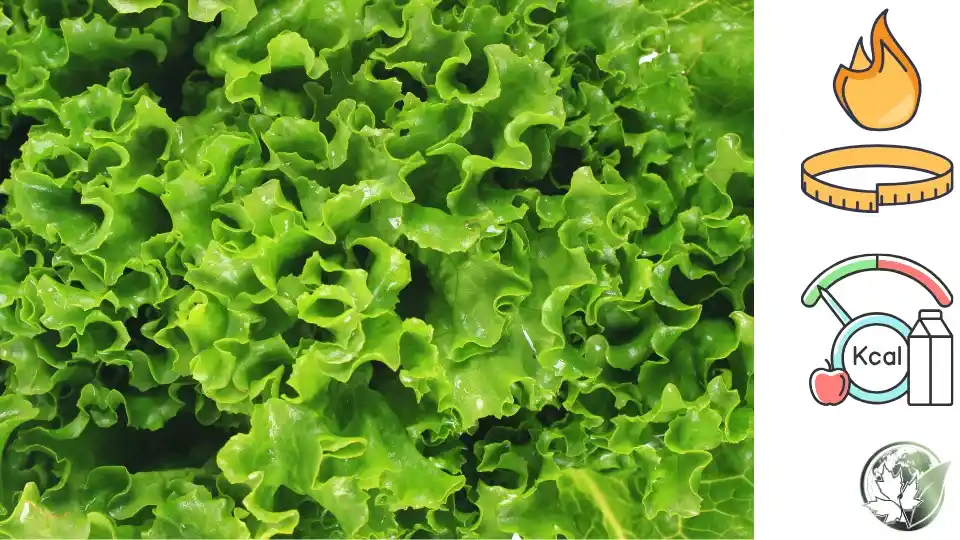
Iceberg, romaine, leaf and butterhead lettuce all have between 13 and 17 calories per 100 grams
How Many Calories Are in Lettuce by Type?
All lettuce types are very low in calories, and the differences are small. The values below are for raw lettuce.
| Lettuce type (raw) | Calories per 100 g | Calories per cup (shredded) | Protein per 100 g | Fiber per 100 g |
|---|---|---|---|---|
| Iceberg | 14 kcal | 10 kcal (72 g) | 0.9 g | 1.2 g |
| Romaine (cos) | 17 kcal | 8 kcal (47 g) | 1.2 g | 2.1 g |
| Green leaf | 15 kcal | 5 kcal (36 g) | 1.4 g | 1.3 g |
| Red leaf | 13 kcal | 5 kcal (28 g per cup) | 1.3 g | 0.9 g |
| Butterhead (Boston, Bibb) | 13 kcal | 7 kcal (55 g) | 1.4 g | 1.1 g |
| Arugula (rocket) | 25 kcal | 5 kcal (20 g) | 2.6 g | 1.6 g |
| Spinach, raw | 23 kcal | 7 kcal (30 g) | 2.9 g | 2.2 g |
| Kale, raw | 35 kcal | 7 kcal (21 g) | 2.9 g | 4.1 g |
| Radicchio | 23 kcal | 9 kcal (40 g) | 1.4 g | 0.9 g |
Romaine has slightly more calories per 100 grams than iceberg, but it brings more fiber, vitamin A, vitamin K and folate. Dark leafy greens are generally more nutritious than pale ones, though the calorie difference is negligible.
How Many Calories Are in One Leaf, a Handful or a Whole Head of Lettuce?
Cups are hard to measure with leaves, so the table below converts lettuce into units people actually use.
| Portion | Weight | Calories (iceberg) | Calories (romaine) |
|---|---|---|---|
| 1 large leaf | 25 g | 4 kcal | 4 kcal |
| 1 medium leaf | 15 g | 2 kcal | 3 kcal |
| 1 handful (loosely packed) | 30 g | 4 kcal | 5 kcal |
| 1 cup shredded | 72 g / 47 g | 10 kcal | 8 kcal |
| 1 side salad (2 cups) | 100 g | 14 kcal | 17 kcal |
| 1 large salad (4 cups) | 200 g | 28 kcal | 34 kcal |
| 1 romaine heart | 100 g | 14 kcal | 17 kcal |
| 1 medium head | 540 g | 76 kcal | 92 kcal |
| 1 large head | 625 g | 88 kcal | 106 kcal |
| 1 lettuce wrap cup (leaf) | 20 g | 3 kcal | 3 kcal |
A whole head of iceberg lettuce has only about 75 to 90 calories. Even if you ate the entire head, the total would be less than a medium banana, which has 105.
Lettuce vs Cucumber: Calories Compared
The question people ask is whether lettuce has more or fewer calories than cucumber. The answer depends on whether you compare by weight or by cup.
| Food | Portion | Weight | Calories | Water |
|---|---|---|---|---|
| Iceberg lettuce | 100 g | 100 g | 14 kcal | 96% |
| Romaine lettuce | 100 g | 100 g | 17 kcal | 95% |
| Cucumber with peel | 100 g | 100 g | 15 kcal | 95% |
| Cucumber peeled | 100 g | 100 g | 12 kcal | 96% |
| Iceberg lettuce | 1 cup shredded | 72 g | 10 kcal | 96% |
| Romaine lettuce | 1 cup shredded | 47 g | 8 kcal | 95% |
| Cucumber with peel | 1 cup sliced | 104 g | 16 kcal | 95% |
| Cucumber | 1 medium (200 g) | 200 g | 30 kcal | 95% |
| Lettuce, 3 cups | large salad | about 170 g | 24 kcal | 95% |
By weight, iceberg lettuce has about 1 calorie fewer than cucumber per 100 grams, and romaine about 2 more. These are differences you cannot measure in daily life. By cup, lettuce has fewer calories than cucumber, simply because a cup of lettuce is lighter. If you want the largest volume for the fewest calories, leaf lettuce is the winner.
Lettuce vs Cucumber: Nutrition Compared
| Per 100 g | Iceberg | Romaine | Cucumber |
|---|---|---|---|
| Calories | 14 kcal | 17 kcal | 15 kcal |
| Carbohydrate | 3.0 g | 3.3 g | 3.6 g |
| Sugar | 1.8 g | 1.2 g | 1.7 g |
| Fiber | 1.2 g | 2.1 g | 0.5 g |
| Protein | 0.9 g | 1.2 g | 0.7 g |
| Fat | 0.1 g | 0.3 g | 0.1 g |
| Vitamin A | 25 mcg | 436 mcg | 5 mcg |
| Vitamin C | 2.8 mg | 4 mg | 2.8 mg |
| Vitamin K | 24 mcg | 103 mcg | 16 mcg |
| Folate | 29 mcg | 136 mcg | 7 mcg |
| Potassium | 141 mg | 247 mg | 147 mg |
Romaine is the nutritional leader of the three, with more than 17 times the vitamin A of iceberg and 4 times the vitamin K of cucumber. Iceberg and cucumber are similar, and mostly useful for water and crunch. A salad that mixes romaine with cucumber covers both volume and nutrition.
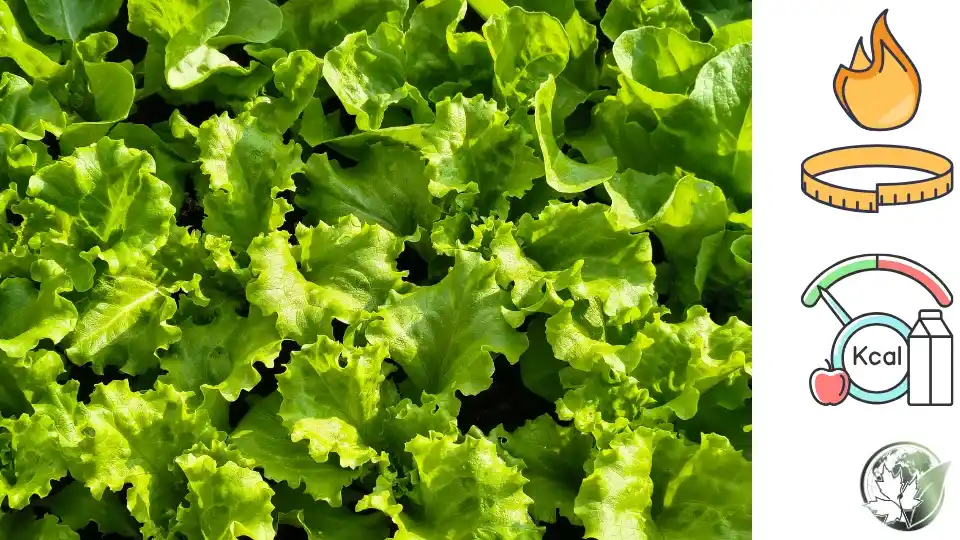
Romaine and cucumber together make a large salad for under 50 calories
How Many Calories Are in a Salad with Lettuce?
The salad itself is rarely the problem. The toppings and dressings are. The table shows how fast calories add up.
| Salad component | Serving | Calories |
|---|---|---|
| Lettuce (3 cups, mixed) | 150 g | 22 kcal |
| Cucumber slices | 1/2 cup | 8 kcal |
| Tomato, cherry | 5 pieces | 15 kcal |
| Carrot, shredded | 1/4 cup | 12 kcal |
| Red onion | 2 tablespoons | 6 kcal |
| Boiled egg | 1 large | 72 kcal |
| Grilled chicken breast | 85 g | 140 kcal |
| Avocado | 1/4 medium | 80 kcal |
| Croutons | 1/4 cup | 30 kcal |
| Parmesan, grated | 2 tablespoons | 43 kcal |
| Bacon bits | 1 tablespoon | 25 kcal |
| Sunflower seeds | 1 tablespoon | 50 kcal |
| Chickpeas | 1/4 cup | 67 kcal |
| Dried cranberries | 2 tablespoons | 52 kcal |
| Feta cheese | 28 g | 75 kcal |
| Olives | 5 pieces | 25 kcal |
A basic garden salad with lettuce, cucumber, tomato, carrot and onion has about 63 calories. Adding chicken, egg and avocado brings it to about 350. A large restaurant salad with fried chicken, cheese, bacon, croutons and creamy dressing can reach 800 calories or more, which is more than a burger.
How Many Calories Are in Salad Dressings?
Dressing is the single biggest source of calories in most salads. A standard serving is two tablespoons (30 ml).
| Dressing | 2 tablespoons | Calories | Fat |
|---|---|---|---|
| Ranch | 30 g | 129 kcal | 13 g |
| Caesar | 30 g | 150 kcal | 16 g |
| Blue cheese | 30 g | 145 kcal | 15 g |
| Thousand Island | 30 g | 120 kcal | 11 g |
| Italian | 30 g | 70 kcal | 7 g |
| Honey mustard | 30 g | 110 kcal | 8 g |
| Balsamic vinaigrette | 30 g | 90 kcal | 9 g |
| Olive oil and vinegar | 30 g | 100 kcal | 11 g |
| Lemon juice and herbs | 30 g | 8 kcal | 0 g |
| Low fat ranch | 30 g | 60 kcal | 3 g |
| Plain yogurt dressing | 30 g | 25 kcal | 1 g |
| Tahini lemon dressing | 30 g | 90 kcal | 8 g |
Two tablespoons of ranch has about 13 times the calories of an entire three-cup salad of lettuce. The simplest way to keep a salad light is to measure the dressing, put it on the side and dip your fork into it, or to use lemon juice, vinegar or yogurt-based dressings.
Is Lettuce Good for Weight Loss?
Lettuce is a classic diet food for good reason. It has very few calories, a lot of water and some fiber, so it adds volume to a meal without adding energy. Studies on energy density show that starting a meal with a large low calorie salad can reduce total calories eaten at that meal by 7 to 12 percent, as long as the salad is not covered in dressing and cheese. Chewing crunchy vegetables also slows down eating, which helps fullness signals arrive in time.
Lettuce alone will not keep you full for long, because it has almost no protein or fat. Pair it with a protein such as eggs, chicken, tuna, beans or cheese, and a small portion of healthy fat to make a satisfying meal. Using lettuce leaves in place of bread, tortillas or buns is another simple swap. A burger wrapped in lettuce instead of a bun saves about 120 to 150 calories.
Swapping a bun for a lettuce wrap saves about 120 to 150 calories
How Many Calories Do You Save with Lettuce Wraps?
| Swap | Original | Calories | Lettuce version | Calories | Saved |
|---|---|---|---|---|---|
| Burger bun | Hamburger bun | 150 kcal | Iceberg leaf wrap | 4 kcal | 146 kcal |
| Sandwich bread | 2 slices white bread | 160 kcal | 2 large romaine leaves | 8 kcal | 152 kcal |
| Taco shell | Flour tortilla | 140 kcal | Butterhead cup | 3 kcal | 137 kcal |
| Hot dog bun | Standard bun | 120 kcal | Romaine leaf | 4 kcal | 116 kcal |
| Rice base | 1 cup cooked rice | 205 kcal | 2 cups shredded lettuce | 15 kcal | 190 kcal |
| Burrito wrap | Large tortilla | 300 kcal | Large lettuce leaves | 10 kcal | 290 kcal |
These swaps work best when the filling is not too wet, and with sturdy leaves such as iceberg, romaine or butterhead. Double up the leaves for strength.
Is Lettuce Healthy?
Lettuce is a healthy food, though it is not a nutritional powerhouse like kale or spinach. Darker lettuces, especially romaine and red leaf, contain good amounts of vitamin A (as beta carotene), vitamin K, folate and polyphenols. A couple of cups of romaine provides about 100 percent of the daily need for vitamin K and about 25 percent of the daily need for vitamin A. Lettuce also provides water, which contributes to hydration, and potassium.
Iceberg lettuce is often criticized as being nutritionally poor, but this is relative. It still has useful amounts of vitamin K and folate, and it is crunchy and affordable, which makes it more likely to be eaten. The best lettuce is the one you will actually eat, and mixing types gives the most variety. If you take blood thinners such as warfarin, keep your intake of leafy greens consistent, because the vitamin K can interact with them.
How Do You Keep Lettuce Fresh and Safe to Eat?
Lettuce spoils quickly. Store unwashed heads in the crisper drawer in a loose plastic bag with a paper towel to absorb moisture. Whole heads of iceberg last one to two weeks, romaine five to seven days and loose leaf varieties three to five days. Wash the leaves just before use under cold running water, and dry them in a salad spinner, because wet leaves go slimy and dilute the dressing.
Raw leafy greens are a known source of food-borne illness, including E. coli and Salmonella, so it is worth washing even bagged lettuce labeled pre-washed if you are pregnant, elderly or have a weak immune system, and discarding outer leaves. Throw out lettuce that is slimy, brown or smells bad.
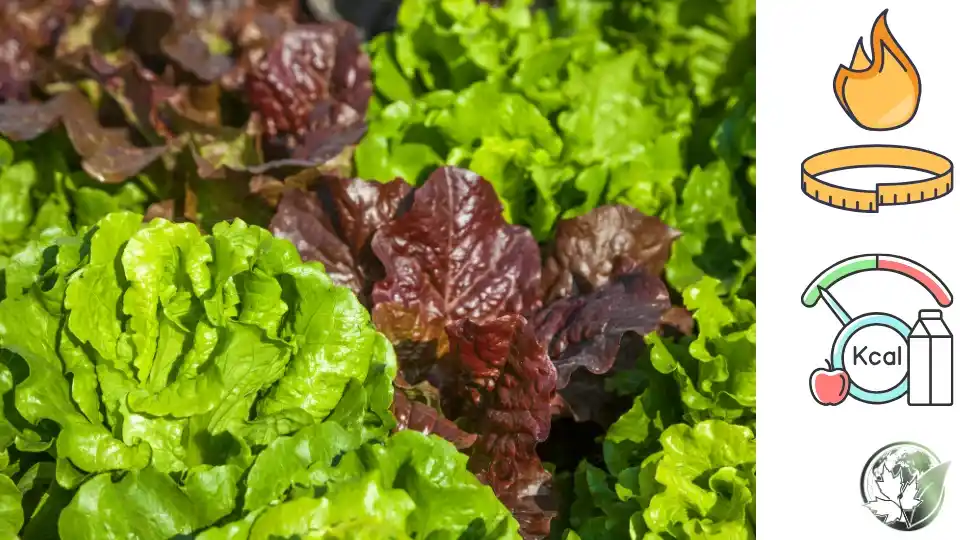
Wash lettuce just before eating and dry it well so the leaves stay crisp
How Many Calories Are in Lettuce-Based Dishes?
| Dish | Serving | Calories |
|---|---|---|
| Garden salad, no dressing | 2 cups | 40 kcal |
| Caesar salad with dressing and croutons | 3 cups | 360 kcal |
| Greek salad with feta and olives | 2 cups | 240 kcal |
| Cobb salad | 1 large | 530 kcal |
| Chicken salad with lettuce | 2 cups | 330 kcal |
| Iceberg wedge with blue cheese and bacon | 1 wedge | 320 kcal |
| Lettuce wrap with minced chicken | 3 wraps | 240 kcal |
| Persian salad shirazi with lettuce | 1 bowl | 90 kcal |
| Lettuce with sekanjabin syrup | 1 serving | 110 kcal |
| Side salad with vinaigrette | 1 small | 120 kcal |
The Persian dish of lettuce with sekanjabin, made from vinegar and sugar syrup, is an example of how a small amount of syrup can add 100 calories to a plate of lettuce. In every case the lettuce is a minor part of the total.
How to Count Lettuce Calories Accurately
For most people, lettuce can be ignored or logged as about 10 calories per cup. If you are counting precisely, weigh the leaves on a scale and use 14 to 17 calories per 100 grams. Count the dressing, cheese, croutons, meat, nuts and dried fruit separately, using a measuring spoon for dressing. Remember that restaurant salads are usually dressed generously, often with 3 to 4 tablespoons, so they can have 300 calories of dressing alone.
How Much Lettuce Is Too Much?
There is no calorie reason to limit lettuce, but there are a couple of practical points. Very large amounts of raw leafy vegetables can cause gas or bloating in some people. A diet based mostly on lettuce would be too low in protein, fat and energy, so it should be part of a balanced diet, not the whole of it. Lettuce eaten for volume is best paired with enough protein, whole grains and healthy fats to reach your energy needs.
How Does Lettuce Compare with Other Salad Vegetables?
Lettuce is the lightest of the common salad vegetables, but most of the others are also very low in calories. Per 100 grams, tomato has 18 calories, bell pepper 20 to 31, celery 14, radish 16, cabbage 25, carrot 41 and raw onion 40. Per cup, shredded cabbage has 22, chopped tomato 32, sliced celery 16, shredded carrot 52 and chopped red onion 64.
| Vegetable (raw, 100 g) | Calories | Water | Fiber |
|---|---|---|---|
| Iceberg lettuce | 14 kcal | 96% | 1.2 g |
| Celery | 14 kcal | 95% | 1.6 g |
| Cucumber | 15 kcal | 95% | 0.5 g |
| Radish | 16 kcal | 95% | 1.6 g |
| Romaine lettuce | 17 kcal | 95% | 2.1 g |
| Tomato | 18 kcal | 94% | 1.2 g |
| Red bell pepper | 31 kcal | 92% | 2.1 g |
| Cabbage | 25 kcal | 92% | 2.5 g |
| Carrot | 41 kcal | 88% | 2.8 g |
| Red onion | 40 kcal | 89% | 1.7 g |
Because these differences are so small, a salad can be built mainly for taste, texture and nutrients rather than calories. Carrots and onions add a little more, but they bring sweetness, fiber and antioxidants, and their portions are usually small.
How Does Lettuce Fit Into Different Diets?
On a low carbohydrate or keto diet, lettuce has about 2 to 3 grams of net carbohydrate per 100 grams, so it is one of the most suitable greens, and it is often used in place of bread and wraps. On a Mediterranean diet, leafy greens are part of the foundation, usually dressed with olive oil and lemon. On a plant-based diet, lettuce provides volume, and it works best alongside beans, nuts, seeds and whole grains for protein and energy. For people with diabetes, lettuce has a negligible effect on blood glucose, with a glycemic load of almost zero. On a low FODMAP diet, most lettuces are allowed in normal portions, although very large servings of some leafy greens may need attention.
What Is the Difference Between Calories in Fresh, Bagged and Cooked Lettuce?
Fresh lettuce, bagged salad mixes and chopped lettuce from a salad bar all have the same basic calories, about 13 to 17 per 100 grams. Bagged mixes sometimes include extras such as dried cranberries, nuts, cheese and dressing packets, and these can add 100 to 250 calories to what looks like a simple bag of greens, so read the label. Lettuce can also be cooked. When it is braised, grilled or added to soups, it loses water and shrinks, so a cup of cooked lettuce weighs more and has more calories than a cup of raw, but the total calories for the same amount of lettuce stay the same unless oil or butter is added. In Chinese cooking, for example, lettuce is often stir-fried with garlic and oil, and the oil provides most of the calories.
How Many Calories Are in a Lettuce Smoothie or Juice?
Lettuce can be blended into green smoothies, where it adds volume and nutrients with almost no taste. Two cups of romaine in a smoothie add about 16 calories. The calories in the smoothie come from the fruit, yogurt, milk and sweeteners that are mixed in. A typical green smoothie with a banana, a cup of milk, a handful of lettuce and a spoon of honey has about 280 calories, and the lettuce is about 6 percent of that. Juicing lettuce removes the fiber and makes it less filling, so eating the whole leaves is better for fullness.
How Do Restaurants and Fast Food Use Lettuce?
Lettuce is a standard garnish in sandwiches, burgers, tacos and wraps. In a fast food burger the shredded lettuce adds about 2 to 5 calories. Most of the calories are in the bun, patty, cheese and sauce. Asking for extra lettuce or a lettuce wrap is a reliable way to cut calories while keeping the meal familiar. Many chains now offer lettuce-wrapped burgers, which can save 100 to 200 calories, though special sauces can still bring the total up, so ask about the sauce too.
How Do You Make a Low Calorie Salad That Still Fills You Up?
Start with two to three cups of mixed lettuce and add other raw vegetables for crunch. Add 85 to 115 grams of lean protein, such as grilled chicken, tuna, shrimp, a boiled egg or chickpeas, for staying power. Add a measured spoon of healthy fat, such as a tablespoon of olive oil in the dressing, a quarter of an avocado or a small handful of nuts. Finish with lemon juice, vinegar or herbs. A salad built this way has 250 to 350 calories, plenty of volume and enough protein to keep you full for three to four hours.
Why Is Lettuce So Low in Calories?
Lettuce is made almost entirely of water, about 95 percent by weight, and the remaining 5 percent is mostly carbohydrate in the form of fiber and small amounts of sugar. It has almost no fat or starch, the two components that pack the most energy per gram. Fat has 9 calories per gram, carbohydrate and protein have 4, and water has none, so a food that is 95 percent water cannot have many calories. The same logic applies to cucumber, celery, watermelon and other watery produce, which are the foods with the lowest energy density.
Key Takeaways: Lettuce Calories vs Cucumber
Lettuce has 13 to 17 calories per 100 grams and 5 to 10 per cup, almost identical to cucumber at 15 per 100 grams. By cup, lettuce has fewer calories than cucumber because it is lighter. The calories in a salad come from dressing, cheese, croutons and meat, not from the greens, so measure those and enjoy as much lettuce as you like.
Frequently Asked Questions
6 questions answered
How many calories are in a cup of lettuce?
About 5 to 10, depending on the type.
How many calories are in a whole head of iceberg lettuce?
About 75 to 90.
Does lettuce have fewer calories than cucumber?
About the same per 100 grams, and fewer per cup.
How many calories are in a lettuce leaf?
About 2 to 4.
Is romaine or iceberg lower in calories?
Iceberg has 14 per 100 grams and romaine 17, but romaine is more nutritious.
How many calories does salad dressing add?
Two tablespoons add 70 to 150 calories.