
How Many Calories Are in Ketchup? The Quick Answer
Ketchup has about 100 calories per 100 grams. A level teaspoon (6 g) has about 6 calories, a standard portion packet (9 g) has about 9, a level tablespoon (17 g) has about 17, a generous squirt of two tablespoons (34 g) has about 34, a quarter cup (68 g) has about 69, and a 500 gram bottle has about 500 calories. Butter has about 717 calories per 100 grams and 102 calories in a tablespoon (14 g).
So a tablespoon of ketchup has about one sixth of the calories of a tablespoon of butter. Per gram, ketchup has about one seventh of the calories. The reason is that ketchup is mostly tomato, vinegar, water and sugar, with no fat, while butter is more than 80 percent fat. It would take six tablespoons of ketchup, about 100 grams, to match the calories in one tablespoon of butter.
But calories are not the whole picture. Ketchup is high in sugar: about 4 grams per tablespoon, about one sugar cube, and about 22 grams per 100 grams. It is also high in sodium, with about 150 milligrams per tablespoon. This guide gives the calories in ketchup per spoon, packet, serving and bottle, and compares them with butter and other sauces. It covers sugar, sodium, healthier options and how to count it. You will find three comparison tables and an FAQ.
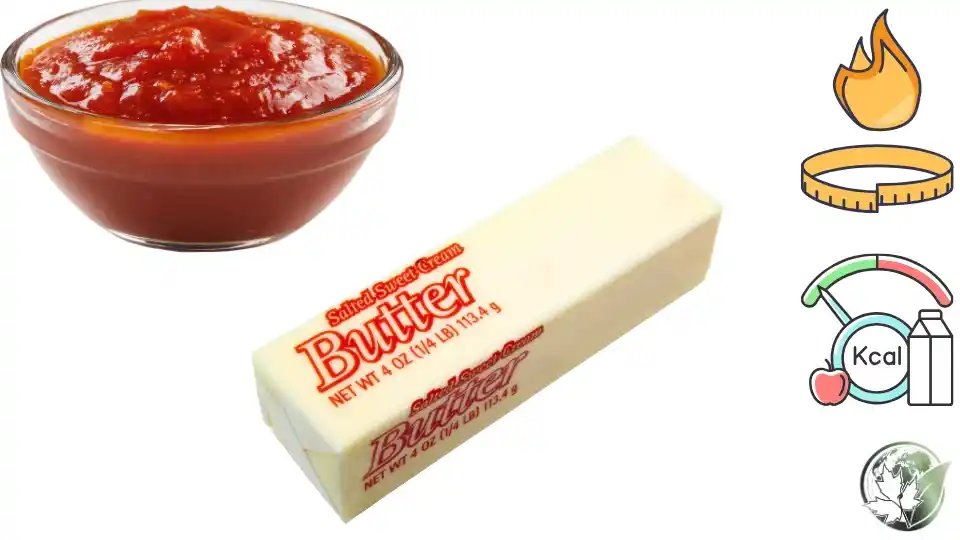
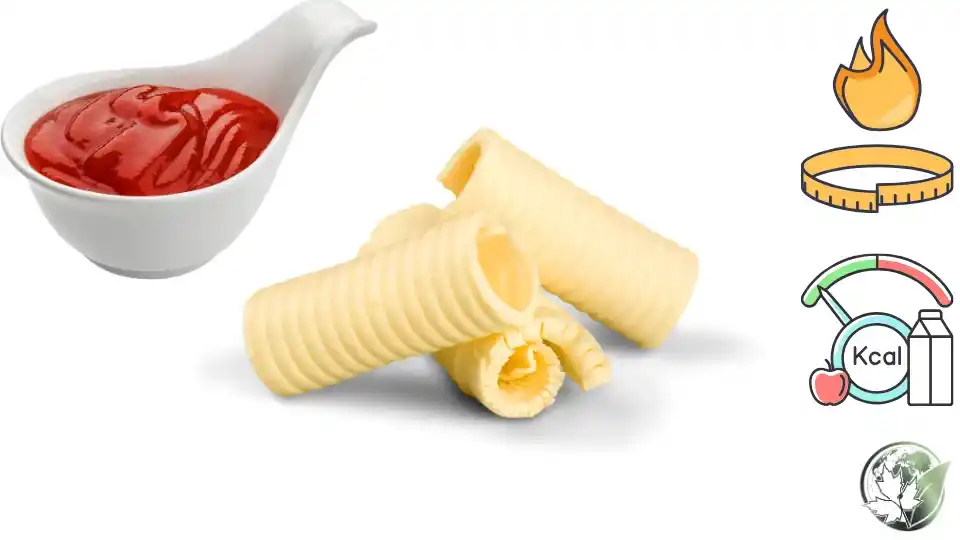
A tablespoon of ketchup has about 17 calories, while a tablespoon of butter has 102
How Many Calories Are in a Tablespoon, Packet and Bottle of Ketchup?
| Portion | Weight | Calories | Sugar | Sodium |
|---|---|---|---|---|
| 1 teaspoon | 6 g | 6 kcal | 1.3 g | 54 mg |
| 1 packet | 9 g | 9 kcal | 2.0 g | 81 mg |
| 1 tablespoon | 17 g | 17 kcal | 3.8 g | 154 mg |
| 2 tablespoons | 34 g | 34 kcal | 7.6 g | 308 mg |
| 3 tablespoons | 51 g | 51 kcal | 11.4 g | 462 mg |
| 1/4 cup | 68 g | 69 kcal | 15.5 g | 617 mg |
| 1/2 cup | 136 g | 137 kcal | 31 g | 1,234 mg |
| 1 bottle (500 g) | 500 g | 505 kcal | 114 g | 4,535 mg |
| Dip cup (fast food) | 28 g | 28 kcal | 6.4 g | 254 mg |
| 100 g | 100 g | 101 kcal | 23 g | 907 mg |
A typical serving with fries is two to three tablespoons, or 34 to 51 calories. A heavy pour on a burger or hot dog can be four tablespoons, with 68 calories and 15 grams of sugar, more than three and a half sugar cubes.
Ketchup vs Butter: Calories and Nutrition Compared
| Per 100 g | Ketchup | Butter |
|---|---|---|
| Calories | 101 kcal | 717 kcal |
| Fat | 0.1 g | 81 g |
| Saturated fat | 0 g | 51 g |
| Carbohydrate | 25.8 g | 0.1 g |
| Sugar | 22.8 g | 0.1 g |
| Protein | 1.0 g | 0.9 g |
| Sodium | 907 mg | 11 mg (unsalted) |
| Potassium | 380 mg | 24 mg |
| Lycopene | 10 to 16 mg | 0 mg |
| Cholesterol | 0 mg | 215 mg |
| Per tablespoon | Ketchup (17 g) | Butter (14 g) |
|---|---|---|
| Calories | 17 kcal | 102 kcal |
| Fat | 0 g | 11.5 g |
| Sugar | 3.8 g | 0 g |
| Sodium | 154 mg | 2 mg |
Ketchup has far fewer calories, no fat, and no cholesterol, but it contains sugar and salt that butter does not. Butter has more calories, saturated fat and cholesterol, but almost no sugar or salt if unsalted. They serve different roles: ketchup is a condiment used for flavor, while butter is a fat used for cooking and spreading.
How Many Sugar Cubes Are in Ketchup?
A tablespoon of ketchup has about 3.8 grams of sugar, almost exactly one sugar cube. Most people use two to four tablespoons on a meal, which is two to four cubes.
| Ketchup portion | Sugar | Sugar cubes (4 g) | Calories |
|---|---|---|---|
| 1 packet (9 g) | 2.0 g | 0.5 | 9 kcal |
| 1 tbsp | 3.8 g | 0.95 | 17 kcal |
| 2 tbsp | 7.6 g | 1.9 | 34 kcal |
| 4 tbsp | 15.2 g | 3.8 | 68 kcal |
| 1/2 cup | 31 g | 7.8 | 137 kcal |
| 1 bottle (500 g) | 114 g | 28.5 | 505 kcal |
Ketchup is about 22 percent sugar, similar to a soft drink at 10 percent, but twice as sweet by weight. Some brands add high fructose corn syrup, and the sugar is the second or third ingredient. If you eat ketchup daily with every meal, the sugar adds up to 10 to 15 grams a day.
Two tablespoons of ketchup with fries add about 34 calories and 2 sugar cubes of sugar
Is Ketchup Healthier Than Butter?
For calories and fat, yes, by a wide margin. Replacing a tablespoon of butter on a baked potato or burger with a tablespoon of ketchup saves 85 calories and eliminates 7 grams of saturated fat. Ketchup is also a source of lycopene, a carotenoid antioxidant that is better absorbed from cooked and processed tomato than from raw. A tablespoon provides about 2 to 3 milligrams of lycopene.
The downsides are sugar and sodium. Added sugar at a few grams per serving is not a problem occasionally, but across the day it contributes. The sodium, about 150 milligrams per tablespoon, is about 7 percent of the daily limit of 2,300 milligrams, and heavy users can reach 600 milligrams or more from ketchup alone. People with high blood pressure should be careful.
Which Sauces Have Fewer Calories Than Ketchup?
| Sauce | Calories per tbsp | Sugar | Sodium |
|---|---|---|---|
| Mustard (yellow) | 3 kcal | 0.1 g | 55 mg |
| Hot sauce | 1 kcal | 0 g | 124 mg |
| Soy sauce | 9 kcal | 0.1 g | 880 mg |
| Salsa | 5 kcal | 0.7 g | 100 mg |
| Vinegar | 3 kcal | 0 g | 0 mg |
| Ketchup | 17 kcal | 3.8 g | 154 mg |
| Tomato sauce (pasta) | 8 kcal | 1.0 g | 70 mg |
| Barbecue sauce | 29 kcal | 5.7 g | 175 mg |
| Sweet chili sauce | 35 kcal | 8.5 g | 120 mg |
| Mayonnaise | 94 kcal | 0.1 g | 88 mg |
| Ranch dressing | 73 kcal | 0.5 g | 122 mg |
| Garlic sauce (toum) | 100 kcal | 0 g | 90 mg |
| Butter | 102 kcal | 0 g | 2 mg |
Ketchup sits in the middle of the sauce range. It has fewer calories than creamy sauces and barbecue sauce, but more than mustard, vinegar or hot sauce.
Ketchup vs Butter on Common Foods
| Food | With 1 tbsp butter | With 1 tbsp ketchup | Difference |
|---|---|---|---|
| Baked potato (medium) | 263 kcal | 178 kcal | 85 kcal |
| Slice of bread | 182 kcal | 97 kcal | 85 kcal |
| Hot dog in a bun | 400 kcal | 315 kcal | 85 kcal |
| Burger (plain, 150 g) | 405 kcal | 320 kcal | 85 kcal |
| Scrambled eggs, 2 | 255 kcal | 170 kcal | 85 kcal |
| Cooked rice, 1 cup | 307 kcal | 222 kcal | 85 kcal |
| Corn on the cob | 190 kcal | 105 kcal | 85 kcal |
| Fries, 100 g | 410 kcal | 325 kcal | 85 kcal |
Each swap saves 85 calories per tablespoon. Over a month of daily use, replacing butter with ketchup would save about 2,550 calories, equal to about a third of a kilogram of body fat.
Does Ketchup Raise Blood Sugar?
Ketchup has a glycemic index of about 55, and a tablespoon has a very low glycemic load of 1 or 2 because the portion is small. In larger amounts, it can contribute 10 to 20 grams of sugar, so people with diabetes should read the label and count it. Reduced-sugar ketchups with stevia or other sweeteners can have only 1 gram of sugar per tablespoon.
What Is Healthier: Regular, Reduced-Sugar or Homemade Ketchup?
| Type | Calories per tbsp | Sugar | Sodium |
|---|---|---|---|
| Regular ketchup | 17 kcal | 3.8 g | 154 mg |
| Organic ketchup | 15 kcal | 3.5 g | 120 mg |
| Reduced-sugar ketchup | 10 kcal | 1.5 g | 135 mg |
| No-sugar-added ketchup | 6 kcal | 0.5 g | 140 mg |
| Reduced-sodium ketchup | 15 kcal | 3.5 g | 90 mg |
| Homemade ketchup | 14 kcal | 2.5 g | 60 mg |
| Spicy ketchup | 18 kcal | 4.0 g | 170 mg |
| Curry ketchup | 20 kcal | 4.5 g | 180 mg |
Homemade ketchup lets you control sugar and sodium, using tomato paste, vinegar, a touch of honey, and spices. It will be less sweet and more tomato-forward.
Homemade ketchup lets you control the sugar and salt
How to Use Less Ketchup
**Measure with a spoon.** Squeeze onto a spoon and see how much you use.
**Dip, do not pour.** Dipping food gives flavor with less sauce.
**Use a small side cup.** A small cup limits the quantity.
**Mix with mustard or hot sauce.** Stronger flavors need less.
**Choose a lower sugar brand.**
**Try salsa, tomato sauce or harissa.** These give more flavor for fewer calories.
How to Store Ketchup
Ketchup is acidic and sweet, so it keeps for a long time. Unopened, it lasts a year or more in the pantry. After opening, store in the refrigerator for up to six months. Keep the lid clean. Separation of watery liquid is normal, and you can shake it. Discard if it has mold or a sour fermented smell.
Refrigerate ketchup after opening and keep the lid clean
How to Count Ketchup Calories Accurately
Use 17 calories per level tablespoon or 1 calorie per gram. Estimate a squirt from a bottle at about one tablespoon. A fast food packet is 9 calories. For restaurant dips, a 28 gram cup is about 28 calories. Count each portion if you are tracking sugar.
What Is Ketchup Made Of?
A typical ketchup is made from tomato concentrate, vinegar, sugar or glucose-fructose syrup, salt and a spice and onion flavoring. The tomatoes are cooked down into a paste, which is then blended with the other ingredients and heated to thicken and sterilize the sauce. Tomato concentrate makes up about 25 to 35 percent of the finished product, sugar about 15 to 25 percent, vinegar about 5 percent and salt about 2 percent. The rest is water.
This composition explains the calories. Tomato solids provide a small amount of carbohydrate and fiber. Sugar provides most of the energy. There is no fat. At about 1 calorie per gram, ketchup is similar to a thick fruit puree. A bottle that holds half a kilogram has about 505 calories, roughly as many as 70 grams of butter.
In some countries, ketchup is made with less sugar, and in others with more spices, such as curry or chili. Premium or organic products tend to use cane sugar and may have fewer additives, but the calories are within a few per tablespoon. The main difference between brands is the proportion of sugar and salt, which you can check on the label. Looking at the sugar per 100 grams is a quick way to compare. A product with about 22 grams is typical, and one with less than 10 grams is a reduced-sugar version.
How Do Ketchup and Tomato Sauce, Paste and Puree Compare?
Many people use ketchup as a general tomato sauce, but there are big differences between ketchup and plain tomato products. The table compares them per 100 grams and per tablespoon.
| Product | Calories per 100 g | Per tbsp | Sugar per 100 g | Sodium per 100 g |
|---|---|---|---|---|
| Fresh tomato | 18 kcal | 3 kcal | 2.6 g | 5 mg |
| Tomato puree (passata) | 32 kcal | 5 kcal | 5 g | 20 mg |
| Tomato sauce, plain | 24 kcal | 4 kcal | 4.5 g | 330 mg |
| Tomato paste | 82 kcal | 13 kcal | 12 g | 100 mg |
| Ketchup | 101 kcal | 17 kcal | 23 g | 907 mg |
| Pizza sauce | 40 kcal | 6 kcal | 6 g | 450 mg |
| Barbecue sauce | 170 kcal | 29 kcal | 33 g | 1,000 mg |
| Sweet chili sauce | 200 kcal | 35 kcal | 45 g | 700 mg |
Plain tomato sauce has about a quarter of the calories of ketchup and much less sugar. If you want a tomato flavor with fewer calories, plain tomato puree with a splash of vinegar and a pinch of sugar and spices is a good substitute. Tomato paste is more concentrated, with 82 calories per 100 grams, but is used in very small amounts.
Is the Lycopene in Ketchup Worth Mentioning?
Tomatoes are a major source of lycopene, a red carotenoid that has been studied for possible protection against heart disease and prostate cancer. Cooking and processing break down cell walls and make lycopene easier to absorb, and oil or fat in a meal improves absorption further. Ketchup contains about 10 to 16 milligrams of lycopene per 100 grams, a tablespoon provides about 2 to 3 milligrams, and a serving of three tablespoons, about 6 to 9 milligrams, which is close to the intake of 6 to 10 milligrams associated with benefits in studies.
That does not make ketchup a health food. The lycopene can be obtained with much less sugar and salt from plain cooked tomatoes, tomato sauce, tomato paste or soup. But it is nice to know that the condiment on your fries is not entirely empty of nutrients. If you like ketchup, you can consider it a modest source of lycopene and potassium alongside sugar and sodium.
How Do Butter Types Compare in Calories?
For a fair comparison with ketchup, it helps to see how butter and similar spreads and fats compare. Butter has about 102 calories per tablespoon, and some alternatives are lighter and some are not.
| Fat or spread | Calories per tbsp | Saturated fat | Notes |
|---|---|---|---|
| Butter, salted or unsalted | 102 kcal | 7.3 g | 80 percent fat |
| Ghee (clarified butter) | 123 kcal | 7.9 g | Pure fat |
| Whipped butter | 67 kcal | 4.8 g | Air whipped in |
| Margarine, stick | 101 kcal | 1.8 g | Plant oils |
| Margarine, soft tub | 80 kcal | 1.5 g | Lower fat |
| Light butter spread | 50 kcal | 3 g | Half fat |
| Olive oil | 119 kcal | 1.9 g | Liquid |
| Cream cheese | 50 kcal | 3.2 g | Lower in fat |
| Ketchup | 17 kcal | 0 g | No fat, some sugar |
| Mustard | 3 kcal | 0 g | Almost none |
If you are looking to cut calories, ketchup, mustard and salsa are the lowest options. They do not provide the creamy texture of butter, but they give moisture and flavor to foods like potatoes, bread and eggs.
How Do Kids and Adults Use Ketchup, and Does It Matter for Calories?
Children often use more ketchup per meal than adults, relative to their size, and ketchup is one of the main ways that kids eat their vegetables and potatoes. A child who uses three tablespoons with each meal and snacks can reach 100 to 150 calories and 22 to 34 grams of sugar a day from ketchup alone, which is close to the recommended added sugar limit of 25 grams for a child. This does not mean that ketchup is forbidden, but it suggests keeping an eye on it, especially if the child already eats cereal, juice and biscuits.
Practical ways to cut back are to offer a small portion in a dipping cup, to mix ketchup with plain tomato sauce or yogurt to make a dip with less sugar, and to introduce alternatives like mild salsa or hummus. For adults, the sodium may be a bigger concern than the sugar, and a no-salt-added version helps.
What Is the Calorie Cost of Ketchup in a Typical Meal?
It helps to look at a whole plate. The table compares a common meal with different sauce choices.
| Meal | Sauce | Sauce calories | Total calories |
|---|---|---|---|
| Burger and fries (about 750 kcal) | 3 tbsp ketchup | 51 kcal | 801 kcal |
| Burger and fries | 3 tbsp mayonnaise | 282 kcal | 1,032 kcal |
| Burger and fries | 3 tbsp barbecue sauce | 87 kcal | 837 kcal |
| Burger and fries | 3 tbsp mustard | 9 kcal | 759 kcal |
| Hot dog (about 300 kcal) | 1 tbsp ketchup, 1 tbsp mustard | 20 kcal | 320 kcal |
| Scrambled eggs on toast (about 280 kcal) | 1 tbsp butter | 102 kcal | 382 kcal |
| Scrambled eggs on toast | 1 tbsp ketchup | 17 kcal | 297 kcal |
| Baked potato (about 160 kcal) | 1 tbsp butter | 102 kcal | 262 kcal |
In most meals, ketchup is a small part of the calories, usually under 10 percent. If you want to reduce a meal, the bigger levers are mayonnaise, butter, cheese and the size of the fries, which add far more calories.
How Can You Make a Healthier Ketchup at Home?
Making ketchup at home is easy and lets you decide the sugar and salt. A simple recipe uses a 400 gram can of tomato paste or a mix of tomato paste and puree, a quarter cup of vinegar, two tablespoons of honey or date syrup, a half teaspoon of salt, and spices such as onion powder, garlic powder, paprika, a pinch of cloves and allspice. Simmer everything with a little water for ten to fifteen minutes, stir until thick and smooth, then cool and refrigerate.
A batch of about two cups, 500 grams, made with two tablespoons of honey has about 330 calories, or about 11 calories per tablespoon, and only about 2 grams of sugar per tablespoon. The sodium is under 60 milligrams per tablespoon when you use only a small amount of salt. It keeps for two to three weeks in the refrigerator, or can be frozen in ice cube trays for several months.
This version tastes less sweet than the store type and more like tomato. If you want it sweeter, add a little more honey or a grated apple. If you want a spicy version, add chili flakes or hot sauce. A date-based version made with two pitted dates blended in has about 15 calories per tablespoon and extra fiber.
Does Ketchup Fit Into Weight Loss and Healthy Eating Plans?
Ketchup is low in calories, so it can fit in a weight loss plan if used in measured amounts. The issues are the sugar and the foods it is typically paired with, such as fries, burgers and hot dogs. A tablespoon on a grilled chicken sandwich or scrambled eggs is a small addition of 17 calories. Three tablespoons on a plate of fries can seem unimportant in a meal of 700 calories, but it is the main source of sugar on the plate.
If you track sugar, remember that ketchup has about 3.8 grams per tablespoon, and compare that with the 25 grams advised as a daily limit for added sugars. If you eat two tablespoons a day, that is about 30 percent of the limit. If you want to keep ketchup in your diet, choose a reduced-sugar brand, measure your serving and consider using other low-calorie sauces such as mustard, salsa, hot sauce or vinegar to share the load.
For people who follow a Mediterranean or DASH-style diet, which emphasize low sodium, ketchup is best used sparingly. Plain tomato sauce and fresh tomato slices provide similar flavor without the sodium and sugar.
Key Takeaways: Ketchup Calories vs Butter
Ketchup has about 17 calories per tablespoon, one sixth of butter at 102, and no fat. It has about one sugar cube of sugar and 150 milligrams of sodium per tablespoon, so use it in measured amounts. Swapping butter for ketchup on food saves about 85 calories per tablespoon.
Frequently Asked Questions
6 questions answered
How many calories are in ketchup?
About 17 per tablespoon and 101 per 100 grams.
How many calories are in a packet of ketchup?
About 9.
Does ketchup have fewer calories than butter?
Yes, about one sixth as many per tablespoon.
How much sugar is in ketchup?
About 3.8 grams per tablespoon, roughly one sugar cube.
Is ketchup healthy?
It contains lycopene, but also sugar and sodium, so use it in moderation.
What is a low calorie alternative to ketchup?
Mustard, salsa, hot sauce or no-sugar-added ketchup.




