How Many Calories Are in Jam? The Quick Answer
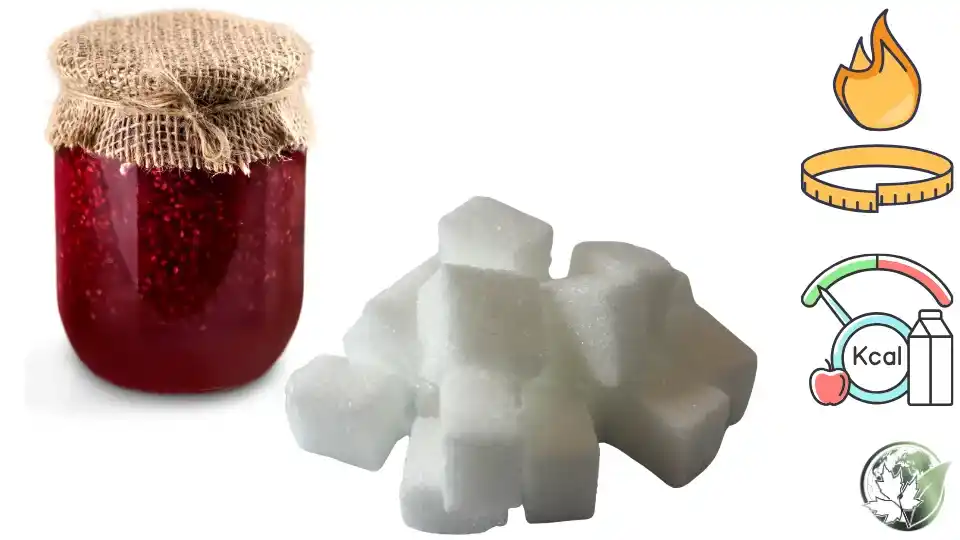
Jam has about 270 calories per 100 grams. A level teaspoon (6 g) has about 17 calories, a level tablespoon (18 g) has about 50, a heaped tablespoon (about 28 g) has about 76, a small 15 gram portion packet has about 41, a thick spread for a slice of toast (about 25 g) has about 68, and a jar of 340 grams has about 920 calories. A sugar cube of 4 grams has about 16 calories, so one tablespoon of jam equals about three sugar cubes in calories, and its 11 grams of sugar equal about 2.8 cubes.
Jam is a preserve of fruit cooked with sugar. Most regular jams contain 55 to 65 percent sugar, so there is a lot of sugar in each spoon, even though there is fruit in the jar. The calories per gram are lower than sugar's 3.87, at about 2.7, because jam also holds water and fruit. But since it is eaten in spoonfuls of 15 to 30 grams, a portion has the sugar of three to six cubes.
This guide lists jam calories per teaspoon, tablespoon, slice and 100 grams, compares regular, reduced-sugar, sugar-free and homemade jams, and shows how jam compares with sugar cubes and other spreads. It also covers Persian morabba, the calories in jam desserts and breakfasts, how to choose a lower sugar jam and how to count it. You will find three comparison tables and an FAQ.
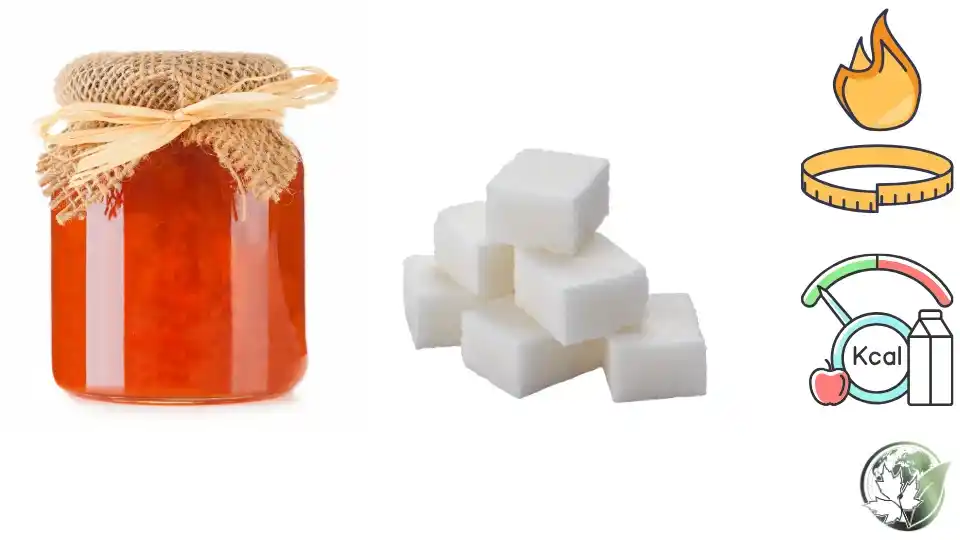
A level tablespoon of jam has about 50 calories
How Many Calories Are in a Teaspoon, Tablespoon and Jar of Jam?
| Portion | Weight | Calories | Sugar | Carbohydrate |
|---|---|---|---|---|
| 1 level teaspoon | 6 g | 17 kcal | 3.7 g | 4.1 g |
| 1 heaped teaspoon | 9 g | 24 kcal | 5.6 g | 6.1 g |
| 1 portion packet | 15 g | 41 kcal | 9.3 g | 10 g |
| 1 level tablespoon | 18 g | 49 kcal | 11.2 g | 12.2 g |
| 1 heaped tablespoon | 28 g | 76 kcal | 17.4 g | 19 g |
| 2 tablespoons | 36 g | 97 kcal | 22.3 g | 24.4 g |
| Spread on 1 slice of toast | 25 g | 68 kcal | 15.5 g | 17 g |
| 1/4 cup | 80 g | 216 kcal | 50 g | 54 g |
| 1 jar (340 g) | 340 g | 918 kcal | 211 g | 231 g |
| 100 g | 100 g | 270 kcal | 62 g | 68 g |
A sandwich with two slices of bread each spread with a tablespoon of jam has about 100 calories from the jam and 25 grams of sugar, nearly 6 sugar cubes.
Jam vs Sugar Cube: Calories and Sugar Compared
| Item | Weight | Calories | Sugar | Sugar cubes (by sugar) |
|---|---|---|---|---|
| 1 sugar cube | 4 g | 16 kcal | 4 g | 1 |
| 3 sugar cubes | 12 g | 48 kcal | 12 g | 3 |
| 6 sugar cubes | 24 g | 96 kcal | 24 g | 6 |
| Jam, 1 tsp | 6 g | 17 kcal | 3.7 g | 0.9 |
| Jam, 1 tbsp | 18 g | 49 kcal | 11.2 g | 2.8 |
| Jam, 2 tbsp | 36 g | 97 kcal | 22.3 g | 5.6 |
| Jam on a slice of toast | 25 g | 68 kcal | 15.5 g | 3.9 |
| Honey, 1 tbsp | 21 g | 64 kcal | 17.2 g | 4.3 |
A teaspoon of jam has almost exactly the calories and sugar of one cube. A tablespoon is about three cubes, and two tablespoons, a normal amount for breakfast, equals nearly six cubes.
What Is in a Jar of Jam?
By law, in many countries, jam must contain a minimum amount of fruit, commonly 35 to 45 percent in standard jams, and 60 to 65 percent soluble solids, most of it sugar. The rest is water, pectin and citric acid. The fruit contributes flavor, color and a small amount of fiber and vitamins, but cooking and long storage reduce vitamin C. Sugar is the main ingredient.
| Component | Typical amount per 100 g | Role |
|---|---|---|
| Sugar | 55 to 65 g | Sweetener and preservative |
| Fruit (cooked) | 35 to 50 g | Flavor, color, fiber |
| Water | 25 to 33 g | Remains after cooking |
| Pectin | 0.5 to 1.5 g | Gelling |
| Citric acid | 0.2 to 0.5 g | Helps set, preserves |
| Fiber | 0.5 to 1.5 g | From fruit |
The high sugar level preserves the jam by binding water, so microbes cannot grow. That is why lower sugar jams must be stored in the refrigerator and used sooner.
Jam vs Sugar: Nutrition Compared
| Per 100 g | Jam (regular) | White sugar |
|---|---|---|
| Calories | 270 kcal | 387 kcal |
| Sugar | 62 g | 100 g |
| Carbohydrate | 68 g | 100 g |
| Fiber | 1.0 g | 0 g |
| Water | 30 g | 0 g |
| Potassium | 60 mg | 2 mg |
| Vitamin C | 2 mg | 0 mg |
| Polyphenols | small | none |
| Per 100 calories | Jam | Sugar |
|---|---|---|
| Weight | 37 g | 26 g |
| Sugar | 23 g | 26 g |
| Spoons | 2 tbsp | 2 tbsp |
| Fiber | 0.4 g | 0 g |
For 100 calories you get about two tablespoons of jam, with 23 grams of sugar, against 26 grams in sugar, so there is almost no difference in sugar per calorie. The extra nutrients in jam are small, since the fruit has been cooked and diluted.
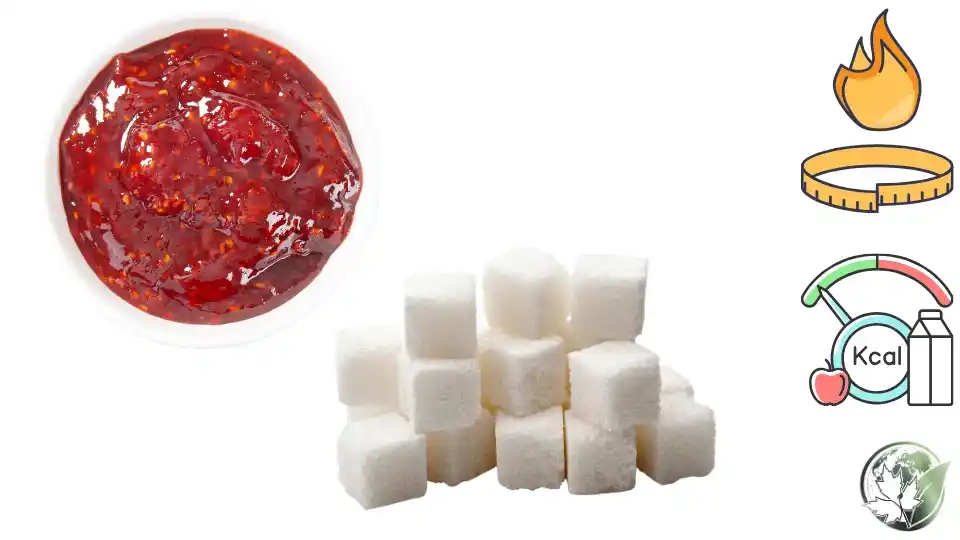
A slice of toast with a thick layer of jam has the sugar of about four sugar cubes
How Do Different Kinds of Jam Compare in Calories?
Jam comes in many styles. The calories per tablespoon depend on the amount of added sugar and water.
| Type | Calories per tbsp | Sugar per tbsp | Notes |
|---|---|---|---|
| Regular jam | 49 kcal | 11.2 g | 55 to 65 percent sugar |
| Preserves (large fruit pieces) | 50 kcal | 11.5 g | Same sugar |
| Jelly (fruit juice) | 51 kcal | 12.5 g | No fiber |
| Marmalade | 49 kcal | 12 g | Citrus peel |
| Reduced-sugar jam | 30 kcal | 7 g | 30 percent less sugar |
| Fruit spread, no added sugar | 40 kcal | 8 g | Sweetened with fruit juice |
| Low-calorie jam, sweetener | 10 kcal | 1.5 g | Sugar alcohols, sucralose |
| Homemade 1:1 jam | 50 kcal | 11.5 g | Equal fruit and sugar |
| Homemade low-sugar jam | 30 kcal | 6.5 g | More fruit, chia or pectin |
| Chia seed jam | 25 kcal | 4 g | Fruit, chia, a little honey |
The jam labeled "no added sugar" is not always much lower in calories, since fruit juice concentrate is itself a sweetener. Check the nutrition label.
How Many Calories Are in Persian Morabba and Other Fruit Preserves?
Iranian morabba is fruit cooked slowly in sugar syrup. Familiar types include carrot, orange peel, sour cherry, quince, apple, fig, rose petal and eggplant morabba. Unlike jam, the fruit stays whole or in big pieces and floats in a thick syrup, which means you eat both fruit and syrup. The calories depend on how much syrup you take.
| Preserve | Serving | Calories | Sugar |
|---|---|---|---|
| Carrot morabba (morabba havij) | 2 tbsp (36 g) | 100 kcal | 24 g |
| Sour cherry preserve | 2 tbsp | 105 kcal | 25 g |
| Orange peel morabba | 2 tbsp | 110 kcal | 26 g |
| Quince morabba (behe) | 2 tbsp | 100 kcal | 24 g |
| Rose petal jam (gol-e-sorkh) | 1 tbsp | 55 kcal | 13 g |
| Apple morabba | 2 tbsp | 95 kcal | 23 g |
| Fig preserve | 2 tbsp | 105 kcal | 25 g |
| Ginger preserve | 1 tbsp | 50 kcal | 12 g |
A teaspoon of morabba syrup has about 17 calories. Many people eat morabba with tea instead of sugar cubes, nibbling a piece of fruit with a sip. If you do this, you swap a cube at 16 calories with a piece of preserve at 25 to 50 calories, which is more.
Is Jam Healthier Than Sugar?
Slightly, but not much. Jam supplies some fruit nutrients, mostly fiber and polyphenols, in small amounts. A tablespoon has about 0.2 grams of fiber and little vitamin C. It is still an added sugar. Health agencies suggest limiting added sugars to under 10 percent of daily calories, and a typical breakfast with two tablespoons of jam uses 22 grams of sugar, almost the whole allowance of 25 grams that is recommended for the ideal limit.
A better strategy is to make jam a flavoring and not a base. A teaspoon on yogurt, or a thin layer on toast, gives taste with a quarter of the sugar. Fresh fruit gives more nutrition for the same sweetness.
Does Jam Raise Blood Sugar?
Jam has a glycemic index of about 51 to 65 depending on the fruit and the amount of sugar, and a tablespoon has a glycemic load of about 6. Eaten on white bread, the combined effect is higher, since refined flour also raises blood sugar. For people with diabetes, jam counts as about 12 grams of carbohydrate per tablespoon. Low-sugar jams and fresh fruit are easier on blood sugar.
How Can You Cut Calories at a Jam Breakfast?
Jam is often part of a sweet breakfast with bread, butter, cream or pastry, and the total can reach several hundred calories.
| Breakfast | Calories | Sugar |
|---|---|---|
| 2 slices white bread, 2 tbsp jam, 1 tbsp butter | 405 kcal | 28 g |
| 2 slices bread, 2 tbsp jam | 300 kcal | 28 g |
| 2 slices whole grain bread, 1 tbsp jam | 220 kcal | 15 g |
| 1 slice bread, 1 tsp jam, 1 boiled egg | 190 kcal | 6 g |
| Plain yogurt (150 g), 1 tsp jam | 110 kcal | 9 g |
| Plain yogurt with fresh strawberries | 100 kcal | 10 g |
| Croissant with 1 tbsp jam | 320 kcal | 18 g |
| Pancakes (2) with 2 tbsp jam | 330 kcal | 32 g |
Using one tablespoon in place of two on toast saves about 49 calories and 11 grams of sugar. Switching to a reduced-sugar jam saves another 20 calories per tablespoon.
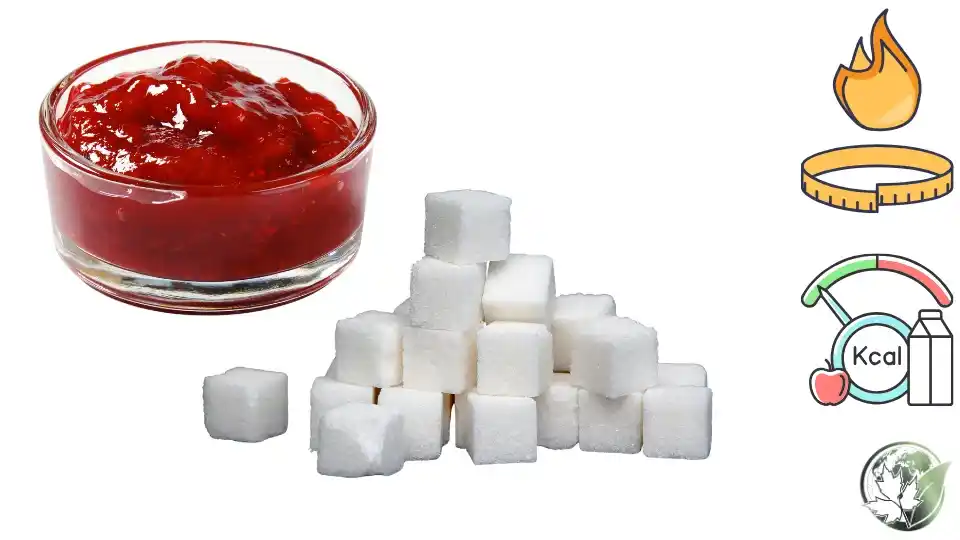
A teaspoon of jam on yogurt gives sweetness for only about 17 calories
How to Choose a Lower Sugar Jam
**Read the ingredients.** Fruit should come first, not sugar or glucose syrup.
**Compare sugar per 100 grams.** Regular jam is about 60 grams, reduced-sugar is 40 grams or less.
**Look for fruit content.** Higher fruit percentage usually means less sugar.
**Avoid high fructose corn syrup.**
**Consider chia or fruit spreads.** They use fruit and seeds for gelling.
**Check sugar-free types.** They may contain sugar alcohols that can cause digestive upset.
How to Store Jam
Unopened jam keeps for one to two years in a cool, dark cupboard. After opening, regular jam keeps for about a month in the refrigerator, and reduced-sugar jams for two to three weeks. Always use a clean spoon, since moisture and crumbs speed up mold. If mold appears, discard the whole jar, since the mold can spread through the soft jam.
Store opened jam in the refrigerator and use a clean spoon each time
How to Count Jam Calories Accurately
Use level spoons: 17 calories per teaspoon and 49 per tablespoon. For toast, estimate about 25 grams or 68 calories for a thick spread. For packaged jam, use the label per 100 grams. For homemade jam, add the calories of the fruit and sugar and divide by the final weight.
How Is Jam Made and Why Does It Contain So Much Sugar?
Making jam is a matter of chemistry. Fruit contains pectin, a fiber that forms a gel when it is heated with sugar and acid. Sugar draws water out of the fruit and binds it, which allows the pectin chains to link up and set into the soft solid that spreads. Acid, usually from the fruit or added lemon juice, helps the pectin work. In a traditional recipe, equal weights of fruit and sugar are simmered until the mixture reaches about 105 degrees Celsius and passes a set test.
The sugar is not only for sweetness. At concentrations of about 60 percent or more, it prevents microorganisms from growing, which is why an unopened jar can sit on a shelf for a year. If you reduce the sugar, you must find another way to preserve and to set the jam. Low-sugar jams use added pectin, calcium or other gelling agents, and are usually stored in the refrigerator or frozen, and their shelf life after opening is shorter.
This is why homemade jam with half the sugar tastes fresher and fruitier but needs more care. A 1:1 jam of strawberries and sugar has about 50 calories per tablespoon, while a version with 1 part sugar to 2 parts fruit has about 30. Both are better than a store jam with glucose syrup and extra sugar, and both are good ways to control what goes in the jar.
How Do Jam, Honey and Sugar Cubes Compare as Sweeteners for Tea and Breakfast?
In many households, jam, honey and sugar are used interchangeably to sweeten tea, yogurt, porridge or bread. The table lists the sugar and calories for a typical amount of each, so you can compare them in the same units.
| Sweetener | Typical amount | Calories | Sugar | Sugar cubes |
|---|---|---|---|---|
| Sugar cube | 2 cubes | 32 kcal | 8 g | 2 |
| Honey | 1 tsp | 21 kcal | 5.7 g | 1.4 |
| Jam | 1 tsp | 17 kcal | 3.7 g | 0.9 |
| Jam | 1 tbsp | 49 kcal | 11.2 g | 2.8 |
| Date syrup | 1 tsp | 19 kcal | 4.5 g | 1.1 |
| Maple syrup | 1 tsp | 18 kcal | 4.7 g | 1.2 |
| Morabba syrup | 1 tsp | 17 kcal | 4.0 g | 1.0 |
| Stevia | 1 packet | 0 kcal | 0 g | 0 |
All of these natural sweeteners are close to each other in calories and sugar per teaspoon. Jam has slightly less sugar per teaspoon because it contains fruit and water. What differs is how they are used. A teaspoon of jam stirred into tea gives a fruity taste but is rarely eaten that way, while jam on bread or yogurt is often eaten in much larger amounts. Matching the portion to the use is the best way to control calories.
Who Should Limit Jam?
Jam is fine for most people in small amounts. Those who should be particularly careful are people with diabetes or prediabetes, who need to count the carbohydrate, people who are trying to lose weight, children, whose added sugar limits are lower than those of adults, and people prone to dental cavities, since jam is sticky and sugary. Anyone who is allergic to a specific fruit, such as strawberries or kiwi, should check labels, since jams made from mixed fruit may contain traces of them.
A practical limit is about one tablespoon a day, which uses about 11 grams of sugar, less than half of the 25 grams suggested as an upper limit for added sugar. If you also eat sweet drinks or desserts, you may want to use even less. And remember that jam in pastries, biscuits and yogurts also counts.
What Are Easy Ways to Make a Lower Calorie Homemade Jam?
Homemade jam does not need to be a sugar bomb. With a few changes, you can make a spread that tastes of fruit and has about half the sugar.
First, start with ripe, flavorful fruit. Sweeter, riper fruit needs less added sugar to taste good. Second, reduce the sugar gradually, from equal weights to about one third sugar by weight of fruit. Third, use a gelling aid. Chia seeds absorb water and set a jam in minutes without any sugar, so a cup of mashed berries with two tablespoons of chia and a teaspoon of honey makes about eight tablespoons of jam with roughly 25 calories each. Fourth, add lemon juice, which provides acid and lets the pectin in the fruit work well. Fifth, cook quickly in a wide pan to keep flavor and color, and store the finished jam in the refrigerator or freezer.
| Homemade jam | Fruit | Sugar | Calories per tbsp | Storage |
|---|---|---|---|---|
| Traditional 1:1 | 500 g | 500 g | 50 kcal | 1 year sealed |
| Reduced sugar | 500 g | 250 g | 36 kcal | 3 weeks refrigerated |
| Low sugar with pectin | 500 g | 150 g | 28 kcal | 3 weeks refrigerated |
| Chia jam | 250 g | 1 tbsp honey | 25 kcal | 2 weeks refrigerated |
| Fruit only (date sweetened) | 500 g | 100 g dates | 32 kcal | 2 weeks refrigerated |
A homemade low sugar jam with a thin spread on toast has about 20 calories, compared with 68 for a store jam on the same slice. Over a year, a daily slice saves about 17,500 calories.
How Do Jam Calories Compare With Other Breakfast Spreads?
Jam is one of the lower calorie spreads on a per-tablespoon basis, because it has no fat. Spreads with fat have more calories, but also more satiety. The table compares common choices per level tablespoon.
| Spread | Calories | Sugar | Fat | Protein |
|---|---|---|---|---|
| Butter | 102 kcal | 0 g | 11.5 g | 0.1 g |
| Peanut butter | 94 kcal | 1.5 g | 8 g | 3.6 g |
| Chocolate hazelnut spread | 95 kcal | 10 g | 5.5 g | 1 g |
| Honey | 64 kcal | 17 g | 0 g | 0.1 g |
| Jam | 49 kcal | 11 g | 0 g | 0.1 g |
| Cream cheese | 50 kcal | 0.5 g | 5 g | 1 g |
| Cream (qeymar) | 90 kcal | 0.5 g | 9.5 g | 0.5 g |
| Tahini | 89 kcal | 0.1 g | 8 g | 2.6 g |
| Date syrup | 58 kcal | 13 g | 0 g | 0.3 g |
| Hummus | 25 kcal | 0 g | 1.5 g | 1 g |
Jam is lighter than butter, nut butters and cream, but it provides no protein or fat to keep you full. A slice of bread with a thin layer of peanut butter and a teaspoon of jam gives about 200 calories and more satisfaction than a slice with two tablespoons of jam at 170 calories.
Why Does Jam Seem Lighter Than It Really Is?
Jam looks like fruit and is sold with pictures of berries, so many people regard it as a mostly natural food. The nutrition label tells a different story. Roughly two thirds of a regular jam is sugar, which is comparable to the sugar content of some candies, and the fruit is the minor ingredient. A tablespoon spread thinly seems like a small amount, but it is easy to double or triple it without noticing, particularly with sticky, easy-to-spread jam on soft bread.
Seeing the portion in sugar cubes helps. A teaspoon is one cube, a tablespoon is nearly three, and two generous tablespoons on a slice or two of toast are about six. If you would not put six cubes of sugar on your toast, you may want to reconsider how much jam you use. Switching to a measured teaspoon, using a thin layer, or choosing a lower sugar version are the simplest ways to keep the taste and cut the sugar by half or more.
Key Takeaways: Jam Calories vs Sugar Cube
Jam has about 17 calories per teaspoon and 49 per tablespoon, almost the same as one and three sugar cubes. It is mostly sugar with a little fruit, so keep portions to a teaspoon or a thin layer. Reduced-sugar jam, fresh fruit and chia jam are lighter choices.
Frequently Asked Questions
6 questions answered
How many calories are in a tablespoon of jam?
About 49 calories.
How many calories are in a teaspoon of jam?
About 17 calories.
How many sugar cubes are in a tablespoon of jam?
About three.
Does jam have fewer calories than sugar?
Per gram yes, about 270 against 387 per 100 grams, but per spoon it is similar.
Is reduced-sugar jam healthier?
It has fewer calories, but check the label for sugar substitutes.
How many calories are in morabba?
About 100 for two tablespoons.