
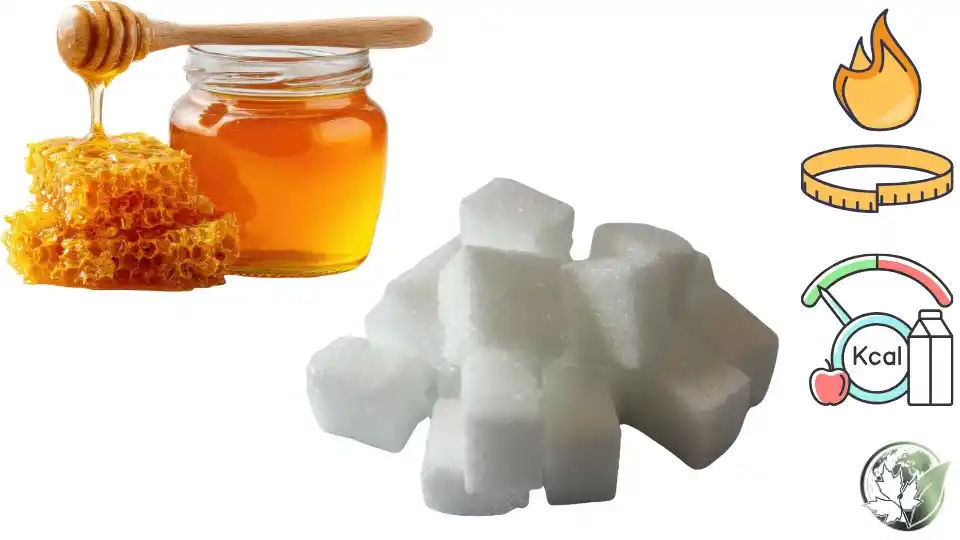
How Many Calories Are in Honey? The Quick Answer
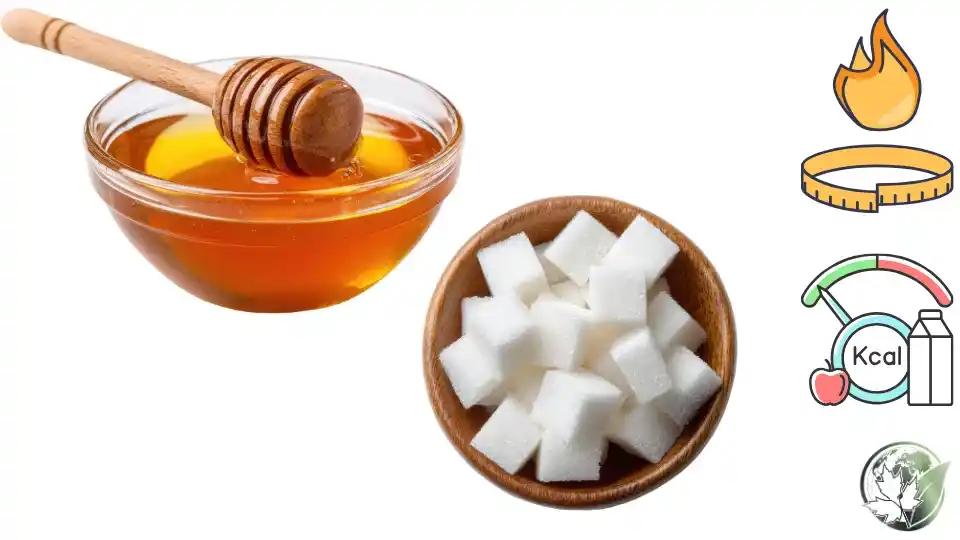
Honey has about 304 calories per 100 grams. A level teaspoon (7 g) has about 21 calories, a level tablespoon (21 g) has about 64, a cup (340 g) has about 1,030 and a single drizzle from a squeeze bottle of about 3 grams has about 9. A sugar cube of 4 grams has about 16 calories, and a level teaspoon of granulated sugar (4 g) has about 16 calories as well. So a teaspoon of honey has about 30 percent more calories than a teaspoon of sugar, and about 1.3 times the calories of a sugar cube.
The reason is density. Honey is about 17 percent water and 82 percent sugar, so each gram has fewer calories than sugar, 3.04 against 3.87. But a spoon of honey holds nearly twice the weight of a spoon of sugar, because honey is a thick liquid and sugar is a loose crystal. As a result, a spoonful of honey has more calories than a spoonful of sugar, even though honey is lighter per gram. That is the surprise for many people who switch to honey to cut calories.
This guide shows honey calories per spoon, per cup, per gram and per serving, compares honey with sugar cubes and other sweeteners, and explains how sweetness, glycemic index and nutrients differ. It covers honey in drinks, in cooking and for children, and it dispels common diet myths. There are three comparison tables and an FAQ.
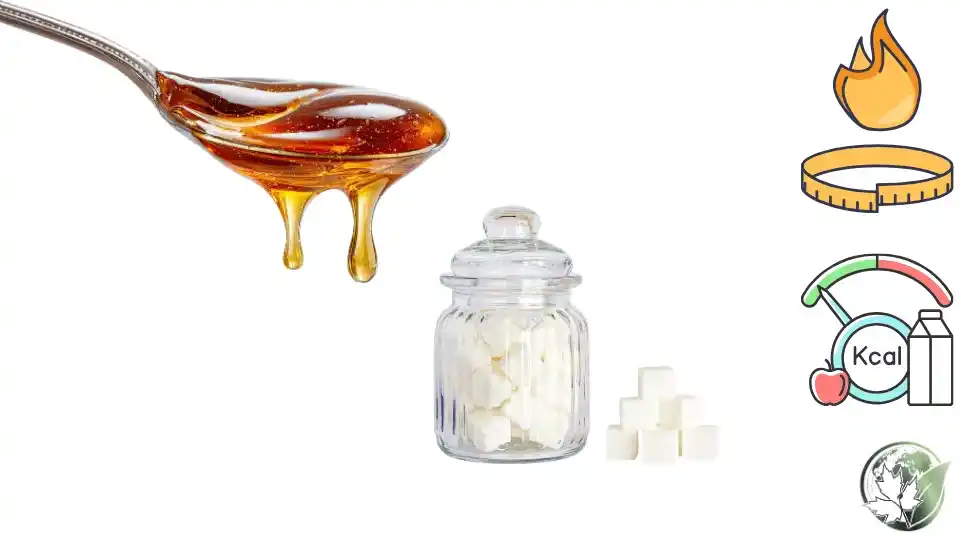
A level teaspoon of honey has about 21 calories
How Many Calories Are in a Teaspoon, Tablespoon and Cup of Honey?
| Portion | Weight | Calories | Sugar | Carbohydrate |
|---|---|---|---|---|
| 1 drizzle | 3 g | 9 kcal | 2.5 g | 2.5 g |
| 1/2 teaspoon | 3.5 g | 11 kcal | 2.9 g | 2.9 g |
| 1 teaspoon | 7 g | 21 kcal | 5.7 g | 5.8 g |
| 1 dessert spoon | 14 g | 43 kcal | 11.5 g | 11.5 g |
| 1 tablespoon | 21 g | 64 kcal | 17.2 g | 17.3 g |
| 1/4 cup | 85 g | 258 kcal | 69.7 g | 70 g |
| 1/2 cup | 170 g | 517 kcal | 139 g | 140 g |
| 1 cup | 340 g | 1,034 kcal | 279 g | 280 g |
| 100 g | 100 g | 304 kcal | 82 g | 82.4 g |
| 1 squeeze packet | 14 g | 43 kcal | 11.5 g | 11.5 g |
If you eat honey with a heaped spoon, the weight rises by 40 to 50 percent, and the calories do too. A heaped tablespoon of honey can reach 90 calories.
Honey vs Sugar Cube: Calories and Sugar Compared
| Sweetener | Portion | Weight | Calories | Sugar |
|---|---|---|---|---|
| Sugar cube | 1 cube | 4 g | 16 kcal | 4 g |
| Sugar cubes | 2 cubes | 8 g | 32 kcal | 8 g |
| Sugar, granulated | 1 tsp | 4 g | 16 kcal | 4 g |
| Sugar, granulated | 1 tbsp | 12.6 g | 49 kcal | 12.6 g |
| Honey | 1 tsp | 7 g | 21 kcal | 5.7 g |
| Honey | 1 tbsp | 21 g | 64 kcal | 17.2 g |
| Brown sugar | 1 tsp | 4.6 g | 17 kcal | 4.5 g |
| Maple syrup | 1 tbsp | 20 g | 52 kcal | 12.1 g |
| Agave syrup | 1 tbsp | 21 g | 64 kcal | 16 g |
One level teaspoon of honey equals 1.3 sugar cubes in calories and 1.4 in sugar. One tablespoon of honey equals about four sugar cubes in both calories and sugar. Honey is not a calorie-free alternative to sugar.
Is Honey Sweeter Than Sugar?
Yes. Honey contains about 38 percent fructose and 31 percent glucose, and fructose tastes about 1.2 to 1.8 times sweeter than sucrose at the same concentration. Because of this, a smaller amount of honey can match the sweetness of sugar. Most cooking guides suggest using about 3/4 cup of honey for 1 cup of sugar, and reducing other liquids by a little.
| To match the sweetness of | Use roughly | Calories of sugar | Calories of honey |
|---|---|---|---|
| 1 tsp sugar | 3/4 tsp honey | 16 kcal | 16 kcal |
| 2 sugar cubes (8 g) | 1/2 tsp to 3/4 tsp honey | 32 kcal | 11 to 16 kcal |
| 1 tbsp sugar | 2 1/4 tsp honey | 49 kcal | 48 kcal |
| 1 cup sugar (200 g) | 3/4 cup honey (255 g) | 774 kcal | 775 kcal |
| 1/4 cup sugar | 3 tbsp honey | 194 kcal | 193 kcal |
When both sweeteners are adjusted to the same sweetness, they come out almost even in calories. Honey saves calories only if you really use less of it, which sweetness makes possible, but is not guaranteed by the switch.
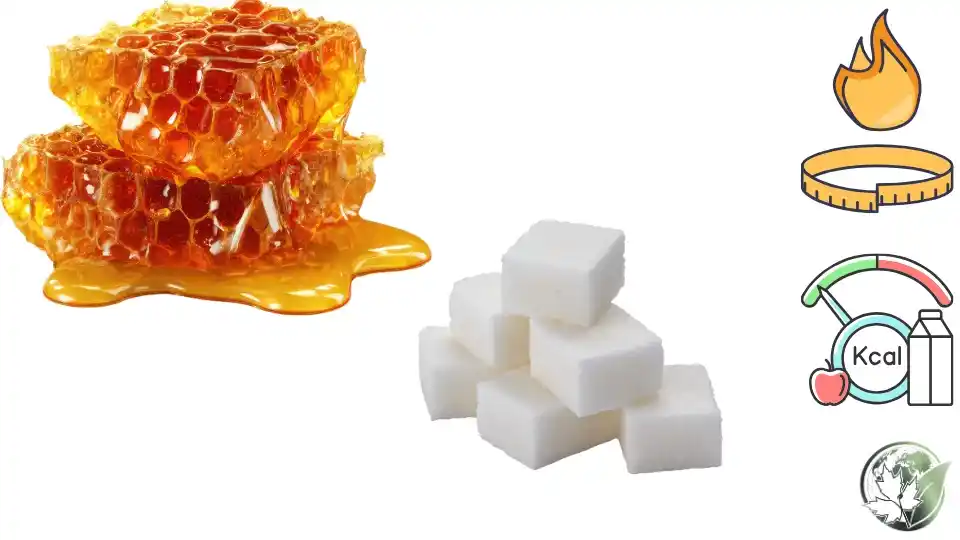
Honey is sweeter than sugar, so you can use a little less in tea
Honey vs Sugar: Nutrition Compared
| Per 100 g | Honey | White sugar |
|---|---|---|
| Calories | 304 kcal | 387 kcal |
| Water | 17.1 g | 0 g |
| Sugar | 82.1 g | 100 g |
| Fructose | 40.9 g | 0 g |
| Glucose | 35.8 g | 0 g |
| Protein | 0.3 g | 0 g |
| Potassium | 52 mg | 2 mg |
| Calcium | 6 mg | 1 mg |
| Iron | 0.4 mg | 0.1 mg |
| Zinc | 0.2 mg | 0.1 mg |
| Antioxidants | flavonoids, phenolic acids | none |
| Per 100 calories | Honey | White sugar |
|---|---|---|
| Weight | 33 g | 26 g |
| Sugar | 27 g | 26 g |
| Potassium | 17 mg | 0.5 mg |
| Volume | 1.6 tbsp | 2 tbsp |
For the same calories, honey has about the same sugar as table sugar and a few more minerals. The trace minerals in honey are too small to make a difference to nutrition, since you would need to eat hundreds of grams to meet daily needs. Its antioxidants are more notable in dark honeys such as buckwheat and forest honey than in light ones.
Does Honey Raise Blood Sugar Less Than Sugar?
The glycemic index of honey ranges from about 35 to 70 depending on the type, with an average around 58. Table sugar is about 65. Honeys that are high in fructose, such as acacia, have a lower index, while honeys high in glucose, which crystallize quickly, have a higher index. For most honeys, the difference from sugar is small.
| Sweetener | Glycemic index | Glycemic load per tbsp |
|---|---|---|
| Acacia honey | 35 | 6 |
| Clover honey | 55 | 9 |
| Typical honey | 58 | 10 |
| Table sugar | 65 | 8 |
| Maple syrup | 54 | 7 |
| Agave syrup | 15 | 2 |
| Date syrup | 50 | 9 |
Honey behaves like sugar in the body. People with diabetes should count it as carbohydrate: a teaspoon has about 6 grams and a tablespoon about 17 grams. Some studies suggest small benefits for blood lipids from honey compared with sugar, but the effect is modest and does not justify eating more.
How Many Calories Does Honey Add to Drinks and Foods?
| Use | Amount of honey | Calories added |
|---|---|---|
| Cup of tea | 1 tsp | 21 kcal |
| Warm lemon water | 1 tsp | 21 kcal |
| Honey and milk | 1 tbsp | 64 kcal |
| Bowl of oatmeal | 1 tbsp | 64 kcal |
| Slice of toast | 1 tbsp | 64 kcal |
| Plain yogurt | 1 tbsp | 64 kcal |
| Salad dressing | 1 tsp | 21 kcal |
| Peanut butter sandwich | 1 tbsp | 64 kcal |
| Pancakes | 2 tbsp | 129 kcal |
| Smoothie | 1 tbsp | 64 kcal |
Used a few times a day, these amounts quickly add up. Three tablespoons of honey would add 192 calories, about the same as a small candy bar.
Does Honey Water or Honey and Lemon Help With Weight Loss?
Warm water with honey and lemon is a popular morning drink in many cultures and is often claimed to burn fat. There is no good evidence that it does. The drink contains about 25 calories for a teaspoon of honey in a glass of water with lemon, and it can replace a sugary drink, which is a benefit, but honey does not boost metabolism or dissolve fat.
The truth is that honey is an added sugar, and a drink with two tablespoons a day adds 128 calories, which is around 47,000 a year. If you enjoy honey water, use a half teaspoon, not a tablespoon, and consider it as a flavored drink rather than a weight loss tool.
Is Honey Healthier Than Sugar?
Honey has some real advantages over sugar. It contains antioxidants, enzymes and trace minerals, and it has been used to soothe coughs. In a review of studies, honey was found to be at least as effective as common cough medicines for children's night coughs, though only in children over one year old. Honey also has antibacterial properties and is used in some medical wound dressings.
As a food, though, it is still sugar. Health agencies count honey among free sugars, and advise limiting free sugars to under 10 percent of daily calories, and ideally under 5 percent. Honey should not be given to babies under 12 months, because of the risk of infant botulism.
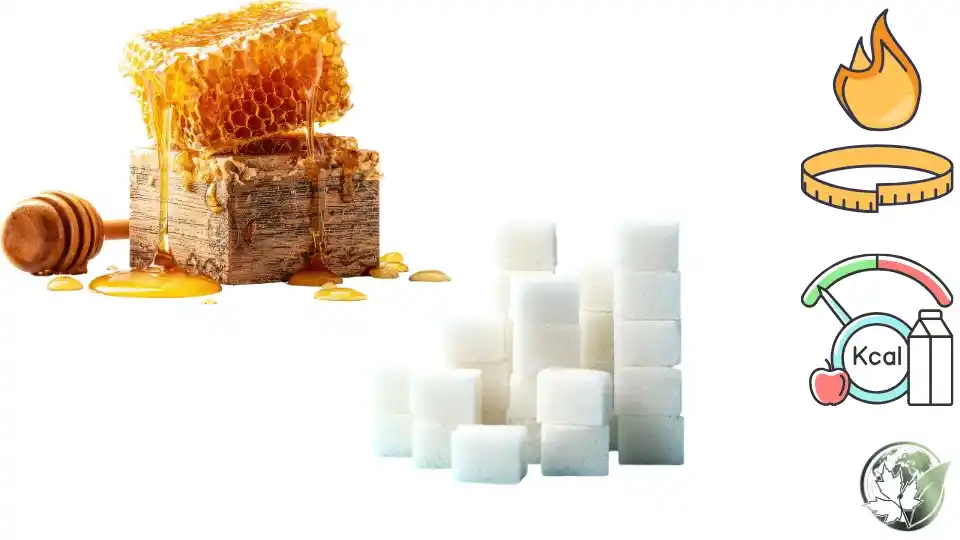
Use a thin drizzle of honey on yogurt instead of a spoonful to keep the calories down
Does the Type of Honey Change the Calories?
All honeys fall within a narrow range of 300 to 310 calories per 100 grams. The sugar content and water content vary slightly between types, but the differences are small compared with the effect of spoon size.
| Honey type | Calories per 100 g | Per teaspoon | Sugar per 100 g | Notes |
|---|---|---|---|---|
| Acacia | 304 kcal | 21 kcal | 81 g | Light, stays liquid |
| Clover | 304 kcal | 21 kcal | 82 g | Mild, common |
| Orange blossom | 304 kcal | 21 kcal | 82 g | Citrus aroma |
| Wildflower | 304 kcal | 21 kcal | 82 g | Variable |
| Thyme | 306 kcal | 21 kcal | 82 g | Strong, herbal |
| Buckwheat | 300 kcal | 21 kcal | 79 g | Dark, strong flavor |
| Manuka | 304 kcal | 21 kcal | 82 g | Premium, antibacterial claims |
| Creamed honey | 304 kcal | 21 kcal | 82 g | Spreadable, finely crystallized |
| Honeycomb | 304 kcal | 21 kcal | 82 g | Wax is edible but not digested |
Premium honeys such as manuka cost many times more than regular honey, but their calories are the same. Their value is in flavor and in specific compounds, not in calories.
How Can You Reduce Sugar Cubes and Honey in Your Day?
Both honey and sugar are easy to cut back slowly. Here are some practical steps.
**Measure with a level spoon.** Use a measuring teaspoon, not a soup spoon.
**Drizzle, do not scoop.** Warm honey flows more easily and covers more food with less.
**Use sweetness from fruit.** Add banana or berries to oatmeal instead of honey.
**Add spice.** Cinnamon and vanilla make foods taste sweeter without sugar.
**Reduce gradually.** Cut 25 percent every week and your taste will adjust.
**Pair with protein.** Honey on Greek yogurt slows the sugar rise.
How to Store Honey
Keep honey in a sealed glass or food-grade plastic jar in a cool, dry place away from direct sunlight. It does not spoil, since its low water content and acidity prevent microbial growth, and jars of honey have been found intact in ancient tombs. Crystallization is natural and does not mean spoilage. To liquefy, warm the jar in water at about 40 degrees Celsius. Do not refrigerate, because the cold speeds crystallization.
Honey does not spoil, but crystallization is natural, and gentle warming makes it liquid again
How to Count Honey Calories Accurately
Weigh honey whenever possible and multiply by 3.04. When using spoons, level them: 21 calories for a teaspoon and 64 for a tablespoon. For honey in recipes, divide the total by the servings. And remember that squeezing honey from a bottle is hard to measure, so squeeze onto a spoon first.
How Do You Substitute Honey for Sugar in Cooking and Baking?
Because honey is a liquid, sweeter than sugar and slightly acidic, it cannot be swapped for sugar one-to-one without adjusting the recipe. A common guide for baking is to use about 3/4 of the amount of honey, reduce the other liquid by about a quarter cup for each cup of honey, add about 1/4 teaspoon of baking soda per cup of honey to neutralize the acid, and lower the oven temperature by about 15 degrees Celsius, because honey browns faster than sugar.
Honey also keeps baked goods moist, which can be an advantage for cakes and breads, and gives a distinctive flavor, which can be a disadvantage in delicate desserts. In calories, the result is close to the sugar version, so do not expect big savings. For a recipe that calls for a cup of sugar, three quarters of a cup of honey brings about 775 calories, compared with 774 for the sugar. If you want to reduce calories, reduce the total sweetener by a quarter or a third, which most recipes tolerate well, and add spices such as cinnamon and vanilla to compensate.
| Recipe change | Sugar version | Honey version | Notes |
|---|---|---|---|
| Muffins, 12 | 3/4 cup sugar, 580 kcal | 1/2 cup honey, 520 kcal | Moister crumb |
| Granola, 1 batch | 1/2 cup sugar, 387 kcal | 1/3 cup honey, 345 kcal | Binds the clusters |
| Salad dressing, 4 servings | 1 tbsp sugar, 49 kcal | 2 tsp honey, 43 kcal | Emulsifies slightly |
| Marinade | 2 tbsp sugar, 98 kcal | 4 tsp honey, 85 kcal | Caramelizes faster |
| Tea, 4 cups | 8 cubes, 128 kcal | 4 tsp honey, 85 kcal | Savings only if reduced |
How Can You Tell Real Honey From Fake Honey?
Honey is among the foods most often adulterated, usually by adding cheap syrups made from corn, rice or sugar cane. Adulterated honey has about the same calories as pure honey, since syrups are also sugar, but it lacks the antioxidants and other compounds that justify the higher price. A few clues can help. Real honey tends to crystallize with time, though some types, such as acacia, remain liquid for years. Very low prices, a perfectly clear and runny product that never thickens, or a flavor that is flat and one-dimensional can all be warning signs. Home tests that use a spoon, flame, water glass or thumb are not reliable.
The safest approach is to buy from a beekeeper or brand you trust, check that the label gives the origin and the floral source, and look for laboratory tests for moisture, sugar profile and HMF. Real honey should have moisture below 20 percent and a pleasant natural smell. Remember also that "raw" means unheated and unfiltered, which retains pollen and enzymes, but does not change the calories.
Is Honey Good for a Sore Throat and Cough?
Honey has a long record of use for sore throats and coughs, and studies support a modest benefit. A teaspoon to a tablespoon of honey before bed has been shown to reduce the frequency and severity of night coughs in children older than one year, and to be at least as helpful as some over-the-counter cough products. Its thick texture coats the throat, and it has mild antibacterial and anti-inflammatory properties. For adults, a spoonful of honey in warm tea with lemon is a comforting remedy.
This is a good example of where a small amount of honey is clearly worth its calories. A tablespoon is 64 calories, which is negligible against the relief it gives. The caution is that honey must never be given to infants under 12 months, and that persistent cough, fever or breathing difficulty needs medical attention rather than a home remedy.
How Should Athletes Think About Honey and Sugar?
For people who exercise for long periods, quick carbohydrate is useful, and both honey and sugar work. A tablespoon of honey provides about 17 grams of carbohydrate in a convenient, easily digested form, and some athletes prefer it to commercial gels because it is natural and cheap. Studies comparing honey with glucose or sports gels during endurance exercise have found similar performance. The mix of glucose and fructose in honey allows more total carbohydrate to be absorbed per hour than glucose alone.
For recovery, a spoon of honey on toast or in yogurt with some protein is an easy snack. Outside of exercise, athletes have the same need to watch sugar as anyone else. A lean diet with whole foods supplies most carbohydrate needs, and honey fits as an energy booster before, during or after a hard session.
How Much Honey Is a Reasonable Daily Amount?
Health guidelines for free sugars suggest keeping them under 10 percent of daily calories, which is about 50 grams or 200 calories for a 2,000 calorie diet, and lower is better. All sources count together: honey, sugar, juice, sweet drinks, desserts and sauces. A level tablespoon of honey gives 17 grams, so one or two teaspoons a day, with 6 to 11 grams, fit comfortably inside the limit for most people. If you also drink sweet tea or soft drinks, honey may need to come out of the plan.
A useful habit is to keep honey for flavor in places where you can really taste it, such as on yogurt, in tea or on toast with butter, and to use less in dishes where the taste is lost. When you treat honey as a seasoning instead of a staple, you naturally use less.
How Is Honey Used in Traditional Breakfasts and Does It Change the Calories?
In Iran and many neighboring countries, honey is a classic breakfast food, often eaten with bread, butter, cream, cheese or walnuts. The combination is delicious, and it is also dense in calories, because it pairs honey at 64 calories per tablespoon with butter at 102 per tablespoon and bread at about 80 per slice. A typical breakfast of two slices of bread, a tablespoon of butter and a tablespoon of honey has about 330 calories, and with a tablespoon of cream added, about 380.
That is not a problem for an active person who needs energy, and the meal provides carbohydrate, fat and a little protein. If you want a lighter version, use a thin scrape of butter, a teaspoon of honey and add a boiled egg or a slice of cheese for protein. Or use plain yogurt, walnuts and a drizzle of honey for about 220 calories with more protein. The sweetness from the honey is the same, but the total is lower.
Key Takeaways: Honey Calories vs Sugar Cube
Honey has about 21 calories per teaspoon and 64 per tablespoon, against 16 per sugar cube. It has fewer calories per gram than sugar but more per spoon, and it is sweeter, so a smaller amount may do. It contains trace nutrients, but it is still an added sugar and should be used in measured amounts.
Frequently Asked Questions
7 questions answered
How many calories are in a teaspoon of honey?
About 21 calories.
How many calories are in a tablespoon of honey?
About 64 calories.
Does honey have fewer calories than sugar?
Per gram yes, but per spoon it has more, since honey is denser.
How many sugar cubes equal a tablespoon of honey?
About four.
Is honey better for diabetics?
Not really. Count it as carbohydrate like sugar.
Does honey help you lose weight?
No, it is an added sugar and has no fat-burning effect.
Can babies eat honey?
No, not under 12 months.




