How Many Calories Are in Hazelnuts? The Quick Answer
Hazelnuts have about 628 calories per 100 grams of shelled kernels. An ounce (28 g), which is about 21 kernels, has about 178 calories, a single hazelnut of about 1.3 grams has about 8.5 calories, a tablespoon of chopped hazelnuts (about 9 g) has about 57 calories, a quarter cup of whole kernels (about 34 g) has about 213 calories and a cup of whole kernels (about 135 g) has about 850 calories. Walnuts have about 654 calories per 100 grams, 185 per ounce (14 halves), about 13 per half and about 765 per cup of halves (117 g).
So hazelnuts have about 4 percent fewer calories than walnuts, per gram, and about 4 percent fewer per ounce. The difference is small. What differs more is how many pieces you get: an ounce is about 21 hazelnuts but only 14 walnut halves, and the fat is very different. Hazelnuts are rich in monounsaturated fat, like olive oil, while walnuts are rich in polyunsaturated fat, including the plant omega-3 fat alpha-linolenic acid.
This guide lists hazelnut calories per nut, ounce, cup and 100 grams, in the shell and shelled, raw and roasted, and in spreads and oil. It compares hazelnuts with walnuts on fat type, protein, fiber and minerals, and covers weight control, heart health, blood sugar, allergies and how to buy and store them. You will find three comparison tables and an FAQ.
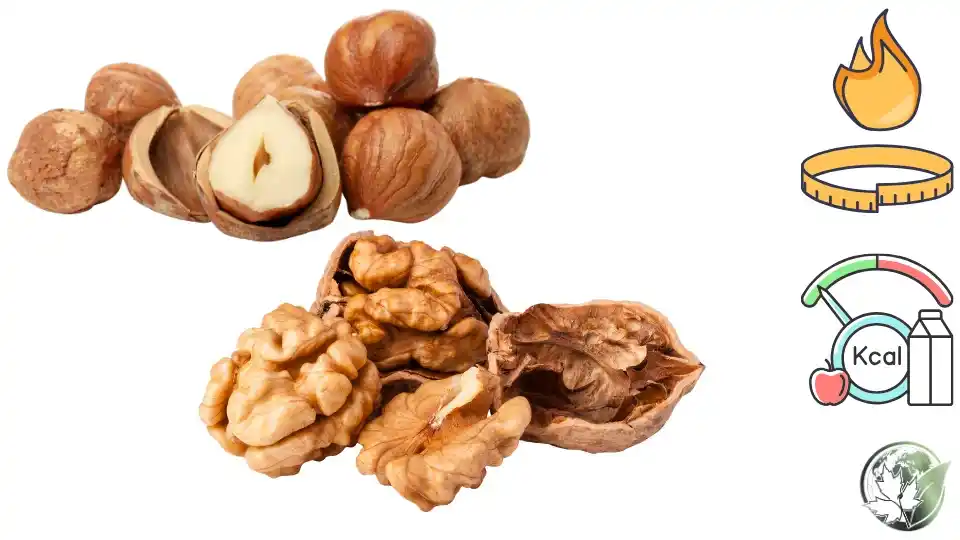
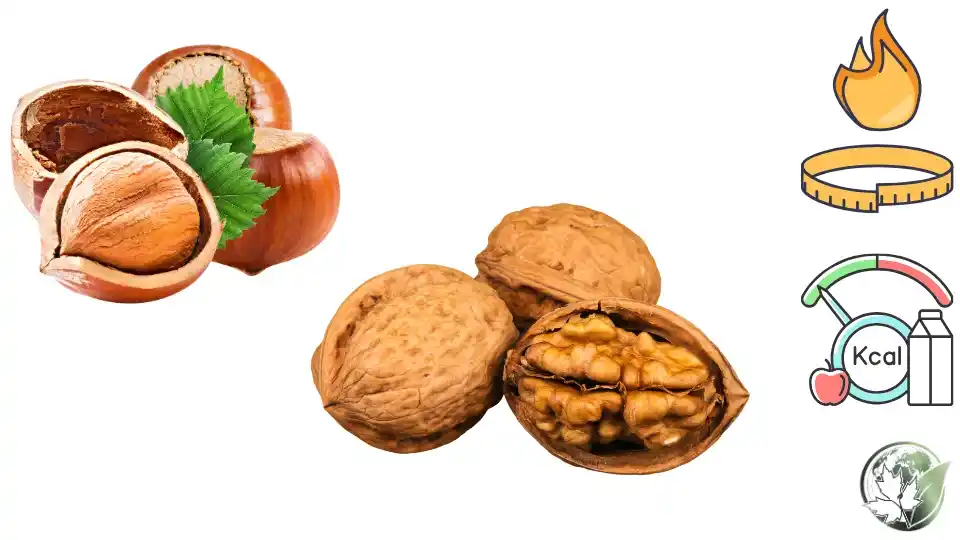
A one ounce serving of hazelnuts, about 21 nuts, has about 178 calories
How Many Calories Are in One Hazelnut, One Ounce and One Cup?
Hazelnuts vary in size, but a typical kernel weighs 1.2 to 1.4 grams. The values below use 1.33 grams per kernel.
| Portion | Weight | Calories | Fat | Protein | Fiber |
|---|---|---|---|---|---|
| 1 hazelnut | 1.33 g | 8.5 kcal | 0.8 g | 0.2 g | 0.13 g |
| 5 hazelnuts | 6.7 g | 42 kcal | 4.1 g | 1.0 g | 0.6 g |
| 10 hazelnuts | 13.3 g | 84 kcal | 8.1 g | 2.0 g | 1.3 g |
| 1 tablespoon chopped | 9 g | 57 kcal | 5.5 g | 1.4 g | 0.9 g |
| 1 oz (about 21 nuts) | 28 g | 178 kcal | 17.2 g | 4.2 g | 2.7 g |
| 1/4 cup whole | 34 g | 213 kcal | 20.6 g | 5.1 g | 3.3 g |
| 1/2 cup whole | 68 g | 427 kcal | 41 g | 10.2 g | 6.6 g |
| 1 cup whole | 135 g | 848 kcal | 82 g | 20 g | 13 g |
| 100 g | 100 g | 628 kcal | 61 g | 15 g | 9.7 g |
An ounce of hazelnuts is a handful of about 21 kernels with 178 calories. Eating 40 nuts, which is not hard to do, means about 340 calories.
How Many Calories Are in In-Shell Hazelnuts?
Hazelnuts are sold in the shell and shelled. The shell makes up about 50 to 55 percent of the weight, so the calories per 100 grams of in-shell nuts are about half.
| In-shell amount | Edible kernel | Calories |
|---|---|---|
| 10 nuts in shell | about 7 g | 44 kcal |
| 25 nuts in shell | about 17 g | 107 kcal |
| 50 g in shell | about 23 g | 144 kcal |
| 100 g in shell | about 46 g | 289 kcal |
| 250 g in shell | about 115 g | 722 kcal |
| 500 g in shell | about 230 g | 1,444 kcal |
If you crack nuts yourself, you eat more slowly and the shells on the table are a visual cue. When counting calories, weigh the kernels after shelling, or use about 46 percent of the in-shell weight as an estimate.
Hazelnuts vs Walnuts: Calories Compared
| Nut | Serving | Weight | Calories | Fat | Protein | Fiber |
|---|---|---|---|---|---|---|
| Hazelnuts | 1 nut | 1.33 g | 8.5 kcal | 0.8 g | 0.2 g | 0.13 g |
| Hazelnuts | 1 oz (21) | 28 g | 178 kcal | 17.2 g | 4.2 g | 2.7 g |
| Hazelnuts | 1/4 cup | 34 g | 213 kcal | 20.6 g | 5.1 g | 3.3 g |
| Walnuts | 1 half | 2 g | 13 kcal | 1.3 g | 0.3 g | 0.1 g |
| Walnuts | 1 oz (14 halves) | 28 g | 185 kcal | 18.5 g | 4.3 g | 1.9 g |
| Walnuts | 1/4 cup halves | 29 g | 190 kcal | 19 g | 4.4 g | 2.0 g |
| Walnuts | 1/4 cup chopped | 30 g | 196 kcal | 19.6 g | 4.6 g | 2.0 g |
| Hazelnut spread | 1 tbsp | 18 g | 95 kcal | 5.5 g | 1.0 g | 0.4 g |
| Hazelnut oil | 1 tbsp | 14 g | 120 kcal | 13.6 g | 0 g | 0 g |
An ounce of hazelnuts has about 7 fewer calories than an ounce of walnuts, a minor gap. What matters for your calorie count is the total amount you eat, not the type.
Hazelnuts vs Walnuts: Nutrition Compared
| Per 100 g | Hazelnuts | Walnuts |
|---|---|---|
| Calories | 628 kcal | 654 kcal |
| Fat | 60.8 g | 65.2 g |
| Saturated fat | 4.5 g | 6.1 g |
| Monounsaturated fat | 45.7 g | 8.9 g |
| Polyunsaturated fat | 7.9 g | 47.2 g |
| Omega-3 (ALA) | 0.1 g | 9.1 g |
| Protein | 15 g | 15.2 g |
| Carbohydrate | 16.7 g | 13.7 g |
| Sugar | 4.3 g | 2.6 g |
| Fiber | 9.7 g | 6.7 g |
| Vitamin E | 15 mg | 0.7 mg |
| Folate | 113 mcg | 98 mcg |
| Manganese | 6.2 mg | 3.4 mg |
| Magnesium | 163 mg | 158 mg |
| Calcium | 114 mg | 98 mg |
| Copper | 1.7 mg | 1.6 mg |
| Per 100 calories | Hazelnuts | Walnuts |
|---|---|---|
| Weight | 15.9 g | 15.3 g |
| Pieces | about 12 nuts | about 7.5 halves |
| Fiber | 1.5 g | 1.0 g |
| Omega-3 (ALA) | 0.02 g | 1.4 g |
| Vitamin E | 2.4 mg | 0.1 mg |
Hazelnuts are richer in vitamin E, manganese, folate and fiber, while walnuts are richer in omega-3 and total polyunsaturated fat. In terms of fat quality, both are healthy, but they play different roles. Eating both gives you the broadest range.
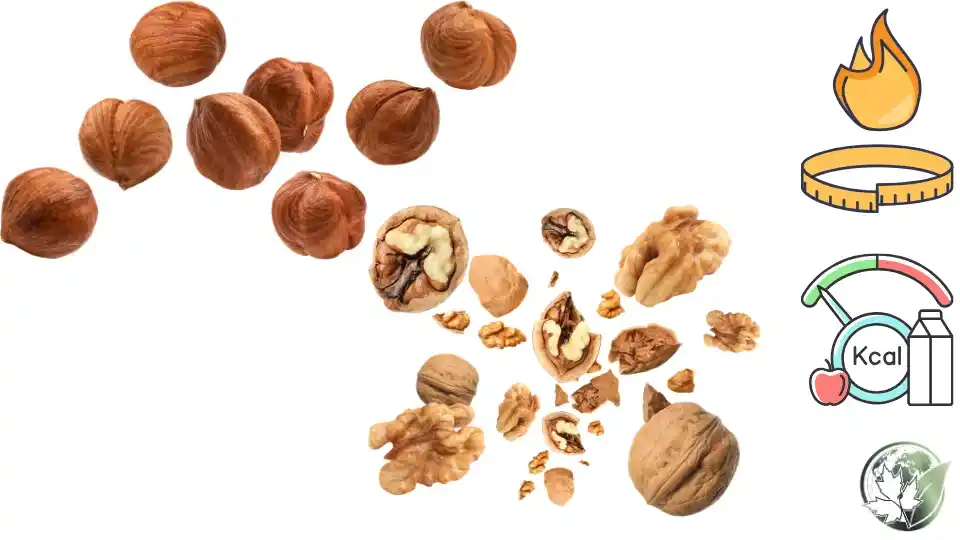
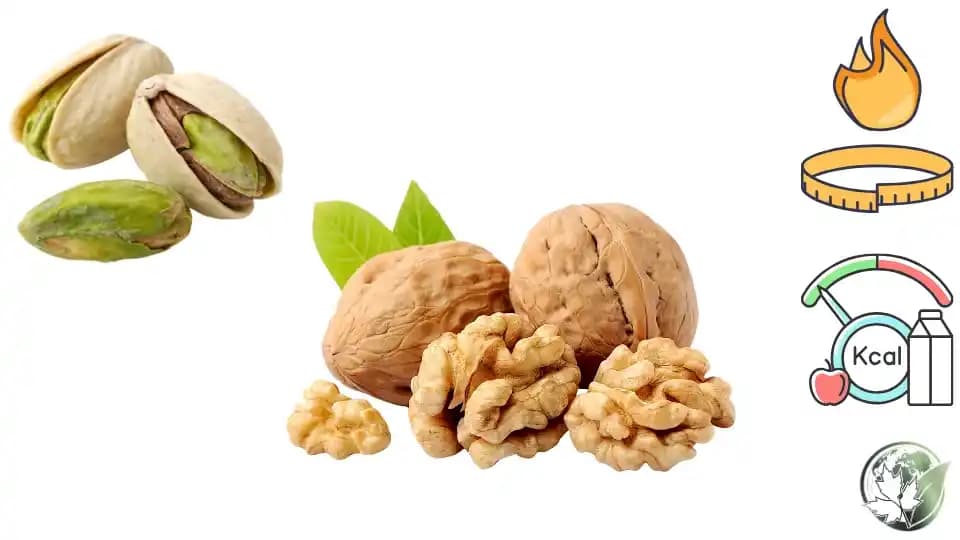
Hazelnuts are rich in monounsaturated fat and vitamin E, while walnuts supply omega-3
What Kind of Fat Do Hazelnuts and Walnuts Contain?
About 75 percent of the fat in hazelnuts is monounsaturated oleic acid, the same fat that makes olive oil healthy. It supports healthy cholesterol levels by lowering LDL without reducing HDL. Walnut fat is about 72 percent polyunsaturated, including 9 grams of ALA per 100 grams, which the body converts in small amounts to the long-chain omega-3 fats EPA and DHA. Both nuts have a low share of saturated fat, about 7 to 9 percent of their total fat.
| Fat profile, per 28 g | Hazelnuts | Walnuts |
|---|---|---|
| Total fat | 17.2 g | 18.5 g |
| Saturated | 1.3 g | 1.7 g |
| Monounsaturated | 12.8 g | 2.5 g |
| Polyunsaturated | 2.2 g | 13.2 g |
| Omega-6 | 2.2 g | 10.8 g |
| Omega-3 | 0.03 g | 2.6 g |
A one ounce serving of walnuts provides about 2.6 grams of ALA, which meets and exceeds the recommended daily intake of 1.1 to 1.6 grams. Hazelnuts offer very little omega-3, but their monounsaturated fat is very beneficial for the heart.
Are Hazelnuts Healthy?
Hazelnuts are among the most nutrient-dense nuts. They are one of the best food sources of vitamin E, a fat-soluble antioxidant, with one ounce providing about 4.3 milligrams, or 28 percent of the daily value. They give manganese, copper, folate, thiamine and magnesium. Clinical studies show that eating about 30 to 60 grams of hazelnuts a day can lower LDL cholesterol and improve markers of inflammation without causing weight gain in the trials.
Like all nuts, their high calorie density means portion size matters. A handful of 21 nuts is a healthy snack, while a bowl of 80 is nearly 700 calories.
Are Hazelnuts or Walnuts Better for Weight Loss?
Neither is a weight loss food, but both can fit well into a weight management diet. Large studies find that people who eat nuts regularly tend to weigh less, probably because nuts are filling and because some of their fat is not absorbed. Hazelnuts and walnuts each have about 180 calories per ounce, and the choice between them is down to taste, texture and portion.
| Snack | Calories | Protein | Fiber | Pieces |
|---|---|---|---|---|
| Hazelnuts, 1 oz | 178 kcal | 4.2 g | 2.7 g | 21 |
| Walnuts, 1 oz | 185 kcal | 4.3 g | 1.9 g | 14 halves |
| Almonds, 1 oz | 164 kcal | 6.0 g | 3.5 g | 23 |
| Pistachios, 1 oz | 159 kcal | 5.7 g | 2.8 g | 49 |
| Cashews, 1 oz | 157 kcal | 5.2 g | 0.9 g | 18 |
| Chocolate hazelnut spread, 2 tbsp | 200 kcal | 2.0 g | 1.0 g | spread |
| Granola bar | 140 kcal | 2.0 g | 1.0 g | 1 bar |
An ounce of nuts is more filling than a granola bar, with more protein and fiber, but nuts have more calories than the bar. The best results come from swapping nuts for foods that are less nutritious, such as chips or biscuits, and keeping to one ounce.
How Many Calories Are in Hazelnut Products?
Hazelnuts are used in many sweets and spreads, where the calories rise because of sugar, oil and chocolate.
| Product | Portion | Calories | Notes |
|---|---|---|---|
| Roasted hazelnuts | 1 oz | 183 kcal | Slightly drier |
| Hazelnut butter, pure | 1 tbsp (16 g) | 100 kcal | Only nuts |
| Chocolate hazelnut spread | 1 tbsp (18 g) | 95 kcal | About 55 percent sugar and oil |
| Hazelnut praline | 1 piece (12 g) | 66 kcal | Caramelized nuts |
| Hazelnut chocolate bar | 43 g | 245 kcal | Mix of chocolate and nuts |
| Hazelnut gelato | 1/2 cup | 210 kcal | Cream, sugar, nuts |
| Hazelnut coffee syrup | 1 tbsp | 40 kcal | Mostly sugar |
| Hazelnut oil | 1 tbsp | 120 kcal | Pure fat |
| Hazelnut flour | 1/4 cup (28 g) | 170 kcal | Ground nuts |
Pure hazelnut butter and flour are as high in calories as whole nuts. Chocolate spreads have fewer calories per tablespoon only because they are partly sugar, but they have much less nutrition.
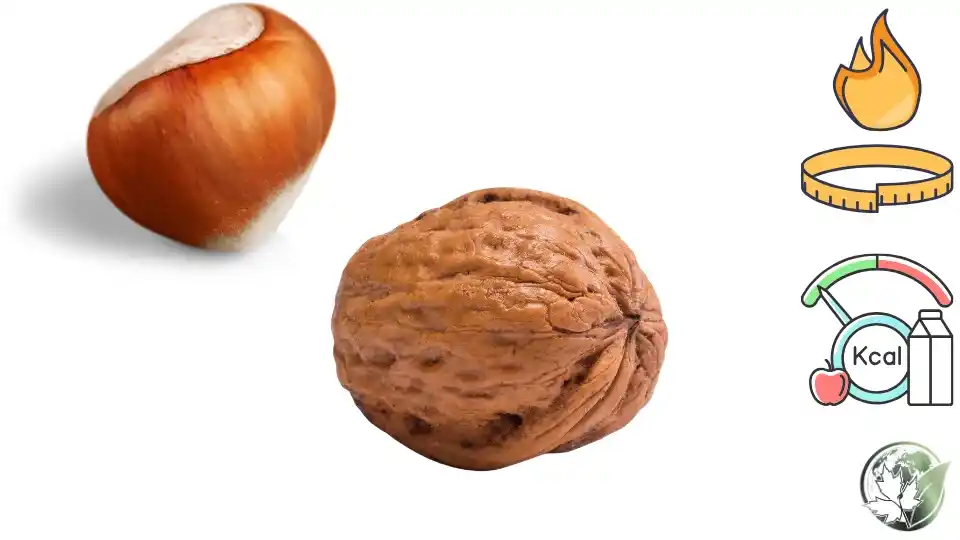
Pure hazelnut butter has about 100 calories per tablespoon, the same as the whole nuts
Do Hazelnuts Raise Blood Sugar?
Hazelnuts and walnuts have very low glycemic indexes, about 15 for hazelnuts, and less than 20 for walnuts. An ounce contains only about 4.7 grams of carbohydrate in hazelnuts, 2.7 grams of it fiber. They do not raise blood sugar significantly, and adding nuts to a meal can lower the blood sugar response to the other foods. People with diabetes often benefit from a small portion of nuts as a snack, as long as they stay within calorie needs.
Who Should Avoid Hazelnuts or Walnuts?
Tree nut allergy is common and can be severe. Anyone with an allergy to hazelnuts or walnuts must avoid them and any foods that may contain traces. Hazelnuts also cross-react with birch pollen in many people, causing an itchy mouth. People on low-fat diets for medical reasons should check with their doctor about nuts. Those with swallowing problems should avoid whole nuts, and children under four should not be given whole nuts because of choking risk.
How to Choose and Store Hazelnuts
Choose shells that are clean, heavy for their size and free of cracks and holes. Shake a nut to check: a loud rattling means the kernel has dried out. Shelled kernels should be plump, creamy white inside and have a sweet smell. Avoid any with a bitter or rancid smell. Store in-shell nuts in a cool, dry place for several months. Keep shelled kernels in an airtight container in the refrigerator for up to 4 to 6 months, or in the freezer for up to a year. Roasted hazelnuts should be eaten sooner.
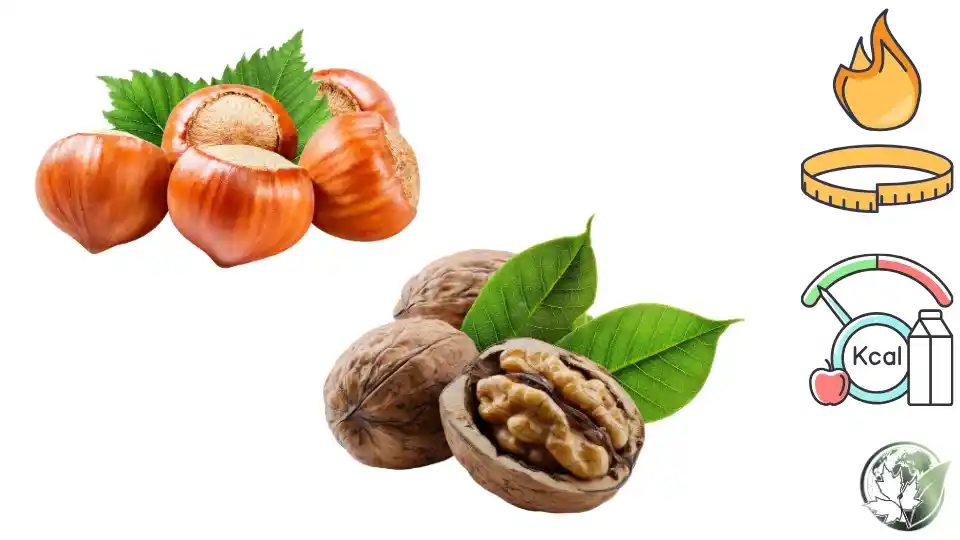
Store shelled hazelnuts in an airtight container in the refrigerator to stop them from going rancid
How to Count Hazelnut Calories Accurately
Weigh shelled hazelnuts and multiply by 6.28 calories per gram. Count in-shell nuts at about 46 percent of the weight. For spreads, check the label because sugar and oil change the calories. Count a tablespoon of chopped nuts as about 57 calories, and a handful as about 180 calories.
Do Roasting and Skinning Change Hazelnut Calories?
Raw hazelnuts and dry roasted hazelnuts have almost the same calories. Roasting removes a little water, so per 100 grams the roasted nuts have about 646 calories against 628 for raw. The difference is mostly a matter of weight: a roasted nut is a bit lighter, so you get slightly more calories per gram. Calories per nut stay almost the same, about 8.5.
Oil roasting adds fat, and salt adds sodium. Honey-roasted and sugar-coated hazelnuts can have about 560 to 600 calories per 100 grams but contain lots of sugar. Roasting does change the taste and texture, giving a deeper, sweeter flavor and a crisper bite. It also loosens the papery brown skin, which many people rub off before eating or baking. The skin contains most of the polyphenols in the nut and is edible, though somewhat bitter, so removing it reduces antioxidants but not calories.
| Hazelnut type (28 g) | Calories | Fat | Sugar | Sodium |
|---|---|---|---|---|
| Raw | 178 kcal | 17.2 g | 1.2 g | 0 mg |
| Dry roasted, unsalted | 183 kcal | 17.7 g | 1.2 g | 0 mg |
| Oil roasted, salted | 190 kcal | 18.5 g | 1.2 g | 120 mg |
| Honey roasted | 170 kcal | 13 g | 8 g | 90 mg |
| Chocolate coated | 160 kcal | 11 g | 14 g | 15 mg |
| Blanched (skin removed) | 178 kcal | 17.2 g | 1.2 g | 0 mg |
How Do Walnuts Differ in Shell, Size and Calories?
Walnuts are also sold in the shell or shelled, and their calories depend on the weight of the kernel. A typical in-shell walnut weighs about 10 to 12 grams, of which about 4.5 to 5 grams is the kernel, giving roughly 30 to 33 calories per in-shell walnut. Shell yield is about 40 to 50 percent. Thin-shelled varieties give more kernel per nut than thick-shelled ones.
| Walnut amount | Edible weight | Calories |
|---|---|---|
| 1 in-shell walnut | about 5 g | 33 kcal |
| 2 in-shell walnuts | about 10 g | 65 kcal |
| 4 in-shell walnuts | about 20 g | 131 kcal |
| 100 g in-shell | about 45 g | 294 kcal |
| 1 half kernel | 2 g | 13 kcal |
| 7 whole walnuts (kernel halves 14) | 28 g | 185 kcal |
A common recommendation of seven whole walnuts a day, or 14 halves, means about 185 calories. It is also notable that walnuts are one of the few nuts with a significant amount of ALA, so a small handful covers a day's need.
How Many Hazelnuts and Walnuts Make a Healthy Daily Portion?
Nutrition guidelines in many countries suggest about 30 grams of nuts a day, equal to one ounce. For hazelnuts, that is 21 kernels and 178 calories. For walnuts, that is 14 halves and 185 calories. Studies of the Mediterranean diet and of heart health use about 30 to 60 grams of mixed nuts daily, and the benefits tend to appear at 20 to 30 grams. More than that adds calories without much more benefit, although for people who are active or need more energy, a larger portion is fine.
A good practice is to measure a handful into a small container for the day, so you can see how much you are eating. Mixing hazelnuts, walnuts and other nuts spreads the nutrients: hazelnuts give vitamin E and manganese, walnuts give omega-3 and almonds give calcium and magnesium. A mixed portion of 30 grams has about 175 to 185 calories regardless of the combination.
How Can You Add Hazelnuts and Walnuts to Meals Without Overeating?
Nuts work best as an ingredient or a topper, which spreads the calories across a dish. Here are some ideas with their calorie costs.
**Breakfast:** Sprinkle a tablespoon of chopped hazelnuts on porridge or yogurt for 57 calories.
**Salads:** Add 10 grams of walnuts to a green salad for about 65 calories, and they make the salad more filling.
**Baking:** Replace part of the flour with ground hazelnuts or fold walnuts into banana bread.
**Rice and grains:** Toast a tablespoon of nuts and mix with herbs and rice.
**Snacks:** Pair a few nuts with fruit such as an apple for 150 to 250 calories in total.
**Sauces:** Blend walnuts with garlic, herbs and pomegranate for a Persian-style paste, using small amounts to add richness.
**Nut butters:** Spread a teaspoon on toast rather than a tablespoon, which cuts calories by two thirds.
By treating nuts as a flavor and texture element, you gain their benefits without letting calories get out of hand.
Which Is Better in Persian Cooking: Hazelnuts or Walnuts?
In Iranian cuisine, walnuts are the more common choice. They are used in fesenjan, the pomegranate and walnut stew, in the herb dish ghormeh sabzi variants, in sweets like baklava and nan-e gerdui, and in the famous torshi and nut and herb mixtures. Hazelnuts are grown in northern regions such as Gilan and are used in sweets, brittle, chocolates and as a snack mixed with other nuts. In cooking, the calories from nuts are spread across the number of servings, so a pot of fesenjan with 150 grams of walnuts has about 980 calories from the nuts alone, divided across six servings, or 163 calories each.
Do Nuts Really Make You Absorb Fewer Calories?
The calories printed on a food label are estimated with standard conversion factors, but whole nuts do not behave quite like the foods used to set those factors. Because the cell walls of nuts are tough, some of the fat inside stays locked in the cells and is never absorbed. Controlled feeding studies suggest that the usable energy from almonds, walnuts and pistachios is lower than the label, by about 5 to 25 percent depending on the nut and how it is prepared. For hazelnuts there are fewer measurements, but the principle is expected to be similar.
This effect is strongest when nuts are eaten whole and well chewed, and weaker for ground nuts, nut butters and oils, in which the cell walls are broken. That is one reason why a handful of hazelnuts may be less fattening than the same calories from spread. It is also why you should not count on the lower absorption as a reason to eat extra, since the effect is uncertain and varies between people.
Key Takeaways: Hazelnut Calories vs Walnuts
Hazelnuts have about 628 calories per 100 grams, 178 per ounce and 8.5 per nut, a little less than walnuts at 654 and 185. They are rich in monounsaturated fat, vitamin E and fiber, while walnuts provide omega-3. Both are healthy in a one ounce daily portion, and eating a mix is a good idea.
Frequently Asked Questions
7 questions answered
How many calories are in hazelnuts?
About 628 per 100 grams and 178 per ounce.
How many calories are in one hazelnut?
About 8.5 calories.
Do hazelnuts have fewer calories than walnuts?
Slightly, 628 against 654 per 100 grams.
How many hazelnuts should I eat a day?
About one ounce, or 21 nuts, is a common recommendation.
Are hazelnuts good for weight loss?
In small portions they are filling and nutritious, but they are high in calories.
Which has more omega-3, hazelnuts or walnuts?
Walnuts, by far.
Is hazelnut spread healthy?
It has less nutrition than pure nuts because it contains a lot of sugar and oil.