How Many Calories Are in Gummy Candy? The Quick Answer
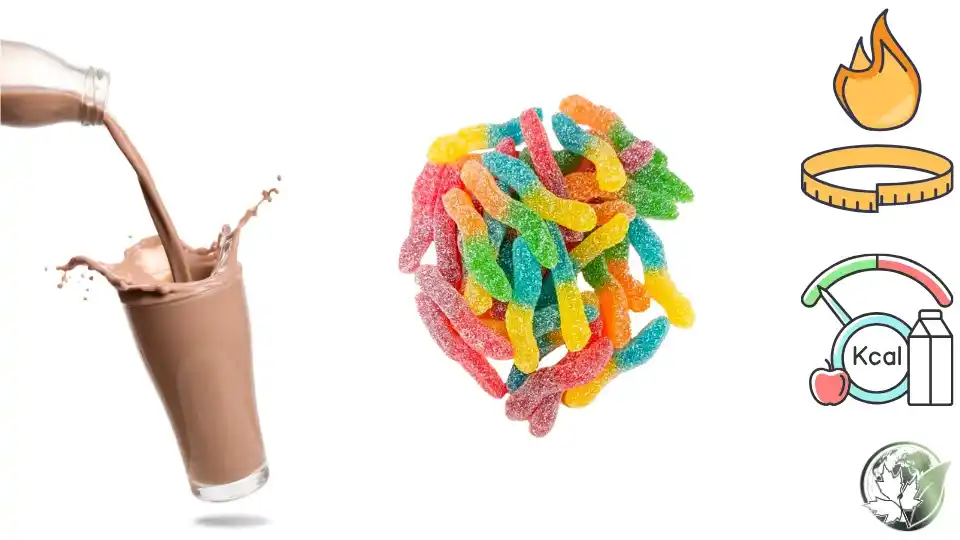
Gummy candy has about 343 calories per 100 grams. One gummy bear of about 2.2 grams has about 7.5 calories, a 30 gram handful (about 14 bears) has about 103, a 40 gram serving has about 137, a 100 gram bag has about 343 and a 200 gram bag has about 686 calories. Milk chocolate has about 535 calories per 100 grams, with 54 calories in a 10 gram square and 230 calories in a 43 gram bar.
Weight for weight, gummy candy has about 36 percent fewer calories than milk chocolate, because it contains no fat. It is nearly all sugar, glucose syrup and gelatin. The sugar content is still very high: about 46 grams per 100 grams, compared with about 52 to 54 for milk chocolate. So gummy candy is lighter in calories but not much lighter in sugar, and it offers no fat, protein or minerals to slow the absorption of that sugar.
This guide gives the calories in gummy candy per piece, per serving and per bag, compares it with milk chocolate in detail and covers sour, sugar-free and vitamin gummies. It explains which sweet is better for weight loss, blood sugar and teeth, and how to count both. You will find three comparison tables and an FAQ.
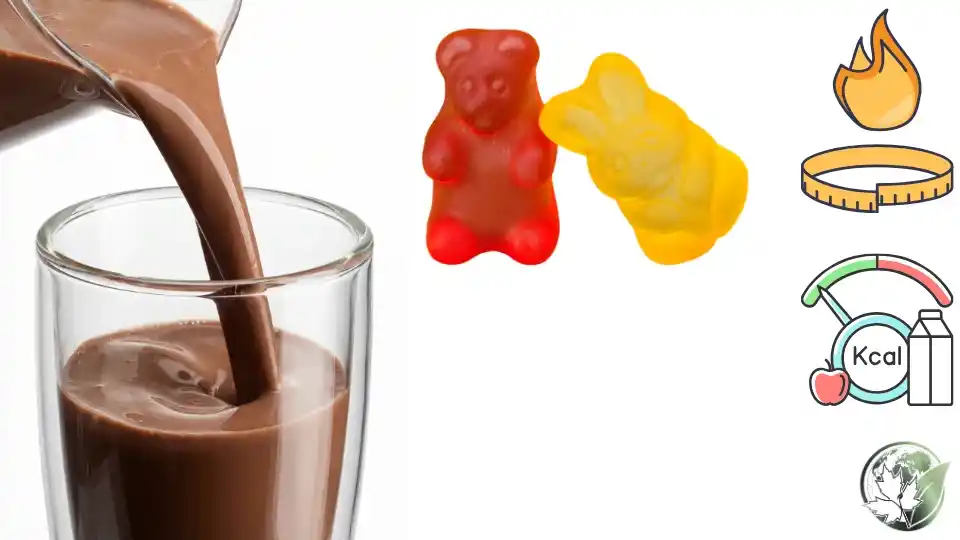
Two squares of milk chocolate have about the same calories as 14 gummy bears
How Many Calories Are in One Gummy, a Handful and a Bag?
Gummy sizes vary: gummy bears are small, rings and worms are larger and fruit gummies sold by weight are mixed. The following uses typical gummy bears at 343 calories per 100 grams.
| Portion | Weight | Calories | Sugar | Fat |
|---|---|---|---|---|
| 1 gummy bear | 2.2 g | 7.5 kcal | 1.0 g | 0 g |
| 5 gummy bears | 11 g | 38 kcal | 5.1 g | 0 g |
| 10 gummy bears | 22 g | 75 kcal | 10.1 g | 0 g |
| 14 gummy bears (handful) | 30 g | 103 kcal | 13.8 g | 0 g |
| 17 gummy bears (label serving) | 40 g | 137 kcal | 18.4 g | 0 g |
| 1 small bag | 50 g | 172 kcal | 23 g | 0 g |
| 1 medium bag | 100 g | 343 kcal | 46 g | 0 g |
| 1 large bag | 200 g | 686 kcal | 92 g | 0 g |
| 1 gummy worm (sour) | 9 g | 31 kcal | 5.5 g | 0 g |
| 1 gummy ring | 5 g | 17 kcal | 2.3 g | 0 g |
A 40 gram serving of 137 calories is the typical label serving, but many people eat a 100 or 200 gram bag in one sitting, which is 343 to 686 calories. The softness and low weight of each piece make it easy to lose track.
How Many Calories Are in Milk Chocolate by Comparison?
| Portion | Weight | Calories | Sugar | Fat |
|---|---|---|---|---|
| 1 square | 10 g | 54 kcal | 5.4 g | 3.0 g |
| 3 squares | 30 g | 161 kcal | 16.2 g | 9.0 g |
| 4 squares | 40 g | 214 kcal | 21.6 g | 12.0 g |
| 1 bar | 43 g | 230 kcal | 23.2 g | 12.9 g |
| 1 medium bar | 100 g | 535 kcal | 54 g | 30 g |
| 1 large bar | 200 g | 1,070 kcal | 108 g | 60 g |
For equal weight, chocolate has about 1.56 times the calories of gummy candy. A 40 gram serving of gummies has 137 calories, and a 40 gram serving of milk chocolate has 214.
Gummy Candy vs Milk Chocolate: Calories Compared
| Item | Weight | Calories | Sugar | Fat | Protein |
|---|---|---|---|---|---|
| Gummy candy | 30 g | 103 kcal | 13.8 g | 0 g | 2.1 g |
| Gummy candy | 40 g | 137 kcal | 18.4 g | 0 g | 2.8 g |
| Gummy candy | 100 g | 343 kcal | 46 g | 0 g | 6.9 g |
| Milk chocolate | 30 g | 161 kcal | 16.2 g | 9.0 g | 2.3 g |
| Milk chocolate | 40 g | 214 kcal | 21.6 g | 12.0 g | 3.1 g |
| Milk chocolate | 100 g | 535 kcal | 54 g | 30 g | 7.7 g |
For the same weight, gummies have fewer calories, about 64 percent of chocolate. But for the same sugar, the picture changes: about 40 grams of gummies provide 18.4 grams of sugar, the same as 34 grams of chocolate, which has about 182 calories. So per gram of sugar, the gummy comes out only slightly ahead.
Gummy Candy vs Milk Chocolate: Nutrition Compared
| Per 100 g | Gummy bears | Milk chocolate |
|---|---|---|
| Calories | 343 kcal | 535 kcal |
| Carbohydrate | 77 g | 59 g |
| Sugar | 46 g | 54 g |
| Fat | 0 g | 30 g |
| Saturated fat | 0 g | 18 g |
| Protein | 6.9 g | 7.7 g |
| Fiber | 0 g | 3.4 g |
| Calcium | 0 mg | 189 mg |
| Potassium | 0 mg | 372 mg |
| Iron | 0 mg | 2.3 mg |
| Sodium | 20 mg | 79 mg |
| Per 100 calories | Gummy candy | Milk chocolate |
|---|---|---|
| Weight | 29 g | 19 g |
| Pieces | about 13 bears | about 2 squares |
| Sugar | 13.4 g | 10.1 g |
| Fat | 0 g | 5.6 g |
| Calcium | 0 mg | 35 mg |
For 100 calories, you can eat 29 grams of gummies or 19 grams of chocolate. The gummies give more sugar, 13 grams against 10, but no fat. Chocolate gives some calcium, iron and fiber, and has a higher amount of cocoa compounds, but also much more saturated fat.
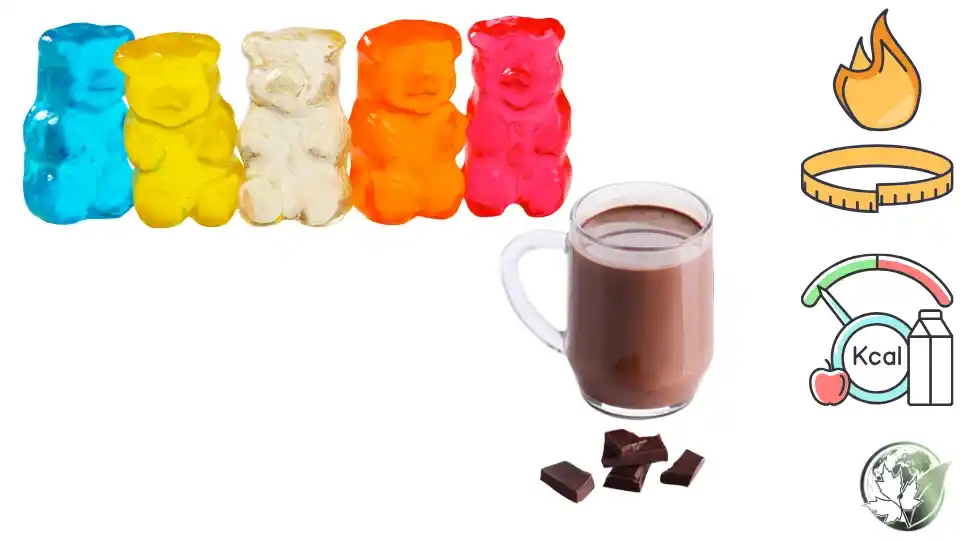
For 100 calories you can have about 13 gummy bears or two squares of milk chocolate
How Much Sugar Is in Gummy Candy Compared With Milk Chocolate?
| Portion | Sugar | Equivalent sugar cubes (4 g) |
|---|---|---|
| 10 gummy bears (22 g) | 10.1 g | 2.5 |
| 17 gummy bears (40 g) | 18.4 g | 4.6 |
| Small bag of gummies (50 g) | 23 g | 5.8 |
| 100 g of gummies | 46 g | 11.5 |
| 2 squares of chocolate (20 g) | 10.8 g | 2.7 |
| 1 chocolate bar (43 g) | 23.2 g | 5.8 |
| 100 g milk chocolate | 54 g | 13.5 |
A small 50 gram bag of gummies has as much sugar as a full 43 gram milk chocolate bar. The gummy's sugar load is not lower. It is just spread over more pieces and has less total calories because there is no fat.
Which Is Better for Blood Sugar: Gummies or Chocolate?
Gummies are made almost entirely of fast-absorbed carbohydrate, glucose syrup and sucrose, and have a glycemic index of about 80 or more. Milk chocolate has a glycemic index of about 43, since the fat and protein slow the stomach. A 40 gram serving of gummies has a glycemic load of about 14, compared with 9 for the same amount of milk chocolate. For people with diabetes or insulin resistance, chocolate in a small portion tends to cause a gentler rise than gummies.
| Candy | Glycemic index | Carbohydrate (40 g) | Glycemic load |
|---|---|---|---|
| Gummy bears | 80 | 31 g | 25 |
| Jelly beans | 78 | 37 g | 29 |
| Milk chocolate | 43 | 23.6 g | 10 |
| Dark chocolate (70 percent) | 23 | 14 g | 3 |
| Sugar cubes (10) | 65 | 40 g | 26 |
For the same amount of candy, gummies raise blood sugar quicker and higher than chocolate. Their use is limited to treating hypoglycemia, where their fast sugar is an advantage.
Which Is Better for Weight Loss: Gummies or Chocolate?
Gummies have fewer calories per gram, so a small handful has fewer calories than chocolate. But because they do not contain fat or fiber, they are much less satisfying, and it is easy to eat much more. Fat in chocolate gives a feeling of richness that tends to stop people sooner. In studies, people tend to eat a similar weight of candy whatever the type, which would give chocolate more calories, but gummies do tend to lead to a rapid rise and fall in blood sugar and renewed hunger.
| Snack | Calories | Sugar | Satisfaction |
|---|---|---|---|
| 30 g gummies | 103 kcal | 13.8 g | Low |
| 20 g milk chocolate | 107 kcal | 10.8 g | Medium |
| 20 g dark chocolate (70 percent) | 120 kcal | 5 g | Medium to high |
| 1 apple | 95 kcal | 19 g | High |
| 1 cup grapes | 104 kcal | 23 g | High |
| 3 dried apricots | 70 kcal | 14 g | Medium |
If you need to satisfy a sweet craving, a small piece of dark chocolate or a fruit is usually a better choice for the same calories. When you want a gummy, count your pieces and put the rest of the bag away.
What About Sugar-Free Gummies?
Sugar-free gummies replace sugar with sugar alcohols such as maltitol, sorbitol or xylitol, and sometimes also fiber such as polydextrose. They usually have about 200 to 250 calories per 100 grams, a third fewer than regular gummies, since sugar alcohols have about 2 to 3 calories per gram instead of 4.
| Candy (per 100 g) | Calories | Sugar | Sugar alcohols |
|---|---|---|---|
| Regular gummy bears | 343 kcal | 46 g | 0 g |
| Sugar-free gummy bears (maltitol) | 230 kcal | 0 g | 65 g |
| Sugar-free gummies (xylitol) | 200 kcal | 0 g | 60 g |
| Vitamin gummies | 330 kcal | 45 g | 0 g |
| Fruit snacks | 340 kcal | 50 g | 0 g |
Sugar alcohols can cause bloating, gas and diarrhea, especially in portions above 20 to 30 grams. Sugar-free gummies have a lower impact on blood sugar and teeth, but they are not calorie-free and should be eaten in small amounts.
Vitamin gummies are candy too, with about 10 to 20 calories each
How Many Calories Are in Vitamin and Fruit Gummies?
Gummy vitamins and fruit snacks are made with the same sugar and gelatin or pectin as candy. One adult vitamin gummy has about 10 to 20 calories and 2 to 4 grams of sugar. Two to four a day can add up to 80 calories and 12 grams of sugar. Fruit snacks sold in small pouches, usually 23 grams, have about 80 calories and 11 grams of sugar. They often contain little real fruit. They are a bit lighter than gummy candy per pouch because of the small portion, but they are still sweets.
Are Gummies or Chocolate Worse for Teeth?
Sticky candies such as gummies are among the worst for teeth. They cling to enamel and into grooves for a long time, giving bacteria hours to feed and produce acid. Sour gummies add acid that directly erodes enamel. Chocolate is less sticky, dissolves faster and contains some compounds that may slow bacterial growth, particularly in dark chocolate. Dentists generally rate gummies as more harmful than chocolate. If you eat gummies, do so with a meal, rinse your mouth with water afterwards and wait 30 minutes before brushing.
How to Choose the Healthier Sweet
**Check the serving size.** Many bags show 17 pieces as a serving but contain 3 to 5 servings.
**Prefer real fruit.** A cup of grapes has similar calories to 30 grams of gummies with much more nutrition.
**If you want chocolate, choose dark.** Two squares of 70 percent chocolate have about 120 calories and 5 grams of sugar.
**Pre-portion.** Put a measured amount in a small bowl.
**Avoid eating while distracted.** Candy is easy to overeat in front of a screen.
**Pair with protein.** A few nuts alongside a sweet reduces the sugar spike.
Measure a handful into a bowl instead of eating from the bag
How to Count Gummy and Chocolate Calories Accurately
Use 3.43 calories per gram for gummies and 5.35 for milk chocolate. If you count pieces, weigh ten to get an average. For packaged candy, read the calories per 100 grams and multiply by the weight you eat, not by the serving size. When you share a bag, divide it before you start.
What Is Gummy Candy Actually Made Of?
The ingredient list of a gummy is short and explains its nutrition. The main ingredients are sugar, glucose syrup, gelatin or pectin, citric acid, flavorings and colors, and a coating of wax or oil to stop the pieces from sticking. Sugar and glucose syrup make up about 75 to 80 percent of the candy by weight, water makes up about 10 to 15 percent and gelatin provides the chewy structure, at roughly 6 to 7 percent. That is why a gummy bear shows about 7 grams of protein per 100 grams, though the protein is collagen from gelatin and is not a complete source of amino acids.
Pectin gummies, which are vegetarian, use fruit-derived pectin in place of gelatin. Their calories are about the same, since the gel-forming agent is a small part of the recipe. Both types are almost entirely sugar, and the fruit flavor usually comes from added flavor and juice concentrate, not from real fruit. Gummies labeled "made with real fruit juice" may contain only a few percent of juice.
Milk chocolate has a very different formula. Cocoa butter, milk powder, sugar and cocoa mass are the main ingredients. The cocoa butter is responsible for the 30 grams of fat per 100 grams. Chocolate also has cocoa solids with polyphenols and minerals, and milk powder with protein and calcium. These ingredients add calories, but they also add some nutrition, which is why chocolate is sometimes viewed as a somewhat better treat nutritionally, even though it has more calories.
How Much Gummy Candy Can You Eat Without Overdoing the Calories?
A sensible limit for sweets in general is about 10 percent of daily calories, which is about 200 calories for a 2,000 calorie diet. In gummy terms, that is about 58 grams, or 27 gummy bears. In chocolate terms, it is about 37 grams, which is around three and a half squares. In practice, most people will do better with much less, because sweets add up with other sources of sugar such as drinks, desserts and sauces.
| Daily budget for sweets | Gummies | Milk chocolate |
|---|---|---|
| 100 calories | 29 g (13 bears) | 19 g (2 squares) |
| 150 calories | 44 g (20 bears) | 28 g (3 squares) |
| 200 calories | 58 g (27 bears) | 37 g (4 squares) |
| 300 calories | 87 g (40 bears) | 56 g (5.5 squares) |
You get more pieces of gummy for the calories, which can feel like more food, but you also get more sugar. If you want to stay within a daily limit of 25 grams of added sugar, 54 grams of gummies is the limit, and 46 grams of milk chocolate.
How Do Gummies and Chocolate Compare With Other Sweets?
| Sweet (100 g) | Calories | Sugar | Fat |
|---|---|---|---|
| Hard candy | 390 kcal | 98 g | 0 g |
| Jelly beans | 375 kcal | 71 g | 0 g |
| Marshmallows | 318 kcal | 58 g | 0 g |
| Gummy candy | 343 kcal | 46 g | 0 g |
| Licorice | 375 kcal | 45 g | 1 g |
| Caramel | 382 kcal | 49 g | 8 g |
| Milk chocolate | 535 kcal | 54 g | 30 g |
| Chocolate with nuts | 540 kcal | 45 g | 35 g |
| Chocolate cookies | 480 kcal | 35 g | 22 g |
| Dark chocolate (70 percent) | 598 kcal | 24 g | 43 g |
Fat-free candies are lower in calories than chocolate by weight, but the sugar content is not far below. Dark chocolate has the most calories but the least sugar, and its intense flavor encourages people to eat less of it.
Can Children Eat Gummy Candy?
Gummy candies are popular with children, and some points are worth keeping in mind. Their stickiness raises the risk of cavities, and they can be a choking hazard for children under four, especially larger gummy rings and worms. Dyes and flavorings in some candies may affect behavior in a small number of sensitive children. A small portion occasionally, with a meal and followed by water, is a reasonable approach. Keep vitamin gummies out of reach, since they look and taste like candy and an overdose of vitamins or minerals such as iron is dangerous.
Why Do Gummies Feel Lighter Than Chocolate Even When the Sugar Is Similar?
Many people believe that gummies are the lighter choice, and it is true in terms of calories per gram. But there are psychological and physiological reasons that the feeling of lightness can mislead. Fat is a strong signal of fullness: when fat reaches the small intestine, hormones tell the brain that you have eaten. Gummies contain none, so the signal is weak, and it is easy to continue eating. The chewy texture is also pleasant to eat repeatedly, and the fruit flavor makes people feel they are eating something close to fruit.
At the same time, the rapid rise in blood sugar after a large portion of gummies is followed by a drop, and for some people this triggers hunger within an hour or two. A small chocolate portion, with fat and protein, tends to produce a flatter curve. Because of this, someone who eats 40 grams of gummies at 137 calories may end up consuming more calories during the day than someone who eats 20 grams of chocolate at 107 calories and feels satisfied.
None of this means that chocolate is better for everyone. The best choice depends on how you eat it. If you are a person who stops after a few squares of chocolate but eats a whole bag of gummies, chocolate is the lower calorie option in practice. If you tend to eat a whole bar but only a few gummies, the opposite holds. Knowing your own habits is the most useful way to pick the sweet that fits your goals.
What Is the Best Way to Enjoy Gummies and Chocolate in Moderation?
If you like both sweets, a plan beats willpower. Decide in advance how often and how much, and make the portion visible. One approach is to buy small packs instead of large bags, since a 30 gram pack has 103 calories while a 200 gram bag has 686, and the bigger package nearly always leads to bigger servings. Another is to link the treat to a meal, such as a few squares of chocolate with coffee after lunch, which stops it from becoming an all-day snack. A third is to switch to treats that need more time to enjoy, such as a piece of dark chocolate that you let melt slowly, or frozen grapes that provide the sweet, chewy bite of a gummy for only 3.5 calories each.
Keep in mind that occasional sweets are part of a normal diet. A few gummies at a party or a few squares of chocolate after dinner do not change your health. What matters is the pattern over weeks and months, so aim for small, measured portions and a base of fruit, vegetables, protein and whole grains.
Key Takeaways: Gummy Candy Calories vs Milk Chocolate
Gummy candy has about 343 calories per 100 grams and 7.5 per bear, a third fewer than milk chocolate at 535. It has no fat but nearly the same sugar, and it raises blood sugar faster. Neither is a health food, so measure your portion and prefer fruit when you can.
Frequently Asked Questions
7 questions answered
How many calories are in a gummy bear?
About 7.5 calories.
How many calories are in a serving of gummy candy?
A 40 gram serving of about 17 bears has about 137 calories.
Do gummies have fewer calories than chocolate?
Per gram, yes: 343 against 535 per 100 grams.
Do gummies have less sugar than chocolate?
Only slightly: about 46 grams against 54 per 100 grams.
Are gummies or chocolate worse for blood sugar?
Gummies have a higher glycemic index and raise blood sugar faster.
Are sugar-free gummies lower in calories?
Somewhat, about 200 to 250 per 100 grams, but they can cause digestive upset.
Are gummy vitamins candy?
They have sugar and calories, about 10 to 20 each.