How Many Calories Are in Fruit Juice? The Quick Answer
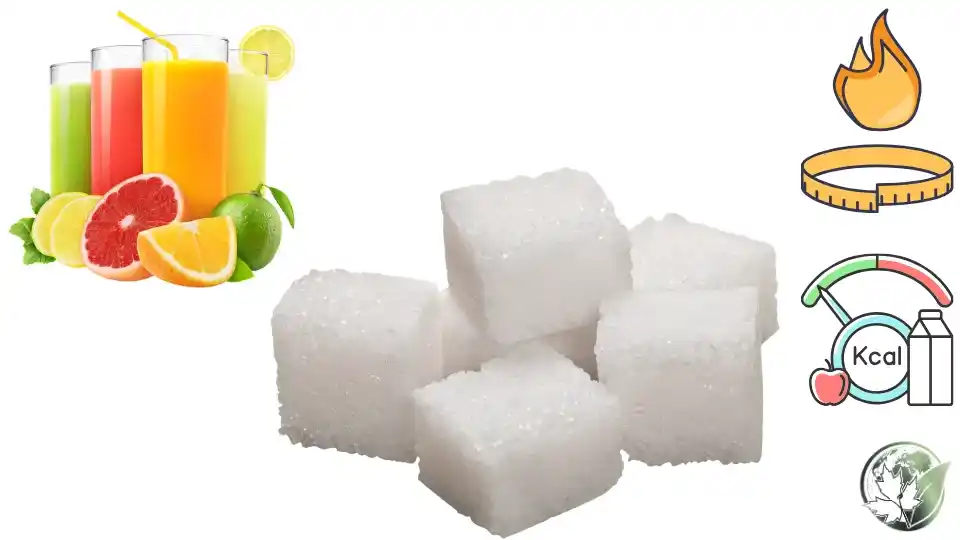
Fruit juice has about 40 to 60 calories per 100 milliliters. A cup (240 ml) of 100 percent orange juice has about 112 calories and 21 grams of sugar. A cup of apple juice has about 114 calories and 24 grams of sugar, grape juice about 152 calories and 36 grams, pineapple juice about 132 calories and 25 grams, pomegranate juice about 134 calories and 32 grams, and prune juice about 182 calories and 42 grams. A small 200 milliliter carton of juice has about 90 to 125 calories. A sugar cube of 4 grams has about 16 calories and 4 grams of sugar, so a cup of orange juice has about the sugar of five cubes, and a cup of grape juice has about nine.
Juice calories are real calories, but juice does not fill you up. The fiber is mostly removed, the fruit's volume is gone, and a glass can be drunk in a minute. The sugar in juice is classified as free sugar by the World Health Organization, together with table sugar and honey, because it is released from the fruit's cell walls. That is why juice often belongs in the same conversation as sugar cubes.
This guide lists the calories and sugar in the most common fruit juices per cup, per carton and per 100 milliliters. It compares juice with sugar cubes, whole fruit, soft drinks and juice drinks, and covers how to choose, dilute and count juice. There are three comparison tables and an FAQ.
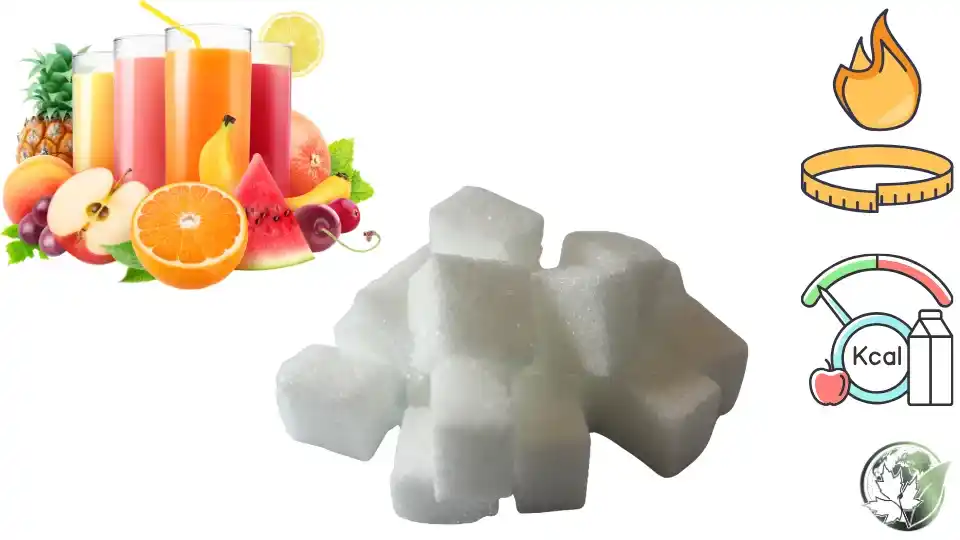
A cup of orange juice has about 112 calories and the sugar of five sugar cubes
How Many Calories Are in a Cup of Each Type of Fruit Juice?
The values below are for 100 percent juice with no added sugar. One cup is 240 milliliters.
| Juice (1 cup) | Calories | Sugar | Sugar cubes (4 g) | Fiber | Vitamin C |
|---|---|---|---|---|---|
| Lemon juice (1 tbsp, 15 ml) | 3 kcal | 0.3 g | 0.1 | 0 g | 6 mg |
| Tomato juice | 41 kcal | 6.3 g | 1.6 | 1.0 g | 22 mg |
| Carrot juice | 94 kcal | 9.2 g | 2.3 | 1.9 g | 20 mg |
| Orange juice | 112 kcal | 20.8 g | 5.2 | 0.5 g | 124 mg |
| Grapefruit juice | 96 kcal | 22.0 g | 5.5 | 0.2 g | 94 mg |
| Apple juice | 114 kcal | 24.0 g | 6.0 | 0.5 g | 2 mg |
| Pineapple juice | 132 kcal | 25.0 g | 6.3 | 0.5 g | 25 mg |
| Cranberry juice (100 percent) | 116 kcal | 30.0 g | 7.5 | 0.3 g | 24 mg |
| Pomegranate juice | 134 kcal | 32.0 g | 8.0 | 0.2 g | 0 mg |
| Grape juice | 152 kcal | 36.0 g | 9.0 | 0.3 g | 0 mg |
| Prune juice | 182 kcal | 42.0 g | 10.5 | 2.6 g | 10 mg |
| Cherry juice | 159 kcal | 34.0 g | 8.5 | 0.5 g | 2 mg |
Tomato and carrot juices are the lowest in sugar and calories, while grape, pomegranate and prune juices are the highest. Citrus juices are in the middle, but orange and grapefruit juice give very large amounts of vitamin C.
How Many Calories Are in a Carton or Bottle of Fruit Juice?
Single-serve juice is sold in sizes from 125 to 1,000 milliliters. The calories add up fast in larger bottles.
| Size | Orange juice | Apple juice | Grape juice | Pomegranate juice |
|---|---|---|---|---|
| 125 ml | 58 kcal | 59 kcal | 79 kcal | 70 kcal |
| 200 ml | 93 kcal | 95 kcal | 127 kcal | 112 kcal |
| 250 ml | 117 kcal | 119 kcal | 158 kcal | 140 kcal |
| 330 ml | 154 kcal | 157 kcal | 209 kcal | 184 kcal |
| 500 ml | 233 kcal | 238 kcal | 317 kcal | 279 kcal |
| 1 liter | 467 kcal | 475 kcal | 633 kcal | 558 kcal |
A 500 milliliter bottle of grape juice has about 317 calories and 75 grams of sugar, equal to nineteen sugar cubes. A liter of apple juice has about 475 calories and 100 grams of sugar. Remember that most bottles contain more than one serving.
Fruit Juice vs Sugar Cube: Calories and Sugar Compared
| Item | Calories | Sugar | Equivalent sugar cubes |
|---|---|---|---|
| 1 sugar cube | 16 kcal | 4 g | 1 |
| 1 cup orange juice | 112 kcal | 20.8 g | 5.2 |
| 1 cup apple juice | 114 kcal | 24 g | 6.0 |
| 1 cup grape juice | 152 kcal | 36 g | 9.0 |
| 1 cup pomegranate juice | 134 kcal | 32 g | 8.0 |
| 1 cup cola | 100 kcal | 26 g | 6.5 |
| 1 cup tomato juice | 41 kcal | 6.3 g | 1.6 |
| 1 tbsp lemon juice | 3 kcal | 0.3 g | 0.1 |
A cup of apple juice has about as much sugar as a cup of cola. The difference is that juice contains some vitamins and minerals, while cola does not. Calories per gram are slightly lower for juice than sugar, since juice is mostly water.
Grape and pomegranate juices have the highest sugar, tomato and carrot juices the lowest
Fruit Juice vs Whole Fruit: Why Does Juice Have More Calories Per Portion?
Making a glass of juice takes more fruit than most people would eat in one sitting. A glass of orange juice uses about three medium oranges, and a glass of apple juice about two to three apples. You would not normally eat three oranges as a snack, but you can drink their juice in a minute. This is why juice adds calories without making you feel full.
| Fruit | Whole fruit portion | Calories | Juice (1 cup) | Calories | Fruit used |
|---|---|---|---|---|---|
| Orange | 1 medium | 62 kcal | Orange juice | 112 kcal | about 2 to 3 |
| Apple | 1 medium | 95 kcal | Apple juice | 114 kcal | about 2 |
| Grapes | 1 cup | 104 kcal | Grape juice | 152 kcal | about 1.5 cups |
| Pineapple | 1 cup chunks | 82 kcal | Pineapple juice | 132 kcal | about 1.6 cups |
| Pomegranate | 1/2 fruit | 117 kcal | Pomegranate juice | 134 kcal | about 1 fruit |
The difference is the fiber and the volume. A whole orange contains about 3 grams of fiber and takes a few minutes to eat, while a glass of juice has about half a gram and takes seconds to drink. Several studies show that the calories in drinks are not compensated for by eating less later, so juice adds to your total intake more than whole fruit does.
Is Fruit Juice Healthy?
Fruit juice has some real benefits. Orange juice supplies vitamin C, folate and potassium, and some studies show that 100 percent juice, in moderate amounts, does not increase the risk of diabetes or heart disease. Pomegranate and cranberry juice contain polyphenols. Prune juice helps with constipation. Tomato juice supplies lycopene.
Still, health organizations recommend limiting juice. The American Academy of Pediatrics advises no juice for babies under 12 months and limits of about 120 milliliters per day for ages 1 to 3, up to 175 milliliters for ages 4 to 6 and 240 milliliters for older children. For adults, a small glass of 150 milliliters a day is a reasonable upper limit, and whole fruit is preferred. The main risks of high juice intake are extra calories, weight gain, tooth decay and blood sugar spikes.
Does Fruit Juice Raise Blood Sugar Like Sugar Cubes?
Juice raises blood sugar faster than whole fruit because there is less fiber to slow absorption. Orange juice has a glycemic index of about 50 and apple juice about 41, lower than table sugar at about 65, but the glycemic load of a full cup is still moderate to high because of the amount of sugar.
| Item | Glycemic index | Carbohydrate | Glycemic load |
|---|---|---|---|
| Orange juice (1 cup) | 50 | 26 g | 13 |
| Apple juice (1 cup) | 41 | 29 g | 12 |
| Grape juice (1 cup) | 53 | 38 g | 20 |
| Sugar cubes (6) | 65 | 24 g | 16 |
| Whole orange | 40 | 15 g | 6 |
| Whole apple | 36 | 25 g | 9 |
People with diabetes can include small juice portions of 100 to 120 milliliters, ideally with a meal, and should count the carbohydrate. Juice is also used to treat low blood glucose because it acts quickly, with about 120 milliliters of apple juice giving 14 grams of carbohydrate.
How Do Juice Drinks, Nectars and Concentrates Compare?
Not everything labeled "fruit" is 100 percent juice. Packaging terms matter.
| Product type | Typical juice content | Calories per cup | Sugar per cup | Notes |
|---|---|---|---|---|
| 100 percent juice | 100 percent | 110 to 150 kcal | 21 to 36 g | No added sugar |
| Juice from concentrate | 100 percent | 110 to 150 kcal | 21 to 36 g | Water added back |
| Nectar | 25 to 50 percent | 120 to 140 kcal | 28 to 32 g | Sugar or sweetener added |
| Juice drink or cocktail | 5 to 30 percent | 110 to 140 kcal | 26 to 32 g | Added sugar, flavoring |
| Fruit-flavored soft drink | 0 to 5 percent | 100 to 130 kcal | 25 to 33 g | Mostly sugar and water |
| Fresh-squeezed juice | 100 percent | 110 to 150 kcal | 21 to 36 g | Same calories, more pulp |
| Smoothie with whole fruit | whole fruit | 150 to 250 kcal | 25 to 40 g | More fiber |
Nectars and drinks often have the same calories as juice but have less vitamins and more sugar from additives. Many Iranian packaged juices are nectars, which contain 40 to 50 percent juice with added sugar, so reading the label is important.
Check the label to see whether a product is 100 percent juice, nectar or a drink
How to Choose a Lower Calorie Fruit Juice
**Prefer 100 percent juice, not nectar or drink.** Look for "no added sugar" on the label.
**Choose lower sugar types.** Tomato, carrot, lemon and grapefruit juice have fewer calories than grape or prune.
**Pick fresh-squeezed with pulp.** Pulp adds a bit of fiber.
**Buy small cartons.** A 200 milliliter carton gives a moderate portion.
**Dilute it.** Mix half juice and half sparkling or plain water to halve the calories while keeping the taste.
**Avoid refilling.** One glass at a meal is enough.
How to Count Fruit Juice Calories Accurately
Check the nutrition label for calories per serving and compare the serving size with the size of your glass. A drinking glass is often 300 milliliters, which is more than a cup. For homemade juice, add the calories of every fruit used and subtract the weight of the pulp and peels you discard. A rule of thumb is 45 calories per 100 milliliters for orange and apple juice, and 60 calories for grape and pomegranate. Include juice in your daily sugar tally, using four grams per sugar cube to visualize it.
How to Store Fruit Juice
Store unopened juice in a cool, dark place. After opening, keep it in the refrigerator and drink within 5 to 7 days for packaged juice and within 1 to 2 days for fresh-squeezed. Juice that smells fermented or fizzes has spoiled. Fresh juice can be frozen in ice cube trays for up to 3 months.
Dilute juice with water to halve the calories and keep the flavor
Why Does Juice Not Fill You Up the Way Fruit Does?
Satiety depends on several signals: the physical volume in the stomach, the time spent chewing, the speed at which the stomach empties and the hormones released as nutrients arrive in the intestine. Whole fruit scores well on every one of these. You chew it for several minutes, the fiber and pectin slow the stomach, and the intact cell walls delay the release of sugar into the bloodstream. A glass of juice scores poorly on nearly all. It passes through the mouth in seconds, requires no chewing and leaves the stomach quickly.
Experiments comparing whole apples, apple sauce and apple juice with the same calories have found that people felt fullest after the whole apple and least full after the juice. In several of these studies, people who drank juice ate about as much at the following meal as people who drank water, which means the juice calories were simply added on top. This is why many health agencies see sweet drinks, including 100 percent juice, as a factor in weight gain when consumed in large amounts.
None of this means juice is bad. It means juice should be counted as a source of calories and sugar, not as a way to feel full. If you want to feel satisfied, eat the fruit; if you want a refreshing drink with a meal, a small glass is fine.
How Many Calories Does a Daily Glass of Juice Add Over a Year?
A habit of one 250 milliliter glass of orange juice every morning adds about 117 calories a day. Over a year, that is 42,700 calories, which is equivalent to about 5.5 kilograms of body fat if everything else stays the same. For grape juice, the figure is 158 calories a day, or 57,700 a year, which is more than 7 kilograms. Seeing the yearly numbers is useful because small daily habits are easy to overlook.
| Daily habit | Calories per day | Calories per year | Approximate body weight effect |
|---|---|---|---|
| 1 glass (250 ml) orange juice | 117 kcal | 42,700 kcal | +5.5 kg |
| 1 glass (250 ml) apple juice | 119 kcal | 43,400 kcal | +5.6 kg |
| 1 glass (250 ml) grape juice | 158 kcal | 57,700 kcal | +7.5 kg |
| 1 small glass (120 ml) orange juice | 56 kcal | 20,400 kcal | +2.6 kg |
| 1 glass diluted 50 percent | 58 kcal | 21,300 kcal | +2.8 kg |
| 1 whole orange | 62 kcal | 22,600 kcal | +2.9 kg |
The effect assumes that you do not compensate by eating less elsewhere, which is not always true, so treat the figures as an illustration, not a prediction. They show that diluting juice or switching to whole fruit halves the impact.
What Is the Best Time to Drink Fruit Juice?
If you drink juice, a few habits reduce the downsides. Drinking it with a meal slows absorption because the sugar mixes with protein, fat and fiber from the food. Drinking it alone on an empty stomach produces a faster rise in blood sugar. Sipping juice slowly through the day bathes the teeth in sugar and acid, so it is better to finish a small glass quickly with a meal and then drink water. Using a straw reduces contact with teeth. For children, avoid giving juice at bedtime or in a bottle that is carried around all day.
After exercise, juice can be a practical way to replace carbohydrate and fluid. A mix of orange juice and water with a pinch of salt works as a simple recovery drink. Outside such situations, plain water is the best default drink.
How Can You Make Fruit Juice at Home With Fewer Calories?
Homemade juice gives you control over the fruit and the sugar. A few simple adjustments help lower calories.
**Use vegetables in the mix.** Blend carrot, cucumber, celery or spinach with an apple or orange to cut the sugar per cup by a third or half.
**Keep the pulp.** Do not strain out all the fiber. A blender smoothie keeps the fiber that a juicer removes.
**Add lemon or lime.** The acidity lets you enjoy less sweetness, and lemon juice has only 3 calories per tablespoon.
**Add ice and water.** A 1:1 mix with water halves the calories per glass.
**Skip added sugar.** Fresh fruit is usually sweet enough, and a pinch of mint or ginger adds flavor.
**Use ripe fruit.** Sweeter fruit needs no sugar.
For example, a glass made from one orange, one carrot and half a cucumber has about 100 calories and 14 grams of sugar, compared with 21 to 24 grams in the same volume of pure orange or apple juice.
Who Should Be Careful With Fruit Juice?
Some people should limit juice more than others. People with diabetes or prediabetes need to count it as a carbohydrate source and usually benefit from small portions. People trying to lose weight can replace juice with whole fruit or water. Young children should not be given large amounts, because it can displace milk and food and cause diarrhea and tooth decay. People with kidney disease who must restrict potassium should be careful with orange, tomato and prune juice, which are rich in it. People who take certain medications, such as some statins and blood pressure drugs, should avoid grapefruit juice, since it interferes with how the body processes them. If you are on any regular medication, ask a pharmacist whether any juice is a problem.
How Do Smoothies and Fresh Juices Differ in Calories?
A smoothie is made by blending the whole fruit, so it keeps the fiber that a juicer discards. This changes how filling it is, but the calories are often higher because smoothies usually include several fruits, yogurt, milk or sweeteners. A typical 350 milliliter fruit smoothie from a shop has 200 to 350 calories, while the same volume of fresh orange juice has about 160.
A homemade smoothie of one banana, half a cup of strawberries and 200 milliliters of milk has about 250 calories, which is more than a glass of juice but includes 4 grams of fiber and 8 grams of protein. If you want a lighter option, use water or ice instead of milk and skip honey, which brings the same smoothie to about 150 calories. Whether you choose juice or a smoothie, the sum of the ingredients is what counts, so add them up before you blend.
What Is a Sensible Daily Limit for Fruit Juice?
Most guidelines suggest that fruit juice should provide no more than one portion of your five daily servings of fruit and vegetables, however much you drink. In practice, that means about 150 milliliters, or a small glass, for adults and less for children. If you drink more, the extra juice does not count toward your servings, because the fiber is gone. For a person who needs 2,000 calories a day, a 150 milliliter glass of orange juice at about 70 calories is only 3.5 percent of intake, a small and reasonable amount. Three large glasses, though, would reach 350 calories and 63 grams of sugar, well above the limit for free sugars.
Key Takeaways: Fruit Juice Calories vs Sugar Cube
A cup of fruit juice has about 110 to 150 calories and 21 to 36 grams of sugar, equal to five to nine sugar cubes. Juice has some vitamins, but it lacks the fiber and fullness of whole fruit. Choose 100 percent juice in small portions, dilute it and eat whole fruit whenever you can.
Frequently Asked Questions
7 questions answered
How many calories are in a glass of fruit juice?
About 110 to 150 calories per cup, depending on the fruit. Orange has about 112 and grape about 152.
How many sugar cubes are in a glass of orange juice?
About five, since a cup has about 21 grams of sugar.
Does fruit juice have as much sugar as cola?
Often yes. Apple juice has about 24 grams per cup, against 26 for cola.
Which juice has the fewest calories?
Tomato juice, at about 41 per cup, followed by carrot juice and lemon juice.
Is fruit juice healthier than soft drinks?
A bit, because of vitamins, but the sugar is similar, so limit both.
Is whole fruit better than juice?
Yes, since it has more fiber and fills you up.
How can I make juice lower in calories?
Dilute it with water and drink smaller portions.