How Many Calories Are in Dried Plums? The Quick Answer
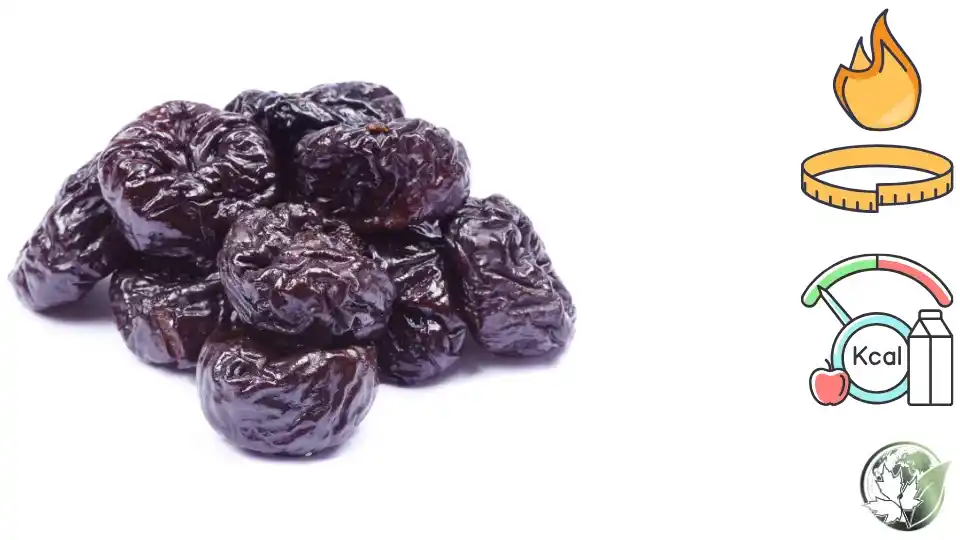
Dried plums, also called prunes, have about 240 calories per 100 grams. One pitted dried plum of about 9.5 grams has about 23 calories, five dried plums (about 48 g) have about 114, a quarter cup of pitted pieces (about 43 g) has about 104, a half cup has about 209 and a full cup of pitted dried plums (about 174 g) has about 418 calories. Raisins have about 299 calories per 100 grams, about 42 calories in a small 14 gram box, about 123 calories in a quarter cup and about 480 calories in a cup.
Per gram, dried plums have about 20 percent fewer calories than raisins. They also contain more fiber, about 7.1 grams per 100 grams against 3.7 for raisins, and almost twice the potassium. The sugar is lower: about 38 grams per 100 grams, against 59 for raisins. A cup of dried plums has about 418 calories and 66 grams of sugar, and a cup of raisins has about 480 calories and 99 grams.
This guide covers dried plum calories per piece, serving and cup, and compares them with raisins and other dried fruits on sugar, fiber, potassium and glycemic effect. It also explains the digestive benefits of prunes, how they relate to fresh plums, prune juice and Iranian dried plum products such as aloo, how to eat them and how to store them. You will find three comparison tables and an FAQ.
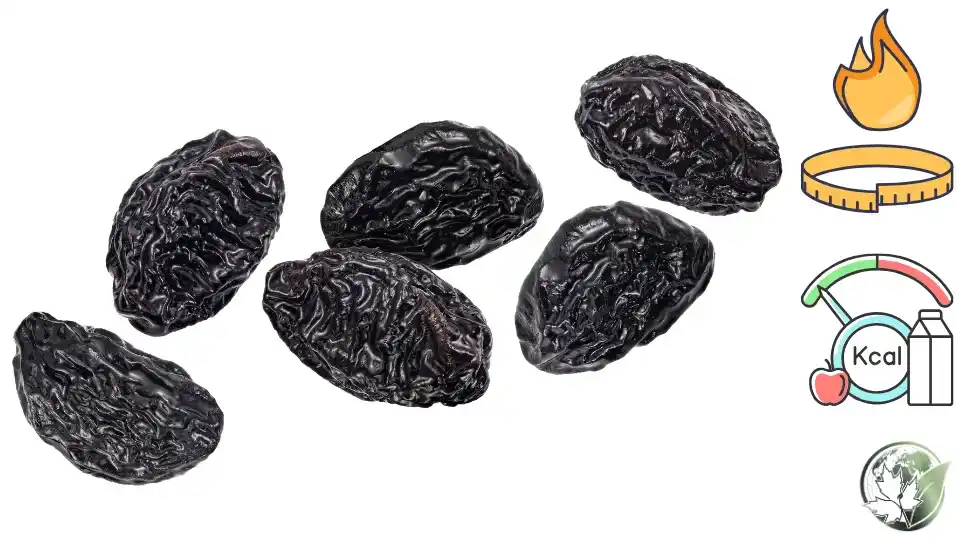
Five dried plums have about 114 calories
How Many Calories Are in One Dried Plum, a Serving and a Cup?
Dried plums come pitted or with the pit in, and the size varies by variety. Pitted prunes of about 9 to 10 grams are common. The calories below are for pitted fruit.
| Portion | Weight | Calories | Sugar | Fiber | Potassium |
|---|---|---|---|---|---|
| 1 dried plum | 9.5 g | 23 kcal | 3.6 g | 0.7 g | 70 mg |
| 3 dried plums | 28.5 g | 68 kcal | 10.8 g | 2.0 g | 209 mg |
| 5 dried plums | 47.5 g | 114 kcal | 18 g | 3.4 g | 348 mg |
| 1 serving (1.5 oz) | 40 g | 96 kcal | 15 g | 2.8 g | 293 mg |
| 1/4 cup pitted | 43 g | 104 kcal | 16.4 g | 3.1 g | 315 mg |
| 1/2 cup pitted | 87 g | 209 kcal | 33 g | 6.2 g | 637 mg |
| 1 cup pitted | 174 g | 418 kcal | 66 g | 12.4 g | 1,274 mg |
| 100 g | 100 g | 240 kcal | 38 g | 7.1 g | 732 mg |
| 1 dried plum with pit | 12 g | 23 kcal | 3.6 g | 0.7 g | 70 mg |
A common serving is about four or five dried plums, at roughly 100 to 114 calories. A cup is 418 calories, about the same as a small meal, so measure the amount.
Dried Plums vs Raisins: Calories Compared
| Dried fruit | Serving | Weight | Calories | Sugar | Fiber |
|---|---|---|---|---|---|
| Dried plums | 1 piece | 9.5 g | 23 kcal | 3.6 g | 0.7 g |
| Dried plums | 1/4 cup | 43 g | 104 kcal | 16.4 g | 3.1 g |
| Dried plums | 1 cup | 174 g | 418 kcal | 66 g | 12.4 g |
| Raisins | 1 tbsp | 9 g | 27 kcal | 5.3 g | 0.3 g |
| Raisins | small box | 14 g | 42 kcal | 8.3 g | 0.5 g |
| Raisins | 1/4 cup | 41 g | 123 kcal | 24 g | 1.5 g |
| Raisins | 1 cup | 165 g | 494 kcal | 98 g | 6.1 g |
| Dried plum juice | 1 cup | 256 g | 182 kcal | 42 g | 2.6 g |
For equal weights, dried plums have about 80 percent of the calories of raisins and about 60 percent of the sugar. Dried plums are bigger, too, so five pieces look like more food than a small box of raisins.
Dried Plums vs Raisins: Nutrition Compared
| Per 100 g | Dried plums | Raisins |
|---|---|---|
| Calories | 240 kcal | 299 kcal |
| Water | 31 g | 15 g |
| Carbohydrate | 64 g | 79 g |
| Sugar | 38 g | 59 g |
| Fiber | 7.1 g | 3.7 g |
| Protein | 2.2 g | 3.1 g |
| Fat | 0.4 g | 0.5 g |
| Potassium | 732 mg | 749 mg |
| Vitamin K | 59.5 mcg | 3.5 mcg |
| Iron | 0.9 mg | 1.9 mg |
| Magnesium | 41 mg | 32 mg |
| Boron | 2.3 mg | 2.2 mg |
| Sorbitol | about 15 g | trace |
| Glycemic index | 29 | 64 |
| Per 100 calories | Dried plums | Raisins |
|---|---|---|
| Weight | 42 g | 33 g |
| Pieces | about 4.4 | about 33 raisins |
| Sugar | 15.8 g | 19.7 g |
| Fiber | 3.0 g | 1.2 g |
| Vitamin K | 24.8 mcg | 1.2 mcg |
For 100 calories, dried plums provide 42 grams of fruit with 3 grams of fiber, while raisins give 33 grams with 1.2 grams of fiber. Dried plums are also rich in vitamin K, important for blood clotting and bones, and they have a much lower glycemic index of about 29 against 64 for raisins, because of their high sorbitol and fiber content.
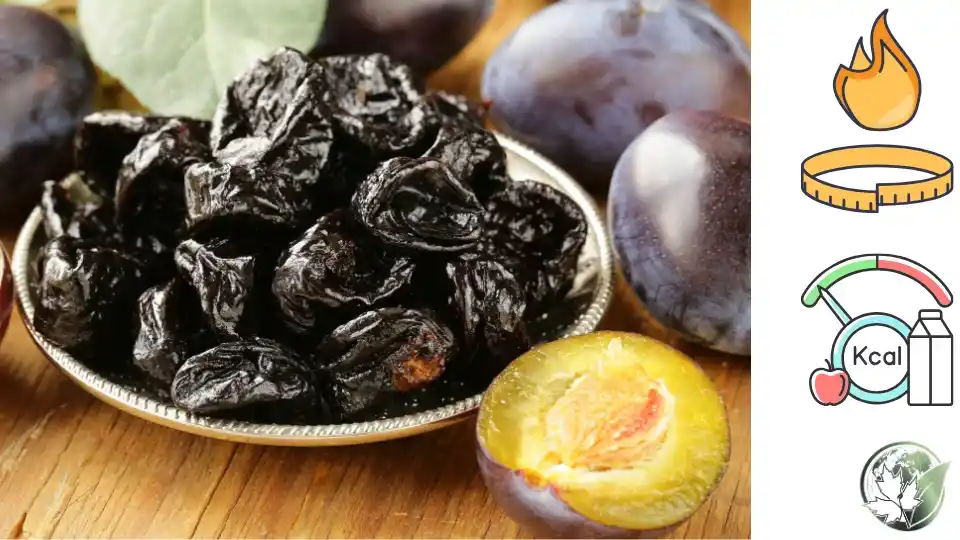
For 100 calories you get about four dried plums or 33 raisins
Why Are Dried Plums Good for Digestion?
Dried plums are the best known natural remedy for constipation. They provide fiber, about 3 grams in a serving, and sorbitol, a sugar alcohol that draws water into the intestine. They also contain phenolic compounds such as chlorogenic acid, which may have a mild laxative effect. In clinical trials, eating 50 grams, about five or six dried plums, twice a day was at least as effective as psyllium for improving stool frequency and consistency in adults with mild to moderate constipation.
| Dose | Calories | Fiber | Sorbitol | Typical effect |
|---|---|---|---|---|
| 2 dried plums | 46 kcal | 1.4 g | 2.8 g | Mild |
| 5 dried plums | 114 kcal | 3.4 g | 7.1 g | Good for most people |
| 10 dried plums | 228 kcal | 6.8 g | 14 g | Strong, may cause cramps |
| 1/2 cup prune juice | 91 kcal | 1.3 g | 7 g | Good for most |
Start with two or three dried plums a day and increase slowly with water. Too many at once can cause gas, cramps and diarrhea. If you have irritable bowel syndrome, begin with a very small portion.
Are Dried Plums Healthy?
Dried plums are one of the more nutritious dried fruits. They provide potassium, vitamin K, boron, copper and antioxidants called polyphenols, including neochlorogenic and chlorogenic acids, which give them one of the highest antioxidant capacities among common fruits. Studies suggest benefits for bone health: in postmenopausal women, eating 50 to 100 grams of dried plums a day for a year slowed bone loss in some trials. They may also support heart health by lowering LDL cholesterol and blood pressure.
Their weaknesses are the same as for any dried fruit: they are calorie-dense and sugary, and portions can grow quickly. Some commercial products contain added sugar, sulfites or preservatives such as potassium sorbate. Choose plain dried plums without added sugar.
Do Dried Plums Raise Blood Sugar?
Dried plums have a low glycemic index of about 29, which is lower than raisins at 64 or dates at about 45 to 55. A serving of 40 grams has a glycemic load of about 7. The high fiber and sorbitol slow the absorption of sugar. For people with diabetes, dried plums are one of the better dried fruits, although the carbohydrate still counts: a serving has about 25 grams of carbohydrate.
| Dried fruit | Glycemic index | Carbohydrate (40 g) | Glycemic load |
|---|---|---|---|
| Dried plums | 29 | 25.6 g | 7 |
| Dried apricots | 31 | 26 g | 8 |
| Dates | 42 | 30 g | 13 |
| Figs | 51 | 25 g | 13 |
| Raisins | 64 | 31.6 g | 20 |
Are Dried Plums Good for Weight Loss?
Their high fiber and sorbitol make dried plums relatively filling and give them a role in diets for weight control in small portions. A study that compared a daily snack of dried plums with a low-fat cookie snack found greater weight loss in the plum group over 12 weeks. At about 23 calories each, three or four dried plums are a fair substitute for a sweet snack at 100 calories. But they are not a low-calorie food, so a cup is 418 calories.
| Snack | Calories | Fiber | Weight |
|---|---|---|---|
| 4 dried plums | 91 kcal | 2.7 g | 38 g |
| Small box raisins | 42 kcal | 0.5 g | 14 g |
| Apple | 95 kcal | 4.4 g | 182 g |
| 2 plain biscuits | 90 kcal | 0.4 g | 20 g |
| 2 dates | 133 kcal | 3.2 g | 48 g |
| 6 fresh plums, small | 130 kcal | 3.9 g | 198 g |
How Do Dried Plums Compare With Fresh Plums?
Fresh plums have about 46 calories per 100 grams, and each fresh plum of 66 grams has about 30 calories. It takes about 2.5 kilograms of fresh plums to make a kilogram of dried plums. As a result, 100 grams of dried plums contain the same energy as about 520 grams of fresh plums, a bit more than seven plums.
| Plum form | Portion | Calories | Sugar | Fiber |
|---|---|---|---|---|
| Fresh plum | 1 medium (66 g) | 30 kcal | 6.6 g | 0.9 g |
| Fresh plums | 100 g | 46 kcal | 9.9 g | 1.4 g |
| Dried plums | 1 piece (9.5 g) | 23 kcal | 3.6 g | 0.7 g |
| Dried plums | 100 g | 240 kcal | 38 g | 7.1 g |
| Plum juice, prune | 1 cup | 182 kcal | 42 g | 2.6 g |
| Plum jam | 1 tbsp | 50 kcal | 12 g | 0.2 g |
| Plum leather (lavashak) | 30 g | 90 kcal | 18 g | 1.0 g |
Fresh plums offer more volume and water and are lower in calories, but dried plums have more fiber and potassium per gram and keep for months.
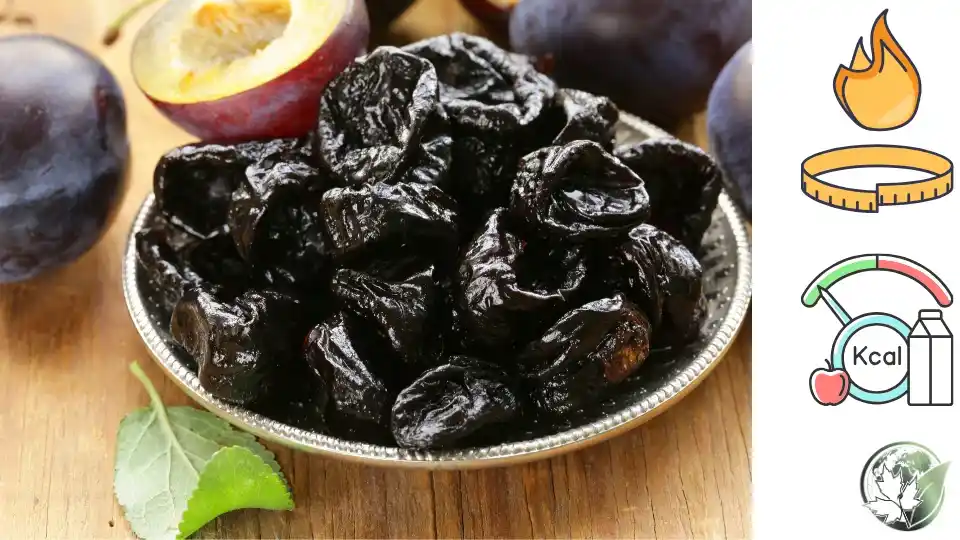
One kilogram of dried plums is made from about 2.5 kilograms of fresh plums
How to Eat Dried Plums
**On their own:** Three or four as a snack with a few almonds.
**In oatmeal or yogurt:** Chop two or three into a bowl.
**In stews:** Add to Persian khoresh dishes with chicken or lamb for a sweet-sour taste.
**In baking:** Puree into a paste to replace some butter or sugar in cakes and brownies.
**Soaked overnight:** Make a compote with cinnamon.
**In rice dishes:** Combine with nuts and herbs in pilaf.
How to Choose and Store Dried Plums
Choose plump, soft, shiny plums with a uniform dark color. Avoid those that are hard, dry or white with sugar crystals, which is natural but means older fruit. Check the ingredients for added sugar or sulfites. Store in a sealed container in a cool, dark place for up to six months, or in the refrigerator for up to a year. Freezing keeps them for two years.
Store dried plums in a sealed container in a cool, dark place
How to Count Dried Plum Calories Accurately
Weigh the plums and use 2.4 calories per gram. Count pitted ones, or subtract about 10 percent of the weight for pits. If you count pieces, use 23 each, but weigh a sample because sizes vary. For soaked or cooked plums, add any sugar or syrup.
What Is the Difference Between Prunes, Dried Plums and Other Dried Plum Products?
The names can be confusing. In 2000, the American industry officially approved the name dried plums for prunes, since many consumers associated the word prune with constipation and old age. Both names refer to the same product: the dried fruit of certain plum varieties with a high sugar content, such as the European plum Prune d'Agen, which can be dried whole with the pit without fermenting.
In Iran and the surrounding region, several related products are common. Aloo khoshk, or aloo bokhara, is a dried plum, usually from tart or sweet-sour varieties, with a flavor that is sharper than Western prunes and is used in stews and rice dishes. Lavashak is a thin sheet of dried plum or other fruit puree, often with added sugar, with a chewy texture and a strong sour taste. Tamarind and cherry plum leathers are similar.
| Product | Serving | Calories | Sugar | Notes |
|---|---|---|---|---|
| Dried plums, pitted | 5 pieces (47 g) | 114 kcal | 18 g | Soft, sweet |
| Aloo khoshk (dried tart plums) | 30 g | 78 kcal | 14 g | Tangy, firm |
| Plum lavashak | 30 g | 90 kcal | 18 g | Contains added sugar |
| Prune juice | 1 cup | 182 kcal | 42 g | No fiber |
| Prune puree (baking paste) | 1 tbsp (15 g) | 36 kcal | 5.7 g | Replaces butter |
| Chocolate-covered prunes | 3 pieces (45 g) | 190 kcal | 24 g | Added fat and sugar |
| Stewed prunes | 1/2 cup | 130 kcal | 28 g | Often sweetened |
Lavashak, though called fruit leather, usually has more sugar than plain dried plums, and many commercial versions are sweetened with sugar and flavored with citric acid. Read the label to see the sugar content and use it like a sweet.
How Many Calories Are in Dishes Made With Dried Plums?
Dried plums appear in sweet and savory dishes. In stews, the plums provide sweetness and body, and their calories are spread over the whole pot. The table gives approximate values for a typical portion.
| Dish | Serving | Calories | Dried plum share |
|---|---|---|---|
| Khoresh aloo (chicken with plums) | 1 plate with 1/2 cup rice | 520 kcal | about 40 kcal |
| Aloo Esfenaj (lamb and spinach stew) | 1 bowl | 380 kcal | about 45 kcal |
| Stewed prune compote | 1/2 cup | 130 kcal | about 100 kcal |
| Prune and oat muffin | 1 muffin | 190 kcal | about 25 kcal |
| Prune bran porridge | 1 bowl | 240 kcal | about 46 kcal |
| Prune and almond energy ball | 1 ball | 85 kcal | about 40 kcal |
| Prune danish | 1 piece | 330 kcal | about 30 kcal |
In stews, the plums are a small part of the calories, and the main sources are meat, oil and rice. For a lighter dish, use less oil and more vegetables, and let the plums supply the sweetness.
Are Dried Plums Good for Bones?
Dried plums are one of the few foods with fairly strong evidence for bone benefits. In a randomized trial of postmenopausal women, those who ate 50 to 100 grams of dried plums a day for 12 months had less loss of bone mineral density at the ulna and spine than those who ate dried apples. The effect is thought to come from polyphenols and boron, as well as vitamin K, which supports bone proteins. Studies in older men are earlier-stage but promising.
A daily dose of 50 grams, or about five or six plums, is about 120 calories, which is manageable. It is not a replacement for calcium, vitamin D and exercise, which remain the foundation of bone health. If you use dried plums for this purpose, plan them as part of your regular snack and not an addition on top of other sweets.
Who Should Be Careful With Dried Plums?
Most people tolerate dried plums well, but a few groups should take care. People with irritable bowel syndrome or fructose malabsorption may react to the sorbitol, and should start with one or two pieces. People taking the blood thinner warfarin need steady vitamin K intake, since dried plums contain about 24 micrograms in a 40 gram serving, and should keep the amount consistent and speak with their doctor. People with kidney disease who restrict potassium should limit them, since 100 grams has 732 milligrams. People who are sensitive to sulfites may need to choose unsulfured products. And anyone who has loose stools should avoid them temporarily, as the sorbitol and fiber can make that worse.
For children, dried plums are sometimes used to treat mild constipation, in small amounts of one or two a day, ideally chopped or pureed, and after discussing with a pediatrician. Whole dried fruit is a choking hazard for toddlers.
How Many Dried Plums Fit in a Daily Calorie Budget?
For a 2,000 calorie diet, a serving of five dried plums, at 114 calories, is under 6 percent of the day. That is a reasonable amount, and it contributes about 3.4 grams of fiber, which is about 12 percent of the daily need. You might eat them in the following ways: two on your oatmeal in the morning at 46 calories, and three as an afternoon snack with almonds at 68 calories plus 82 for 14 grams of almonds. This is about 196 calories, which provides fiber, potassium and healthy fat.
Compared with the same calories from biscuits, which provide around 400 calories per 100 grams of mostly flour, sugar and fat, the plums supply more nutrients and fiber and keep you satisfied. Compared with raisins, you get fewer calories and sugar per gram. And compared with fresh fruit, you get less volume, so it is wise to limit the amounts and to also eat fresh fruit.
How to Make Dried Plums at Home
You can dry plums yourself, which lets you avoid added sugar and sulfites. Choose firm, ripe plums with a high sugar content, such as prune plums. Wash them and cut them in half, removing the pit, or leave them whole with a small slit in the skin so that the water can escape. For an oven, spread them on trays at 70 degrees Celsius for 8 to 12 hours, turning once, until they are leathery and no longer wet inside. A dehydrator at 57 degrees Celsius takes 18 to 24 hours.
The yield is about one part dried plum to every 2.5 parts fresh, by weight. A kilogram of fresh plums, at 460 calories, gives about 400 grams of dried plums, with about 960 calories after drying. This is the same fruit energy, but it seems like much more when you divide it into pieces, because the water is gone. Cool the plums completely, then store them in airtight jars. If they feel too hard, soak them in warm water for 15 minutes.
What Are the Best Ways to Combine Dried Plums With Other Foods?
Pairing dried plums with protein or fat makes them more satisfying and slows the sugar. A few ideas follow, with their calories.
| Combination | Calories | Why it works |
|---|---|---|
| 3 dried plums and 10 almonds | 150 kcal | Fiber, protein, healthy fat |
| 3 dried plums and 30 g cheese | 190 kcal | Sweet and salty |
| 2 dried plums in plain yogurt (150 g) | 140 kcal | Protein and probiotics |
| 3 dried plums and 1 boiled egg | 140 kcal | Balanced mini meal |
| 4 dried plums and a cup of tea | 93 kcal | Natural sweetener |
| 5 dried plums with 1 tbsp walnuts | 160 kcal | Omega-3 and fiber |
These combinations deliver the benefits of the plums with small, controlled portions. They are also helpful for people who find that fruit alone does not keep them full.
Key Takeaways: Dried Plums Calories vs Raisins
Dried plums have about 240 calories per 100 grams and 23 per piece, about 20 percent fewer than raisins. They have more fiber, less sugar and a low glycemic index, and they are a classic aid for constipation. Keep portions to three to five pieces a day.
Frequently Asked Questions
6 questions answered
How many calories are in dried plums?
About 240 per 100 grams and 23 per piece.
How many calories are in five prunes?
About 114.
Do dried plums have fewer calories than raisins?
Yes, about 240 against 299 per 100 grams.
How many dried plums should I eat a day?
Three to five pieces are enough for most people.
Do prunes help with constipation?
Yes, thanks to fiber and sorbitol.
Are dried plums good for diabetics?
They have a low glycemic index, but count the carbohydrate.