
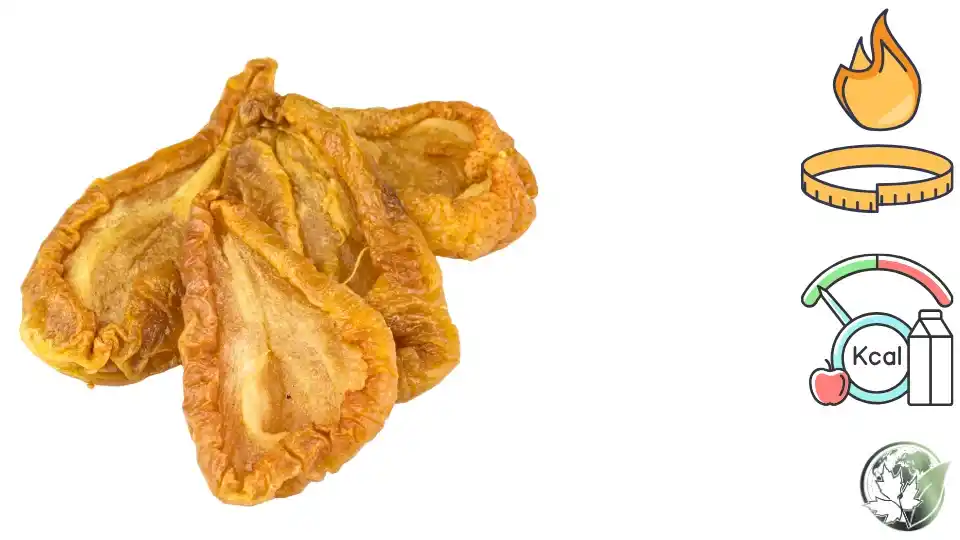
How Many Calories Are in Dried Pear? The Quick Answer
Dried pear has about 262 calories per 100 grams. A standard serving of one ounce (28 g) has about 73 calories, one dried pear half of about 20 grams has about 52, a quarter cup (about 40 g) has about 105 and a cup of dried pear pieces (about 160 g) has about 420. A fresh pear, in comparison, has about 57 calories per 100 grams, and a medium pear of 178 grams has about 101.
Per gram, dried pear has about 4.6 times the calories of fresh pear, because it is about 80 percent lighter after drying. Per piece, the difference is smaller: one dried half has about 52 calories, but it represents about 90 grams of fresh pear. A medium fresh pear, 101 calories, is equal to about two dried halves, which together weigh only 40 grams. The fruit's calories are the same; only the water is gone.
This guide gives the calories in dried pear per serving, per half and per cup, compares dried and fresh pear in calories, sugar, fiber and fullness, and shows how dried pear compares with other dried fruits and sweets. It also covers how to choose pure dried pear, how to use it, how much to eat and how to store it. You will find three comparison tables and an FAQ.
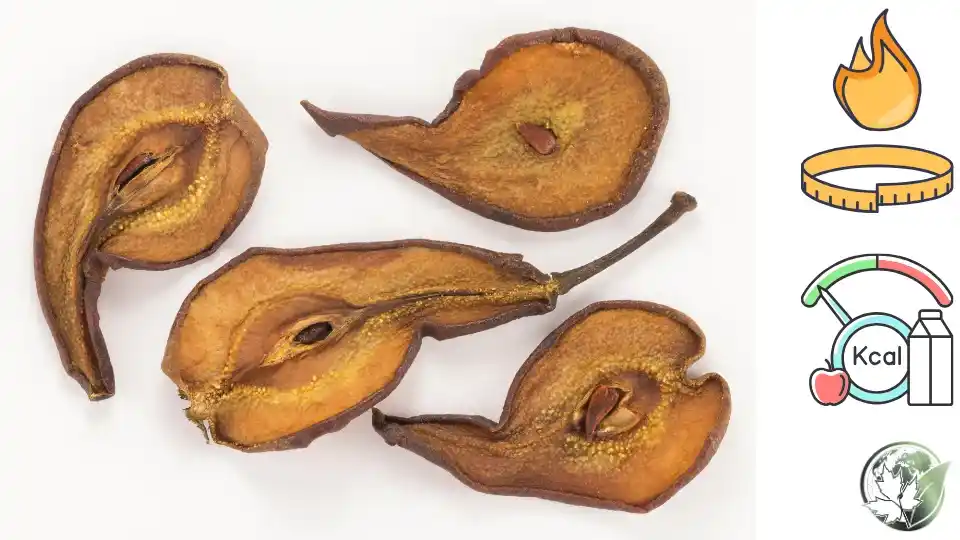
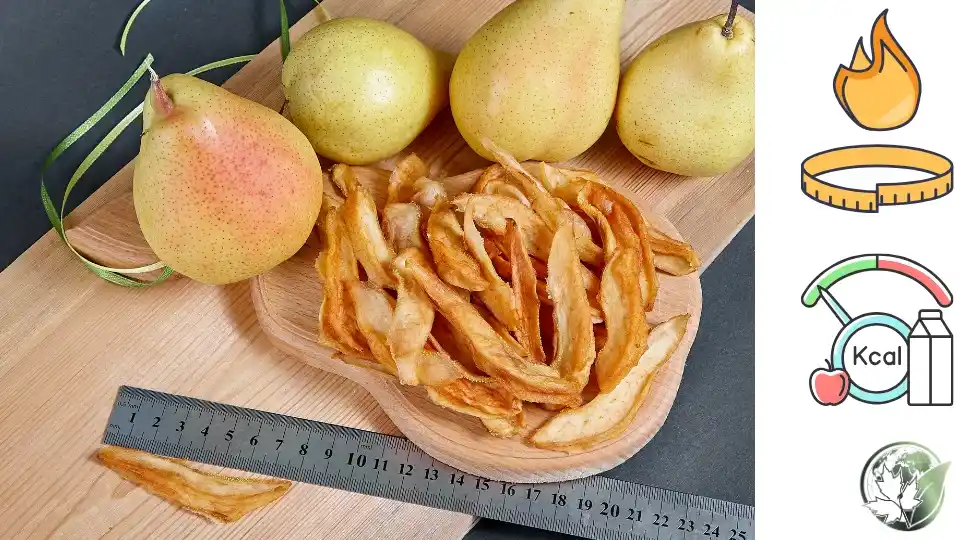
A one ounce serving of dried pear has about 73 calories
How Many Calories Are in One Serving, One Half and One Cup of Dried Pear?
Dried pears are sold as halves, slices and pieces. The weight of each piece varies, so weighing a serving is the best method.
| Portion | Weight | Calories | Sugar | Fiber |
|---|---|---|---|---|
| 1 slice | 8 g | 21 kcal | 5.0 g | 0.6 g |
| 1 half | 20 g | 52 kcal | 12.4 g | 1.5 g |
| 2 halves | 40 g | 105 kcal | 24.8 g | 3.0 g |
| 1 serving (1 oz) | 28 g | 73 kcal | 17.4 g | 2.1 g |
| 1/4 cup pieces | 40 g | 105 kcal | 24.8 g | 3.0 g |
| 1/2 cup pieces | 80 g | 210 kcal | 49.6 g | 6.0 g |
| 1 cup pieces | 160 g | 420 kcal | 99 g | 12 g |
| 100 g | 100 g | 262 kcal | 62 g | 7.5 g |
A common label serving is 40 grams or about 1/4 cup, giving about 105 calories and 25 grams of sugar. A one ounce portion gives about 73 calories and 17 grams of sugar. If you eat directly from a bag, a 200 gram pack has about 524 calories.
How Do Dried and Fresh Pear Calories Compare?
Both forms come from the same fruit, so the difference is the concentration. The table shows both per 100 grams and per equal portion of fruit.
| Pear form | Serving | Weight | Calories | Sugar | Fiber |
|---|---|---|---|---|---|
| Fresh pear, small | 1 pear | 148 g | 84 kcal | 14.5 g | 4.6 g |
| Fresh pear, medium | 1 pear | 178 g | 101 kcal | 17.4 g | 5.5 g |
| Fresh pear, sliced | 1 cup | 140 g | 80 kcal | 13.7 g | 4.3 g |
| Dried pear | 1 half | 20 g | 52 kcal | 12.4 g | 1.5 g |
| Dried pear | 2 halves | 40 g | 105 kcal | 24.8 g | 3.0 g |
| Canned pear in juice | 1/2 cup | 124 g | 62 kcal | 15 g | 2.0 g |
| Canned pear in heavy syrup | 1/2 cup | 127 g | 94 kcal | 24 g | 2.0 g |
| Pear juice | 1 cup | 248 g | 118 kcal | 26 g | 0.5 g |
| Pear jam | 1 tbsp | 20 g | 50 kcal | 12 g | 0.2 g |
Two dried halves have the same calories as one medium fresh pear, about 101 to 105, but one is 40 grams and the other 178 grams. Fresh fruit takes longer to eat and fills the stomach more.
Dried Pear vs Fresh Pear: Nutrition Compared
Nutrients are concentrated by drying, except vitamin C, which is largely lost.
| Per 100 g | Fresh pear (with skin) | Dried pear |
|---|---|---|
| Calories | 57 kcal | 262 kcal |
| Water | 84 g | 26 g |
| Carbohydrate | 15.2 g | 69 g |
| Sugar | 9.8 g | 62 g |
| Fiber | 3.1 g | 7.5 g |
| Protein | 0.4 g | 1.9 g |
| Fat | 0.1 g | 0.6 g |
| Potassium | 116 mg | 533 mg |
| Vitamin C | 4.3 mg | 2 mg |
| Vitamin K | 4.4 mcg | 3 mcg |
| Per 100 calories | Fresh pear | Dried pear |
|---|---|---|
| Weight | 175 g | 38 g |
| Sugar | 17 g | 23.7 g |
| Fiber | 5.4 g | 2.9 g |
| Potassium | 203 mg | 203 mg |
| Time to eat | about 4 minutes | about 1 minute |
For the same calories, fresh pear has almost twice the fiber and more than four times the weight. Dried pear is a convenient snack with a long shelf life, but fresh pear is the better choice for fullness and digestion.
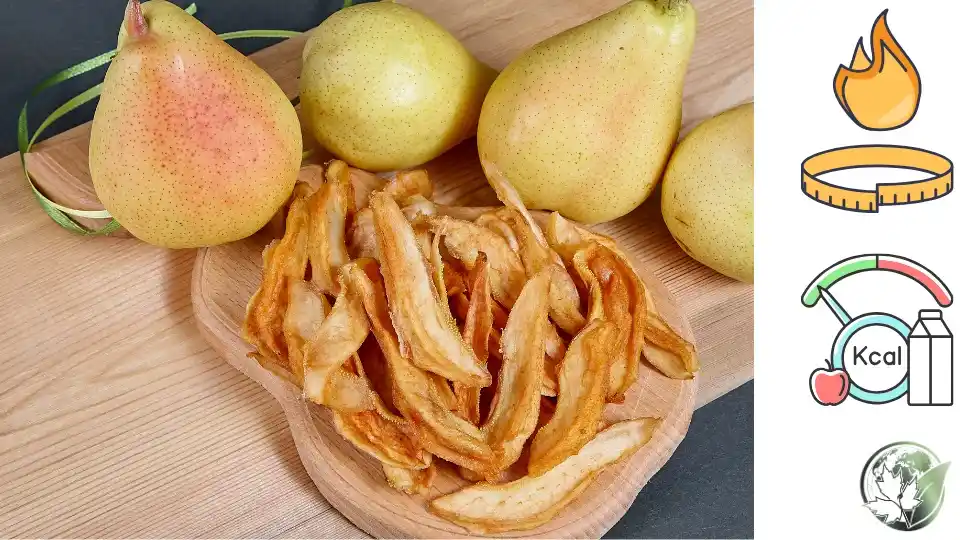
Two dried pear halves have about the same calories as a medium fresh pear, 101 to 105
How Much Sugar Is in Dried Pear?
Dried pear contains about 62 grams of sugar per 100 grams, mostly fructose, with glucose and sorbitol. Pears are unusually high in fructose and sorbitol compared with most fruits, which is why large amounts can cause gas and loose stools in some people. A one ounce serving has 17 grams of sugar, about four sugar cubes.
| Dried pear portion | Sugar | Equivalent sugar cubes (4 g) |
|---|---|---|
| 1 slice (8 g) | 5.0 g | 1.2 |
| 1 half (20 g) | 12.4 g | 3.1 |
| 1 oz (28 g) | 17.4 g | 4.3 |
| 1/4 cup (40 g) | 24.8 g | 6.2 |
| 1 cup (160 g) | 99 g | 24.8 |
A cup of dried pear contains nearly 25 sugar cubes' worth of sugar, even though it is all natural. The sugar is bound with fiber, but concentrated enough that portions should be small.
Is Dried Pear Healthy?
Dried pear retains most of the fiber, potassium and polyphenols of the fresh fruit. A one ounce portion supplies about 2 grams of fiber, which includes pectin and cellulose, and it supports gut bacteria. Pears are associated with lower risk of heart disease and type 2 diabetes in observational studies, and the skin holds many of the antioxidants such as flavonoids.
The drawbacks are concentrated sugar, the loss of vitamin C and the risk of sulfites or added sugar in some products. Dried pear is a reasonable snack in controlled portions and is best combined with protein or fat. It does not replace fresh fruit.
Does Dried Pear Raise Blood Sugar?
Fresh pear has a low glycemic index of about 30 to 38, one of the lowest among fruits, because of its fiber and high fructose to glucose ratio. Dried pear has a somewhat higher glycemic load because of concentration: a one ounce serving has about 19 grams of carbohydrate. This is still moderate and similar to a small apple.
People with diabetes can include small portions, about 15 to 20 grams, along with protein. It helps to avoid eating dried fruit on an empty stomach, and to check blood glucose responses. A fresh pear remains a better option because of its volume and fiber.
Is Dried Pear Good for Weight Loss?
Dried pear can be part of a weight loss diet in small portions, but it is energy dense. A 28 gram serving of 73 calories is moderate, but it is not very filling. A fresh pear at 101 calories keeps you full for much longer, which helps with weight control.
| Snack | Calories | Fiber | Weight |
|---|---|---|---|
| Fresh pear | 101 kcal | 5.5 g | 178 g |
| Dried pear (1 oz) | 73 kcal | 2.1 g | 28 g |
| Dried pear (2 halves) | 105 kcal | 3.0 g | 40 g |
| Apple | 95 kcal | 4.4 g | 182 g |
| Banana | 105 kcal | 3.1 g | 118 g |
| Rice cakes (3) | 105 kcal | 0.8 g | 27 g |
If you like dried pear, soak it in warm water for 15 minutes before eating or cooking, which adds volume and makes it seem like more food. Stewed dried pears with cinnamon are a dessert of about 100 calories per serving with no added sugar.
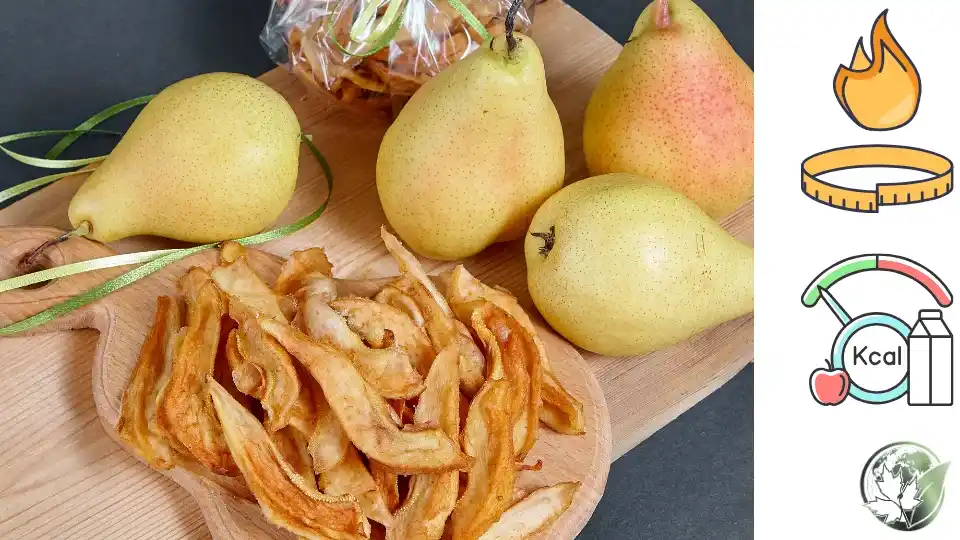
Stewed dried pears with cinnamon make a dessert of about 100 calories with no added sugar
How Does Dried Pear Compare With Other Dried Fruits?
Dried pear sits in the middle of the range for calories and is high in sugar.
| Dried fruit (100 g) | Calories | Sugar | Fiber |
|---|---|---|---|
| Dried apple | 243 kcal | 57 g | 8.7 g |
| Dried apricots | 241 kcal | 53 g | 7.3 g |
| Prunes | 240 kcal | 38 g | 7.1 g |
| Dried pear | 262 kcal | 62 g | 7.5 g |
| Dried figs | 249 kcal | 48 g | 9.8 g |
| Raisins | 299 kcal | 59 g | 3.7 g |
| Dried mango | 319 kcal | 66 g | 2.4 g |
| Dates | 277 kcal | 66 g | 6.7 g |
| Dried cranberries, sweetened | 308 kcal | 65 g | 5.7 g |
Dried pears have a bit more calories than dried apples and apricots, with a similar amount of fiber. They are lower in calories than raisins, mango and dates. If you are comparing, prunes and figs provide the most fiber and fewer sugars per 100 grams.
How to Use Dried Pear in Recipes
Dried pear has a mellow, honey-like flavor and a soft, slightly grainy texture. It works in many dishes.
**Oatmeal and porridge:** Chop one half into a bowl, about 52 calories.
**Compote:** Simmer with water, cinnamon and a few cloves.
**Salads:** Add to arugula, walnut and cheese salads.
**Baked goods:** Chop into muffins, breads and cakes.
**Stuffing and rice:** Combine with nuts and herbs.
**Cheese plates:** Pair with blue cheese or hard cheeses.
**Tea:** Add dried pear to a pot of herbal tea for natural sweetness.
In Iranian cuisine, dried pears are cooked in stews and rice dishes, and a traditional khoresh may use a few pieces to add sweetness. Calories from the pear in such dishes are about 20 to 50 per serving.
How to Choose Dried Pear
Choose dried pear with a natural light brown to golden color. Avoid products with added sugar, syrup or oil. Some pears are treated with sulfur dioxide, which gives a lighter color, so check for a sulfite warning if you are sensitive. The pieces should be flexible and slightly sticky, not rock hard. Check the calories per 100 grams, which should be near 260 for pure dried pear. A much higher number suggests added sugar.
How to Make Dried Pear at Home
Choose ripe but firm pears. Wash and core them, then cut into slices of 5 millimeters or into halves. Dip in lemon juice and water to prevent browning. Dry in an oven at 80 degrees Celsius for 4 to 6 hours, turning once, until chewy and leathery. In a dehydrator, use 57 degrees Celsius for 8 to 12 hours. Four medium pears (about 700 grams) yield about 130 grams of dried pear, with about 400 calories in total. Cool completely and store in airtight containers.
How to Store Dried Pear
Store in a sealed container in a cool, dry and dark place for 6 to 12 months. Refrigerate or freeze for up to two years. If the pieces are sticky, separate them with a bit of parchment paper. Discard any with mold or a sour smell. In warm and humid places, use small jars so that you open fresh batches more often.
Dried pear lasts six to twelve months in an airtight jar
How to Count Dried Pear Calories Accurately
Weigh your portion and use 2.62 calories per gram. If you count halves, use 52 per half, but weigh a few to check the typical size in your pack. For recipes, add the weight of dried pear before cooking, and ignore the water used for soaking, which adds no calories. If a label shows calories for a serving of 40 grams, divide by 40 and multiply by your weight. Add the calories of sugar or syrup if you cook the pears in sweetened liquid.
How Does Dried Pear Compare With Sweets and Snacks?
Many people reach for dried pear instead of candy or biscuits, so it helps to see how the calories stack up on a realistic portion rather than per 100 grams. A single dried half has about 52 calories, which is close to a 10 gram square of milk chocolate at about 54 calories. The difference is in what comes with the calories: the chocolate brings saturated fat and little fiber, while the pear brings potassium, fiber and polyphenols.
| Snack | Portion | Calories | Sugar | Fiber |
|---|---|---|---|---|
| Dried pear | 28 g | 73 kcal | 17.4 g | 2.1 g |
| Milk chocolate | 28 g | 150 kcal | 15.9 g | 1.0 g |
| Sweet biscuits | 28 g | 126 kcal | 8 g | 0.6 g |
| Raisins | 28 g | 84 kcal | 16.5 g | 1.0 g |
| Sugar cubes | 4 cubes (16 g) | 64 kcal | 16 g | 0 g |
| Honey | 1 tbsp (21 g) | 64 kcal | 17 g | 0 g |
Sugar per portion is similar across these snacks. A one ounce portion of dried pear has about as much sugar as four sugar cubes, which is a useful picture when you are tempted to eat a large handful. Where dried pear wins is that it has roughly half the calories of the same weight of chocolate and carries fiber that slows the sugar's arrival in the blood. Where it loses to fresh fruit is volume: you can eat a whole pear and still not reach the sugar of a few dried halves.
The practical rule is to treat dried pear as a sweet rather than as a fruit serving. A small portion after a meal, paired with a few nuts or a spoon of plain yogurt, is satisfying and keeps calories near 100 to 150. Eating it straight from a large bag while working or watching television is how a 73 calorie snack becomes a 400 calorie one without anyone noticing.
How Do Dried Pear Calories Change With Processing?
Not every dried pear is the same product. Some are simply dried fruit, and others are coated, sweetened or infused. The calories per 100 grams can vary a lot, and the label is the only way to know.
Pure sun-dried or oven-dried pear is the baseline at about 262 calories per 100 grams. Sulfured pear has the same calories but a lighter color and a small sulfite content. Sweetened or infused pear, which is soaked in sugar syrup before drying, can reach 300 to 340 calories per 100 grams because sugar is added to the fruit. Dried pear chips that are fried or coated with oil can pass 450 calories per 100 grams and are closer to a potato chip than a fruit. Freeze-dried pear is very light, so a cup weighs only about 20 to 25 grams and has about 60 to 90 calories, which makes cup measures misleading across product types.
This is why weighing matters more than counting pieces. A cup of freeze-dried pear and a cup of chewy dried pear are very different amounts of food, and a half of each has a very different weight. When you compare brands, always compare calories per 100 grams, and check the ingredient list for sugar, glucose syrup, oil or fruit juice concentrate. A short ingredient list that says only pears is what you want.
How Many Calories Are in Pear Dishes Made With Dried Pear?
Dried pears are often cooked, and the finished dish has different calories from the fruit alone. The numbers below are approximate per serving for common preparations.
| Dish | Portion | Calories | Notes |
|---|---|---|---|
| Stewed dried pears, no sugar | 1/2 cup | 100 kcal | Cooked with cinnamon and water |
| Stewed dried pears with honey | 1/2 cup | 145 kcal | 1 tsp honey added per serving |
| Oatmeal with 2 dried halves | 1 bowl | 280 kcal | Made with water |
| Pear and walnut salad with dried pear | 1 plate | 230 kcal | Includes 10 g walnuts and light dressing |
| Dried pear muffin | 1 muffin | 210 kcal | Chopped dried pear, medium muffin |
| Pear compote with sugar | 1/2 cup | 170 kcal | 2 tsp sugar per serving |
The takeaway is that the fruit itself is rarely the main calorie source in these dishes. Added sugar, butter, flour and nuts contribute most of the energy. If you want to keep a dessert light, stew the pears in water with spices and let the natural sweetness do the work. Soaking dried pears before cooking also lowers the amount you need, because the pieces swell and taste sweeter after rehydration.
Who Should Be Careful With Dried Pear?
Dried pear is safe for most people, but a few groups should be careful with portions. People with irritable bowel syndrome or fructose malabsorption often react to pears, fresh or dried, because of the high levels of fructose and sorbitol. A half of a dried pear may be tolerated while a handful causes bloating, cramps or diarrhea. Introducing it slowly and trying a small amount with other foods can help find your limit.
People who track carbohydrates, such as those with diabetes, should count a one ounce portion as about 19 grams of carbohydrate and adjust the rest of the meal accordingly. People who are sensitive to sulfites, including some with asthma, should look for unsulfured dried pear, which is usually darker brown. Parents should also be careful with young children, because dried fruit is sticky, can stick to teeth and increases cavity risk, so it is best given with meals and followed by water rather than eaten slowly through the day.
Finally, anyone trying to lose weight should remember that dried fruit is easy to overeat because it is small and sweet. A measured portion in a small bowl works better than eating from the package, and pairing it with protein reduces the chance of going back for more.
How Can You Fit Dried Pear Into a Balanced Day?
A balanced day does not need to exclude dried pear. The key is to decide the role it plays. If it replaces sugar, such as sweetening porridge or yogurt, it is a good swap, because one dried half adds about 52 calories and also brings fiber and potassium, while a tablespoon of sugar adds 49 calories and nothing else. If it replaces fresh fruit, it is a weaker swap, because the volume and water are lost. If it replaces candy, it is a clear improvement.
A sample pattern could be a half or one dried pear chopped into breakfast oats at about 52 to 105 calories, fresh pear as a mid-afternoon snack at about 101 calories, and a small stewed portion with cinnamon after dinner at about 100 calories. That gives you pear in three forms for about 250 to 300 calories. Across the week, rotate with other fruits so you also get vitamin C from citrus and berries, which dried pear cannot supply.
For athletes and hikers, dried pear is useful in the opposite way. Its light weight, shelf life and quick carbohydrates make it a practical fuel during long efforts, where a 40 gram handful gives about 105 calories and 25 grams of sugar in a pocket-sized package. In that context, concentrated calories are an advantage, not a drawback.
Key Takeaways: Dried Pear Calories vs Fresh Pear
Dried pear has about 262 calories per 100 grams and 73 per one ounce serving, compared with 57 per 100 grams for fresh pear. Two dried halves have about the same calories as one medium fresh pear, but with less volume and less fiber per calorie. Choose pure dried pear, limit portions to 20 to 40 grams and enjoy fresh pears when you want a more filling snack.
Frequently Asked Questions
8 questions answered
How many calories are in dried pear?
About 262 per 100 grams, 73 in a one ounce serving and 52 per half.
How many calories are in a serving of dried pear?
A one ounce serving has about 73 calories, and a quarter cup (40 g) has about 105.
Does dried pear have more calories than fresh pear?
Per gram, yes, about 4.6 times as many, since the water is removed. A medium fresh pear and two dried halves have similar calories.
How much sugar is in dried pear?
About 62 grams per 100 grams, or 17 grams in a one ounce serving.
Is dried pear healthy?
It provides fiber and potassium, but it is concentrated in sugar, so portion size matters.
Is dried pear good for weight loss?
In small portions it can be a lighter snack than sweets, but fresh pear is more filling.
Can dried pear cause gas?
Yes, in large amounts, because of sorbitol and fructose.
How should I store dried pear?
In an airtight container in a cool, dry place for six to twelve months.




