
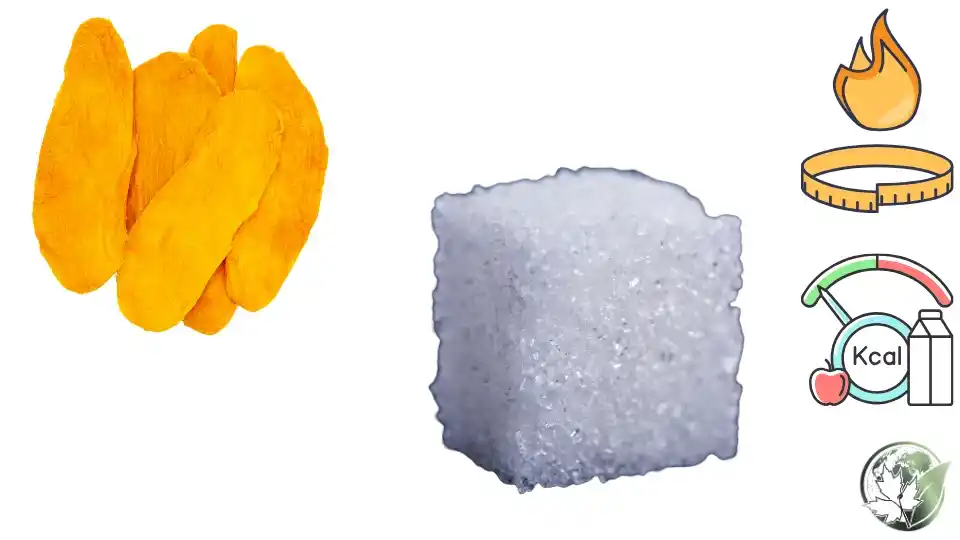
How Many Calories Are in Dried Mango vs a Sugar Cube? The Quick Answer
A standard sugar cube weighs about 4 grams and has 16 calories. A slice of sweetened dried mango weighs about 8 grams and has around 26 calories, so one slice is higher in calories than one cube. Per 100 grams, though, sugar has 387 calories and sweetened dried mango has 319, so by weight dried mango is lower. A 30 gram handful (three to four slices) has about 96 calories and 20 grams of sugar, equal to five sugar cubes.
The comparison explains why dried mango is both a fruit and a sweet. It contains fiber, vitamin A and potassium, yet its sugar content is so concentrated that a small bag holds the sugar of a dozen cubes or more. This guide compares calories per piece, per 100 grams and per serving, converts dried mango into sugar cubes, and shows how to enjoy it sensibly. It includes three comparison tables and an FAQ.
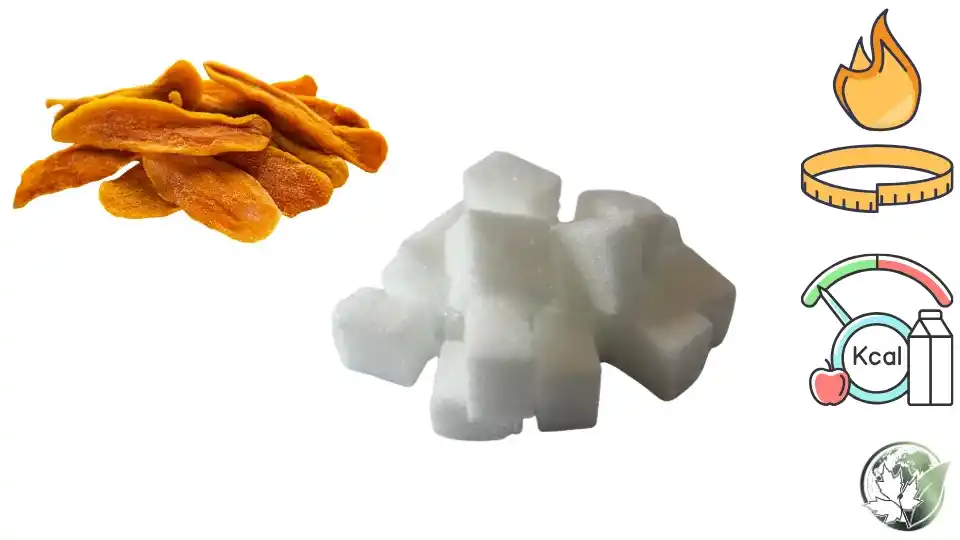
One slice of dried mango has about 5 grams of sugar, a little more than one sugar cube
How Many Calories Are in a Sugar Cube?
| Sugar | Weight | Calories | Sugar |
|---|---|---|---|
| 1 sugar cube (standard) | 4 g | 16 kcal | 4 g |
| 1 sugar cube (small) | 3 g | 12 kcal | 3 g |
| 1 sugar cube (large) | 5 g | 19 kcal | 5 g |
| 2 cubes (tea or coffee) | 8 g | 31 kcal | 8 g |
| 1 teaspoon granulated sugar | 4.2 g | 16 kcal | 4.2 g |
| 1 tablespoon | 12.5 g | 48 kcal | 12.5 g |
| 10 cubes | 40 g | 155 kcal | 40 g |
| 100 g | 100 g | 387 kcal | 100 g |
How Many Calories Are in Dried Mango?
| Dried mango | Weight | Calories | Sugar | Sugar cubes |
|---|---|---|---|---|
| 1 slice | 8 g | 26 kcal | 5.3 g | 1.3 |
| 2 slices | 16 g | 51 kcal | 10.6 g | 2.6 |
| 3-4 slices | 30 g | 96 kcal | 20 g | 5 |
| Handful | 40 g | 128 kcal | 26 g | 6.6 |
| 1/2 cup | 70 g | 223 kcal | 46 g | 11.5 |
| 100 g | 100 g | 319 kcal | 66 g | 16.5 |
| Bag (113 g) | 113 g | 361 kcal | 75 g | 18.7 |
| Unsweetened, 30 g | 30 g | 94 kcal | 18 g | 4.5 |
| Mango leather | 20 g | 66 kcal | 13 g | 3.3 |
Dried Mango vs Sugar Cube: Calories Compared
| Amount | Dried mango (sweetened) | Sugar |
|---|---|---|
| 1 piece | 26 kcal (slice, 8 g) | 16 kcal (cube, 4 g) |
| 10 g | 32 kcal | 39 kcal |
| 30 g | 96 kcal | 116 kcal |
| 50 g | 160 kcal | 194 kcal |
| 100 g | 319 kcal | 387 kcal |
| 100 calories | 31 g | 26 g |
| Sugar in 100 kcal | 21 g | 26 g |
Weight for weight, sugar has about 20 percent more calories than dried mango, because mango still contains some water (about 15 percent), fiber and a little protein. Slice for slice, however, mango has more because a slice weighs twice as much as a cube.
Dried Mango vs Sugar Cube: Nutrition Compared
| Per 100 g | Dried mango (sweetened) | Dried mango (unsweetened) | White sugar |
|---|---|---|---|
| Calories | 319 kcal | 314 kcal | 387 kcal |
| Carbohydrate | 78 g | 79 g | 100 g |
| Sugar | 66 g | 60 g | 100 g |
| Fiber | 2.4 g | 5.5 g | 0 g |
| Protein | 1.5 g | 2.4 g | 0 g |
| Fat | 0.8 g | 1.2 g | 0 g |
| Vitamin A | 300 mcg | 360 mcg | 0 mcg |
| Vitamin C | 5 mg | 6 mg | 0 mg |
| Potassium | 300 mg | 400 mg | 2 mg |
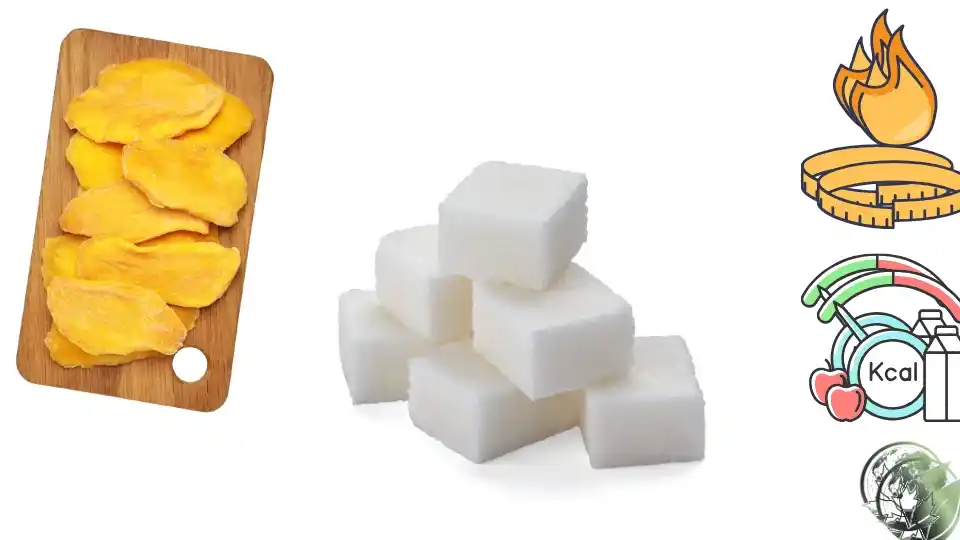
Dried mango is about two thirds sugar by weight, with fiber and vitamins that sugar lacks
Which Has More Calories: Dried Mango or a Sugar Cube?
One slice of dried mango has more calories than one sugar cube (26 against 16), and a handful has far more (96 against 16). But the comparison depends on the unit. By weight, sugar is more energy dense. Sugar cubes are small and are usually added to drinks, while dried mango is eaten in handfuls, so the practical effect on a day's sugar intake is much bigger from the mango.
| Comparison | Result |
|---|---|
| 1 slice mango vs 1 cube | 26 vs 16 kcal, mango higher |
| 30 g mango vs 30 g sugar | 96 vs 116 kcal, mango lower |
| Sugar in 30 g mango | 20 g, equal to 5 cubes |
| Handful (40 g) mango | 6.6 cubes of sugar |
| Bag (113 g) | 18.7 cubes of sugar |
How Many Sugar Cubes Are in Dried Mango?
Take the sugar grams and divide by four. A single slice has 1.3 cubes, a 30 gram portion has five, and a 113 gram bag has nearly 19. The World Health Organization recommends that free sugars stay under 10 percent of daily calories, about 50 grams or 12 cubes for an adult on 2,000 calories, with 25 grams (6 cubes) as an even better target. Added sugar in sweetened dried mango counts toward this limit, though the natural sugar in unsweetened dried fruit is classed by some guidelines as free sugar too, since the fruit's structure is broken down by drying.
| Portion | Sugar | Sugar cubes | Share of 25 g limit |
|---|---|---|---|
| 1 slice | 5.3 g | 1.3 | 21% |
| 30 g | 20 g | 5 | 80% |
| 40 g | 26 g | 6.6 | 104% |
| 70 g (1/2 cup) | 46 g | 11.5 | 184% |
| 113 g bag | 75 g | 18.7 | 300% |
Is Dried Mango Healthier Than Sugar?
Yes, in general. Dried mango provides fiber that slows absorption, vitamin A for vision and immunity, potassium and antioxidants such as mangiferin. Sugar offers none of these. However, sweetened dried mango has added sugar and can be 66 percent sugar, so the advantage is smaller than it looks. A better comparison is to fresh mango, which has only 14 grams of sugar per 100 grams and 60 calories, and bulk to fill you up.
| Factor | Dried mango (unsweetened) | Dried mango (sweetened) | Sugar |
|---|---|---|---|
| Fiber | 5.5 g/100 g | 2.4 g/100 g | 0 |
| Vitamins | A, C, E | A, C | None |
| Antioxidants | Yes | Yes | No |
| Added sugar | None | Yes | 100% |
| Glycemic index | 51 | 60 | 65 |
| Satiety | Moderate | Moderate | None |
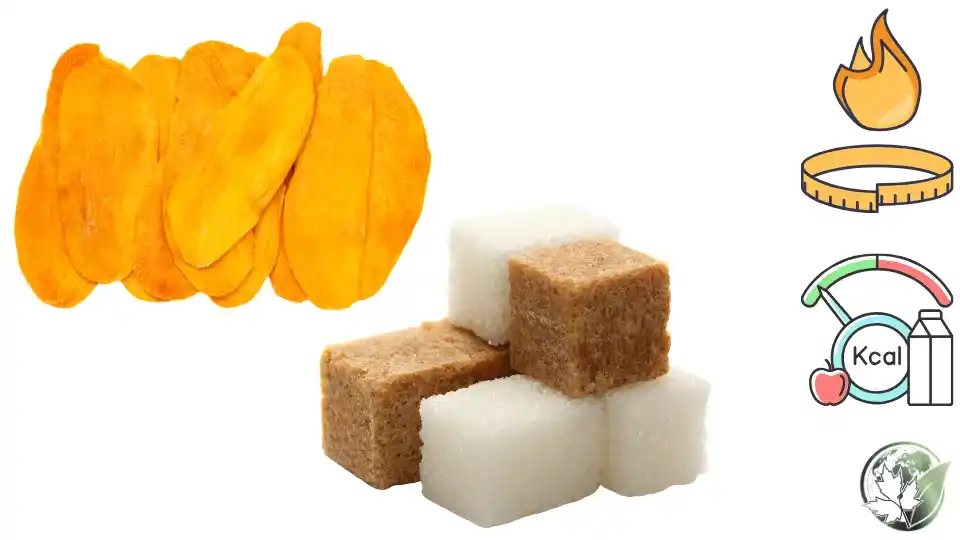
Fresh mango has only 60 calories per 100 grams, a fifth of the dried version
Why Is Dried Mango So Calorie Dense?
Fresh mango is 83 percent water. Removing the water leaves behind the sugar, fiber and nutrients in about one fifth of the weight. Five kilograms of fresh mango become roughly one kilogram of dried slices. That means 100 grams of dried mango represents about 500 grams of fresh fruit, an amount few people would eat in one sitting. The 319 calories per 100 grams are the same energy that was in the fresh fruit, only compacted.
| Mango form | Calories per 100 g | Water | Sugar |
|---|---|---|---|
| Fresh | 60 kcal | 83% | 14 g |
| Frozen | 60 kcal | 83% | 14 g |
| Canned in syrup | 76 kcal | 78% | 17 g |
| Dried (sweetened) | 319 kcal | 15% | 66 g |
| Dried (unsweetened) | 314 kcal | 15% | 60 g |
| Mango juice | 54 kcal | 87% | 12 g |
Can You Use Dried Mango Instead of Sugar?
Dried mango can sweeten oatmeal, yogurt and baking in place of some sugar. Chop 30 grams (96 calories, 20 grams of sugar) and stir into a bowl of oatmeal instead of two tablespoons of sugar (96 calories, 25 grams). The calories are the same, but you also get fiber, vitamin A and a fruity flavor. Another option is to puree soaked dried mango into a paste to sweeten smoothies or sauces. For the lowest calories, use fresh mango, which provides sweetness with a fifth of the energy.
| Use | With sugar | With dried mango |
|---|---|---|
| Oatmeal | 2 tbsp sugar: 96 kcal | 30 g mango: 96 kcal |
| Yogurt | 1 tbsp sugar: 48 kcal | 15 g mango: 48 kcal |
| Baking | 100 g sugar: 387 kcal | 120 g mango puree: 190 kcal |
| Tea | 2 cubes: 31 kcal | Not suitable |
| Smoothie | 1 tbsp sugar: 48 kcal | 1/2 cup fresh mango: 50 kcal |
What Is a Healthy Serving of Dried Mango?
A reasonable serving is 30 to 40 grams, three to four slices, giving 96 to 128 calories. It can be a snack or part of a trail mix, preferably with nuts. For children, 15 to 20 grams is enough. Because 113 gram bags are sold as a single package, divide them into three portions on opening. If you have diabetes or watch your weight, count 30 grams of dried mango as about 20 grams of carbohydrate-sugar, or one and a half fruit exchanges.
| Group | Recommended serving | Calories | Sugar cubes |
|---|---|---|---|
| Child | 15-20 g | 48-64 kcal | 2.5-3.3 |
| Adult | 30 g | 96 kcal | 5 |
| Active adult | 40 g | 128 kcal | 6.6 |
| Hiking snack | 50 g with nuts | 160 + 100 kcal | 8 |
How Does Dried Mango Affect Blood Sugar Compared With Sugar?
Table sugar is half glucose and half fructose and is absorbed within minutes when eaten on its own, with a glycemic index of about 65. Sweetened dried mango has a glycemic index near 60 and unsweetened about 51. The difference is modest because dried mango is also mostly sugar, but the fiber and the structure of the fruit slow absorption slightly. Five sugar cubes (20 grams) produce a glycemic load of about 13, while 30 grams of sweetened dried mango, with the same 20 grams of sugar, has a load near 14 because of its additional starch and carbohydrate. In practice, the two raise blood glucose in a similar way. Eating mango with protein or fat, such as nuts or yogurt, is the more effective way to flatten the curve.
| Food (equal sugar, 20 g) | Weight | Glycemic index | Fiber |
|---|---|---|---|
| Sugar cubes | 20 g (5 cubes) | 65 | 0 g |
| Sweetened dried mango | 30 g | 60 | 0.7 g |
| Unsweetened dried mango | 33 g | 51 | 1.8 g |
| Fresh mango | 143 g | 51 | 2.3 g |
| Dried mango with 15 almonds | 30 g + 17 g | 45 | 3 g |
How Do Dried Mango Slices Compare With Other Sugar Equivalents?
Thinking in sugar cubes is a quick way to judge a snack. One cube is 4 grams, so you can compare foods using their sugar grams per serving. Dried mango is close to the top of the fruit list, because dried fruit concentrates sugar. Grapes and bananas are lower per serving because of their water content, while raisins and dates are similar to dried mango. A 30 gram serving of dried mango has the same sugar as a small can of cola mixed with a quarter of another. This is not to demonize the fruit, only to show why serving sizes matter.
| Food | Serving | Sugar | Sugar cubes |
|---|---|---|---|
| Dried mango (sweetened) | 30 g | 20 g | 5 |
| Raisins | 30 g | 18 g | 4.5 |
| Medjool date | 24 g (1 date) | 16 g | 4 |
| Banana | 118 g | 14 g | 3.5 |
| Apple | 182 g | 19 g | 4.7 |
| Fresh mango | 165 g | 23 g | 5.7 |
| Cola | 330 ml | 35 g | 8.8 |
How Much Sugar Should You Have in a Day?
The World Health Organization suggests keeping free sugars below 10 percent of total energy and below 5 percent for added benefit, which is about 50 and 25 grams for a 2,000 calorie diet. The American Heart Association recommends no more than 25 grams of added sugar for women and 36 grams for men, and under 25 grams for children. Natural sugars inside whole fruit are not counted as free sugars, but those in dried and juiced fruit usually are counted in some guidance. Sweetened dried mango clearly contributes added sugar, so a single portion can use up most of the day's allowance.
| Organization | Limit (adults) | In cubes | Dried mango equivalent |
|---|---|---|---|
| WHO (strong) | 50 g | 12.5 | 75 g |
| WHO (ideal) | 25 g | 6 | 38 g |
| AHA women | 25 g | 6 | 38 g |
| AHA men | 36 g | 9 | 55 g |
| AHA children | 25 g | 6 | 38 g |
What Is the Difference Between Sweetened and Unsweetened Dried Mango?
Sweetened dried mango has sugar added in the form of syrup or dry sugar coating, and often has sulfur dioxide as a preservative to keep the bright orange color. Unsweetened dried mango is made by drying only the fruit, so it is darker, chewier and more tart. The calorie difference is small (319 against 314 per 100 grams), but the sugar and fiber differ more: 66 against 60 grams of sugar and 2.4 against 5.5 grams of fiber. Look at the ingredient list. If it says "mango" and nothing else, it is unsweetened. If it lists sugar, glucose syrup or fruit juice concentrate, it is sweetened.
| Feature | Sweetened | Unsweetened |
|---|---|---|
| Color | Bright orange | Pale or brownish |
| Texture | Soft, sticky | Chewy, leathery |
| Taste | Very sweet | Sweet-tart |
| Added sugar | Yes | No |
| Fiber (per 100 g) | 2.4 g | 5.5 g |
| Preservatives | Often sulfites | Often none |
| Price | Lower | Higher |
How Can You Reduce the Sugar in Your Dried Mango Snack?
Soak the slices in water for ten minutes and pat them dry to wash off part of the surface sugar from coated pieces, although the sugar inside remains. A better approach is to mix mango with unsweetened foods: one part dried mango to two parts nuts and seeds cuts the sugar per handful from 20 grams to about 7 grams, while adding protein and healthy fat. You can also chop dried mango into plain oatmeal or yogurt, so a few grams spread through a whole bowl. Another trick is to choose fresh or frozen mango when you want a larger portion.
| Mix (30 g total) | Mango | Nuts or seeds | Sugar | Calories |
|---|---|---|---|---|
| Plain dried mango | 30 g | 0 g | 20 g | 96 kcal |
| 1:1 mix | 15 g | 15 g | 10 g | 130 kcal |
| 1:2 mix | 10 g | 20 g | 6.7 g | 150 kcal |
| Mango in yogurt | 15 g | 100 g yogurt | 14 g | 125 kcal |
| Mango in oatmeal | 15 g | 40 g oats | 11 g | 195 kcal |
What Are the Health Benefits of Dried Mango?
Despite the sugar, dried mango offers nutrients. A 30 gram portion supplies about 90 micrograms of vitamin A (10 percent of the daily value), small amounts of vitamin C, vitamin E and folate, and 90 milligrams of potassium. It also contains polyphenols, including mangiferin, studied for their antioxidant activity. The fiber, particularly in unsweetened slices, supports digestion. These benefits are real but modest, and you can get the same nutrients along with far fewer calories from fresh mango. Dried mango is best seen as a convenient, portable source of energy, not as a replacement for fresh fruit.
| Nutrient (30 g, sweetened) | Amount | Percent of daily value |
|---|---|---|
| Vitamin A | 90 mcg | 10% |
| Vitamin C | 1.5 mg | 2% |
| Potassium | 90 mg | 2% |
| Fiber | 0.7 g | 3% |
| Iron | 0.3 mg | 2% |
| Calcium | 9 mg | 1% |
Who Should Be Careful With Dried Mango?
People with diabetes should count the carbohydrate and keep to small portions, as 30 grams contains about 23 grams of carbohydrate. Those who are sensitive to sulfites, including some people with asthma, should avoid products listing sulfur dioxide or E220. Anyone with a mango allergy, which is related to the urushiol in the skin, should avoid it. People watching their weight should stick to measured portions, as dried mango is easy to overeat. Those with sensitive teeth or braces should be aware of its stickiness. For most healthy people, a small portion now and then is fine.
| Condition | Concern | Advice |
|---|---|---|
| Diabetes | Carbohydrate load | 15-30 g, with protein |
| Sulfite sensitivity | Reaction to E220 | Choose sulfite-free |
| Weight management | Calorie density | Measure 30 g |
| Dental braces | Stickiness | Choose fresh or soft pieces |
| Mango allergy | Allergic reaction | Avoid |
How Do You Read a Dried Mango Label?
Start with the serving size, which is often 30 or 40 grams, and check how many servings are in the pack. Multiply calories and sugar by the number of servings you actually eat. Then read the ingredient list from the top. Mango should come first, and sugar should not appear, or only far down the list. Look at "added sugars" if present. Finally, check for preservatives such as sulfur dioxide and for colors such as turmeric or artificial dyes. A good bag will list a short ingredient panel with a total sugar below 60 grams per 100 grams.
| Label item | What to look for | Red flag |
|---|---|---|
| Serving size | 30-40 g | Very small, unrealistic servings |
| Servings per pack | 3-4 | Eaten as 1 serving |
| Ingredients | Mango only | Sugar, glucose syrup |
| Added sugars | 0 g | Over 10 g per serving |
| Preservatives | None or sulfur dioxide | Artificial colors |
| Sugar per 100 g | Under 60 g | Over 70 g |
How Does Dried Mango Compare With Other Sweeteners in Cooking?
In recipes, dried mango can replace part of the sugar, but it also adds moisture, chew and tartness. Soak 100 grams of dried mango in warm water for 30 minutes and blend it into a paste to replace about 60 grams of sugar in muffins or energy balls. The paste contributes about 190 calories and 40 grams of sugar against 232 calories and 60 grams of sugar from the replaced sugar, so you cut both modestly while adding fiber. Honey, maple syrup and date syrup are other options with their own calorie counts, but all remain concentrated sugars and should be used in measured amounts.
| Sweetener | Amount | Calories | Sugar |
|---|---|---|---|
| White sugar | 1 tbsp (12.5 g) | 48 kcal | 12.5 g |
| Honey | 1 tbsp (21 g) | 64 kcal | 17 g |
| Maple syrup | 1 tbsp (20 g) | 52 kcal | 13 g |
| Dried mango paste | 1 tbsp (20 g) | 64 kcal | 13 g |
| Fresh mango puree | 1 tbsp (15 g) | 9 kcal | 2 g |
How Many Dried Mango Slices Equal One Teaspoon of Sugar?
One teaspoon of sugar is about 4 grams, containing 16 calories. A slice of sweetened dried mango has 5.3 grams of sugar, so a slice equals about 1.3 teaspoons. Three slices equal four teaspoons, and a full cup of dried mango pieces (about 160 grams) holds the sugar of 26 teaspoons. Visualizing it this way helps when deciding whether to take one more handful. If you wouldn't spoon five teaspoons of sugar into your mouth, it may be worth stopping at two or three slices.
| Dried mango | Sugar | Teaspoons of sugar |
|---|---|---|
| 1 slice | 5.3 g | 1.3 |
| 3 slices | 16 g | 4 |
| 30 g | 20 g | 5 |
| 1/2 cup (70 g) | 46 g | 11.5 |
| 1 cup (160 g) | 106 g | 26 |
Key Takeaways: Dried Mango vs Sugar Cube Calories
A sugar cube has about 16 calories and a slice of dried mango about 26, but by weight sugar has 387 against 319 calories per 100 grams. A 30 gram handful of dried mango contains five cubes' worth of sugar, so measure your portion, choose unsweetened and pair it with nuts.
Frequently Asked Questions
6 questions answered
Does dried mango have more calories than a sugar cube?
One slice does, 26 against 16, but sugar is denser by weight.
How many sugar cubes are in dried mango?
About five in 30 grams.
How many calories are in a sugar cube?
About 16 for a 4 gram cube.
Is dried mango healthier than sugar?
Yes, it has fiber and vitamins, though sweetened versions have added sugar.
How much dried mango should I eat?
About 30 grams, or 3-4 slices.
Is fresh mango better than dried?
It has 60 calories per 100 grams, a fifth of the dried form.




