How Many Calories Are in Dried Mango vs Gummy Candy? The Quick Answer
Sweetened dried mango has about 319 calories per 100 grams, and gummy candy has about 335. A 30 gram handful (three to four slices) of dried mango has around 96 calories, and a 30 gram handful of gummy bears (about 14 pieces) around 100. So the two are almost identical in energy and in sugar, which is about 66 grams per 100 grams for dried mango and 47 to 50 for gummies. Dried mango has a bit more sugar by weight than gummy candy, but the sugar in mango comes with fiber, vitamin A and vitamin C, while gummies contain gelatin or pectin, flavorings and colors.
Dried mango is promoted as a fruit snack, yet most commercial slices are made with added sugar, and a bag of it can be as sugary as candy. Unsweetened dried mango, made from the fruit alone, has 314 calories per 100 grams and 60 grams of sugar. The comparison matters for people choosing a snack for hiking, school lunches or cravings. This guide compares dried mango and gummy candy per piece, per 100 grams and per serving, looks at sugar, fiber, vitamins and ingredients, and gives tips for choosing and portioning both. It has three comparison tables and an FAQ.
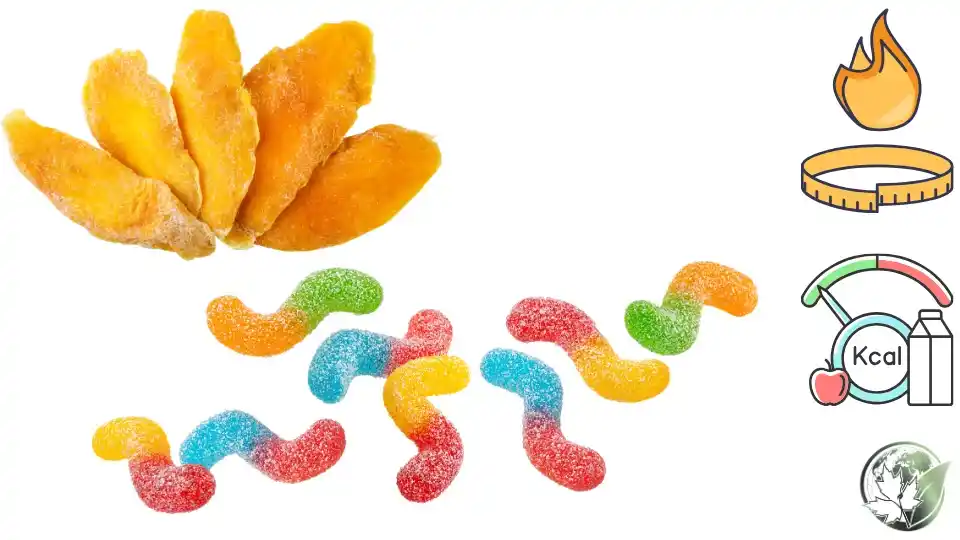
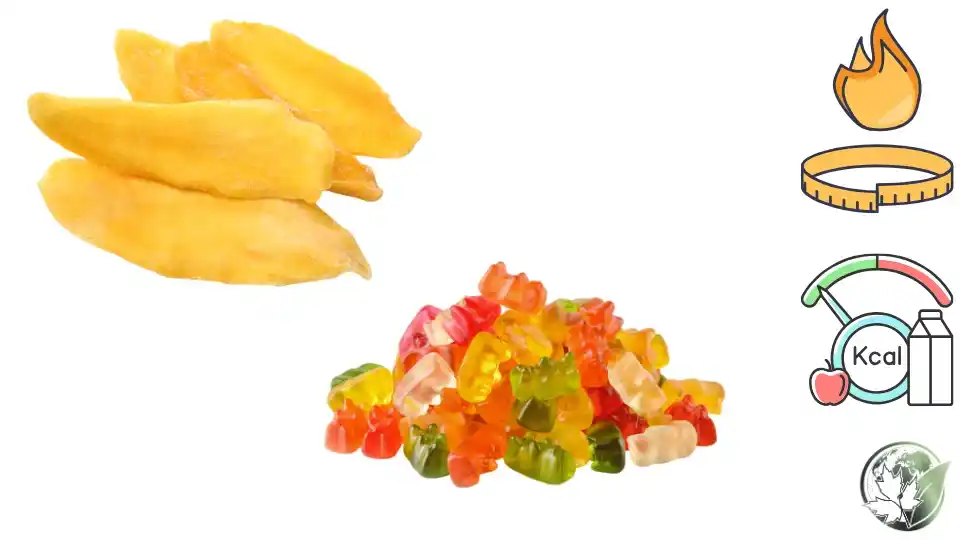
A 30 gram handful of dried mango and a 30 gram handful of gummy bears both have about 100 calories
How Many Calories Are in Dried Mango?
| Dried mango | Weight | Calories | Sugar | Fiber |
|---|---|---|---|---|
| 1 slice (sweetened) | 8 g | 26 kcal | 5.3 g | 0.3 g |
| 3-4 slices (sweetened) | 30 g | 96 kcal | 20 g | 1 g |
| Handful (sweetened) | 40 g | 128 kcal | 26 g | 1.3 g |
| 1/2 cup (sweetened) | 70 g | 223 kcal | 46 g | 2.4 g |
| 100 g (sweetened) | 100 g | 319 kcal | 66 g | 2.4 g |
| 100 g (unsweetened) | 100 g | 314 kcal | 60 g | 5.5 g |
| 30 g (unsweetened) | 30 g | 94 kcal | 18 g | 1.7 g |
| Mango leather | 20 g | 66 kcal | 13 g | 0.8 g |
| Chili-lime dried mango | 30 g | 90 kcal | 17 g | 1 g |
How Many Calories Are in Gummy Candy?
| Gummy candy | Weight | Calories | Sugar | Fiber |
|---|---|---|---|---|
| 1 gummy bear | 2.2 g | 7 kcal | 1 g | 0 g |
| 13-14 gummy bears | 30 g | 100 kcal | 14 g | 0 g |
| Gummy worm | 11 g | 37 kcal | 5.6 g | 0 g |
| Gummy ring | 5 g | 17 kcal | 2.4 g | 0 g |
| Fruit gummies (pectin), 1 serving | 40 g | 130 kcal | 18 g | 0 g |
| Vitamin gummy | 3 g | 10 kcal | 1.5 g | 0 g |
| Sour gummies | 30 g | 105 kcal | 15 g | 0 g |
| 100 g | 100 g | 335 kcal | 47 g | 0 g |
| Bag (150 g) | 150 g | 500 kcal | 70 g | 0 g |
Dried Mango vs Gummy Candy: Calories Compared
| Amount | Dried mango (sweetened) | Gummy candy |
|---|---|---|
| 1 piece | 26 kcal (slice, 8 g) | 7 kcal (bear, 2.2 g) |
| 10 g | 32 kcal | 33 kcal |
| 30 g | 96 kcal | 100 kcal |
| 50 g | 160 kcal | 168 kcal |
| 100 g | 319 kcal | 335 kcal |
| 150 g bag | 479 kcal | 500 kcal |
| 100 calories | 31 g | 30 g |
| Sugar per 100 kcal | 21 g | 14 g |
For equal weights, gummy candy is a few percent higher in calories. For equal calories, dried mango carries more sugar, 21 grams per 100 calories against 14 for gummies. The mango also brings a little fiber and vitamins, which the candy does not.
Dried Mango vs Gummy Candy: Nutrition Compared
| Per 100 g | Dried mango (sweetened) | Dried mango (unsweetened) | Gummy candy |
|---|---|---|---|
| Calories | 319 kcal | 314 kcal | 335 kcal |
| Carbohydrate | 78 g | 79 g | 77 g |
| Sugar | 66 g | 60 g | 47 g |
| Fiber | 2.4 g | 5.5 g | 0 g |
| Protein | 1.5 g | 2.4 g | 6.9 g |
| Fat | 0.8 g | 1.2 g | 0 g |
| Vitamin A | 300 mcg | 360 mcg | 0 mcg |
| Vitamin C | 5 mg | 6 mg | 0 mg |
| Potassium | 300 mg | 400 mg | 4 mg |
| Sodium | 10 mg | 11 mg | 25 mg |
| Per 30 g serving | Dried mango (sweetened) | Gummy candy |
|---|---|---|
| Calories | 96 kcal | 100 kcal |
| Sugar | 20 g | 14 g |
| Sugar cubes (4 g) | 5 | 3.5 |
| Fiber | 0.7 g | 0 g |
| Vitamin A | 90 mcg | 0 mcg |
| Vitamin C | 1.5 mg | 0 mg |
Gelatin gummies contain some protein from the gelatin (6.9 grams per 100 grams), but it is an incomplete protein of little nutritional value. Pectin-based gummies have none. Dried mango offers vitamin A and C and potassium, though drying and sweetening reduce some of the fresh fruit's vitamin C.
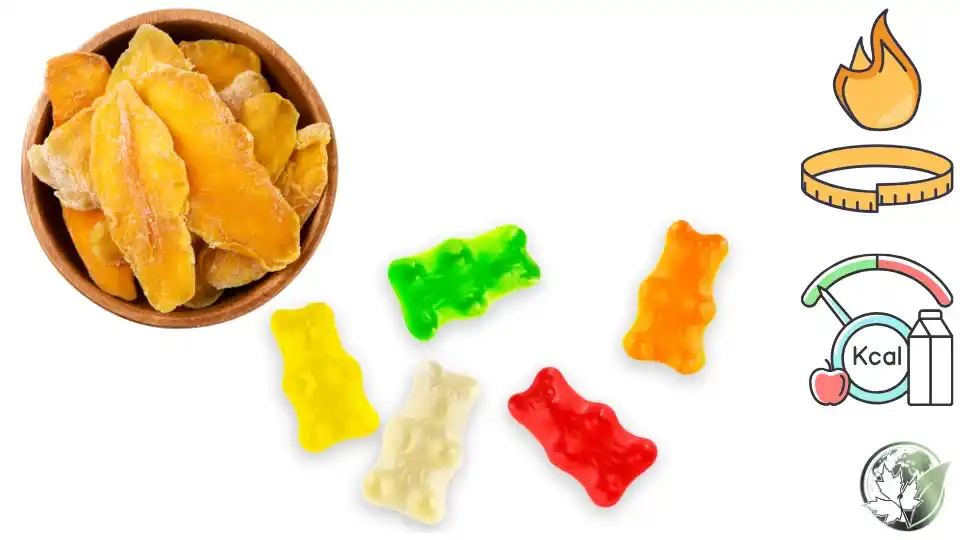
Dried mango has about 20 grams of sugar per 30 grams, more than gummy candy at 14
Which Has More Calories: Dried Mango or Gummy Candy?
Gummy candy is slightly higher per gram, 335 against 319. But dried mango contains more sugar per gram, and a typical bag of dried mango (113 grams) can contain 361 calories and 75 grams of sugar. In practice, you can regard them as equal. The distinction is in the nutrients, the ingredient list and how the snack fills you up.
| Comparison | Calories | Verdict |
|---|---|---|
| 30 g dried mango vs 30 g gummies | 96 vs 100 | About equal |
| 100 g dried mango vs 100 g gummies | 319 vs 335 | Mango slightly lower |
| Sugar in 30 g | 20 g vs 14 g | Gummies lower |
| Fiber in 30 g | 0.7 g vs 0 g | Mango higher |
| Vitamin A | 90 mcg vs 0 | Mango higher |
| Unsweetened dried mango vs gummies (30 g) | 94 vs 100 | Mango lower |
Why Are Dried Mango and Gummy Candy So Similar?
Both are nearly pure sugar. Fresh mango is 82 percent water and 14 percent sugar. Drying removes most of the water and the sugar becomes concentrated, and commercial dried mango is often soaked in sugar syrup before drying, raising the sugar to 66 percent. Gummy candy is made from sugar, glucose syrup, gelatin or pectin, acids and flavorings, and contains around 47 percent sugar plus another 30 percent as glucose syrup. At 4 calories per gram of carbohydrate, both end up at 320 to 335 calories per 100 grams.
Is Dried Mango Healthier Than Gummy Candy?
Unsweetened dried mango is healthier, as it is a whole fruit with fiber, vitamin A, potassium and polyphenols. Sweetened dried mango is closer to candy, though still contains some of these nutrients. Gummy candy provides sugar, flavor and color and little else, apart from the gelatin or pectin. However, because dried mango has more sugar per gram than gummies, its advantage is mainly in the extra nutrients and the lack of artificial colors and flavors. Portion size remains the most important factor.
| Factor | Dried mango (unsweetened) | Dried mango (sweetened) | Gummy candy |
|---|---|---|---|
| Added sugar | None | Yes | Yes |
| Fiber | 5.5 g/100 g | 2.4 g/100 g | 0 |
| Vitamin A | Yes | Yes | No |
| Artificial colors | No | Sometimes | Often |
| Sulfites | Possible | Possible | No |
| Glycemic index | 51 | 60 | 78 |
| Dental risk | High (sticky) | High | High |
What Are Typical Portions of Dried Mango and Gummies?
A serving of dried mango is typically 40 grams, about four slices, with 128 calories. Gummy candy is usually listed as 30 or 40 grams. A small bag of gummies from a corner store may have 50 to 60 grams (170 to 200 calories), and a supermarket bag of dried mango 113 to 227 grams (360 to 720 calories). Large bags make overeating easy. Portion the amount into a bowl and put the bag back in the cupboard.
| Pack | Weight | Calories | Sugar | Sugar cubes |
|---|---|---|---|---|
| Single-serve gummies | 40 g | 134 kcal | 19 g | 4.7 |
| Mini bag of gummies | 55 g | 184 kcal | 26 g | 6.5 |
| Standard bag of gummies | 150 g | 500 kcal | 70 g | 17.5 |
| Single-serve dried mango | 40 g | 128 kcal | 26 g | 6.6 |
| Dried mango bag | 113 g | 361 kcal | 75 g | 18.7 |
| Large dried mango bag | 227 g | 724 kcal | 150 g | 37.5 |
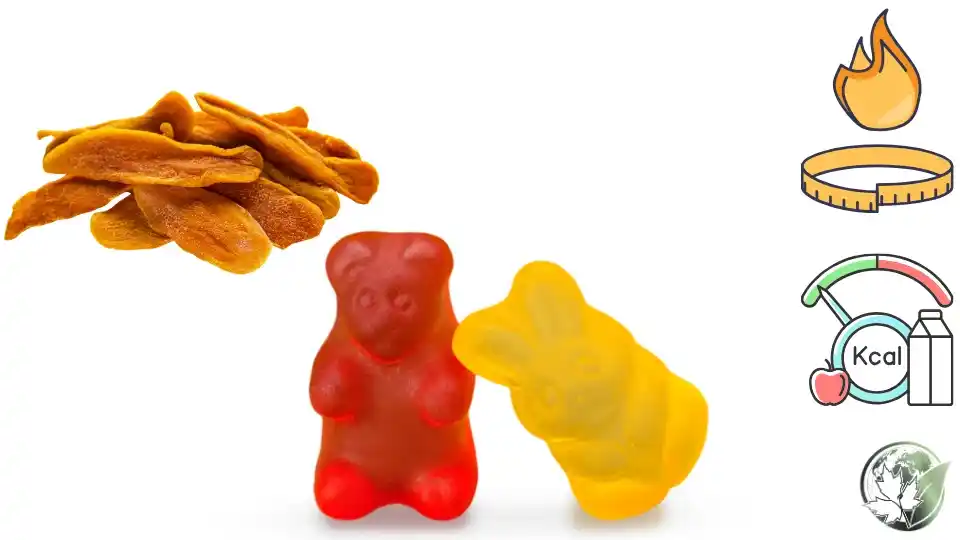
Dried mango with nuts makes a better balanced snack than candy for hiking
Which Is Better for Hiking and Sports?
Both provide quick carbohydrate. Dried mango is lightweight and delivers potassium and some vitamin C, and is easier on the stomach than some gummies, particularly during long activities. Gummies are designed for sports chews in some versions, with added electrolytes. For a hike, a mix of dried mango, nuts and pretzels gives a balance of carbohydrate, fat and salt. A 30 gram portion of mango (96 calories) with 15 almonds (105 calories) is about 200 calories of long-lasting energy.
How Can You Choose a Better Dried Mango?
Read the ingredient list: the best contain only mango. Avoid "sugar", "glucose syrup", "sulfur dioxide" if you are sensitive, and "artificial color". Look for soft, flexible, orange-yellow slices and avoid very hard or sugar-coated ones. Unsweetened dried mango can taste tart at first, but you will adapt over time. Compare the total sugar per 100 grams on the label: below 60 is a good sign.
Can You Replace Gummy Candy With Dried Mango?
If you tend to snack on gummies, replacing them with dried mango (preferably unsweetened) gives you fiber and vitamins, and the chewy, fruity texture, with similar calories. Even better, fresh mango has only 60 calories per 100 grams, so you can have a whole cup (165 grams, 99 calories) for the same energy as a 30 gram handful of gummies. When fresh isn't available, frozen mango chunks are a refreshing, low-calorie choice.
| Swap | Calories | Sugar | Fiber |
|---|---|---|---|
| 30 g gummy candy | 100 kcal | 14 g | 0 g |
| 30 g dried mango (unsweetened) | 94 kcal | 18 g | 1.7 g |
| 1 cup fresh mango (165 g) | 99 kcal | 23 g | 2.6 g |
| 1 cup frozen mango (165 g) | 100 kcal | 22 g | 2.6 g |
| 30 g trail mix with dried mango | 140 kcal | 12 g | 1.5 g |
How Does Dried Mango Affect Blood Sugar Compared With Gummy Candy?
Both are fast carbohydrates, but they behave a little differently. Gummy candy is mostly sucrose and glucose syrup with no fiber, so it is absorbed quickly and has a glycemic index of about 78. Sweetened dried mango has a glycemic index of about 60 and unsweetened about 51, helped by its fiber and the fructose in the fruit. A 30 gram portion of gummies delivers about 22 grams of carbohydrate with a glycemic load near 17, while the same amount of sweetened dried mango delivers 23 grams with a glycemic load around 14. Neither is a good choice for someone managing diabetes in large amounts, but a small portion of unsweetened mango eaten with nuts or yogurt produces a gentler rise than candy eaten alone.
| Snack (30 g) | Carbohydrate | Glycemic index | Glycemic load |
|---|---|---|---|
| Gummy candy | 22 g | 78 | 17 |
| Sweetened dried mango | 23 g | 60 | 14 |
| Unsweetened dried mango | 24 g | 51 | 12 |
| Dried mango with 10 almonds | 27 g | 45 | 12 |
| Fresh mango (100 g) | 15 g | 51 | 8 |
How Much Sugar Is Added to Commercial Dried Mango?
Fresh mango contains roughly 14 grams of natural sugar per 100 grams. When the water is removed, the natural sugar of unsweetened dried mango rises to about 60 grams per 100 grams. Sweetened versions soak the slices in sugar syrup, which can push the total to 66 or even 70 grams. That means a typical 40 gram serving carries 26 grams of sugar, more than six teaspoons. Labels often list the figure as "total sugars" and may show "added sugars" separately, so check both lines. Brands that list only "mango" in the ingredients have no added sugar, though their natural sugar is still high.
| Product type | Ingredients | Sugar per 100 g | Calories per 100 g |
|---|---|---|---|
| Unsweetened dried mango | Mango | 60 g | 314 kcal |
| Lightly sweetened | Mango, sugar | 64 g | 318 kcal |
| Standard sweetened | Mango, sugar, sulfur dioxide | 66 g | 319 kcal |
| Candied or coated mango | Mango, sugar, glucose syrup | 72 g | 340 kcal |
| Chili-lime dried mango | Mango, sugar, chili, lime | 57 g | 300 kcal |
What Is in Gummy Candy Besides Sugar?
Gummy candy usually combines sugar, glucose syrup, water and a gelling agent, either gelatin from animal collagen or plant-based pectin or starch. Citric or malic acid gives sourness, and flavorings, colors and a coating of wax such as carnauba add shine so the pieces do not stick together. Some products add vitamin C or other vitamins, which is why vitamin gummies are marketed as supplements, but they remain candy with 10 calories per piece. People who avoid animal products should check for gelatin, and those sensitive to dyes should look for products colored with fruit and vegetable extracts.
| Ingredient | Role | Calories contributed |
|---|---|---|
| Sugar | Sweetness and bulk | About 4 kcal/g |
| Glucose syrup | Chewy texture, prevents crystals | About 4 kcal/g |
| Gelatin or pectin | Gel structure | Gelatin 4 kcal/g, pectin little |
| Citric acid | Tartness | Minimal |
| Colors and flavors | Appearance and taste | Negligible |
| Wax coating | Shine and anti-stick | Negligible |
How Do Dental Effects Compare?
Both snacks are sticky and cling to teeth, giving bacteria a long supply of sugar. Dried fruit is often assumed to be gentler than candy, but studies on dental health show that sticky dried fruit can remain on the teeth as long as other chewy sweets. Gummies add acid, which can soften enamel, particularly the sour kinds. The practical advice is the same for both: eat them with a meal rather than sipping or grazing through the day, drink water afterward and brush later. Do not brush immediately after acidic sweets.
| Habit | Dried mango | Gummy candy |
|---|---|---|
| Stickiness | High | High |
| Acid exposure | Low to moderate | Moderate to high (sour types) |
| Best timing | With a meal | With a meal |
| After eating | Rinse with water | Rinse with water |
| Frequency to avoid | Constant grazing | Constant grazing |
How Do Children and Adults Differ in Portion Needs?
Children aged 4 to 8 need about 1,200 to 1,600 calories a day, so a 30 gram handful of either snack is 6 to 8 percent of their daily energy, with 14 to 20 grams of sugar. The recommendation for added sugar in this age range is under 25 grams a day, so one serving of sweetened dried mango or gummies can use most of the allowance. For adults on a 2,000 calorie diet, 100 calories is 5 percent. A sensible serving for a child is 15 to 20 grams, about two slices of mango or seven gummy bears, while adults can keep to 30 grams.
| Person | Daily calories | 30 g snack share | Added sugar guideline |
|---|---|---|---|
| Child 4-8 years | 1,400 | 7% | 25 g |
| Teenager | 2,200 | 4.5% | 36 g |
| Adult woman | 2,000 | 5% | 25 g |
| Adult man | 2,500 | 4% | 36 g |
How Can You Make Dried Mango at Home Without Added Sugar?
Slice ripe mango about 5 millimeters thick, lay the slices on a baking tray lined with parchment and dry them in an oven at 70 degrees Celsius (160 Fahrenheit) for six to eight hours, turning once, until leathery but flexible. A food dehydrator at 57 degrees Celsius does the same job in eight to twelve hours. Homemade slices keep for a month in an airtight jar. Four fresh mangoes of about 200 grams each yield approximately 150 grams of dried fruit, roughly 470 calories in all, with no added sugar. Cool the slices fully before storing so they do not clump.
| Step | Setting | Time |
|---|---|---|
| Slice | 5 mm thick | 15 minutes |
| Oven drying | 70 degrees C | 6-8 hours |
| Dehydrator | 57 degrees C | 8-12 hours |
| Cooling | Room temperature | 30 minutes |
| Storage | Airtight jar | Up to 1 month |
What Is the Best Way to Enjoy Either Snack in Moderation?
Decide on a portion before you start, put it in a small bowl and eat slowly. Pair dried mango with unsalted nuts or plain yogurt so protein and fat slow down the sugar. Keep gummies for an occasional treat rather than a daily habit. If you want something chewy and sweet most days, choose unsweetened dried mango, a few dates or frozen grapes. Track the calories if you are managing weight: 100 calories of mango is about four slices, while 100 calories of gummies is about 14 bears, and both disappear quickly.
| Strategy | Example | Calories |
|---|---|---|
| Pre-portion | 30 g dried mango in a bowl | 96 kcal |
| Pair with protein | 30 g mango + 100 g plain yogurt | 155 kcal |
| Pair with fat | 30 g mango + 10 almonds | 170 kcal |
| Occasional treat | 30 g gummies once a week | 100 kcal |
| Frozen alternative | 1 cup frozen mango | 100 kcal |
How Do Dried Mango and Gummy Candy Compare on Price per Calorie?
Gummy candy is usually cheaper per gram than dried mango, which costs more because it takes about five kilograms of fresh fruit to make one kilogram of dried slices. A 150 gram bag of gummy bears is often priced like a 50 gram pack of dried mango. If you buy for nutrition, the extra cost of unsweetened mango buys fiber, vitamin A and potassium. If you buy only for a sweet craving, a smaller portion of either will satisfy you. Buying bulk bags and portioning them at home into small containers lowers the price and also controls how much you eat.
| Item | Typical pack | Calories per pack | Relative cost per 100 kcal |
|---|---|---|---|
| Gummy bears | 150 g | 500 kcal | Low |
| Sweetened dried mango | 113 g | 361 kcal | Medium |
| Unsweetened dried mango | 100 g | 314 kcal | High |
| Fresh mango | 1 whole (200 g) | 120 kcal | Medium |
How Should You Store Dried Mango and Gummy Candy?
Dried mango keeps best in a sealed bag or jar in a cool, dark place for six months, or in the refrigerator for up to a year. Moisture makes slices sticky and mold can grow if they are stored warm and damp. Gummy candy lasts for months at room temperature but melts and clumps together in heat, and turns hard if left open to the air. Neither should be left in a hot car. If dried mango becomes too hard, a few minutes in a covered bowl with a damp paper towel softens it again without changing the calories.
| Food | Room temperature | Refrigerator | Warning sign |
|---|---|---|---|
| Sweetened dried mango | 6 months | 12 months | Mold, sour smell |
| Unsweetened dried mango | 3-4 months | 8 months | Dark spots, hard texture |
| Gummy candy | 6-9 months | Not needed | Melting, hard crust |
| Homemade dried mango | 1 month | 3 months | Moisture, mold |
Key Takeaways: Dried Mango vs Gummy Candy Calories
Sweetened dried mango has about 319 calories per 100 grams and gummy candy 335, so a 30 gram handful of either has roughly 100 calories. Dried mango has more sugar but also fiber and vitamin A. Choose unsweetened dried mango, measure out a portion and pair with nuts, or enjoy fresh mango for fewer calories.
Frequently Asked Questions
6 questions answered
Does dried mango have more calories than gummy candy?
No, 319 against 335 per 100 grams.
How many calories are in a handful of dried mango?
About 96 for 30 grams.
How many calories are in gummy bears?
About 100 for 30 grams, or 7 each.
Is dried mango healthier than gummies?
Unsweetened dried mango is, as it has fiber and vitamins.
Does dried mango have added sugar?
Most commercial slices do; check the label.
What is a low-calorie alternative?
Fresh or frozen mango, at 60 calories per 100 grams.