
How Many Calories Are in Chickpeas? The Quick Answer
Cooked chickpeas have about 164 calories per 100 grams, and one cup (164 g) has about 269 calories. Canned chickpeas, drained, have a little less, about 139 calories per 100 grams. Dried chickpeas, before cooking, have about 364 calories per 100 grams, but they absorb water and roughly double in weight as they cook. A single cooked chickpea weighs about 0.5 grams and has about 1 calorie.
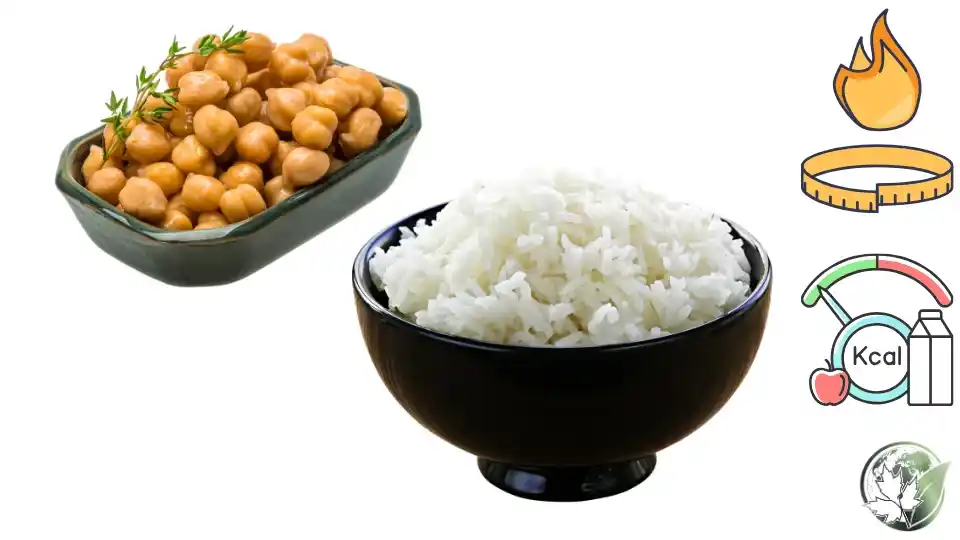
Cooked white rice is the usual side dish chickpeas replace or accompany. One hundred grams of cooked white rice has about 130 calories, and a cup (158 g) has about 205. Chickpeas therefore have about 26 percent more calories per gram and about 31 percent more per cup. But the nutrition per calorie differs greatly: chickpeas have more than three times the protein, about 19 times the fiber and more iron, folate and potassium. A cup of chickpeas provides 14.5 grams of protein and 12.5 grams of fiber, while a cup of white rice provides 4.3 grams of protein and 0.6 grams of fiber.
This guide gives the calories in chickpeas dried, cooked, canned, roasted, as hummus and as falafel, compares them with white and brown rice on calories, protein, fiber, glycemic index and minerals, and shows how to combine them in balanced meals. You will find three comparison tables, tips for cooking and storing and a complete FAQ.
A cup of cooked chickpeas has about 269 calories and 14.5 grams of protein
How Many Calories Are in Cooked, Canned and Dried Chickpeas?
Because chickpeas absorb water when cooked, calories per gram depend on the form. Weigh them as they will be eaten, and use the matching value.
| Chickpea form | Serving | Calories | Protein | Fiber |
|---|---|---|---|---|
| Dried, uncooked | 100 g | 364 kcal | 19.3 g | 17.4 g |
| Dried, uncooked | 1/4 cup (50 g) | 182 kcal | 9.7 g | 8.7 g |
| Cooked, boiled, no salt | 100 g | 164 kcal | 8.9 g | 7.6 g |
| Cooked, boiled | 1/2 cup (82 g) | 135 kcal | 7.3 g | 6.2 g |
| Cooked, boiled | 1 cup (164 g) | 269 kcal | 14.5 g | 12.5 g |
| Canned, drained | 100 g | 139 kcal | 7.1 g | 6.4 g |
| Canned, drained | 1 cup (164 g) | 228 kcal | 11.6 g | 10.5 g |
| Canned, with liquid | 1/2 cup (130 g) | 105 kcal | 5.5 g | 4.8 g |
| 1 tablespoon cooked | 10 g | 16 kcal | 0.9 g | 0.8 g |
| 1 cooked chickpea | 0.5 g | 1 kcal | 0 g | 0 g |
A can of 400 grams (240 grams drained) has about 330 calories and 17 grams of protein, which makes a solid meal base for two people. One cup of dried chickpeas weighs about 200 grams and yields about 3 cups cooked, about 800 calories in total.
How Many Calories Are in Hummus, Falafel and Roasted Chickpeas?
Processing and adding oil, tahini or frying changes the calories a lot.
| Chickpea food | Serving | Calories | Fat |
|---|---|---|---|
| Hummus | 2 tbsp (30 g) | 50 kcal | 3 g |
| Hummus | 1/4 cup (62 g) | 103 kcal | 6 g |
| Falafel patty | 1 patty (17 g) | 57 kcal | 3 g |
| Falafel sandwich in pita | 1 sandwich | 480 kcal | 18 g |
| Roasted chickpeas (snack) | 1 oz (28 g) | 120 kcal | 3 g |
| Chickpea flour (besan) | 1/4 cup (30 g) | 116 kcal | 2 g |
| Chickpea pasta, cooked | 1 cup | 190 kcal | 3.5 g |
| Chana masala | 1 cup | 290 kcal | 9 g |
| Chickpea salad with olive oil | 1 cup | 250 kcal | 9 g |
| Chickpea soup | 1 bowl | 220 kcal | 5 g |
| Chickpea stew with lamb (abgoosht) | 1 bowl | 500 kcal | 22 g |
Hummus is nutritious, but the oil and tahini double its calories per gram compared with plain chickpeas. Falafel is deep fried and adds about 60 to 70 percent more calories than boiled chickpeas of the same weight.
How Many Calories Are in Cooked Rice?
Rice has a similar starch base, but it contains much less protein and fiber. The calories depend on the type of rice and the amount of water it absorbs.
| Rice type | Per 100 g cooked | Per cup | Protein per cup | Fiber per cup |
|---|---|---|---|---|
| White long-grain | 130 kcal | 205 kcal (158 g) | 4.3 g | 0.6 g |
| White, short-grain | 130 kcal | 242 kcal (186 g) | 4.4 g | 0.6 g |
| Brown | 112 kcal | 218 kcal (195 g) | 4.5 g | 3.5 g |
| Basmati | 121 kcal | 191 kcal (158 g) | 4.0 g | 0.7 g |
| Wild rice | 101 kcal | 166 kcal (164 g) | 6.5 g | 3.0 g |
| Persian rice (polo) with oil | 165 kcal | 260 kcal (158 g) | 4.3 g | 0.6 g |
| Tahdig (crust), 1 piece | 50 g | 120 kcal | 2.0 g | 0.2 g |
Persian rice cooked with butter or oil and tahdig is higher in calories than plain boiled rice, an important detail when counting a plate of rice and chickpeas or other stews.
Chickpeas vs Cooked Rice: Calories and Nutrition Compared
When you compare chickpeas and rice, chickpeas win on protein, fiber and minerals, and rice wins on lower calories per gram and simplicity.
| Per 100 g cooked | Chickpeas | White rice | Brown rice |
|---|---|---|---|
| Calories | 164 kcal | 130 kcal | 112 kcal |
| Carbohydrate | 27.4 g | 28.2 g | 23.5 g |
| Protein | 8.9 g | 2.7 g | 2.3 g |
| Fat | 2.6 g | 0.3 g | 0.8 g |
| Fiber | 7.6 g | 0.4 g | 1.8 g |
| Sugar | 4.8 g | 0.1 g | 0.4 g |
| Iron | 2.9 mg | 0.2 mg | 0.5 mg |
| Folate | 172 mcg | 3 mcg | 4 mcg |
| Potassium | 291 mg | 35 mg | 43 mg |
| Magnesium | 48 mg | 12 mg | 43 mg |
| Glycemic index | 28 | 73 | 68 |
| Per typical serving | 1/2 cup chickpeas (82 g) | 1/2 cup white rice (79 g) |
|---|---|---|
| Calories | 135 kcal | 103 kcal |
| Protein | 7.3 g | 2.1 g |
| Fiber | 6.2 g | 0.3 g |
| Iron | 2.4 mg | 0.2 mg |
Chickpeas have about 26 percent more calories than white rice per gram, but 3.3 times the protein and 19 times the fiber. They also have a much lower glycemic index, about 28 versus 73, so they cause a slower rise in blood sugar. For equal calories, chickpeas fill you more.
A plate of chickpeas and rice combines complementary proteins and keeps you full longer
Which Is More Filling per Calorie: Chickpeas or Rice?
Fiber and protein are the two nutrients most strongly linked to satiety. Per 200 calories, you get this much of each.
| 200 calorie portion | Weight | Protein | Fiber |
|---|---|---|---|
| Cooked chickpeas | 122 g | 10.9 g | 9.3 g |
| Cooked white rice | 154 g | 4.2 g | 0.6 g |
| Cooked brown rice | 179 g | 4.1 g | 3.2 g |
| Cooked lentils | 172 g | 15.5 g | 6.9 g |
| Whole wheat pasta | 115 g | 8.1 g | 4.9 g |
| Boiled potato | 258 g | 5.0 g | 5.7 g |
Per 200 calories, chickpeas give 2.6 times the protein of white rice and 15 times the fiber. Studies show that adding legumes to a meal reduces hunger and later calorie intake. For that reason, replacing part of the rice on a plate with chickpeas often lowers total calories in practice, even though chickpeas are more energy dense per gram.
How Do Chickpeas and Rice Affect Blood Sugar?
White rice has a glycemic index of about 73 and a high glycemic load for a large serving, which means it causes a fast rise in blood sugar. Chickpeas have a glycemic index of about 28 because their starch is partly resistant and their fiber and protein slow digestion. When chickpeas and rice are eaten together, the combined glycemic response is lower than that of rice alone. A mix of half rice and half chickpeas can lower the glycemic load of a meal by about 30 to 40 percent.
For people with diabetes, a serving of 1/2 cup of chickpeas has about 22 grams of carbohydrate, and 1/2 cup of rice has about 22 grams. Pairing chickpeas with vegetables and lean protein, and reducing rice portions, is a common recommendation. As always, individual response varies and a health professional can give personalized advice.
What Is the Protein Quality of Chickpeas and Rice Together?
Chickpeas are rich in lysine but low in methionine, while rice is the opposite: rich in methionine and low in lysine. Eating them together provides a more complete amino acid profile, which is why legume and grain combinations are traditional worldwide, such as chickpeas and rice in the Middle East, beans and rice in Latin America and dal and rice in India. A cup of each provides about 19 grams of protein, equal to about 3 ounces of chicken breast, for about 475 calories.
For vegetarians and vegans, this combination is one of the easiest ways to meet protein needs without animal products. The amino acids do not need to be eaten in the same meal, but combining them makes it simple.
Chickpeas and rice together provide a more complete protein than either alone
Are Chickpeas Good for Weight Loss?
Chickpeas can support weight loss because of their fiber and protein. Research on pulses shows that eating about one serving a day is associated with modest weight loss and improved fullness, even without calorie restriction. They are cost effective, and a bowl of chickpea soup or salad is filling for about 250 calories.
The key is portion size and preparation. A cup of boiled chickpeas has 269 calories, but a cup of fried falafel or oily hummus may have 400 to 600. Use plain boiled chickpeas in salads, soups and stews, roast them with spray oil for a crunchy snack and measure hummus in tablespoons.
How to Cook Chickpeas So They Are Soft and Digestible
Dried chickpeas need soaking and long cooking. Rinse them, cover with plenty of water and soak for 8 to 12 hours, then drain and rinse. Simmer in fresh water for 60 to 90 minutes until tender, or cook in a pressure cooker for 15 to 20 minutes. Add salt toward the end, and a pinch of baking soda to soften the skins if desired. Skim foam as it appears.
Soaking and discarding the water reduces compounds that cause gas, and cooking until fully soft improves digestion. If you have a sensitive stomach, start with 1/4 cup and increase gradually. Canned chickpeas are convenient and have similar calories, but rinse them to lower sodium by about 40 percent.
How to Choose and Store Chickpeas
Buy dried chickpeas that are uniform in color, whole and not shriveled. Store in an airtight container in a cool, dark place for up to a year, though older chickpeas take longer to cook. Cooked chickpeas keep in the refrigerator for five days and in the freezer for six months. Canned chickpeas last two to three years unopened. Choose cans labeled low sodium or no salt added when possible, and check that the cans are not dented or bulging.
Dried chickpeas keep for a year, and cooked chickpeas freeze well for six months
How to Count Calories for Chickpeas and Rice Accurately
Weigh them cooked and use the matching values: 164 calories per 100 grams for boiled chickpeas, 139 for canned and drained, and 130 for white rice. If you weigh dried, use 364 for chickpeas and 360 for raw white rice, which both roughly double or triple in weight when cooked. Add oil, butter and sauces separately. For a plate with one cup of cooked rice, half a cup of chickpeas and a tablespoon of oil, the total is about 205 + 135 + 119 = 459 calories.
Why Do Chickpeas Have More Calories per Gram Than Rice?
Both foods absorb water when cooked, but chickpeas absorb less in proportion. Dried chickpeas roughly double in weight when boiled, going from 364 to about 164 calories per 100 grams, while dried rice more than doubles, going from 360 to about 130. Rice also swells more because its starch gelatinizes and traps a lot of water. Chickpeas additionally contain more protein and fat, which have more energy than the water that dilutes rice. Fat contributes about 2.6 grams per 100 grams in chickpeas against 0.3 grams in rice, adding about 21 calories.
It is helpful to remember that the calories in dry food do not change. The calories are the same before and after cooking, but they are spread over more weight after cooking, and the amount of water absorbed determines the final number per 100 grams. That is why cooked weights and dry weights give different values, and why you must be consistent in your tracking.
How Do Chickpeas Compare With Other Legumes and Grains?
Chickpeas belong to the legume family, together with beans, lentils and peas. Their calories are in line with other legumes and higher than most cooked grains.
| Food (cooked, per 100 g) | Calories | Protein | Fiber |
|---|---|---|---|
| Chickpeas | 164 kcal | 8.9 g | 7.6 g |
| Lentils | 116 kcal | 9.0 g | 7.9 g |
| Black beans | 132 kcal | 8.9 g | 8.7 g |
| Kidney beans | 127 kcal | 8.7 g | 6.4 g |
| Green peas | 84 kcal | 5.4 g | 5.5 g |
| White rice | 130 kcal | 2.7 g | 0.4 g |
| Quinoa | 120 kcal | 4.4 g | 2.8 g |
| Whole wheat pasta | 124 kcal | 5.3 g | 3.9 g |
| Couscous | 112 kcal | 3.8 g | 1.4 g |
| Bulgur | 83 kcal | 3.1 g | 4.5 g |
Chickpeas are the most calorie dense of the common legumes because they contain a bit more fat. Lentils and peas are lighter. If you are watching calories closely, lentils offer almost the same protein with about 30 percent fewer calories, and bulgur and quinoa are lighter grains than rice in terms of fiber and protein per calorie.
What Are Some Easy Chickpea and Rice Meals?
Combining the two is simple and economical. A bowl with 1/2 cup of rice, 1/2 cup of chickpeas, roasted vegetables and a spoon of yogurt sauce has about 400 calories and 16 grams of protein. Mix cooked chickpeas into pilaf with onions, tomatoes and spices, or stir them into soups and stews.
| Meal idea | Ingredients | Calories |
|---|---|---|
| Chickpea and rice bowl | 1/2 cup each, vegetables, yogurt | 400 kcal |
| Chickpea pilaf | 1 cup, with onion and spices | 310 kcal |
| Chickpea salad | Chickpeas, cucumber, tomato, olive oil | 280 kcal |
| Chana masala with rice | 1 cup curry, 1/2 cup rice | 395 kcal |
| Stuffed peppers | Rice, chickpeas, herbs, 2 halves | 330 kcal |
| Chickpea soup with a little rice | 1 bowl | 260 kcal |
These meals are affordable, nutrient rich and satisfying. Adding vegetables, herbs and spices boosts flavor and nutrients without many calories, and a squeeze of lemon adds vitamin C that improves iron absorption from the legumes.
How Do Chickpeas Fit Into Special Diets?
Chickpeas are vegan, gluten free and rich in plant protein, so they fit vegetarian, vegan and celiac diets, as long as the preparation does not include gluten ingredients. They are high in carbohydrate, so they are limited on strict low-carbohydrate or ketogenic diets, where a small amount of 1/4 cup might fit. For people with irritable bowel syndrome on a low-FODMAP diet, canned and rinsed chickpeas in small portions, about 1/4 cup, are usually tolerated, while larger servings may cause symptoms.
For people with kidney disease, the potassium and phosphorus in chickpeas may need to be limited, as advised by a dietitian. For athletes, chickpeas offer slow-digesting carbohydrates and protein for recovery and sustained energy.
How Can You Reduce Gas From Chickpeas?
Chickpeas contain oligosaccharides such as raffinose and stachyose, which humans cannot digest. Gut bacteria ferment them and produce gas. You can reduce the effect with a few steps. Soak dried chickpeas for at least 8 hours in plenty of water and discard the soaking water. Cook them until very soft. Rinse canned chickpeas well. Introduce legumes gradually, starting with small portions and building up over weeks, as gut bacteria adapt. Spices such as cumin, fennel, ginger and asafoetida are traditionally used to make legumes easier to digest, and drinking water with high-fiber meals helps as well.
What Is the Cost Advantage of Chickpeas Over Rice?
Both are low cost foods, but chickpeas give far more protein per unit of cost. A kilogram of dried chickpeas yields about 2.5 kilograms of cooked chickpeas, enough for about 15 servings with 15 grams of protein each. Rice is cheaper per kilogram, but each serving contains only 4 grams of protein. For households, mixing the two keeps costs low while improving nutrition. For importers and retailers, chickpeas are a stable dry commodity with a long shelf life, and quality depends on size, color uniformity, moisture content and the share of broken or damaged seeds.
How Much Chickpeas and Rice Should You Eat in One Meal?
A good guide for adults is to fill half the plate with vegetables, a quarter with protein and a quarter with starch. Chickpeas can serve as both protein and starch, so a portion of 3/4 cup of chickpeas (about 200 calories) with 1/4 cup of rice (about 50 calories) and a large serving of vegetables is a balanced, filling meal of about 300 calories. People with higher energy needs, such as athletes or manual workers, can increase to a full cup of each, for about 475 calories. Adjust to your hunger and goals, and use measuring cups at first so you learn what the portions look like.
Key Takeaways: Chickpeas Calories vs Cooked Rice
Cooked chickpeas have about 164 calories per 100 grams and 269 per cup, higher than white rice at 130 and 205. They have more than three times the protein, 19 times the fiber and a much lower glycemic index, making them more filling per calorie. Use chickpeas in place of part of the rice, watch added oil and enjoy the combination for a complete plant protein.
Frequently Asked Questions
9 questions answered
How many calories are in chickpeas?
Cooked chickpeas have about 164 calories per 100 grams and 269 per cup. Dried have about 364 per 100 grams.
How many calories are in canned chickpeas?
Drained canned chickpeas have about 139 calories per 100 grams, or about 228 per cup.
Do chickpeas have more calories than rice?
Per gram, yes: 164 versus 130 for cooked white rice. They also have far more protein and fiber.
How many calories are in hummus?
About 50 calories in two tablespoons, because of the added tahini and oil.
Are chickpeas good for weight loss?
Yes, as part of a balanced diet, because their fiber and protein help you feel full.
Which has more protein, chickpeas or rice?
Chickpeas, about 8.9 grams per 100 grams cooked versus 2.7 for white rice.
How many calories are in falafel?
A falafel patty has about 57 calories, and a falafel sandwich about 480.
Can I replace rice with chickpeas?
Partly. Replacing half the rice with chickpeas adds protein and fiber and lowers the glycemic load.
How many calories are in roasted chickpeas?
About 120 calories per ounce for a typical snack.




