How Many Calories Are in Chicken Liver vs Chicken Breast? The Quick Answer
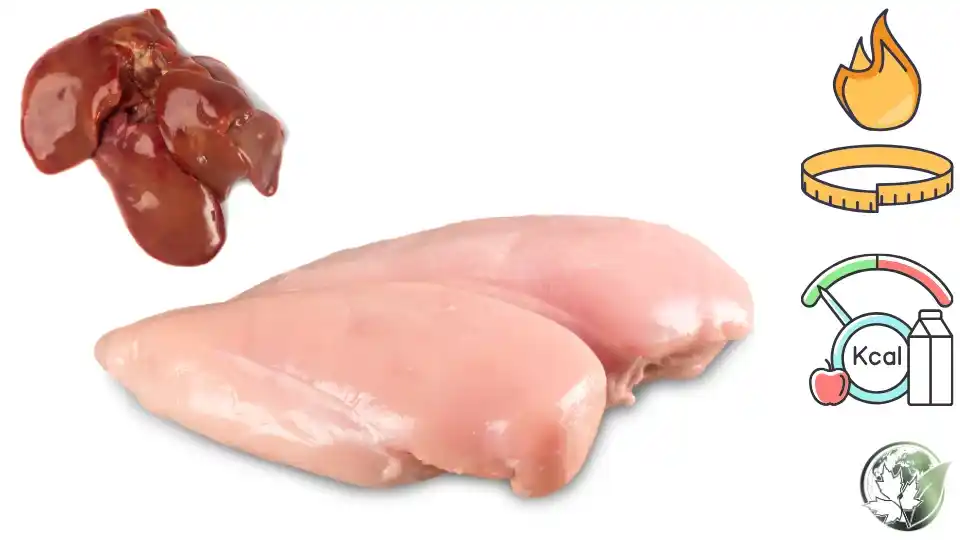
Cooked chicken liver has about 167 calories per 100 grams, and cooked skinless chicken breast has about 165, so the two are practically equal. Raw, chicken liver has about 119 calories per 100 grams and raw skinless chicken breast about 120. The calories are almost the same, but the nutritional profile is very different. Chicken breast gives 31 grams of protein per 100 grams cooked, compared with 24.5 grams in liver, and has very little fat (3.6 grams against 6.5 grams). Liver, on the other hand, is one of the most nutrient-dense foods you can eat, with huge amounts of vitamin A, vitamin B12, folate, iron and copper, and also about 560 milligrams of cholesterol per 100 grams, compared with 85 for breast.
How the liver is cooked matters as much as the cut. Pan-fried in oil or butter, 100 grams of chicken liver can reach 200 to 230 calories, while a breaded and deep-fried liver can exceed 300. A chicken breast is also affected by cooking: grilled without skin it has 165 calories, but fried in batter 250 or more. This guide compares chicken liver and chicken breast per 100 grams and per serving, raw and cooked, shows the nutrients that set them apart, and explains how much liver is a sensible portion. It has three comparison tables and an FAQ.
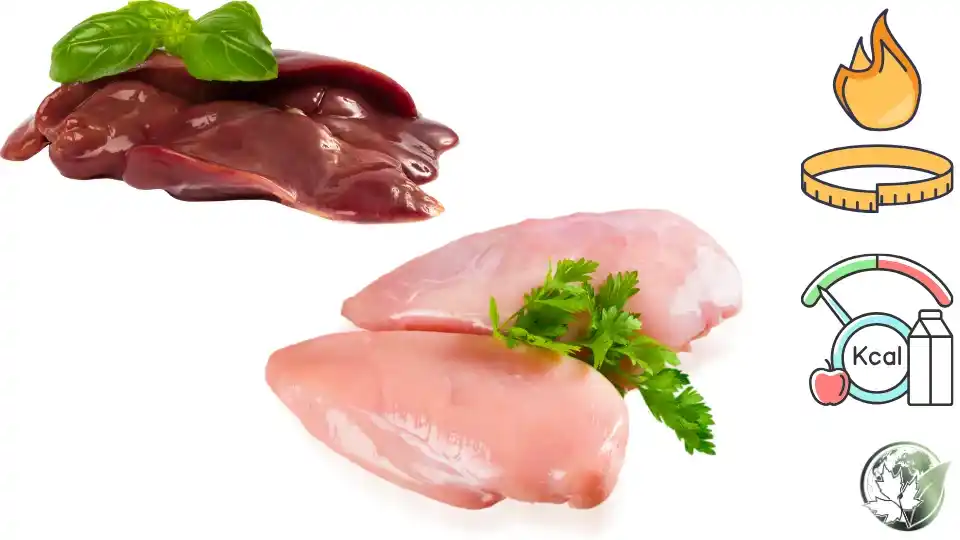
Cooked chicken liver and cooked chicken breast have almost identical calories per 100 grams
How Many Calories Are in Chicken Liver?
| Chicken liver preparation | Per 100 g | Typical serving | Calories per serving |
|---|---|---|---|
| Raw | 119 kcal | 100 g | 119 kcal |
| Simmered or boiled | 167 kcal | 85 g | 142 kcal |
| Pan-fried, 1 tsp oil | 190 kcal | 85 g | 162 kcal |
| Pan-fried with onions | 185 kcal | 150 g | 278 kcal |
| Sauteed in butter | 215 kcal | 85 g | 183 kcal |
| Breaded and deep fried | 290 kcal | 85 g | 247 kcal |
| Chicken liver pate | 201 kcal | 30 g | 60 kcal |
| Grilled on skewers (jigar kabab) | 175 kcal | 100 g | 175 kcal |
One average chicken liver weighs 25 to 30 grams raw, which is about 33 calories, or 40 calories cooked. A typical serving of 3 to 4 livers (85 grams cooked) is around 140 to 165 calories.
How Many Calories Are in Chicken Breast?
| Chicken breast preparation | Per 100 g | Typical serving | Calories per serving |
|---|---|---|---|
| Raw, skinless | 120 kcal | 170 g | 204 kcal |
| Grilled or roasted, skinless | 165 kcal | 120 g | 198 kcal |
| Boiled or poached | 151 kcal | 120 g | 181 kcal |
| Pan-fried, 1 tsp oil | 185 kcal | 120 g | 222 kcal |
| With skin, roasted | 197 kcal | 120 g | 236 kcal |
| Breaded and deep fried | 260 kcal | 120 g | 312 kcal |
| Grilled kabab (barg, marinated) | 175 kcal | 100 g | 175 kcal |
| Canned in water | 117 kcal | 85 g | 99 kcal |
A typical boneless, skinless breast weighs 170 to 200 grams raw and 120 to 140 grams cooked, giving 200 to 230 calories.
Chicken Liver vs Chicken Breast: Calories Compared
| Amount | Chicken liver (cooked) | Chicken breast (cooked) |
|---|---|---|
| 28 g (1 oz) | 47 kcal | 46 kcal |
| 85 g (3 oz) | 142 kcal | 140 kcal |
| 100 g | 167 kcal | 165 kcal |
| 150 g | 251 kcal | 248 kcal |
| 200 g | 334 kcal | 330 kcal |
| 100 g raw | 119 kcal | 120 kcal |
| 100 calories | 60 g | 61 g |
| Protein per 100 kcal | 14.7 g | 18.8 g |
| Fat per 100 kcal | 3.9 g | 2.2 g |
For the same calories, breast gives about 28 percent more protein and 44 percent less fat. In the pan, oil can tip the balance, since liver absorbs more fat than breast when fried.
Chicken Liver vs Chicken Breast: Nutrition Compared
| Per 100 g cooked | Chicken liver | Chicken breast |
|---|---|---|
| Calories | 167 kcal | 165 kcal |
| Protein | 24.5 g | 31 g |
| Fat | 6.5 g | 3.6 g |
| Saturated fat | 2.1 g | 1 g |
| Cholesterol | 563 mg | 85 mg |
| Carbohydrate | 0.9 g | 0 g |
| Iron | 11.6 mg | 1 mg |
| Vitamin A | 3,296 mcg | 6 mcg |
| Vitamin B12 | 16.6 mcg | 0.3 mcg |
| Folate | 588 mcg | 4 mcg |
| Riboflavin (B2) | 2.3 mg | 0.1 mg |
| Selenium | 77 mcg | 27 mcg |
| Copper | 0.5 mg | 0.04 mg |
| Zinc | 3.8 mg | 1 mg |
| Sodium | 71 mg | 74 mg |
| % of daily value, per 100 g | Chicken liver | Chicken breast |
|---|---|---|
| Vitamin A | 366% | 1% |
| Vitamin B12 | 692% | 13% |
| Folate | 147% | 1% |
| Iron | 64% | 6% |
| Copper | 55% | 4% |
| Protein | 49% | 62% |
Liver has hundreds of percent of the daily value for several vitamins, and is sometimes called a natural multivitamin. That is exactly why portions should be modest, especially for pregnant women and for those who take vitamin A supplements.
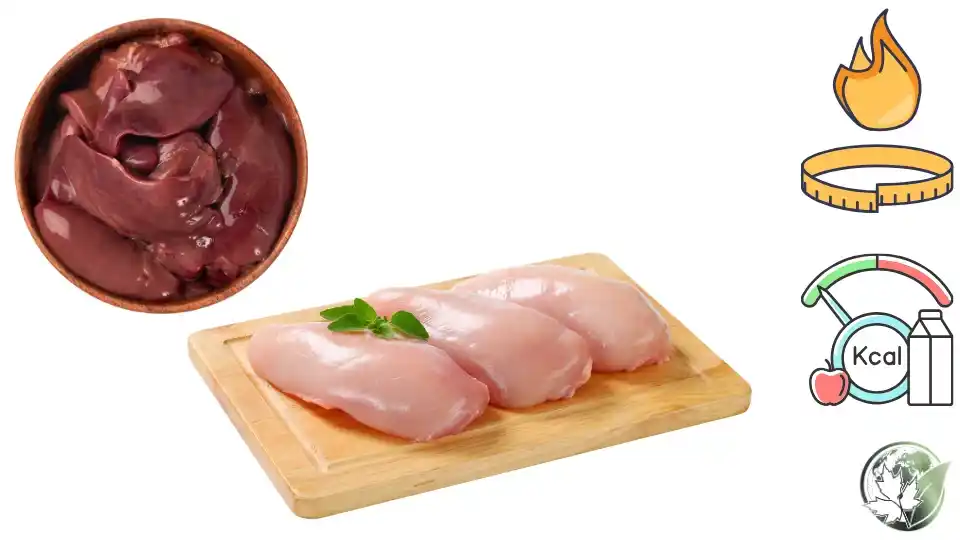
A 100 g serving of cooked chicken liver provides more than three times the daily vitamin A need
Which Has More Calories: Chicken Liver or Chicken Breast?
They are equal in the raw state and almost equal when cooked by simple methods. The decisive factor is the cooking method. Liver is soft and spongy, and soaks up oil during frying. Chicken breast is dry and can be cooked with almost no fat, but when fried or breaded it also increases. For the calories, either one is a good choice.
| Comparison | Calories | Verdict |
|---|---|---|
| Raw liver vs raw breast (100 g) | 119 vs 120 | Equal |
| Simmered liver vs grilled breast (100 g) | 167 vs 165 | Equal |
| Pan-fried liver vs pan-fried breast | 190 vs 185 | About equal |
| Butter-sauteed liver vs grilled breast | 215 vs 165 | Breast lower |
| Breaded fried liver vs breaded fried breast | 290 vs 260 | Breast lower |
| Protein per calorie | 14.7 vs 18.8 g/100 kcal | Breast higher |
Why Are Their Calories So Similar?
Both are lean, high-protein meats. Chicken breast is made of muscle with very little fat. Chicken liver is an organ that stores glycogen (a form of carbohydrate), vitamins and iron, and has a small amount of fat. Protein supplies 4 calories per gram, so 24 to 31 grams of protein account for 100 to 125 calories in both cases, with fat and a little carbohydrate making up the rest. As the liver contains slightly more fat and carbohydrate, it is slightly higher in calories per gram of protein.
What Is the Nutritional Value of Chicken Liver?
Chicken liver is among the best natural sources of vitamin A (as retinol), vitamin B12, folate, riboflavin and iron in the human diet. A 100 gram serving of cooked liver provides more than the daily need for vitamin A, B12 and folate, and 64 percent of the iron, in a highly absorbable heme form. It also has high amounts of choline, important for the brain and liver, and copper. It is a particularly useful food for people with low iron or B12, though they should be advised by their doctor. Liver is also naturally free of carbohydrates apart from about 1 gram.
| Nutrient in a 50 g serving (cooked liver) | Amount | % daily value |
|---|---|---|
| Vitamin A | 1,648 mcg | 183% |
| Vitamin B12 | 8.3 mcg | 346% |
| Folate | 294 mcg | 74% |
| Iron | 5.8 mg | 32% |
| Riboflavin | 1.2 mg | 92% |
| Choline | 165 mg | 30% |
| Calories | 84 kcal | n/a |
How Much Cholesterol Is in Chicken Liver?
Chicken liver has about 563 milligrams of cholesterol per 100 grams, which is very high, compared to 85 for chicken breast and 372 for a large egg (per 100 grams). In the past, dietary guidelines limited cholesterol to 300 milligrams a day. Now the main guidelines emphasize that saturated fat has a larger influence on blood cholesterol than dietary cholesterol for most people. Still, people with high LDL cholesterol, familial hypercholesterolemia or diabetes are usually advised to limit organ meats. A small serving of 50 grams once a week is a common recommendation for healthy adults.
How Much Chicken Liver Can You Safely Eat?
Because liver is rich in preformed vitamin A, eating it in large amounts regularly may lead to excess. The tolerable upper intake for adults is 3,000 micrograms of retinol a day, and 100 grams of chicken liver has 3,296. Eating 100 grams once a week is fine for most healthy adults, while pregnant women are advised to avoid liver or to limit it heavily because too much vitamin A can harm the baby. Children should eat smaller portions of 20 to 30 grams. Cook liver thoroughly to 74 degrees Celsius to kill bacteria such as Campylobacter and Salmonella. Do not eat pink liver or lightly seared pate unless it is made safely.
| Group | Suggested liver portion | Frequency |
|---|---|---|
| Healthy adults | 50-100 g | Once a week |
| Older adults with low iron | 50-85 g | Once a week |
| Children (4-8 years) | 20-30 g | Occasionally |
| Pregnant women | Avoid or very small | Ask your doctor |
| People with high cholesterol or gout | Avoid or limit | Ask your doctor |
Is Chicken Liver or Chicken Breast Better for Weight Loss?
Chicken breast is the classic weight loss protein, because it provides 31 grams of protein for 165 calories, with very little fat, so it is easy to fit into a deficit. Chicken liver has about the same calories but less protein and a small amount of fat. It can also be part of a weight loss plan. A small serving offers iron and B12, vitamins that are sometimes low in people who restrict their intake. A reasonable approach is to use breast as the staple and add liver once a week.
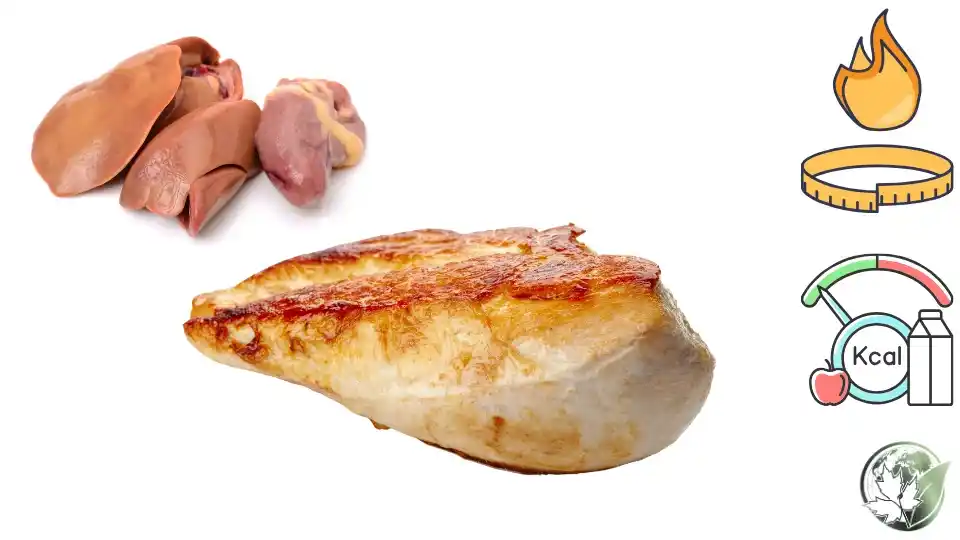
A grilled chicken breast with vegetables is a classic lean meal of about 350 calories
How Do You Cook Chicken Liver Without Adding Many Calories?
Rinse the livers, trim any green or white connective tissue and pat dry. Cook in a non-stick pan with a teaspoon of olive oil and chopped onion over medium heat for 5 to 7 minutes, until no pink remains and the center reaches 74 degrees Celsius. Do not overcook, as it becomes grainy. Season with garlic, pepper, lemon juice, parsley or sumac. Soaking in milk for 30 minutes can soften the taste. Avoid breading and deep-frying, which add 100 calories or more per serving.
| Method (85 g liver) | Added fat | Calories |
|---|---|---|
| Simmered in water | 0 | 142 kcal |
| Baked or grilled | 0 | 145 kcal |
| Pan-fried, 1 tsp oil | 5 g | 162 kcal |
| Pan-fried, 1 tbsp butter | 14 g | 215 kcal |
| Breaded and deep fried | 12 g | 247 kcal |
How Do You Cook Chicken Breast Without Drying It Out?
Brine for 30 minutes in cold water with a tablespoon of salt, or pound to an even thickness. Cook on a hot pan or grill for 5 to 6 minutes per side, until the center reaches 74 degrees Celsius, then rest for 5 minutes. Poach gently in barely simmering water for 15 minutes for salads and sandwiches. Marinate in yogurt, lemon, garlic and saffron, as in a classic joojeh kabab, to keep it juicy with no added oil.
How Do Chicken Liver and Chicken Breast Compare With Other Meats?
Chicken breast and liver sit at the lean end of the meat spectrum. Beef liver has similar calories to chicken liver but even more vitamin A and iron. Chicken thigh, lamb and beef cuts contain more fat and so more calories per 100 grams. Putting them side by side helps when planning meals, particularly for those choosing between organ meats and muscle meats.
| Cooked meat, 100 g | Calories | Protein | Fat | Iron |
|---|---|---|---|---|
| Chicken breast, skinless | 165 kcal | 31 g | 3.6 g | 1 mg |
| Chicken liver | 167 kcal | 24.5 g | 6.5 g | 11.6 mg |
| Chicken thigh, skinless | 209 kcal | 26 g | 10.9 g | 1.3 mg |
| Chicken heart | 185 kcal | 26 g | 7.9 g | 6 mg |
| Chicken gizzard | 154 kcal | 30 g | 2.7 g | 3.4 mg |
| Beef liver | 175 kcal | 27 g | 4.7 g | 6.5 mg |
| Lean beef steak | 217 kcal | 26 g | 12 g | 2.6 mg |
| Lamb leg | 258 kcal | 25 g | 17 g | 1.8 mg |
| Turkey breast | 135 kcal | 30 g | 0.7 g | 1.4 mg |
What Are the Other Chicken Organ Meats and Their Calories?
In many cuisines, chicken hearts, gizzards and livers are grilled together. Hearts and gizzards are lean and chewy, with good protein and iron, and are popular skewered over charcoal. They are less rich in vitamin A than liver but also lower in cholesterol per 100 grams for the gizzard. A mixed skewer of 100 grams of hearts, gizzards and livers has about 170 calories.
| Chicken organ (cooked, 100 g) | Calories | Protein | Cholesterol |
|---|---|---|---|
| Liver | 167 kcal | 24.5 g | 563 mg |
| Heart | 185 kcal | 26 g | 242 mg |
| Gizzard | 154 kcal | 30 g | 240 mg |
| Mixed skewer | 170 kcal | 26 g | 350 mg |
Does Chicken Liver Help With Anemia?
Chicken liver is one of the best food sources of heme iron, which the body absorbs at a rate of 15 to 35 percent, compared to 2 to 20 percent for the iron in plants. It also contains vitamin B12 and folate, which are needed for red blood cell production. For people with mild iron deficiency, adding a small serving of liver once a week can help raise levels, though a doctor should diagnose and treat anemia, and supplements are often needed. Pairing liver with vitamin C, such as a squeeze of lemon, a tomato salad or peppers, boosts absorption of non-heme iron from other foods on the plate.
What Should You Watch for When Buying Chicken Liver?
Choose livers that are glossy, plump and a uniform reddish-brown, with no green or yellow patches and no strong or sour smell. They should be refrigerated at the store and used within one to two days, or frozen immediately for up to three months. Thaw in the refrigerator, not on the counter. Always wash your hands, board and knife after handling raw liver, since raw poultry organs can carry Campylobacter. Free-range or organic chicken liver may differ in fat and nutrient content, but the calories are about the same.
How Do Portions Look on the Plate?
A palm-sized piece of chicken breast of 120 grams cooked supplies about 198 calories and 37 grams of protein. A serving of liver of four small pieces, 85 grams cooked, supplies around 142 calories and 21 grams of protein. Serving the liver with sauteed onions, a salad and rice or bread makes a complete meal. The usual plate is half vegetables, a quarter protein and a quarter starch.
| Meal | Calories | Protein |
|---|---|---|
| Grilled chicken breast (120 g), rice (1 cup), salad | 480 kcal | 42 g |
| Pan-fried liver (85 g) with onions, bread and salad | 330 kcal | 24 g |
| Chicken breast sandwich, whole grain | 380 kcal | 35 g |
| Liver pate on toast (30 g + 1 slice) | 140 kcal | 7 g |
| Liver kabab, rice, grilled tomato | 520 kcal | 28 g |
Is Chicken Liver Safe for People With Gout or Kidney Problems?
Organ meats are high in purines, which the body converts to uric acid, and people with gout are generally advised to avoid or strictly limit them. A 100 gram serving of chicken liver has around 312 milligrams of purines, among the highest of any food, whereas chicken breast has about 175, which is moderate. People with kidney disease may also need to limit protein, phosphorus and potassium, and should follow their dietitian's advice. For healthy people without these conditions, an occasional serving is not a concern.
| Food (100 g) | Purines | Gout guidance |
|---|---|---|
| Chicken liver | 312 mg | Avoid |
| Chicken breast | 175 mg | Moderate portions |
| Beef liver | 554 mg | Avoid |
| Sardines | 480 mg | Avoid or limit |
| Eggs | 5 mg | Fine |
| Low-fat yogurt | 8 mg | Fine |
How Can You Flavor Chicken Liver and Breast With Few Calories?
Spices and acids deliver flavor without calories. For liver: onion, garlic, sumac, parsley, black pepper, a splash of pomegranate molasses (20 calories per teaspoon) or a squeeze of lemon. For breast: saffron and yogurt marinade, lemon and za'atar, smoked paprika, or herbs and mustard. Cooking sprays, a nonstick pan and a hot grill reduce the need for oil. A teaspoon of olive oil is 40 calories, while a tablespoon of butter is 102.
What Is a Balanced Weekly Plan With Chicken Liver and Breast?
A sensible week for a healthy adult could include chicken breast three times (about 120 grams each), fish twice, legumes twice, and chicken liver or another organ meat once in a small portion of 50 to 85 grams. The total of about 600 grams of cooked breast and 85 grams of liver supplies around 1,130 calories and 200 grams of protein across the week, leaving room for other foods. Rotating proteins reduces exposure to any single nutrient excess or contaminant and keeps meals interesting.
How Do You Store and Reheat Cooked Liver and Breast Safely?
Cooked chicken liver and breast should be cooled within two hours, refrigerated in airtight containers and eaten within three to four days. Liver in particular can develop a strong flavor on storage, so it is best eaten fresh. Freeze cooked portions for up to three months. Reheat to 74 degrees Celsius throughout, stirring or turning so that it heats evenly, and avoid reheating more than once. Pate should be kept cold and eaten within three days of opening.
| Item | Fridge | Freezer |
|---|---|---|
| Raw chicken liver | 1-2 days | 3 months |
| Raw chicken breast | 1-2 days | 9 months |
| Cooked chicken liver | 3 days | 3 months |
| Cooked chicken breast | 3-4 days | 4 months |
| Liver pate, opened | 3 days | 2 months |
Key Takeaways: Chicken Liver vs Chicken Breast Calories
Cooked chicken liver has about 167 calories per 100 grams and cooked chicken breast 165, so they are equal, while raw values are 119 and 120. Breast offers more protein and less fat and cholesterol, while liver is a concentrated source of iron, vitamin A, B12 and folate. Eat breast as a regular lean protein, and liver in small portions about once a week, cooked thoroughly with little added fat.
Frequently Asked Questions
6 questions answered
Does chicken liver have more calories than chicken breast?
No, they are almost equal: 167 against 165 per 100 grams cooked.
How many calories are in one chicken liver?
About 33 raw and 40 cooked.
Which has more protein, liver or breast?
Breast, with 31 grams per 100 grams against 24.5.
Is chicken liver good for you?
It is very rich in iron, B12 and vitamin A, but should be eaten in moderation.
How often can I eat chicken liver?
About once a week for healthy adults.
Is chicken liver high in cholesterol?
Yes, about 563 milligrams per 100 grams.