How Many Calories Are in Cheese vs Greek Yogurt? The Quick Answer
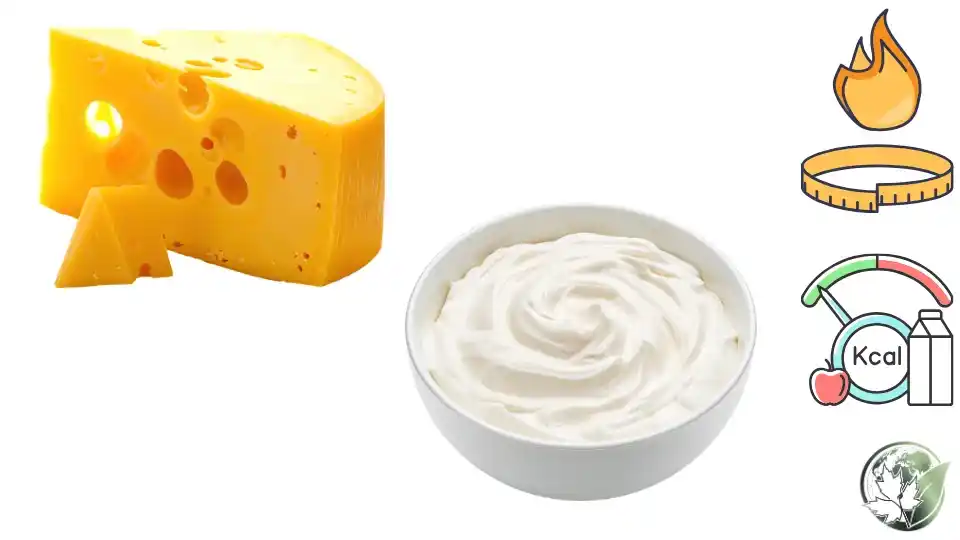
Cheese is much more concentrated than Greek yogurt. Cheddar has about 403 calories per 100 grams, which is 113 per ounce (28 grams) or 70 per slice of 17 grams. Part-skim mozzarella has about 254 per 100 grams, feta 264 and cottage cheese 98. Plain nonfat Greek yogurt has 59 per 100 grams, or 17 per ounce, and plain whole milk Greek yogurt has 97 per 100 grams, or 27 per ounce. So hard cheese has about four to seven times more calories than Greek yogurt by weight, and even soft, lighter cheeses have double or more.
The explanation is again water and fat. Greek yogurt is about 80 to 85 percent water, while cheddar is only 37 percent, and cheese is made by removing whey and concentrating the milk's fat and protein. It takes about 10 liters of milk to make 1 kilogram of cheese. Yogurt keeps much more of its water. Cheese does have more protein per 100 grams (25 grams in cheddar compared with 10 grams in nonfat Greek yogurt) and much more calcium, and fits many diets when used in sensible portions. This guide compares cheese and Greek yogurt per ounce, slice, tablespoon and 100 grams, looks at the types of cheese, and explains how to choose between them for different goals. It has three comparison tables and an FAQ.
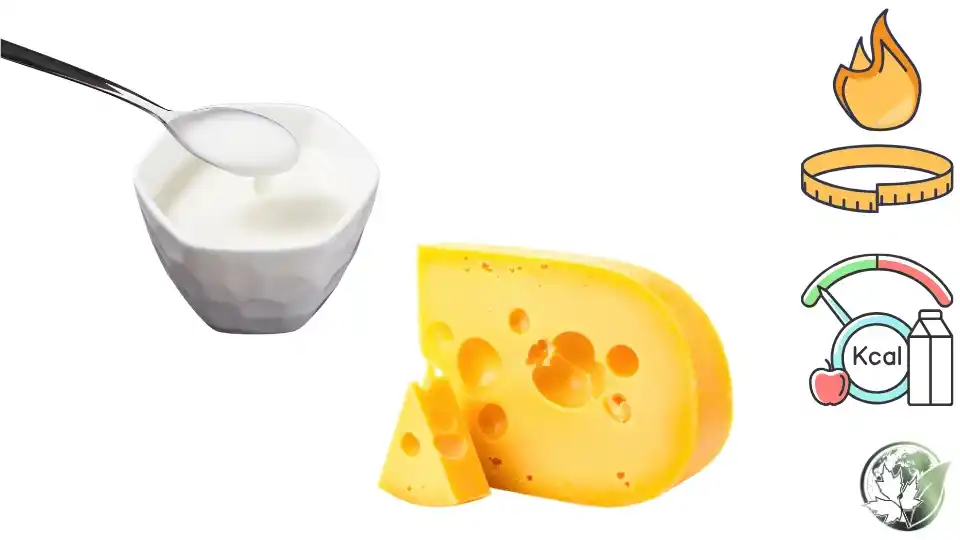
An ounce of cheddar has about six times the calories of an ounce of nonfat Greek yogurt
How Many Calories Are in Cheese?
| Cheese | Per 28 g (1 oz) | Per 100 g | Fat per 100 g | Protein per 100 g |
|---|---|---|---|---|
| Cheddar | 113 kcal | 403 kcal | 33 g | 25 g |
| Mozzarella, whole milk | 85 kcal | 300 kcal | 22 g | 22 g |
| Mozzarella, part-skim | 72 kcal | 254 kcal | 16 g | 24 g |
| Feta | 74 kcal | 264 kcal | 21 g | 14 g |
| Persian white cheese (panir) | 74 kcal | 264 kcal | 21 g | 14 g |
| Parmesan | 122 kcal | 431 kcal | 29 g | 38 g |
| Swiss | 106 kcal | 380 kcal | 28 g | 27 g |
| Gouda | 101 kcal | 356 kcal | 27 g | 25 g |
| Brie | 95 kcal | 334 kcal | 28 g | 21 g |
| Cream cheese | 96 kcal | 342 kcal | 34 g | 6 g |
| Cottage cheese, 2% | 23 kcal | 81 kcal | 2.3 g | 11 g |
| Ricotta, part-skim | 40 kcal | 138 kcal | 8 g | 11 g |
Common portions: 1 cheddar slice (21 g) 85 kcal, 1 string cheese (28 g) 80 kcal, 1 tablespoon grated parmesan (5 g) 22 kcal, 1/4 cup shredded cheddar (28 g) 113 kcal, 1 tablespoon cream cheese (14 g) 50 kcal.
How Many Calories Are in Greek Yogurt?
| Greek yogurt | Per 28 g (1 oz) | Per 100 g | Per tub (170 g) | Fat per 100 g | Protein per 100 g |
|---|---|---|---|---|---|
| Nonfat | 17 kcal | 59 kcal | 100 kcal | 0.4 g | 10.2 g |
| Low fat (2%) | 20 kcal | 73 kcal | 124 kcal | 1.9 g | 9.9 g |
| Whole milk | 27 kcal | 97 kcal | 165 kcal | 5 g | 9 g |
| Strained, thick | 31 kcal | 110 kcal | 187 kcal | 6 g | 9 g |
A spoonful of Greek yogurt (15 grams) has 9 calories if nonfat and 15 if whole milk. A 200 gram bowl has 118 or 194 calories.
Cheese vs Greek Yogurt: Calories Compared
| Amount | Cheddar | Mozzarella (part-skim) | Cottage cheese (2%) | Nonfat Greek yogurt | Whole Greek yogurt |
|---|---|---|---|---|---|
| 28 g | 113 kcal | 72 kcal | 23 kcal | 17 kcal | 27 kcal |
| 50 g | 202 kcal | 127 kcal | 41 kcal | 30 kcal | 49 kcal |
| 100 g | 403 kcal | 254 kcal | 81 kcal | 59 kcal | 97 kcal |
| 150 g | 605 kcal | 381 kcal | 122 kcal | 89 kcal | 146 kcal |
| 100 calories | 25 g | 39 g | 123 g | 170 g | 103 g |
| Protein in 100 kcal | 6.2 g | 9.4 g | 13.6 g | 17.3 g | 9.3 g |
For 100 calories, you can have 25 grams of cheddar (a thin slice and a half) or 170 grams of nonfat Greek yogurt, a full tub. Cottage cheese comes closest to Greek yogurt in lightness.
Cheese vs Greek Yogurt: Nutrition Compared
| Per 100 g | Cheddar | Feta | Cottage cheese (2%) | Nonfat Greek yogurt | Whole Greek yogurt |
|---|---|---|---|---|---|
| Calories | 403 kcal | 264 kcal | 81 kcal | 59 kcal | 97 kcal |
| Protein | 25 g | 14 g | 11 g | 10.2 g | 9 g |
| Fat | 33 g | 21 g | 2.3 g | 0.4 g | 5 g |
| Saturated fat | 21 g | 15 g | 1.4 g | 0.1 g | 3.2 g |
| Carbohydrate | 1.3 g | 4 g | 3.4 g | 3.6 g | 4 g |
| Sodium | 621 mg | 917 mg | 321 mg | 36 mg | 35 mg |
| Calcium | 721 mg | 493 mg | 111 mg | 110 mg | 100 mg |
| Water | 37 g | 55 g | 81 g | 85 g | 80 g |
| Per typical serving | Cheddar (28 g) | Feta (28 g) | Greek yogurt, nonfat (170 g) |
|---|---|---|---|
| Calories | 113 kcal | 74 kcal | 100 kcal |
| Protein | 7 g | 4 g | 17 g |
| Fat | 9.3 g | 6 g | 0.7 g |
| Sodium | 174 mg | 260 mg | 61 mg |
| Calcium | 202 mg | 138 mg | 187 mg |
Per serving, Greek yogurt supplies more protein and as much calcium as an ounce of cheddar, for fewer calories and much less sodium. Cheese is richer in calcium per gram and has no sugar, a point for people who prefer to avoid carbohydrates.

An ounce of cheddar has 7 grams of protein, while a tub of nonfat Greek yogurt has 17 grams
Which Has More Calories: Cheese or Greek Yogurt?
Cheese has more calories than Greek yogurt at every comparable weight. The difference ranges from 1.4 times (cottage cheese vs whole Greek yogurt) to 7 times (cheddar vs nonfat Greek yogurt). The difference is smallest for fresh, high-moisture cheeses such as cottage cheese, ricotta and fresh mozzarella, and greatest for hard, aged ones.
| Comparison (per 100 g) | Calories | Verdict |
|---|---|---|
| Cheddar vs nonfat Greek yogurt | 403 vs 59 | Yogurt lower |
| Parmesan vs whole Greek yogurt | 431 vs 97 | Yogurt lower |
| Feta vs whole Greek yogurt | 264 vs 97 | Yogurt lower |
| Cottage cheese vs nonfat Greek yogurt | 81 vs 59 | Yogurt lower |
| Cottage cheese vs whole Greek yogurt | 81 vs 97 | Cottage cheese lower |
| Cream cheese vs whole Greek yogurt | 342 vs 97 | Yogurt lower |
Why Is Cheese So Much Higher in Calories?
Cheese is concentrated milk. During cheesemaking, milk is curdled and the whey (the watery part) is drained, leaving protein and fat in the curds. Cheddar is then pressed and aged, which removes more water. As a result, 100 grams of cheddar contains the fat and protein of about 1 liter of milk. Fat provides 9 calories per gram, and 33 grams of fat in 100 grams of cheddar is already 297 calories. Greek yogurt is strained but not pressed, so most of its water stays.
Which Is Better for Weight Loss: Cheese or Greek Yogurt?
Plain nonfat or low-fat Greek yogurt is generally the better choice for calorie control, as you can eat a generous portion of 170 to 200 grams for 100 to 120 calories, with 17 to 20 grams of protein. Cheese can still be part of a weight loss diet in small portions, since its protein and fat promote satiety, and some studies find no weight gain with moderate dairy intake. The key is measuring: one ounce is a die-sized cube, not the handful of grated cheese that goes on a pasta dish. For those who love cheese, stronger-tasting varieties such as parmesan, feta and blue cheese give more flavor per calorie, so a small amount is enough.
| Snack | Calories | Protein | Fullness |
|---|---|---|---|
| 1 oz cheddar | 113 kcal | 7 g | Moderate |
| 2 oz cheddar | 226 kcal | 14 g | Good |
| 170 g nonfat Greek yogurt | 100 kcal | 17 g | Good |
| 170 g whole Greek yogurt | 165 kcal | 15 g | Very good |
| 1/2 cup cottage cheese | 90 kcal | 12 g | Good |
| String cheese | 80 kcal | 7 g | Moderate |
How Do Cheese and Greek Yogurt Compare for Sodium and Saturated Fat?
Cheese is high in sodium, as salt is used in cheesemaking for flavor and preservation. Feta contains 917 milligrams per 100 grams, cheddar 621 and processed cheese slices up to 1,500. Greek yogurt has 36 milligrams. Cheese is also high in saturated fat, with 21 grams per 100 grams of cheddar, compared to 0.1 gram in nonfat yogurt. Current guidelines advise people with high blood pressure or high LDL cholesterol to choose lower-fat dairy. Yet fermented dairy products, including cheese and yogurt, have not been shown to raise heart disease risk in observational studies, when eaten in moderate amounts.
| Per 28 g | Sodium | Saturated fat |
|---|---|---|
| Cheddar | 174 mg | 5.9 g |
| Feta | 260 mg | 4.2 g |
| Processed cheese slice | 420 mg | 3.5 g |
| Mozzarella, part-skim | 175 mg | 2.9 g |
| Cottage cheese | 90 mg | 0.4 g |
| Greek yogurt (nonfat) | 10 mg | 0 g |
Can You Replace Cheese With Greek Yogurt?
In many dishes you can. Greek yogurt can take the place of cream cheese in dips and spreads, of sour cream on baked potatoes and tacos, and of some of the cheese in sauces. A tablespoon of cream cheese has 50 calories and a tablespoon of nonfat Greek yogurt has 9. In a cheesy sauce, replace half the cheese with Greek yogurt, and use mustard, paprika and garlic for savory depth. Some foods, such as pizza and grilled cheese, depend on melted cheese and will not work with yogurt, but you can use less, in a stronger variety.
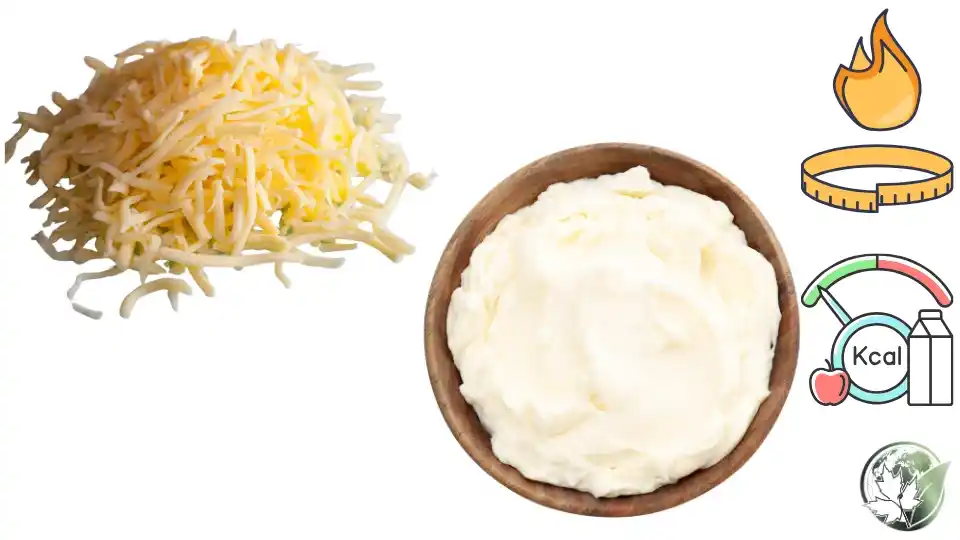
A cheese sandwich with a side of yogurt balances protein and calcium
How Much Calcium Do Cheese and Greek Yogurt Provide?
Both are good sources of calcium. An ounce of cheddar contains around 200 milligrams (15 percent of the daily value), while a 170 gram tub of Greek yogurt contains 187 milligrams. Parmesan is richest at 330 milligrams per ounce. Cottage cheese is lower, around 31 milligrams per ounce. For calcium per calorie, Greek yogurt wins: 1.9 mg per calorie against 1.8 for cheddar, though cheese is better per gram. Yogurt also contains live cultures, whereas cheese retains them only if it is not heated, and aged cheese has fewer.
What Are the Best Cheese and Yogurt Choices for Different Goals?
For maximum protein per calorie, choose nonfat Greek yogurt or cottage cheese. For flavor with few calories, choose parmesan, feta or blue cheese in small amounts. For a creamy dessert, use whole milk Greek yogurt with fruit. For a quick portable snack, choose string cheese or a small tub of yogurt. For lactose sensitivity, aged cheeses such as parmesan, cheddar and Swiss contain almost no lactose, while Greek yogurt contains less lactose than milk because of straining.
| Goal | Best choice | Calories |
|---|---|---|
| Highest protein per calorie | Nonfat Greek yogurt | 59 per 100 g |
| Lowest-calorie cheese | Cottage cheese 2% | 81 per 100 g |
| Most flavor per calorie | Parmesan, grated | 22 per tbsp |
| Portable snack | String cheese | 80 each |
| Low lactose | Aged cheddar | 113 per oz |
| Satisfying dessert | Whole Greek yogurt + fruit | 165 per tub |
How Many Calories Do Cheese Dishes Add to a Meal?
Cheese often goes unnoticed in recipes, yet it can account for a large share of a dish's calories. A sandwich with two slices of cheddar adds 170 calories. A quarter cup of shredded cheese on a taco salad adds 113, and a heavy handful of 60 grams on a pizza slice adds 240. In comparison, the same dishes topped with Greek yogurt add very little: a dollop of 30 grams is 18 calories.
| Dish | Cheese added | Calories from cheese | If topped with Greek yogurt instead |
|---|---|---|---|
| Cheese sandwich (2 slices cheddar) | 42 g | 170 kcal | n/a |
| Omelet with cheese | 30 g | 120 kcal | n/a |
| Taco salad topping | 28 g | 113 kcal | 17 kcal |
| Baked potato with cheese | 30 g | 120 kcal | 18 kcal (sour cream swap) |
| Pasta with parmesan | 15 g | 65 kcal | n/a |
| Pizza slice topping | 60 g | 240 kcal | n/a |
| Salad with feta | 40 g | 106 kcal | 24 kcal |
| Burger with cheese slice | 20 g | 80 kcal | n/a |
How Do Different Cheeses Rank From Lightest to Heaviest?
If you like cheese but need to watch calories, knowing the ranking helps. The lightest are fresh, high-moisture cheeses with a lot of whey still in them. The heaviest are aged, hard cheeses and creamy double or triple creams. Choosing from the left end of the scale for everyday use, and from the right for flavor in small amounts, is a practical strategy.
| Rank | Cheese | Calories per 100 g |
|---|---|---|
| 1 | Cottage cheese, nonfat | 72 kcal |
| 2 | Cottage cheese, 2% | 81 kcal |
| 3 | Ricotta, part-skim | 138 kcal |
| 4 | Fresh mozzarella (in water) | 240 kcal |
| 5 | Feta | 264 kcal |
| 6 | Part-skim mozzarella | 254 kcal |
| 7 | Halloumi | 321 kcal |
| 8 | Brie | 334 kcal |
| 9 | Gouda | 356 kcal |
| 10 | Swiss | 380 kcal |
| 11 | Cheddar | 403 kcal |
| 12 | Parmesan | 431 kcal |
| 13 | Mascarpone | 429 kcal |
What About Persian Cheeses and Dairy?
Iranian households traditionally eat white brine cheese (panir lighvan or Iranian feta) with bread, walnuts and herbs for breakfast. It is similar in calories to feta at about 264 per 100 grams, with 74 per ounce, and a matchbox-sized piece of 30 grams has 79. Kashk, a fermented whey product, is lower in calories, while labneh-style strained yogurt (mast-e chekideh) has around 160 per 100 grams. Plain mast, yogurt, has 61 calories per 100 grams for regular full fat and is eaten daily with meals. Using lighter dairy at breakfast and measuring the cheese is an effective habit.
| Persian dairy | Per 100 g | Typical serving | Calories |
|---|---|---|---|
| White brine cheese (panir) | 264 kcal | 30 g | 79 kcal |
| Plain yogurt (mast) | 61 kcal | 150 g | 92 kcal |
| Strained yogurt (mast-e chekideh) | 160 kcal | 50 g | 80 kcal |
| Kashk | 150 kcal | 20 g | 30 kcal |
| Cream (sarshir) | 340 kcal | 15 g | 51 kcal |
| Doogh | 25 kcal | 250 ml | 63 kcal |
| Fresh herbs and walnut with panir | n/a | 1 plate | 190 kcal |
How Should You Store Cheese and Greek Yogurt?
Hard cheeses keep well for weeks in the refrigerator, wrapped in wax paper or parchment and loose plastic so that they can breathe. Soft cheeses such as feta should be kept in their brine, and used within a week of opening. Greek yogurt keeps for two weeks sealed, and five to seven days after opening, stirred to mix any liquid whey back in. The liquid is nutritious and can be stirred back or poured off for a thicker result. Never leave dairy out for more than two hours.
Is Full-Fat Dairy Better Than Low-Fat?
Recent research has softened the older advice to always choose low-fat dairy. Many studies show that full-fat yogurt and cheese are not linked to a higher risk of heart disease or diabetes, and some show that full-fat dairy may be more satisfying. The calorie difference is real, though: 97 vs 59 per 100 grams of Greek yogurt, a gap of 38. For people watching calories or with high LDL cholesterol, low-fat is still sensible. For others, the choice between 0 and 5 percent comes down to taste and what keeps you full. Whichever you choose, avoid flavored varieties with added sugar.
How Can You Build a Balanced Breakfast With Cheese and Yogurt?
A breakfast plate does not need to choose one or the other. A small cube of cheese with cucumber and tomato, a bowl of Greek yogurt with walnuts and a slice of whole grain bread comes to roughly 400 calories and offers about 30 grams of protein. The cheese adds savory flavor, the yogurt adds creaminess and the vegetables add volume and fiber. Compare this with a cheese omelet and white toast, at 520 calories and 24 grams of protein.
| Breakfast | Calories | Protein | Sodium |
|---|---|---|---|
| 30 g feta, cucumber, tomato, bread, tea | 250 kcal | 11 g | 620 mg |
| 170 g nonfat Greek yogurt, 6 walnut halves, 1 tsp honey | 235 kcal | 19 g | 75 mg |
| Both of the above, bread halved | 400 kcal | 30 g | 640 mg |
| Cheese omelet, 2 slices white toast | 520 kcal | 24 g | 880 mg |
| Cottage cheese, fruit, 1 slice toast | 260 kcal | 16 g | 380 mg |
How Much Cheese or Yogurt Is Right for Children and Older Adults?
Children aged 4 to 8 need around 2.5 cups of dairy equivalents a day, and teenagers and adults 3 cups, where 1.5 ounces of natural cheese counts as one cup. This means 42 grams of cheddar (170 calories) equals about a cup, as does a 245 gram cup of yogurt (130 to 238 calories). Older adults need calcium and protein to protect bones and muscle, and soft options like Greek yogurt and cottage cheese are easy to eat. In both groups, choose plain, lower-sodium options most of the time.
Can Cheese and Yogurt Fit a Low-Carb or High-Protein Diet?
Both fit well. Cheese has almost no carbohydrate (1.3 grams per 100 grams of cheddar) and is a mainstay of ketogenic diets. Plain Greek yogurt has 3.6 grams of carbohydrate per 100 grams, so a 170 gram tub has 6, which is low enough for many low-carb plans. For high-protein diets, nonfat Greek yogurt and cottage cheese give the most protein per calorie, while cheddar and parmesan give the most protein per gram. A practical day might include 200 grams of yogurt at breakfast (20 grams of protein) and 30 grams of cheese at lunch (7 grams).
| Food | Carbs | Protein | Calories |
|---|---|---|---|
| 28 g cheddar | 0.4 g | 7 g | 113 kcal |
| 28 g parmesan | 0.9 g | 10 g | 122 kcal |
| 170 g nonfat Greek yogurt | 6 g | 17 g | 100 kcal |
| 170 g whole Greek yogurt | 7 g | 15 g | 165 kcal |
| 1/2 cup cottage cheese | 4 g | 12 g | 90 kcal |
Key Takeaways: Cheese vs Greek Yogurt Calories
Cheddar has about 403 calories per 100 grams and 113 per ounce, while plain nonfat Greek yogurt has 59 and 17, and whole 97 and 27. Cheese is more concentrated in calories, sodium and saturated fat, while yogurt is lighter with more protein per calorie. Enjoy cheese in measured ounces and use Greek yogurt as a filling, lower-calorie base.
Frequently Asked Questions
6 questions answered
Does cheese have more calories than Greek yogurt?
Yes, 254 to 431 per 100 grams for most cheeses against 59 to 97 for yogurt.
How many calories are in a slice of cheese?
About 70 to 85 for a cheddar slice.
How many calories are in Greek yogurt?
About 100 for a 170 gram nonfat tub and 165 for whole milk.
Which has more protein, cheese or Greek yogurt?
Cheese per 100 grams, but yogurt per calorie.
Is cottage cheese lower in calories than Greek yogurt?
It is close: 81 against 59 to 97 per 100 grams.
Is Greek yogurt a good substitute for cheese?
In dips and sauces, yes.