
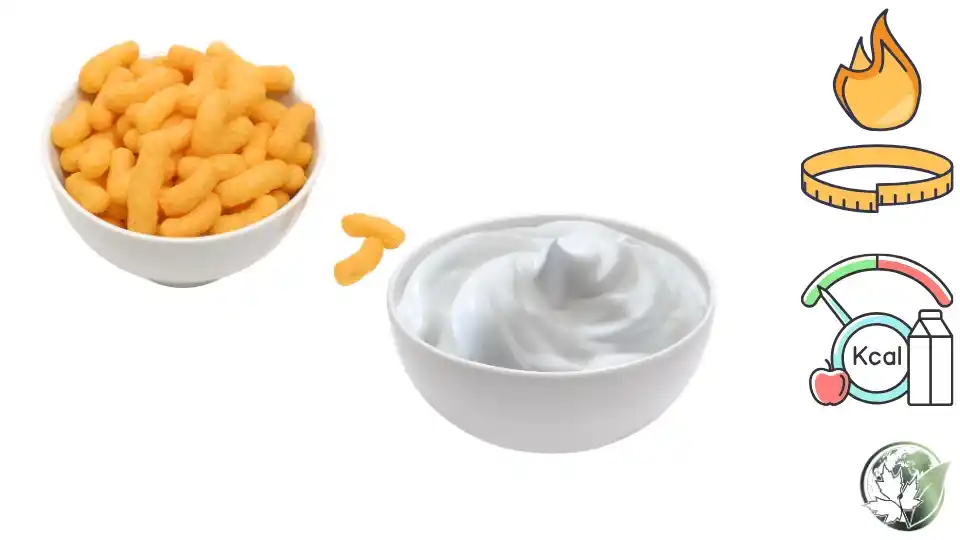
How Many Calories Are in Cheese Puffs vs Greek Yogurt? The Quick Answer
A 28 gram serving of cheese puffs, about 21 pieces or one small handful, has roughly 160 calories, which works out to about 570 calories per 100 grams. A 170 gram tub of plain nonfat Greek yogurt has about 100 calories, and 100 grams has 59. Plain whole milk Greek yogurt has 97 calories per 100 grams, or 165 in a 170 gram tub. So the same weight of cheese puffs has about ten times the calories of nonfat Greek yogurt and nearly six times the calories of the whole milk version.
Weight is not the only comparison that matters. Cheese puffs are very light and airy, so 28 grams is a small, fast-disappearing handful, and a lunch-box bag of 28 grams holds only 160 calories, but a regular 255 gram bag has 1,450. In contrast, Greek yogurt is dense and creamy, and a full tub is a real portion. Yogurt also supplies about 17 grams of protein per tub, compared with 2 grams in a handful of puffs. This guide compares cheese puffs and Greek yogurt per handful, per bag, per tub and per 100 grams, looks at fat, sodium and protein, and suggests crunchy swaps for those who want a cheesy snack. It includes three comparison tables and an FAQ.

A handful of cheese puffs has more calories than a full tub of nonfat Greek yogurt
How Many Calories Are in Cheese Puffs?
| Cheese puff product | Serving | Calories | Per 100 g |
|---|---|---|---|
| Crunchy cheese puffs | 28 g (21 pieces) | 160 kcal | 570 kcal |
| Puffed corn cheese balls | 28 g | 150 kcal | 535 kcal |
| Baked cheese puffs | 28 g | 130 kcal | 465 kcal |
| Cheese puffs, small bag | 49 g | 280 kcal | 570 kcal |
| Cheese puffs, sharing bag | 255 g | 1,450 kcal | 570 kcal |
| Cheese curls | 28 g | 155 kcal | 553 kcal |
| White cheddar puffs | 28 g | 150 kcal | 535 kcal |
| Popped cheese snack | 28 g | 120 kcal | 430 kcal |
| Freeze-dried cheese puffs | 28 g | 130 kcal | 465 kcal |
Cheese puffs are made from cornmeal, fried or baked, with oil, cheese powder and salt. About 55 to 60 percent of the calories come from fat, mostly from the frying oil.
How Many Calories Are in Greek Yogurt?
| Plain Greek yogurt | 100 g | Single tub (170 g) | Cup (245 g) |
|---|---|---|---|
| Nonfat (0%) | 59 kcal | 100 kcal | 130 kcal |
| Low fat (2%) | 73 kcal | 124 kcal | 179 kcal |
| Whole milk (5%) | 97 kcal | 165 kcal | 238 kcal |
| Strained extra thick | 110 kcal | 187 kcal | 270 kcal |
| Flavored with honey | 105 kcal | 178 kcal | 257 kcal |
| Fruit on the bottom | 95 kcal | 162 kcal | 233 kcal |
Choose plain varieties. Flavored and fruit Greek yogurts can contain 12 to 20 grams of sugar per tub.
Cheese Puffs vs Greek Yogurt: Calories Compared
| Amount | Cheese puffs | Nonfat Greek yogurt | Whole Greek yogurt |
|---|---|---|---|
| 28 g | 160 kcal | 17 kcal | 27 kcal |
| 50 g | 285 kcal | 30 kcal | 49 kcal |
| 100 g | 570 kcal | 59 kcal | 97 kcal |
| 170 g | 969 kcal | 100 kcal | 165 kcal |
| 160 calories | 28 g | 271 g | 165 g |
| 1 handful vs 1 tub | 160 kcal | 100 kcal | 165 kcal |
| Small bag (49 g) vs tub | 280 kcal | 100 kcal | 165 kcal |
| Sharing bag (255 g) vs tub | 1,450 kcal | 100 kcal | 165 kcal |
For the calories in one handful of puffs, you could eat a whole tub of whole milk Greek yogurt with a spoonful of honey. It illustrates the difference in energy density: cheese puffs 5.7 calories per gram, whole Greek yogurt 1 calorie per gram, and nonfat 0.6.
Cheese Puffs vs Greek Yogurt: Nutrition Compared
| Per 100 g | Cheese puffs | Nonfat Greek yogurt | Whole Greek yogurt |
|---|---|---|---|
| Calories | 570 kcal | 59 kcal | 97 kcal |
| Protein | 6 g | 10.2 g | 9 g |
| Fat | 36 g | 0.4 g | 5 g |
| Saturated fat | 6 g | 0.1 g | 3.2 g |
| Carbohydrate | 54 g | 3.6 g | 4 g |
| Sugar | 2 g | 3.2 g | 4 g |
| Fiber | 1.8 g | 0 g | 0 g |
| Sodium | 1,000 mg | 36 mg | 35 mg |
| Calcium | 80 mg | 110 mg | 100 mg |
| Per serving | Cheese puffs (28 g) | Nonfat Greek yogurt (170 g) |
|---|---|---|
| Calories | 160 kcal | 100 kcal |
| Protein | 1.7 g | 17 g |
| Fat | 10 g | 0.7 g |
| Sodium | 280 mg | 61 mg |
| Protein per 100 kcal | 1 g | 17 g |
A tub of Greek yogurt provides ten times the protein of a handful of cheese puffs for fewer calories. Cheese puffs are salty and fatty, with almost no vitamins, while the yogurt provides calcium, B12 and potassium.
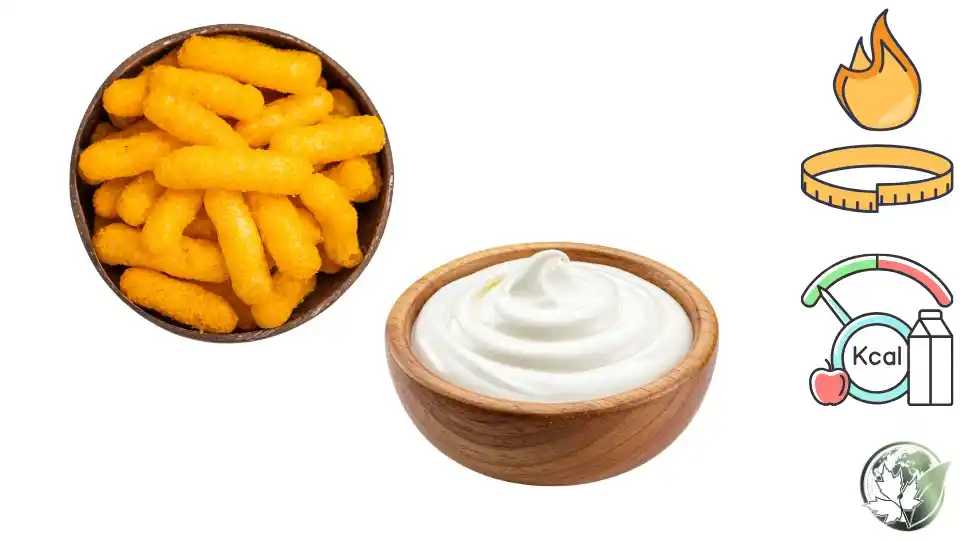
A small handful of cheese puffs has around 160 calories and 280 mg of sodium
Which Has More Calories: Cheese Puffs or Greek Yogurt?
Cheese puffs have more calories by weight and by serving than nonfat Greek yogurt, and more than whole yogurt per 100 grams. A single 28 gram handful of puffs equals or exceeds a whole tub of nonfat yogurt. However, "per serving" can be misleading because a tub is six times bigger than a handful. The best comparison is satiety. A tub of yogurt with 17 grams of protein keeps you full for hours, while a handful of puffs melts in the mouth and leaves you hungry.
| Comparison | Calories | Verdict |
|---|---|---|
| 28 g puffs vs 170 g nonfat yogurt | 160 vs 100 | Yogurt lower |
| 28 g puffs vs 170 g whole yogurt | 160 vs 165 | About equal |
| 100 g puffs vs 100 g yogurt | 570 vs 59 | Yogurt much lower |
| Protein per 100 calories | 1 g vs 17 g | Yogurt higher |
| Sodium per 100 calories | 175 mg vs 61 mg | Yogurt lower |
Why Are Cheese Puffs So High in Calories?
Cheese puffs contain almost no water, as they are puffed to a dry, airy texture, which means that every gram is fat or starch. Oil used in frying (or sprayed on baked versions) provides 9 calories per gram, and cornmeal provides 4. The cheese powder adds a small amount of protein, fat and plenty of salt. The result is 570 calories per 100 grams, similar to potato chips and not far from chocolate. Greek yogurt, on the other hand, is about 80 percent water and made of milk protein, so there is little room for calories.
Why Are Cheese Puffs So Easy to Overeat?
Food scientists describe a phenomenon called "vanishing caloric density". Cheese puffs melt quickly in your mouth, so the brain registers fewer calories than you actually ate. Together with salt and fat, which are highly palatable, this makes it very easy to eat an entire bag without noticing. One 255 gram sharing bag holds about 9 servings and 1,450 calories, which is about 70 percent of a day's energy for many adults. Pouring a serving into a bowl, and putting the bag away, is the single most effective habit.
| Eating pattern | Amount | Calories |
|---|---|---|
| Measured serving | 28 g | 160 kcal |
| Two handfuls | 56 g | 320 kcal |
| Small bag | 49 g | 280 kcal |
| Half a sharing bag | 128 g | 730 kcal |
| Entire sharing bag | 255 g | 1,450 kcal |
Is Greek Yogurt a Better Snack Than Cheese Puffs?
For most health goals, yes. Greek yogurt is high in protein, lower in sodium and calories, and provides calcium and probiotics. It keeps you full. Cheese puffs are fine for an occasional treat, and there is no need to avoid them completely, but they are not a source of nutrition. If it is the cheesy, crunchy, salty experience you want, you can have a small portion of puffs together with a protein like yogurt or fruit.
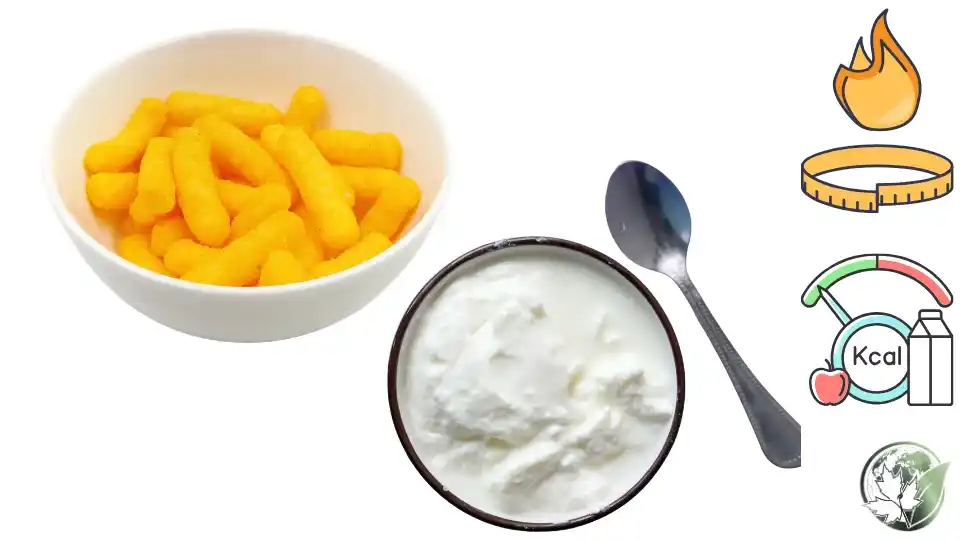
Greek yogurt with fruit and nuts gives protein, fiber and crunch for 150 to 200 calories
What Are Good Crunchy Swaps for Cheese Puffs?
If you want crunch with a cheese flavor but fewer calories, there are many options. Air-popped popcorn with a little grated parmesan has 110 calories for three cups. Roasted chickpeas have 120 per 28 grams and 5 grams of protein. Baked cheese crisps made from a single slice of cheese are 100 calories. Rice cakes with cottage cheese, vegetable sticks with a yogurt dip, or edamame with salt are also good.
| Swap | Serving | Calories | Protein |
|---|---|---|---|
| Cheese puffs | 28 g | 160 kcal | 1.7 g |
| Baked cheese puffs | 28 g | 130 kcal | 1.5 g |
| Popcorn with parmesan | 3 cups + 1 tbsp | 110 kcal | 4 g |
| Roasted chickpeas | 28 g | 120 kcal | 5 g |
| Baked cheese crisps | 1 slice | 100 kcal | 6 g |
| Rice cakes + cottage cheese | 2 cakes + 60 g | 125 kcal | 8 g |
| Edamame, shelled | 80 g | 95 kcal | 9 g |
| Greek yogurt with cucumber | 170 g + veg | 120 kcal | 17 g |
Can You Eat Cheese Puffs and Yogurt Together?
Mixing cheese puffs into yogurt is not common, but the logic of pairing a salty crunchy snack with a protein-rich creamy one holds. Rather than eating puffs alone, have a half-portion (14 grams, 80 calories) with a small tub of Greek yogurt dip. The protein from the yogurt blunts the rise in hunger. A simple approach is to dip carrots or cucumber in cheesy yogurt (mix yogurt with a spoon of parmesan and paprika) and have a few puffs alongside.
How Do Cheese Puffs Compare With Other Salty Snacks?
Cheese puffs are in the middle of the salty snack range. Per 28 gram serving they have fewer calories than nuts and about the same as potato chips, but more than pretzels and popcorn. Because the pieces are so light, a 28 gram serving looks bigger than the same weight of nuts, yet it gives less protein and fiber.
| Snack (28 g) | Calories | Fat | Protein | Sodium |
|---|---|---|---|---|
| Cheese puffs | 160 kcal | 10 g | 1.7 g | 280 mg |
| Baked cheese puffs | 130 kcal | 5 g | 1.5 g | 270 mg |
| Potato chips | 152 kcal | 9.8 g | 2 g | 148 mg |
| Tortilla chips | 142 kcal | 7 g | 2 g | 120 mg |
| Pretzels | 108 kcal | 0.8 g | 2.9 g | 352 mg |
| Air-popped popcorn (3 cups) | 93 kcal | 1.1 g | 3 g | 2 mg |
| Salted peanuts | 166 kcal | 14 g | 7 g | 140 mg |
| Cheese cubes (cheddar) | 114 kcal | 9.4 g | 7 g | 180 mg |
| Plain Greek yogurt (170 g, nonfat) | 100 kcal | 0.7 g | 17 g | 61 mg |
How Much Sodium Is in Cheese Puffs?
Cheese puffs typically contain around 1,000 milligrams of sodium per 100 grams, or 280 milligrams per 28 gram serving. This is 12 percent of the recommended limit of 2,300 milligrams in just one handful. A small bag has 490 milligrams, and a sharing bag over 2,500, more than the whole day's limit. High sodium intake is linked to raised blood pressure, so people who watch their salt should be careful with this snack. Plain Greek yogurt contains only 61 milligrams per tub.
| Amount | Cheese puffs sodium | % of daily limit |
|---|---|---|
| 28 g | 280 mg | 12% |
| 49 g (small bag) | 490 mg | 21% |
| 100 g | 1,000 mg | 43% |
| 255 g (sharing bag) | 2,550 mg | 111% |
| Greek yogurt, 170 g | 61 mg | 3% |
Do Cheese Puffs Contain Real Cheese?
Most cheese puffs contain only a small amount of cheese, in the form of dried cheese powder, usually 3 to 7 percent of the product. The bulk is cornmeal, vegetable oil and seasonings, together with flavor enhancers and sometimes artificial colors. "Real cheese" varieties, such as baked cheese crisps or freeze-dried cheese puffs, are made mostly from cheese and have more protein: a 28 gram serving of baked parmesan crisps has 7 to 10 grams of protein and about 120 calories. Reading the ingredient list tells you quickly whether you are eating a corn snack or a cheese snack.
| Product | Cheese content | Protein per 28 g |
|---|---|---|
| Standard cheese puffs | 3-7% | 1.7 g |
| Baked cheese puffs | 5-10% | 1.5 g |
| Puffed cheese (dried) | 90%+ | 9 g |
| Parmesan crisps | 100% | 10 g |
| Cheddar cheese crisps | 100% | 8 g |
| Cheese cubes | 100% | 7 g |
How Many Calories Do You Burn Eating Cheese Puffs vs Yogurt?
The thermic effect of food, the energy used for digestion, is around 20 to 30 percent of the calories for protein, 5 to 10 percent for carbohydrates and 0 to 3 percent for fat. A tub of Greek yogurt, mostly protein, uses up around 15 to 20 of its 100 calories, whereas a handful of puffs, high in fat and refined starch, uses up about 8 of its 160. The difference is small in absolute terms, but it adds to the larger gap in fullness and in net calories.
Is Greek Yogurt Good Before or After Exercise?
Greek yogurt is a convenient pre- or post-workout snack, with 17 grams of high-quality protein in a tub, containing all essential amino acids, especially leucine, which supports muscle repair. Combined with fruit or honey for carbohydrates, it replenishes glycogen. Cheese puffs do not offer the same benefit, although the salt they contain may be useful during very long sweaty sessions. For a post-workout snack, 170 grams of yogurt with a banana and a tablespoon of honey comes to about 270 calories, 19 grams of protein and 46 grams of carbohydrate.
| Post-workout snack | Calories | Protein | Carbs |
|---|---|---|---|
| Greek yogurt + banana + honey | 270 kcal | 19 g | 46 g |
| Greek yogurt + berries | 140 kcal | 18 g | 14 g |
| Greek yogurt + granola (30 g) | 245 kcal | 20 g | 28 g |
| Cheese puffs (56 g) | 320 kcal | 3 g | 30 g |
| Chocolate milk (250 ml) | 190 kcal | 8 g | 26 g |
What Do Dietitians Say About Cheese Puffs?
Dietitians generally classify cheese puffs as a "sometimes" food. They recommend not to ban the snack, which often leads to cravings and binge eating, but to plan for it: measure out a serving, sit down to eat it, and have it with something that provides protein and fiber, such as an apple, a boiled egg or yogurt. For children, who often like the bright colors and the melting texture, a half portion with fruit is a sensible way to include them in a party or lunch box.
How Can You Make a Healthier "Cheesy" Snack at Home?
At home, you can create cheesy crunch with whole ingredients. Toss air-popped popcorn with grated parmesan, smoked paprika and a mist of olive oil. Roast chickpeas with nutritional yeast and garlic powder. Bake slices of cheese or small mounds of grated parmesan until crisp. Mix cottage cheese with a spoon of grated cheddar and serve with cucumber. In each case, you control the oil and salt, and add protein or fiber.
| Homemade snack | Serving | Calories |
|---|---|---|
| Parmesan popcorn | 3 cups | 120 kcal |
| Nutritional yeast chickpeas | 1/2 cup | 150 kcal |
| Baked parmesan crisps | 4 crisps | 90 kcal |
| Cheesy yogurt dip + cucumber | 1/2 cup + 1 cucumber | 80 kcal |
| Cheese toast, 1 slice whole grain | 1 slice | 170 kcal |
| Cottage cheese + cherry tomatoes | 100 g + 5 | 105 kcal |
What Should You Check on the Greek Yogurt Label?
Look for "plain" with an ingredient list of milk and live cultures. The label should show 9 to 10 grams of protein per 100 grams and no added sugar. Be careful with "Greek-style" products, which are thickened with starches or milk protein concentrate and can have less protein. The fat percentage determines the calories: 0 percent is the lightest, 2 percent is a good middle, and 5 percent tastes richest and is more filling for some people. Check the tub size, because many individual cups are 150 grams and some are 200.
How Should Parents Handle Cheese Puffs for Kids?
Cheese puffs are a favorite with toddlers because they dissolve easily, and they are often used as a first finger food. A small handful of 10 pieces (about 13 grams) has 75 calories, and a lunch box bag of 28 grams 160. For young children, the main concerns are the high salt and the low nutrition, so use them as an occasional extra. Greek yogurt, unsweetened and mixed with mashed fruit, is a better regular choice, giving protein and calcium for growth. Plain yogurt for kids under one year is fine in small amounts, but whole milk varieties are preferred for toddlers because they need fat for brain development.
| Kids' snack | Calories | Protein | Sodium |
|---|---|---|---|
| 10 cheese puffs (13 g) | 75 kcal | 0.8 g | 130 mg |
| Lunch box bag (28 g) | 160 kcal | 1.7 g | 280 mg |
| Whole Greek yogurt, 100 g | 97 kcal | 9 g | 35 mg |
| Yogurt + 1/2 mashed banana | 150 kcal | 9.5 g | 37 mg |
| Cheese stick (21 g) | 70 kcal | 5 g | 190 mg |
| Apple slices + 1 tbsp yogurt dip | 70 kcal | 1 g | 10 mg |
How Can You Fit Cheese Puffs Into a Calorie Budget?
If you eat 1,800 calories a day, a 28 gram serving of puffs is about 9 percent of your energy. If you plan it, you can reduce the rest of your snacks, or add a 20 minute walk (about 80 to 100 calories). A smart approach is to eat puffs only as a planned treat once or twice a week and to rely on Greek yogurt, fruit and nuts on other days. Over a month, replacing a daily 160 calorie bag of puffs with a 100 calorie tub of yogurt saves 1,800 calories, and adds about 450 grams of protein.
| Daily snack habit | Calories per day | Per month |
|---|---|---|
| 1 handful cheese puffs | 160 kcal | 4,800 kcal |
| 1 tub nonfat Greek yogurt | 100 kcal | 3,000 kcal |
| 1 tub whole Greek yogurt | 165 kcal | 4,950 kcal |
| 1 handful puffs + 1 tub yogurt | 260 kcal | 7,800 kcal |
| Swap puffs for yogurt | -60 kcal | -1,800 kcal |
Key Takeaways: Cheese Puffs vs Greek Yogurt Calories
A 28 gram handful of cheese puffs has about 160 calories (570 per 100 grams), more than a 170 gram tub of nonfat Greek yogurt at 100 (59 per 100 grams). Yogurt provides ten times the protein and far less sodium. Portion puffs into a bowl, choose popcorn, chickpeas or cheese crisps as crunchy swaps, and keep plain Greek yogurt for filling snacks.
Frequently Asked Questions
6 questions answered
How many calories are in cheese puffs?
About 160 for a 28 gram serving and 570 per 100 grams.
How many calories are in Greek yogurt?
About 59 per 100 grams nonfat and 97 whole, or 100 to 165 for a 170 gram tub.
Do cheese puffs have more calories than Greek yogurt?
Yes, about ten times more per 100 grams than nonfat.
Are baked cheese puffs healthier?
They have about 20 percent fewer calories, but are still low in protein and high in salt.
What is a healthy alternative to cheese puffs?
Air-popped popcorn with parmesan or roasted chickpeas.
Is Greek yogurt a good snack?
Yes, it is high in protein and low in calories when plain.




