
How Many Calories Are in a Carrot? The Quick Answer
A medium raw carrot of about 61 grams has roughly 25 calories. One hundred grams of raw carrot contains about 41 calories, and one cup of chopped raw carrot (128 g) has about 52. A large carrot of 72 grams has about 30 calories, and a baby carrot of 10 grams has only 4. Carrots are therefore a low calorie vegetable, though slightly higher than leafy greens, because they contain natural sugars and starch.
Potatoes are the natural comparison, since both are root vegetables that people eat as side dishes. One hundred grams of raw potato has about 77 calories, almost twice the energy of carrot. A medium baked potato with skin (173 g) has about 161 calories, and a medium boiled potato about 130. On a per-weight basis, carrots have about 47 percent fewer calories than potatoes, with more vitamin A and about the same amount of fiber.
This guide covers calories in raw, boiled, steamed, roasted and juiced carrots, compares carrots with potatoes on energy, carbohydrate, glycemic index and vitamins, and shows how cooking fat changes the totals. You will also find ideas for using carrots in meals, how to buy and store them and a full FAQ. Three comparison tables are included.
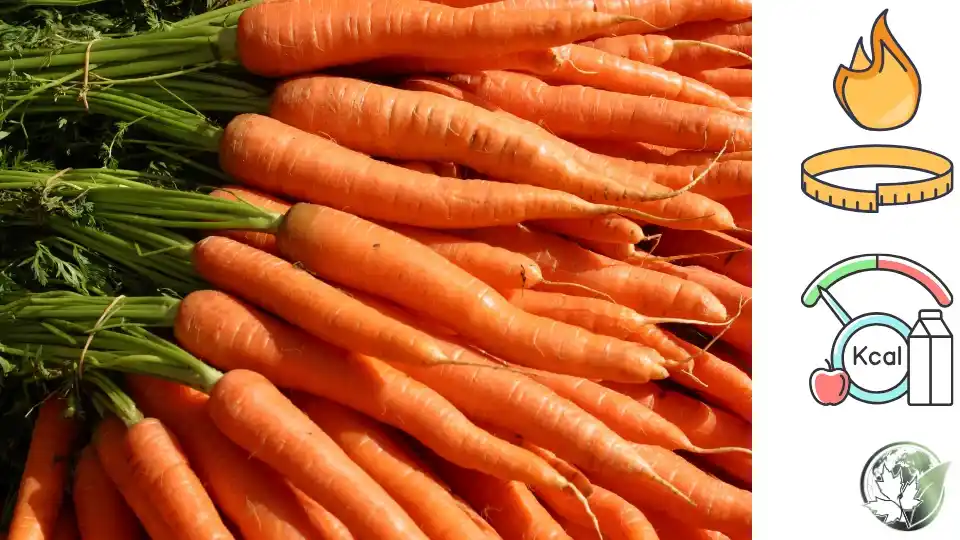
A medium raw carrot has about 25 calories and a large one about 30
How Many Calories Are in One Carrot, One Cup and 100 Grams?
The easiest way to count carrot calories is by weight, but household measures are more convenient. The table below lists common portions of raw carrot.
| Carrot portion | Weight | Calories | Carbohydrate | Fiber |
|---|---|---|---|---|
| 1 baby carrot | 10 g | 4 kcal | 1.0 g | 0.3 g |
| 1 small carrot | 50 g | 21 kcal | 4.8 g | 1.4 g |
| 1 medium carrot | 61 g | 25 kcal | 5.8 g | 1.7 g |
| 1 large carrot | 72 g | 30 kcal | 6.9 g | 2.0 g |
| 1 cup, chopped | 128 g | 52 kcal | 12.3 g | 3.6 g |
| 1 cup, shredded | 110 g | 45 kcal | 10.6 g | 3.1 g |
| 100 g | 100 g | 41 kcal | 9.6 g | 2.8 g |
| 1 pound (454 g) | 454 g | 186 kcal | 43.6 g | 12.7 g |
A snack bag of 85 grams of baby carrots has about 35 calories, which makes carrots one of the easiest snacks to include in a calorie-controlled plan. You can eat several large carrots in a day and still stay under 100 calories.
How Do Cooking Methods Change Carrot Calories?
Cooking changes carrots in two ways. It softens the fiber and releases some sugars, and it adds calories if you use oil, butter or glaze. Boiling and steaming do not add energy, but because cooked carrots lose water or absorb it, calories per 100 grams can differ slightly.
| Preparation | Serving | Calories |
|---|---|---|
| Raw | 100 g | 41 kcal |
| Boiled, drained | 100 g | 35 kcal |
| Steamed | 100 g | 37 kcal |
| Roasted with 1 tsp olive oil | 100 g | 85 kcal |
| Sautéed in 1 tbsp butter | 100 g | 140 kcal |
| Glazed with butter and honey | 100 g | 120 kcal |
| Carrot juice, fresh | 240 ml | 94 kcal |
| Canned carrots, drained | 100 g | 25 kcal |
| Frozen carrots, boiled | 100 g | 35 kcal |
| Carrot cake (with frosting) | 110 g | 420 kcal |
Boiled carrots contain slightly fewer calories per 100 grams than raw, because they take in some water. Roasting concentrates sugar and flavor, but oil adds about 40 calories per teaspoon. The most calorie-dense carrot dishes are cakes, glazed sides and fried preparations.
Carrot vs Potato: Calories and Nutrition Compared
Carrots and potatoes are often used in the same meals, but they differ in energy and nutrients. Potatoes are starchier and more filling, while carrots are sweeter and lighter.
| Per 100 g (raw) | Carrot | Potato (with skin) |
|---|---|---|
| Calories | 41 kcal | 77 kcal |
| Carbohydrate | 9.6 g | 17.5 g |
| Starch | 1.4 g | 15 g |
| Sugar | 4.7 g | 0.8 g |
| Fiber | 2.8 g | 2.2 g |
| Protein | 0.9 g | 2.0 g |
| Fat | 0.2 g | 0.1 g |
| Vitamin A | 835 mcg | 0 mcg |
| Vitamin C | 5.9 mg | 19.7 mg |
| Potassium | 320 mg | 425 mg |
| Water | 88 g | 79 g |
| Per typical serving | 1 medium carrot (61 g) | 1 medium potato (173 g) |
|---|---|---|
| Calories | 25 kcal | 133 kcal |
| Carbohydrate | 5.8 g | 30 g |
| Vitamin A | 509 mcg | 0 mcg |
| Potassium | 195 mg | 735 mg |
Per 100 grams, carrots have 47 percent fewer calories than potatoes. In a typical serving, the difference is much larger, because a medium potato is nearly three times heavier than a medium carrot. Carrots deliver a massive dose of vitamin A in the form of beta-carotene: one medium carrot supplies about 57 percent of the daily value. Potatoes provide more potassium and vitamin C.
Carrots have about 41 calories per 100 g, while potatoes have about 77
How Do Carrots and Potatoes Compare on Blood Sugar?
The glycemic index of raw carrots is about 16, and of boiled carrots about 39 to 47, both low to moderate. Potatoes have a much higher glycemic index. Boiled potatoes range from 50 to 78 depending on variety and cooling, while baked potatoes and mashed potatoes can reach 85 to 95. In practical terms, carrots cause a gentler rise in blood sugar than potatoes.
The glycemic load, which accounts for the amount of carbohydrate in a serving, is even more favorable for carrots. A medium raw carrot has a glycemic load of about 1, while a medium baked potato has a glycemic load of about 25, in the high range. For people managing diabetes or trying to avoid energy crashes, carrots are the safer choice, and the starch in potatoes should be portioned with protein and fiber.
Cooling cooked potatoes increases resistant starch, which lowers the glycemic response. Potato salad made with chilled boiled potatoes has a lower glycemic effect than hot mashed potatoes, but still more than carrot-based salad.
How Much Vitamin A and Beta-Carotene Are in Carrots?
Carrots are one of the best dietary sources of beta-carotene, which the body converts to vitamin A. One cup of chopped raw carrots supplies about 1,069 micrograms of retinol activity equivalents, which is 119 percent of the daily value. Vitamin A supports vision, immune function, skin and growth.
Cooking can increase the absorption of beta-carotene. Studies show that cooked carrots release more carotenoids than raw ones, and that eating carrots with a little fat, such as a teaspoon of olive oil, increases absorption further. So a lightly cooked carrot with oil may supply more usable vitamin A than a raw carrot eaten alone, at the cost of about 40 extra calories.
Carrots also contain vitamin K, vitamin B6, biotin and antioxidants such as lutein and alpha-carotene. Purple, yellow and red carrots contain different pigments: anthocyanins in purple carrots and lycopene in red ones.
How Many Calories Are in Carrot Juice, Carrot Cake and Other Carrot Foods?
Many carrot products have more calories than the vegetable itself. Juicing removes the fiber and concentrates the sugar, while baking adds flour, sugar and fat.
| Carrot food | Serving | Calories | Sugar |
|---|---|---|---|
| Carrot, raw | 1 medium | 25 kcal | 2.9 g |
| Carrot sticks with hummus | 5 sticks + 2 tbsp | 90 kcal | 4 g |
| Carrot soup | 1 bowl (300 g) | 120 kcal | 9 g |
| Carrot juice | 240 ml | 94 kcal | 9 g |
| Carrot salad with mayo | 1/2 cup | 110 kcal | 8 g |
| Carrot halwa (gajar ka halwa) | 100 g | 220 kcal | 25 g |
| Carrot cake with cream cheese frosting | 1 slice | 420 kcal | 36 g |
| Carrot muffin | 1 medium | 330 kcal | 28 g |
| Carrot and rice (Persian havij polo) | 1 cup | 260 kcal | 8 g |
The jump from a 25 calorie carrot to a 420 calorie slice of carrot cake shows how much calories depend on recipe. A glass of carrot juice requires about four carrots and contains little fiber, so it is less filling than eating the carrots whole.
A glass of fresh carrot juice has about 94 calories, as much as nearly four carrots without the fiber
Is Carrot Good for Weight Loss?
Carrots are a useful food for weight management for several reasons. They are low in calories, with only 41 per 100 grams. They contain fiber and water, which help you feel full. They are sweet enough to satisfy a craving for something sugary without adding many calories. They also take time to chew, which slows eating.
Swapping a calorie-dense snack for carrots can create a substantial deficit. For example, replacing an afternoon snack of 30 grams of potato chips (160 calories) with 100 grams of carrot sticks (41 calories) saves about 120 calories a day, which is about 3,600 calories in a month, or roughly half a kilogram of body fat.
Carrots are not magical, and eating only carrots is not a sustainable or healthy plan. A balanced approach includes protein, healthy fats and a variety of vegetables. You may notice a slight orange tint to your skin if you eat very large amounts of carrots, a harmless condition called carotenemia.
How Do Carrots Compare With Other Vegetables?
Carrots are higher in calories than non-starchy greens but lower than starchy roots.
| Vegetable (100 g raw) | Calories | Carbohydrate | Fiber |
|---|---|---|---|
| Cucumber | 15 kcal | 3.6 g | 0.5 g |
| Tomato | 18 kcal | 3.9 g | 1.2 g |
| Cabbage | 25 kcal | 5.8 g | 2.5 g |
| Carrot | 41 kcal | 9.6 g | 2.8 g |
| Beetroot | 43 kcal | 9.6 g | 2.8 g |
| Turnip | 28 kcal | 6.4 g | 1.8 g |
| Sweet potato | 86 kcal | 20 g | 3.0 g |
| Potato | 77 kcal | 17.5 g | 2.2 g |
| Parsnip | 75 kcal | 18 g | 4.9 g |
Among root vegetables, carrots are the lightest apart from turnips. They offer a rare combination of sweetness, crunch, low calories and high nutrition.
How to Cook Carrots Without Adding Many Calories
Choose techniques that bring out flavor without heavy fat. Steaming for 5 to 8 minutes keeps them tender-crisp with no added energy. Roasting at 200 degrees Celsius with just one teaspoon of oil for a whole tray of carrots, and a pinch of cumin or thyme, adds only a few calories per serving. Shredding raw carrots into salads with lemon juice and herbs gives a bright, low calorie side.
Other ideas include adding carrots to soups and stews to boost volume, grating them into meatballs or burgers to add moisture, and using them as a natural sweetener in baked goods in place of some sugar. Avoid sugary glazes and heavy cream sauces if your goal is to keep calories low.
How to Choose and Store Carrots
Pick firm, smooth carrots with bright orange color and no cracks or soft spots. If they come with tops, the greens should be fresh. Thicker carrots are often sweeter, and very thin ones can be woody or bitter. Remove the leafy tops before storing, because they draw moisture from the root.
Store unwashed carrots in the refrigerator in a plastic bag or container with a damp paper towel, where they last three to four weeks. Peeled baby carrots keep about two weeks in the refrigerator and should stay in the original sealed bag. For longer storage, blanch chopped carrots for three minutes, cool and freeze for up to ten months.
Carrots stay crisp for weeks in the refrigerator when stored with a little moisture
How Many Carrots Can You Eat a Day?
For most people, one to three medium carrots a day is a healthy amount, which provides 25 to 75 calories and plenty of vitamin A. Very high intake, such as a kilogram per day, may cause carotenemia, and juice in large amounts adds sugar. Nutrition guidelines recommend two to three cups of vegetables a day for adults, and carrots can be part of that along with leafy greens, cruciferous vegetables and legumes.
Why Do Carrots Taste Sweet if They Have Few Calories?
Carrots contain about 4.7 grams of sugar per 100 grams, mostly sucrose, with smaller amounts of glucose and fructose. That is enough to taste noticeably sweet, but because carrots are 88 percent water and contain fiber, the total energy stays low. Sweetness and calories are not the same thing. A carrot tastes sweeter than a potato even though a potato has almost twice the energy, because most of the potato's carbohydrate is starch, which has little taste until it is digested.
Sweetness also changes with storage and cooking. Carrots stored in the cold convert some starch into sugar, which is why winter carrots taste sweeter than fresh summer ones. Roasting caramelizes the sugars and makes carrots taste even sweeter, so you can often use less added sugar in recipes. This makes carrots valuable for people who want to cut down on sweeteners, since grated carrot in muffins, pancakes or oatmeal adds sweetness and moisture for only a few calories.
How Do Carrots Support Eye, Skin and Heart Health?
The famous link between carrots and eyesight comes from vitamin A, which is needed to make rhodopsin, the pigment in the retina that allows vision in dim light. Deficiency causes night blindness, though carrots do not improve normal vision beyond what adequate vitamin A already provides. Lutein and zeaxanthin in carrots, in smaller amounts than in leafy greens, are associated with a lower risk of age-related macular degeneration.
For skin, beta-carotene acts as an antioxidant and may offer slight protection from sun damage when consumed regularly over months, though it is not a substitute for sunscreen. For the heart, carrots provide potassium, fiber and antioxidants, and studies of carotenoid-rich diets show a link with lower blood pressure and a lower risk of cardiovascular disease. The soluble fiber pectin in carrots may also help lower cholesterol modestly.
These effects come from eating carrots as part of an overall vegetable-rich diet. Supplements of isolated beta-carotene have not shown the same benefits and, in smokers, high doses have been linked to higher lung cancer risk, which is another reason to prefer whole foods.
How Many Calories Are in a Carrot Compared With Common Snacks?
A carrot has far fewer calories than most snack foods, which is why it appears in so many diet plans. The table compares a standard snack serving.
| Snack | Serving | Calories | Fiber |
|---|---|---|---|
| Medium carrot | 61 g | 25 kcal | 1.7 g |
| Baby carrots | 85 g | 35 kcal | 2.4 g |
| Apple, medium | 182 g | 95 kcal | 4.4 g |
| Banana, medium | 118 g | 105 kcal | 3.1 g |
| Potato chips | 28 g | 152 kcal | 1.2 g |
| Salted peanuts | 28 g | 166 kcal | 2.4 g |
| Granola bar | 40 g | 170 kcal | 1.5 g |
| Biscuits (3 plain) | 21 g | 95 kcal | 0.5 g |
| Milk chocolate bar | 43 g | 230 kcal | 1.5 g |
You would need to eat nine medium carrots to match the calories of a standard chocolate bar, which is something most people would find impossible. This is exactly why swapping even one snack a day for carrots makes a noticeable difference over weeks.
How to Make Carrots More Satisfying as a Snack
Plain carrot sticks are healthy, but some people find them boring. Pairing them with a dip increases satisfaction and gives a balance of protein and fat. Hummus adds about 25 calories per tablespoon, Greek yogurt dip about 15 and guacamole about 25. Nut butter adds more, about 95 per tablespoon, so measure it. Seasoning with lemon juice, chili powder or za'atar changes the flavor without adding calories.
For variety, cut carrots into ribbons with a peeler, spiralize them into noodles or roast them until slightly crisp. A bowl of roasted carrots with a spoonful of yogurt and herbs is a filling snack of about 90 calories. Keeping washed, cut carrots at eye level in the refrigerator makes them the easiest choice when hunger strikes.
How Do Carrots Fit Into a Day of Eating?
A balanced day might include grated carrot in breakfast oats or an omelet, carrot sticks with lunch, a side of steamed carrots with dinner and a raw carrot as an afternoon snack. Together that is about 120 to 150 calories from carrots, with more than 200 percent of the daily vitamin A and a good amount of fiber. For children, carrots are an easy finger food when cut into thin sticks or cooked until soft; whole raw carrots can be a choking hazard for toddlers.
How Do You Count Carrot Calories in Recipes?
Weigh the carrots raw after peeling and trimming, then multiply by 0.41 to get calories. For example, 300 grams of peeled carrot adds about 123 calories to a soup. Add the oil, butter or cream separately. If a recipe loses water during cooking, divide the total calories by the final weight to find calories per 100 grams, and then weigh your portion. This simple method is accurate enough for most home cooking and avoids the guesswork that leads many people to underestimate calories in vegetable dishes.
Key Takeaways: Carrot Calories vs Potato
A medium raw carrot has about 25 calories, and 100 grams has about 41, compared with 77 per 100 grams in raw potato. Carrots have a lower glycemic index, more vitamin A and similar fiber, while potatoes offer more potassium and vitamin C. Cooking methods, glazes and juices change the total, so steam, roast lightly or eat them raw to keep carrots a low calorie staple.
Frequently Asked Questions
10 questions answered
How many calories are in a carrot?
A medium raw carrot (61 g) has about 25 calories. A large carrot has about 30.
How many calories are in 100 grams of carrot?
One hundred grams of raw carrot has about 41 calories, and boiled carrot has about 35.
Does a carrot have fewer calories than a potato?
Yes. Per 100 grams, carrots have about 41 calories and raw potatoes about 77, so carrots have about half the energy.
How many calories are in a cup of carrots?
One cup of chopped raw carrots (128 g) has about 52 calories, and a cup of shredded has about 45.
How many calories are in baby carrots?
One baby carrot has about 4 calories, and a 85 gram snack bag has about 35.
Are carrots good for weight loss?
They are low in calories and high in fiber and water, so they are a useful filling snack within a balanced diet.
Is carrot juice high in calories?
A 240 ml glass has about 94 calories and 9 grams of sugar, which is more than whole carrots with the same volume of chewing and fiber.
Do cooked carrots have more calories than raw?
Not by themselves. Boiled carrots have about 35 calories per 100 grams versus 41 raw. Added oil, butter or sugar raises the total.
Are carrots high in sugar?
Carrots have about 4.7 grams of natural sugar per 100 grams, which is modest, and the fiber slows absorption.
Can you eat too many carrots?
Very large amounts can turn skin slightly orange, which is harmless, but otherwise eating carrots in normal quantities is safe.




