How Many Calories Are in Canned Tuna vs Fresh Tuna? The Quick Answer
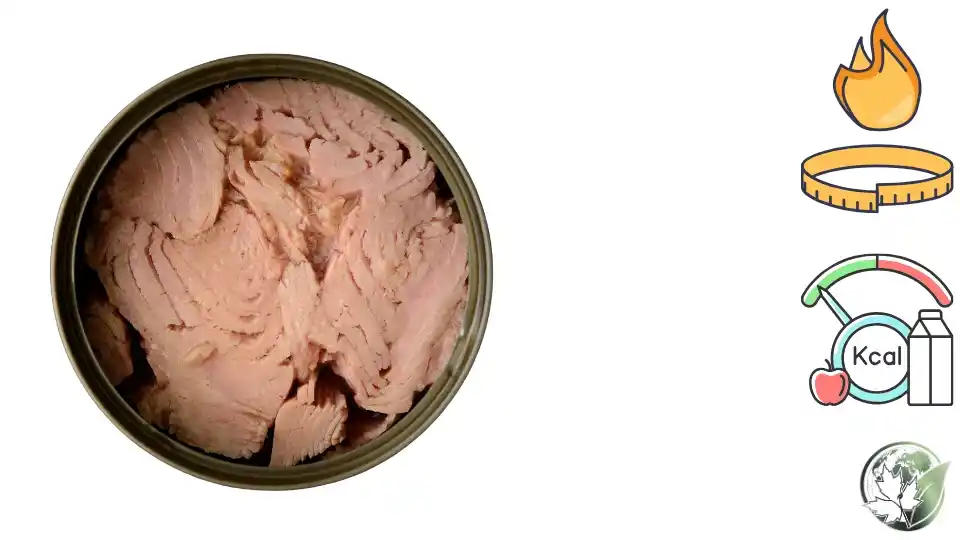
Canned tuna packed in water has about 116 calories per 100 grams of drained fish, and tuna packed in oil has about 198 calories per 100 grams. Fresh yellowfin tuna has about 109 calories per 100 grams raw and roughly 130 calories when grilled or seared, while fatty bluefin tuna has 144 raw and about 184 cooked. So canned tuna in water is about the same as a fresh yellowfin steak, canned tuna in oil is about 50 percent higher, and bluefin sits between them.
The reason is simple. Tuna is a lean fish, and the calories in a can depend almost entirely on the liquid it is packed in. Draining oil-packed tuna removes only part of the fat, because the oil soaks into the flesh. A can of tuna in oil can therefore have 60 to 90 more calories per serving than a can in water. Fresh tuna depends on the species and the cut: the belly (toro) of bluefin can have 300 calories per 100 grams, while the loin of skipjack has only 110.
This guide compares canned and fresh tuna per 100 grams, per can and per serving, explains the effect of water, oil and tomato sauce, covers protein, fat, sodium and mercury, and suggests ways to eat tuna in a calorie-conscious diet. It has three comparison tables and an FAQ.

Tuna in water is nearly as light as a fresh yellowfin steak, while tuna in oil is much higher
How Many Calories Are in Canned Tuna?
| Canned tuna type | Per 100 g drained | Per 85 g (3 oz) | Per 142 g can drained (about 112 g) |
|---|---|---|---|
| Light tuna in water | 116 kcal | 99 kcal | 130 kcal |
| Albacore (white) in water | 128 kcal | 109 kcal | 143 kcal |
| Tuna in tomato sauce | 120 kcal | 102 kcal | 134 kcal |
| Tuna in brine | 110 kcal | 94 kcal | 123 kcal |
| Tuna in sunflower oil | 190 kcal | 162 kcal | 213 kcal |
| Tuna in olive oil | 198 kcal | 168 kcal | 222 kcal |
| Tuna pouch, flavored | 105 kcal | 89 kcal | 118 kcal |
| Tuna with mayo, ready made | 180 kcal | 153 kcal | 202 kcal |
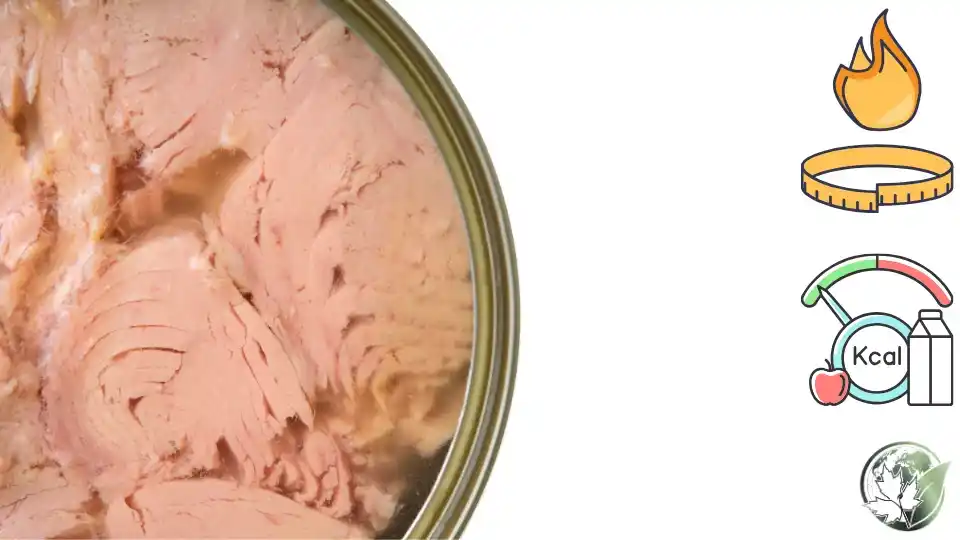
Water-packed tuna is the lowest calorie canned choice. A standard 142 gram can drained to about 112 grams has around 130 calories, with 28 grams of protein.
How Many Calories Are in Fresh Tuna?
| Fresh tuna | Raw per 100 g | Cooked per 100 g | 150 g steak, cooked |
|---|---|---|---|
| Skipjack | 103 kcal | 132 kcal | 198 kcal |
| Yellowfin (ahi) | 109 kcal | 130 kcal | 195 kcal |
| Albacore | 139 kcal | 170 kcal | 255 kcal |
| Bluefin lean (akami) | 144 kcal | 184 kcal | 276 kcal |
| Bluefin medium fatty (chutoro) | 210 kcal | 255 kcal | 383 kcal |
| Bluefin belly (otoro) | 308 kcal | 340 kcal | 510 kcal |
| Seared yellowfin in 1 tsp oil | n/a | 165 kcal | 225 kcal |
Cooking removes water, so the calories per 100 grams rise slightly, but the steak itself loses weight, so the total in the pan stays the same. Searing adds oil, about 40 calories per teaspoon.
Canned Tuna vs Fresh Tuna: Calories Compared
| Amount | Canned in water | Canned in oil | Fresh yellowfin, cooked |
|---|---|---|---|
| 100 g | 116 kcal | 198 kcal | 130 kcal |
| 85 g (3 oz) | 99 kcal | 168 kcal | 111 kcal |
| 1 can (112 g drained) | 130 kcal | 222 kcal | n/a |
| 150 g | 174 kcal | 297 kcal | 195 kcal |
| 200 g | 232 kcal | 396 kcal | 260 kcal |
| Protein per 100 g | 26 g | 24 g | 29 g |
| Fat per 100 g | 1 g | 10 g | 1 g |
The extra calories in oil-packed tuna come entirely from fat. A fresh yellowfin steak is a little higher than water-packed tuna per 100 grams but still lean, and it has the most protein of the three.
Canned Tuna vs Fresh Tuna: Nutrition Compared
| Per 100 g | Canned in water | Canned in oil | Fresh yellowfin (raw) | Fresh bluefin (raw) |
|---|---|---|---|---|
| Calories | 116 kcal | 198 kcal | 109 kcal | 144 kcal |
| Protein | 26 g | 24 g | 24 g | 23 g |
| Fat | 1 g | 8.2 g | 0.5 g | 4.9 g |
| Saturated fat | 0.2 g | 1.3 g | 0.1 g | 1.3 g |
| Omega-3 | 0.2 g | 0.3 g | 0.1 g | 1.2 g |
| Sodium | 247 mg | 354 mg | 45 mg | 39 mg |
| Selenium | 80 mcg | 76 mcg | 36 mcg | 36 mcg |
| Vitamin D | 1.7 mcg | 1.4 mcg | 1.7 mcg | 4 mcg |
| Carbohydrate | 0 g | 0 g | 0 g | 0 g |
| Per serving | 1 can in water | 1 can in oil | 150 g yellowfin steak (raw) |
|---|---|---|---|
| Calories | 130 kcal | 222 kcal | 164 kcal |
| Protein | 29 g | 27 g | 36 g |
| Sodium | 277 mg | 396 mg | 68 mg |
Canned tuna is much higher in sodium than fresh because of the brine, around 250 to 350 milligrams per 100 grams, which is 11 to 15 percent of the daily limit of 2,300 milligrams. Fresh tuna has little sodium. Canned tuna contains less omega-3 than fresh bluefin, because it uses mostly leaner skipjack and albacore.
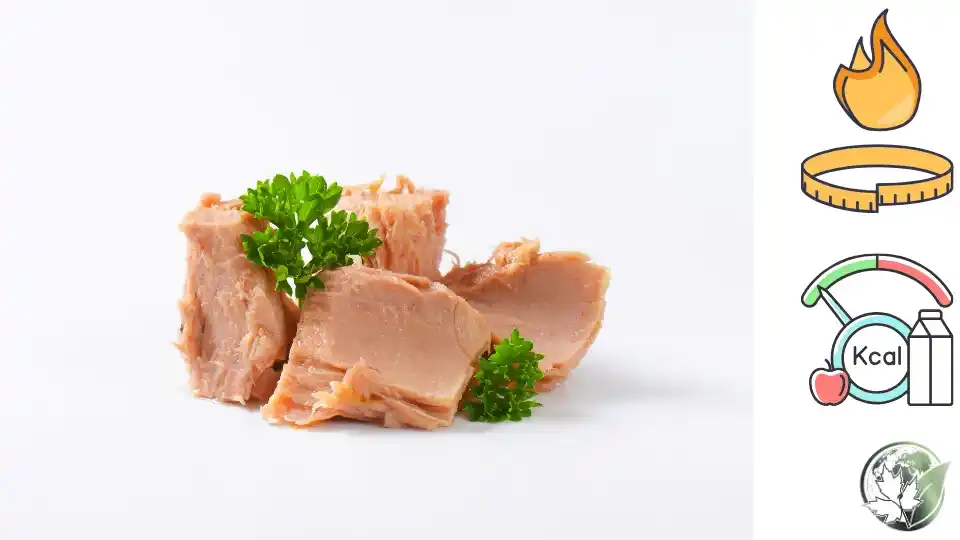
A 150 g seared yellowfin steak has around 195 calories and 36 g of protein
Which Has More Calories: Canned or Fresh Tuna?
It depends on the can and the cut. Water-packed canned tuna, at 116 calories, has fewer calories than fresh yellowfin cooked at 130, and similar calories to raw yellowfin at 109. Oil-packed tuna at 198 has more calories than every fresh lean cut and about the same as lean bluefin cooked at 184. The fatty cuts of bluefin, chutoro and otoro, have more calories than any canned tuna.
| Comparison | Calories per 100 g | Verdict |
|---|---|---|
| Canned in water vs yellowfin cooked | 116 vs 130 | Canned lower |
| Canned in oil vs yellowfin cooked | 198 vs 130 | Fresh lower |
| Canned in oil vs bluefin lean cooked | 198 vs 184 | About equal |
| Canned in water vs skipjack raw | 116 vs 103 | Fresh lower |
| Tomato sauce vs water | 120 vs 116 | About equal |
| Canned in oil vs otoro | 198 vs 308 | Canned lower |
Why Does Oil-Packed Tuna Have So Many More Calories?
Oil has 9 calories per gram, more than twice that of protein, which has 4. When tuna is canned in oil, the flesh absorbs part of the oil, and when you drain the can only about half the oil comes out. A 142 gram can with 25 grams of olive oil adds roughly 220 calories of oil to the fish, of which you eat 8 to 12 grams after draining, or 70 to 110 calories. If you eat the whole contents without draining, a can of tuna in oil can reach 350 calories or more. Draining well and pressing the fish with the lid can reduce the oil by an extra third.
| Can | Fish alone | Oil eaten after draining | Total |
|---|---|---|---|
| Tuna in water, drained | 120 kcal | 10 kcal | 130 kcal |
| Tuna in oil, well drained | 125 kcal | 70 kcal | 195 kcal |
| Tuna in oil, lightly drained | 125 kcal | 100 kcal | 225 kcal |
| Tuna in oil, not drained | 125 kcal | 220 kcal | 345 kcal |
| Tuna in tomato sauce | 120 kcal | 14 kcal | 134 kcal |
Is Canned Tuna or Fresh Tuna Better for Weight Loss?
Both are good protein sources for weight loss, because they are high in protein and low in calories, which makes them filling. A can of water-packed tuna with 29 grams of protein and 130 calories is one of the cheapest and most convenient options. Fresh yellowfin steak gives more protein per portion and much less sodium, but costs more and takes longer to prepare. Oil-packed tuna is tasty and satisfying, but for a calorie deficit, the water-packed variety allows you to control how much oil you add, such as 1 teaspoon of olive oil (40 calories) instead of the 70 to 100 in the can.
What About Mercury in Canned and Fresh Tuna?
Tuna contains methylmercury, which accumulates in large predatory fish. Light canned tuna (skipjack) has the lowest levels, about 0.13 parts per million, while albacore has about 0.35 and fresh or frozen yellowfin and bigeye have more (0.35 to 0.7). The US FDA lists light canned tuna as a "best choice" at two to three servings a week, and albacore and yellowfin as a "good choice" at one serving a week. Pregnant women, young children and people who eat a lot of fish should follow local guidance. Varying your seafood, such as sardines, salmon and shrimp, spreads out the risk.
| Tuna | Mercury (ppm) | Suggested frequency |
|---|---|---|
| Canned light (skipjack) | 0.13 | 2-3 servings a week |
| Canned albacore | 0.35 | 1 serving a week |
| Fresh/frozen yellowfin | 0.35 | 1 serving a week |
| Fresh bigeye | 0.69 | Avoid or occasional |
| Fresh bluefin | 0.68 | Occasional |
A tuna salad bowl with water-packed tuna and vegetables can stay under 350 calories
How Many Calories Are in Common Tuna Dishes?
What you mix with the tuna changes the calories more than the choice between can or steak. A tablespoon of mayonnaise has 94 calories, so a tuna salad sandwich with three tablespoons and two slices of bread climbs to about 520 calories. A tuna salad with olive oil dressing has 330. Using plain Greek yogurt in place of mayonnaise saves 80 calories per 2 tablespoons.
| Dish | Calories |
|---|---|
| Tuna (water) on salad with lemon | 250 kcal |
| Tuna salad with olive oil dressing (1 tbsp) | 330 kcal |
| Tuna mayo sandwich, 2 slices bread | 520 kcal |
| Tuna sandwich with Greek yogurt | 380 kcal |
| Tuna pasta (1 cup cooked pasta + tuna in oil) | 530 kcal |
| Tuna melt with cheese | 600 kcal |
| Seared tuna steak with rice and vegetables | 480 kcal |
| Tuna sushi roll (6 pieces) | 290 kcal |
| Tuna poke bowl | 520 kcal |
How Much Protein Does Tuna Provide?
Tuna provides about 26 grams of protein per 100 grams in cans and about 24 to 29 grams in fresh, which is higher than chicken breast on a per-calorie basis. Per 100 calories, water-packed tuna has 22 grams of protein, chicken breast 19 grams, and a boiled egg 8.5 grams. For someone aiming for 100 grams of protein a day, two cans give 58 grams. The protein is complete, containing all the essential amino acids, and is easy to digest.
| Food | Calories | Protein | Protein per 100 kcal |
|---|---|---|---|
| Tuna in water (100 g) | 116 kcal | 26 g | 22 g |
| Fresh yellowfin, cooked (100 g) | 130 kcal | 29 g | 22 g |
| Chicken breast (100 g) | 165 kcal | 31 g | 19 g |
| Tuna in oil (100 g) | 198 kcal | 24 g | 12 g |
| Salmon, cooked (100 g) | 206 kcal | 22 g | 11 g |
| Egg (1 large) | 72 kcal | 6 g | 8 g |
How Do You Choose a Good Can or Steak?
For canned tuna, read the label for the packing liquid, the species (skipjack, yellowfin, albacore), the sodium per serving and the drained weight. "Solid" or "fillet" pieces are firmer than "chunk" or "flaked". Look for pole-and-line or FAD-free labels for more sustainable fishing. For fresh tuna, look for deep red, glossy flesh without brown edges, a clean sea smell and firm texture. Keep it cold and cook it within a day or two, or freeze. Sushi-grade fish is frozen at very low temperatures to reduce parasites.
How Can You Lower the Sodium and Fat in Canned Tuna?
Rinse canned tuna under cold running water in a sieve for 30 seconds, which can reduce the sodium by up to 30 percent. Choose "no salt added" cans, which have about 40 milligrams per serving. For oil-packed fish, drain the oil and press the lid on the fish, or rinse briefly to remove surface oil. Add flavor with lemon, black pepper, herbs and mustard, rather than salt and mayonnaise.
How Does Canned Tuna Compare With Other Canned and Fresh Fish?
Tuna is one of the leanest fish. Compared with other popular choices it has fewer calories than salmon, sardines and mackerel, and more protein per calorie than almost any of them. The trade-off is that oily fish provide much more omega-3, which supports heart and brain health. A balanced week may include tuna for protein and an oily fish for omega-3.
| Fish (per 100 g) | Calories | Protein | Fat | Omega-3 |
|---|---|---|---|---|
| Canned tuna in water | 116 kcal | 26 g | 1 g | 0.2 g |
| Canned tuna in oil | 198 kcal | 24 g | 8 g | 0.3 g |
| Canned salmon | 142 kcal | 20 g | 6 g | 1.5 g |
| Canned sardines in oil | 208 kcal | 25 g | 11 g | 1.4 g |
| Canned mackerel | 156 kcal | 23 g | 7 g | 1.6 g |
| Fresh salmon, cooked | 206 kcal | 22 g | 12 g | 2.0 g |
| Cod, cooked | 105 kcal | 23 g | 0.9 g | 0.2 g |
| Shrimp, cooked | 99 kcal | 24 g | 0.3 g | 0.3 g |
| Chicken breast, cooked | 165 kcal | 31 g | 3.6 g | 0 g |
How Do Raw, Seared and Grilled Fresh Tuna Differ?
A raw tuna steak or sashimi has the fewest calories since nothing has been added. Searing for one to two minutes per side in a hot pan with a teaspoon of oil leaves the center rare and adds 40 calories to the whole steak. Grilling without oil adds nothing. Cooking all the way through, to 63 degrees Celsius, makes lean tuna dry, so chefs usually serve it rare to medium rare, which is safe when the fish has been handled properly and is very fresh. Pregnant women and anyone with a weak immune system should eat fully cooked fish or canned tuna.
| Preparation (150 g steak) | Calories |
|---|---|
| Raw, sashimi | 164 kcal |
| Grilled, no oil | 195 kcal |
| Seared with 1 tsp olive oil | 235 kcal |
| Pan-fried with 1 tbsp butter | 300 kcal |
| Breaded and fried | 390 kcal |
| Teriyaki glaze (2 tbsp) | 245 kcal |
How Many Tuna Cans Are in a Kilogram and What Do They Cost in Calories?
Because cans differ in size, the easiest way to compare is by drained weight. A small can of 80 grams drained contains about 93 calories in water and 158 in oil. A standard can of 112 grams gives 130 and 222. A large can of 170 grams drained has 197 in water and 337 in oil. Tuna pouches contain 70 to 85 grams of fish and are usually 70 to 90 calories, since they hold little liquid. For meal planning, a pouch is a convenient portion.
| Can size | Drained weight | In water | In oil |
|---|---|---|---|
| Small (95 g) | 70 g | 81 kcal | 139 kcal |
| Standard (142 g) | 112 g | 130 kcal | 222 kcal |
| Large (185 g) | 140 g | 162 kcal | 277 kcal |
| Family (400 g) | 300 g | 348 kcal | 594 kcal |
| Pouch (74 g) | 74 g | 77 kcal | n/a |
Is Tuna Good for Heart Health, Muscle and Energy?
Lean fish provide protein for muscle maintenance, selenium for thyroid function, vitamin B12 and niacin for energy metabolism, and vitamin D. Studies link eating fish about twice a week to a lower risk of heart disease, mainly due to omega-3s, which are higher in fatty fish than in canned light tuna. For muscle building, a can of tuna gives about 29 grams of protein with almost no carbohydrate, which makes it popular with gym-goers. For energy, pair it with whole grains or fruit, as tuna alone has no carbohydrates.
How Should You Build a Low-Calorie Tuna Meal?
Start with water-packed tuna, add volume with vegetables such as cucumber, tomato, lettuce, peppers and sweet corn, and use a light dressing based on lemon juice, mustard and a teaspoon of olive oil. Greek yogurt can replace mayonnaise. Serve in lettuce cups or with a small portion of whole grain bread. A bowl of this kind fills a plate for about 300 calories.
| Ingredient | Calories |
|---|---|
| Tuna in water, 1 can drained | 130 kcal |
| Cucumber and tomato, 150 g | 28 kcal |
| Lettuce, 50 g | 8 kcal |
| Lemon juice and mustard | 8 kcal |
| 1 tsp olive oil | 40 kcal |
| 1 slice whole grain bread | 80 kcal |
| Total | 294 kcal |
How Do You Store Canned and Fresh Tuna Safely?
Unopened canned tuna keeps for three to five years in a cool, dry cupboard, and the date on the can is a quality guide. Once opened, transfer it to a glass or plastic container, refrigerate, and use within three to four days. Fresh tuna should be kept at 0 to 2 degrees Celsius on ice or in the coldest part of the refrigerator and cooked within 24 hours of purchase. For longer storage, wrap steaks tightly and freeze for up to three months. Thaw in the refrigerator overnight, not on the counter. These habits protect against spoilage and histamine formation, which can cause scombroid food poisoning in tuna that has been kept warm.
Which Is Better Value: Canned or Fresh Tuna?
Canned tuna is the clear winner on price per gram of protein. A can of light tuna costing a few dollars supplies 29 grams of protein, while a fresh yellowfin steak of the same protein content may cost three to five times as much. Fresh tuna is a treat meal, with a different taste and texture, and lower sodium. For daily eating, canned tuna in water is a realistic staple, and fresh steaks suit weekends. Whichever you choose, the calories are modest, so the real decisions are the packing liquid, the dressing and the side dishes.
How Many Calories Does Tuna Add to a Weekly Meal Plan?
Eating tuna three times a week as the main protein is easy to fit into a plan. Three cans of water-packed tuna per week come to 390 calories and 87 grams of protein, an average of 56 calories a day, with very low fat. Replacing the same three servings with oil-packed cans would add 276 calories a week. That is a small difference, but over a year it comes to about 14,000 calories, equal to roughly 2 kilograms of body fat.
Key Takeaways: Canned Tuna vs Fresh Tuna Calories
Canned tuna in water has about 116 calories per 100 grams, canned tuna in oil about 198, and fresh yellowfin 109 raw and 130 cooked. The oil is the whole difference. Choose water-packed or fresh lean cuts for the lowest calories, drain and rinse, and watch the mayonnaise.
Frequently Asked Questions
6 questions answered
Does canned tuna have more calories than fresh tuna?
Only if it is packed in oil; water-packed is about the same as fresh yellowfin.
How many calories are in a can of tuna?
About 130 for water-packed and about 220 for oil-packed once drained.
How many calories are in 100 grams of fresh tuna?
About 109 raw yellowfin and about 130 cooked.
Is canned tuna in water or oil better for weight loss?
Water-packed, because it has about 80 fewer calories per 100 grams.
Is fresh tuna healthier than canned?
Fresh has less sodium and often more omega-3, but canned is a convenient, affordable protein.
How much canned tuna can I eat a week?
Two to three servings of light tuna is a common guideline.