
How Many Calories Are in Butter vs Greek Yogurt? The Quick Answer
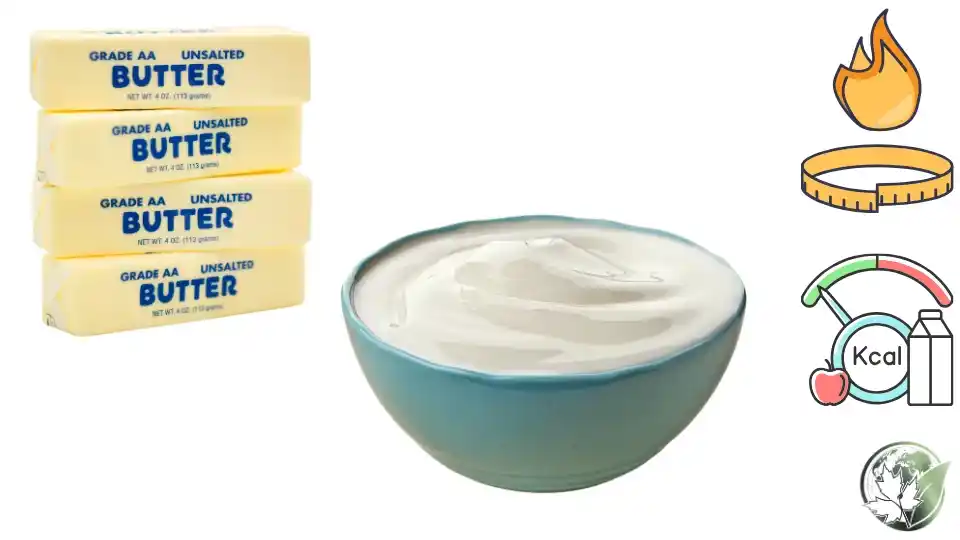
Butter has about 717 calories per 100 grams, about 102 calories per tablespoon (14.2 grams), about 34 per teaspoon and about 810 for a standard 113 gram stick. Plain nonfat Greek yogurt has about 59 calories per 100 grams, about 9 calories per tablespoon (15 grams) and about 130 per cup (245 grams). Whole milk Greek yogurt has about 97 calories per 100 grams, about 15 per tablespoon and about 238 per cup. So per gram, butter has about 12 times the calories of nonfat Greek yogurt, and about 7.4 times the calories of the full-fat version. A tablespoon of butter has the calories of about 11 tablespoons of nonfat Greek yogurt, or nearly 7 tablespoons of whole milk Greek yogurt.
The two foods come from the same source, milk, but they are at opposite ends of the dairy range. Butter is churned cream, about 80 to 82 percent fat, with only about 16 percent water and almost no protein or carbohydrate. Greek yogurt is strained fermented milk, mostly water and protein: nonfat Greek yogurt is about 82 percent water, 10 percent protein, 3.6 percent carbohydrate and under 0.5 percent fat. Because fat has 9 calories per gram and protein and carbohydrate only 4, the fat in butter makes it one of the most calorie dense foods in the kitchen, while Greek yogurt is a lean, high protein food.
That makes Greek yogurt a popular substitute for butter, sour cream and mayonnaise in healthier cooking and baking. This guide compares the calories and nutrition of butter and Greek yogurt per tablespoon, cup and 100 grams, in spreads, baking, sauces and mashed potatoes, explains what changes when you swap one for the other and gives practical ratios. It has three comparison tables, step-by-step swaps and an FAQ.
A tablespoon of butter has the calories of about eleven tablespoons of nonfat Greek yogurt
How Many Calories Are in Butter?
| Portion | Weight | Calories | Fat | Saturated fat |
|---|---|---|---|---|
| 1 teaspoon | 4.7 g | 34 kcal | 3.8 g | 2.4 g |
| 1 tablespoon | 14.2 g | 102 kcal | 11.5 g | 7.3 g |
| 2 tablespoons (1 oz) | 28.4 g | 204 kcal | 23.0 g | 14.6 g |
| 1/4 cup (half stick) | 57 g | 408 kcal | 46.0 g | 29.3 g |
| 1/2 cup (1 stick) | 113 g | 810 kcal | 91.5 g | 58.3 g |
| 1 cup (2 sticks) | 227 g | 1,627 kcal | 184 g | 117 g |
| 1 pat | 5 g | 36 kcal | 4.1 g | 2.6 g |
| 1 butter portion pack | 10 g | 72 kcal | 8.1 g | 5.1 g |
| 100 g | 100 g | 717 kcal | 81.1 g | 51.4 g |
| 250 g block | 250 g | 1,793 kcal | 203 g | 129 g |
Salted and unsalted butter have the same calories. Whipped butter has fewer calories per tablespoon, around 67, because air is whipped into it, but the same per gram.
How Many Calories Are in Greek Yogurt?
| Greek yogurt type | Portion | Weight | Calories | Protein | Fat |
|---|---|---|---|---|---|
| Nonfat | 1 tablespoon | 15 g | 9 kcal | 1.5 g | 0.1 g |
| Nonfat | 1/2 cup | 123 g | 73 kcal | 12.5 g | 0.2 g |
| Nonfat | 1 cup | 245 g | 130 kcal | 22.3 g | 0.7 g |
| Nonfat | 100 g | 100 g | 59 kcal | 10.2 g | 0.4 g |
| 2 percent | 1 tablespoon | 15 g | 11 kcal | 1.5 g | 0.4 g |
| 2 percent | 1 cup | 245 g | 179 kcal | 20.7 g | 4.9 g |
| 2 percent | 100 g | 100 g | 73 kcal | 8.4 g | 2.0 g |
| Whole milk | 1 tablespoon | 15 g | 15 kcal | 1.4 g | 0.8 g |
| Whole milk | 1 cup | 245 g | 238 kcal | 22.0 g | 10.2 g |
| Whole milk | 100 g | 100 g | 97 kcal | 9.0 g | 5.0 g |
| Flavored with fruit | 1 container (150 g) | 150 g | 150 kcal | 10 g | 2 g |
Flavored Greek yogurts can contain added sugar, with 12 to 20 grams per container, which raises calories well above the plain versions.
Butter vs Greek Yogurt: Calories Compared
| Amount | Butter | Nonfat Greek yogurt | Whole milk Greek yogurt |
|---|---|---|---|
| 1 teaspoon (5 g) | 34 kcal | 3 kcal | 5 kcal |
| 1 tablespoon (15 g) | 102 kcal | 9 kcal | 15 kcal |
| 2 tablespoons (30 g) | 204 kcal | 18 kcal | 29 kcal |
| 1/4 cup (about 60 g) | 408 kcal | 35 kcal | 58 kcal |
| 1/2 cup (about 120 g) | 810 kcal | 71 kcal | 116 kcal |
| 100 g | 717 kcal | 59 kcal | 97 kcal |
| 100 calories | 14 g | 169 g | 103 g |
| 1 stick (113 g) | 810 kcal | 67 kcal | 110 kcal |
For 100 calories you can have about 14 grams of butter, roughly a tablespoon, or 169 grams of nonfat Greek yogurt, three quarters of a cup. A stick of butter has the same calories as 1.4 kilograms of nonfat Greek yogurt.
Butter vs Greek Yogurt: Nutrition Compared
| Per 100 g | Butter | Nonfat Greek yogurt | Whole milk Greek yogurt |
|---|---|---|---|
| Calories | 717 kcal | 59 kcal | 97 kcal |
| Fat | 81.1 g | 0.4 g | 5.0 g |
| Saturated fat | 51.4 g | 0.1 g | 3.2 g |
| Protein | 0.9 g | 10.2 g | 9.0 g |
| Carbohydrate | 0.1 g | 3.6 g | 4.0 g |
| Sugar | 0.1 g | 3.2 g | 3.6 g |
| Cholesterol | 215 mg | 5 mg | 13 mg |
| Calcium | 24 mg | 110 mg | 100 mg |
| Potassium | 24 mg | 141 mg | 141 mg |
| Vitamin A | 684 mcg | 0 mcg | 25 mcg |
| Sodium | 11 mg | 36 mg | 35 mg |
| Probiotics | none | live cultures | live cultures |
| Water | 16 g | 82 g | 78 g |
| Per 100 calories | Butter | Nonfat Greek yogurt |
|---|---|---|
| Weight | 14 g | 169 g |
| Protein | 0.1 g | 17.3 g |
| Calcium | 3 mg | 186 mg |
| Fat | 11.3 g | 0.7 g |
Per 100 calories, Greek yogurt provides about 17 grams of protein and nearly 190 milligrams of calcium, while butter provides virtually none. Butter has more vitamin A, but in the amounts normally used the difference is slight. On a purely nutritional basis, Greek yogurt is the more nutrient dense food, while butter is an ingredient valued for taste, texture and cooking performance.
One stick of butter has the calories of about 1.4 kilograms of nonfat Greek yogurt
Can You Substitute Greek Yogurt for Butter?
In many recipes you can, but not always in a one-to-one ratio, and results differ. Butter provides fat, which tenderizes baked goods, helps them brown, carries flavor and aerates when creamed with sugar. Greek yogurt contributes moisture, protein and acidity, giving baked goods a denser, moister crumb, and the lack of fat can make them tougher or rubbery if overmixed. A reliable approach is to replace half of the butter with an equal amount of Greek yogurt in muffins, quick breads, pancakes and cakes. For brownies and cookies, replacing a quarter to a half works. For pastry, pie crust and shortbread, where solid fat is essential, yogurt is not a good substitute.
| Recipe use | Swap | Result | Calories saved (per 1/2 cup butter) |
|---|---|---|---|
| Muffins, quick breads | Replace half of butter with Greek yogurt | Moist, tender | About 390 kcal |
| Cakes | Replace half | Moist, slightly denser | About 390 kcal |
| Pancakes, waffles | Replace all butter in batter | Soft, less crisp edges | About 740 kcal |
| Brownies | Replace a third to a half | Fudgier, less rich | About 260 to 390 kcal |
| Cookies | Replace a quarter | Softer, cakier | About 190 kcal |
| Mashed potatoes | Replace all butter with yogurt | Tangy, creamy | About 740 kcal |
| Toast spread | Greek yogurt with herbs instead of butter | Fresh, tangy | About 90 kcal per tbsp |
| Frosting | Replace half the butter | Lighter, tangy | About 390 kcal |
| Pie crust, shortbread | Not recommended | Tough | None |
When you substitute, bake at the same temperature, check doneness a few minutes earlier, and add a pinch of baking soda to balance the acidity if you use a lot of yogurt.
How Many Calories Do You Save by Swapping Butter for Greek Yogurt?
The savings depend on the amounts. A recipe for 12 muffins calls for 1/2 cup of butter, 810 calories, which is 68 calories per muffin from butter. Replacing half with nonfat Greek yogurt reduces the butter to 405 calories and adds 36 calories of yogurt, saving about 370 calories in the batch, or 31 calories per muffin. For mashed potatoes with 4 tablespoons of butter for 4 servings, 408 calories, using 4 tablespoons of nonfat yogurt, 36 calories, saves 372 calories, or 93 calories per serving. On toast, a teaspoon of butter, 34 calories, replaced by a teaspoon of Greek yogurt, 3 calories, saves 31 calories each slice.
| Dish | With butter | With Greek yogurt | Saved per serving |
|---|---|---|---|
| Mashed potatoes, 4 tbsp for 4 | 408 kcal total | 36 kcal total | 93 kcal |
| Muffins, 12, half swap | 810 kcal total | 438 kcal total | 31 kcal |
| Pancakes, 12, all butter | 405 kcal total | 36 kcal total | 31 kcal |
| Baked potato topping, 1 tbsp | 102 kcal | 9 kcal | 93 kcal |
| Toast, 1 tsp | 34 kcal | 3 kcal | 31 kcal |
| Corn on the cob, 1 tsp | 34 kcal | 3 kcal | 31 kcal |
What Are the Differences in Taste and Texture?
Butter is rich, creamy, a little sweet and unmistakably dairy, and it melts at body temperature, giving a coating mouthfeel. It browns into nutty beurre noisette and forms flaky layers in pastry. Greek yogurt is tangy, thick and cool, and it brings freshness rather than richness. On hot foods it can curdle if boiled, so it should be added at the end of cooking, off the heat, or stabilized with a spoonful of flour or cornstarch. As a spread, it works on bagels, toast with herbs and baked potatoes, but it is not a good substitute for sautéing, frying or browning. For these tasks, use a small amount of oil or butter, or substitute broth.
Is Butter or Greek Yogurt Better for Heart Health?
Butter is high in saturated fat, with about 7 grams per tablespoon, a third of the recommended daily maximum of about 20 grams on a 2,000 calorie diet. High intake of saturated fat raises LDL cholesterol in many people, and dietary guidelines recommend limiting it to under 10 percent of calories. Moderate butter use, such as a teaspoon on toast, is not a problem for most healthy people, but it adds up quickly. Greek yogurt, especially nonfat and low fat, contains very little saturated fat, plus calcium, protein, potassium and probiotics, and fermented dairy such as yogurt has been linked in observational studies to a lower risk of type 2 diabetes and neutral to beneficial effects on cardiovascular health. Replacing butter with Greek yogurt, or with olive oil in cooking, is consistent with advice to swap saturated fat for unsaturated fat.
Is Greek Yogurt Better for Weight Loss?
Yes, in most cases. Greek yogurt provides about 17 grams of protein per 100 calories, which increases fullness, compared with butter, which gives almost none. Swapping butter for yogurt in cooking reduces energy density, so you can eat the same volume of food with fewer calories. As a snack, a cup of nonfat plain Greek yogurt at 130 calories with berries is a satisfying, protein-rich option. However, butter in small amounts, such as a teaspoon on vegetables, can make healthy food more enjoyable and help you absorb fat-soluble vitamins, so it need not be eliminated. The key is the quantity: a teaspoon is 34 calories, while a thick slather is 100 or more.
Greek yogurt with herbs can replace butter on toast, saving about 30 calories per teaspoon
How Many Calories Are in Foods Made With Butter and Greek Yogurt?
| Food | Serving | Calories | Notes |
|---|---|---|---|
| Buttered toast | 1 slice | 105 kcal | 1 tsp butter, 71 for bread |
| Toast with Greek yogurt | 1 slice | 75 kcal | 1 tsp yogurt |
| Baked potato with butter | 1 medium | 263 kcal | 1 tbsp |
| Baked potato with Greek yogurt | 1 medium | 170 kcal | 1 tbsp |
| Butter on corn | 1 ear | 135 kcal | 1 tsp |
| Garlic butter sauce | 2 tbsp | 210 kcal | Butter, garlic |
| Greek yogurt garlic sauce | 2 tbsp | 20 kcal | Yogurt, garlic, lemon |
| Butter cookies | 1 cookie | 95 kcal | Shortbread |
| Greek yogurt parfait | 1 cup | 190 kcal | Berries, granola |
| Butter chicken | 1 cup | 380 kcal | Cream, butter |
| Tzatziki | 1/4 cup | 45 kcal | Cucumber, olive oil |
How to Choose and Store Butter and Greek Yogurt
For butter, check the label for the fat content, which is at least 80 percent in most countries, and choose unsalted for cooking so you can control the salt. Store butter wrapped in the refrigerator for up to three months, or freeze for up to nine months, and keep a small amount in a covered dish at room temperature for a few days if you need it soft. For Greek yogurt, choose plain with no added sugar, with live cultures mentioned on the label, and protein of at least 9 grams per 100 grams. Keep it in the refrigerator and use it by the date on the pack, within about a week of opening. Stir in any liquid that separates on top, which is whey and is harmless.
Choose plain Greek yogurt with live cultures and no added sugar
How to Count Butter and Greek Yogurt Calories Accurately
Measure butter by weight on a scale, 7.2 calories per gram, or by tablespoon markings on the wrapper, 102 per tablespoon. Do not count a heaped knife as one teaspoon: a generous spread is often 10 grams, 72 calories. For Greek yogurt, use the label for the type: about 0.6 calories per gram for nonfat, 0.73 for 2 percent and 0.97 for whole. Check fruit and flavored versions, because the sugar changes the numbers. In a recipe, add up all the butter and yogurt calories, then divide by the number of servings.
What Are the Different Types of Butter and How Do Their Calories Compare?
Not all butter products are the same, but the calories per gram are close for the standard ones. Regular butter is about 80 to 82 percent fat. European-style butter has 82 to 86 percent fat, making it slightly richer, at about 740 calories per 100 grams. Ghee, clarified butter with the water and milk solids removed, is nearly 100 percent fat, with about 112 calories per tablespoon. Whipped butter is about a third air, so a tablespoon has about 67 calories. Light butter blends and reduced fat spreads can have 40 to 70 calories per tablespoon, while margarine is similar to butter at about 100 per tablespoon unless it is a light version.
| Product (1 tbsp) | Calories | Fat | Notes |
|---|---|---|---|
| Regular butter | 102 kcal | 11.5 g | 80 percent fat |
| European-style butter | 108 kcal | 12.2 g | 83 to 86 percent fat |
| Ghee | 112 kcal | 12.7 g | Pure milk fat |
| Whipped butter | 67 kcal | 7.5 g | Air whipped |
| Light butter | 50 kcal | 5.5 g | Blended with water |
| Margarine, stick | 101 kcal | 11.4 g | Vegetable oils |
| Reduced fat spread | 45 kcal | 5 g | Plant based |
| Cream cheese | 50 kcal | 5 g | For comparison |
| Greek yogurt, whole | 15 kcal | 0.8 g | For comparison |
How Does Greek Yogurt Compare With Other Dairy Replacements for Butter?
Greek yogurt is not the only butter replacement. Mashed avocado, applesauce, mashed banana, pumpkin puree and nut butters each work in some recipes. Applesauce, at about 8 calories per tablespoon, is excellent for moist cakes and muffins but adds sugar. Mashed avocado, at about 23 calories per tablespoon, replaces butter one-to-one in brownies and cookies with a creamy texture and healthy fats. Olive oil replaces butter at about three quarters of the amount, with similar calories but unsaturated fat. Cottage cheese blended smooth gives protein and creaminess. Greek yogurt stands out for protein and tang, and it works especially well in recipes that already contain some acid, like buttermilk pancakes or banana bread.
| Butter substitute (1 tbsp) | Calories | Works best in |
|---|---|---|
| Nonfat Greek yogurt | 9 kcal | Muffins, pancakes, mash |
| Applesauce, unsweetened | 8 kcal | Cakes, muffins |
| Mashed banana | 14 kcal | Quick breads |
| Pumpkin puree | 5 kcal | Muffins, brownies |
| Mashed avocado | 23 kcal | Brownies, cookies |
| Olive oil (3/4 tbsp) | 90 kcal | Savory baking |
| Almond butter | 98 kcal | Cookies |
| Butter | 102 kcal | Everything |
Do Butter and Greek Yogurt Affect Cholesterol Differently?
Yes. Butter raises LDL cholesterol in many people because of its saturated fat, and the effect is larger than that of the same amount of fat from cheese or yogurt, possibly because of the structure of the food matrix. A study comparing butter, cheese and olive oil found that butter raised LDL more than cheese of the same fat content, while olive oil lowered it. Greek yogurt, particularly low fat, has little effect, and fermented dairy has been associated in cohort studies with neutral or favorable effects on cardiovascular risk. If you have high cholesterol, doctors usually suggest replacing butter with unsaturated oils or spreads and choosing low fat dairy, which fits well with swapping to yogurt.
What Are Common Mistakes When Swapping Butter for Greek Yogurt?
The first is replacing all the butter in a recipe that needs solid fat, which gives rubbery, dense results. The second is using flavored yogurt, which adds sugar and changes taste. The third is adding yogurt to a hot sauce over direct heat, which curdles it. The fourth is overmixing the batter, which toughens gluten when fat is low. The fifth is forgetting to adjust baking time and temperature, as moist batters take longer. The sixth is assuming the lighter version is a free pass: a muffin with half the butter still has 150 to 250 calories, depending on size and sugar. Tasting and adjusting, starting with a half swap, avoids most problems.
Key Takeaways: Butter vs Greek Yogurt Calories
Butter has about 717 calories per 100 grams and 102 per tablespoon, while nonfat Greek yogurt has about 59 and 9, so butter is about 12 times more calorie dense. Greek yogurt offers protein, calcium and probiotics instead of saturated fat. Replace half the butter in baked goods and all of it in mash and spreads to save hundreds of calories, and keep a teaspoon of butter for flavor where it matters.
Frequently Asked Questions
6 questions answered
How many calories are in a tablespoon of butter?
About 102.
How many calories are in a tablespoon of Greek yogurt?
About 9 for nonfat and 15 for whole milk.
Does butter have more calories than Greek yogurt?
Yes, about 12 times more per gram than nonfat Greek yogurt.
Can I replace butter with Greek yogurt in baking?
Yes, usually half of the butter, and not in pastry or shortbread.
Is Greek yogurt healthier than butter?
It has more protein and calcium and far less saturated fat.
Does Greek yogurt work as a spread?
Yes, on toast and potatoes, especially with herbs.




