How Many Calories Are in Barhi Dates vs Medjool Dates? The Quick Answer
A ripe Barhi date (about 11 grams without the pit) has roughly 30 calories, and a Medjool date (about 24 grams) has roughly 66 calories. One Medjool therefore has the calories of just over two Barhi dates. Per 100 grams the two are almost identical: soft Barhi dates have about 275 calories and Medjool dates about 277. The difference per date is entirely about size. Medjool dates are large and fleshy, while Barhi are small, round and short.
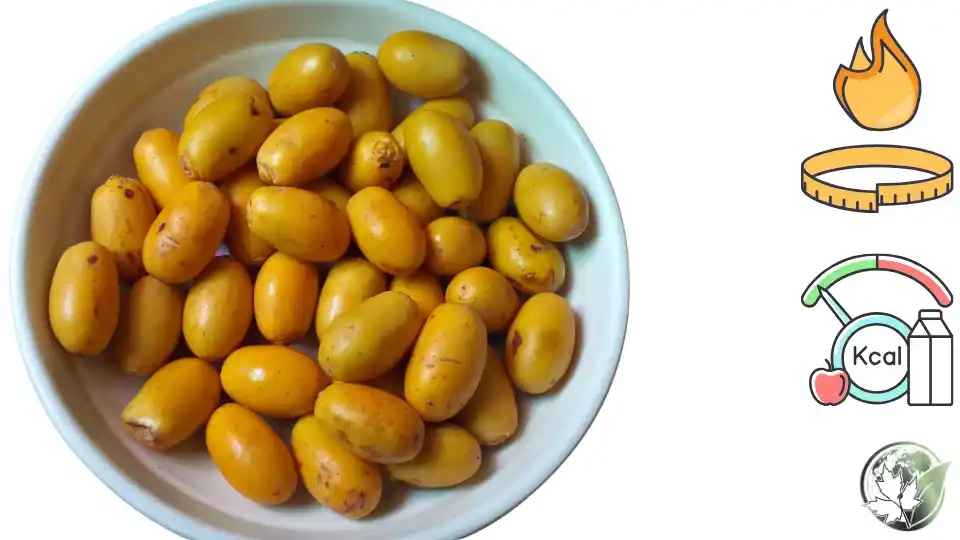
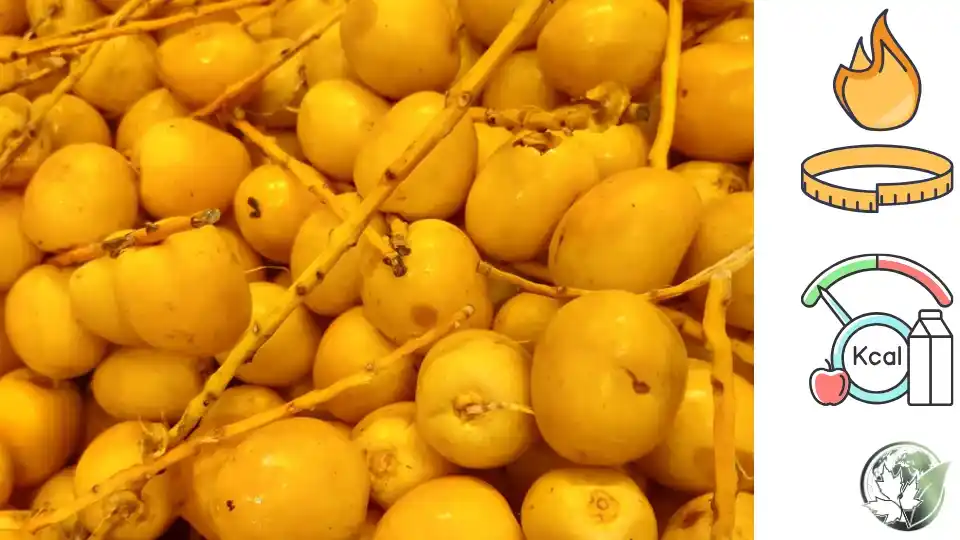
Barhi dates also have a second form that Medjool does not. They are commonly eaten at the yellow khalal stage, when they are crunchy, juicy and lower in calories, at about 150 to 180 per 100 grams, or 25 calories per date. So a fresh yellow Barhi date is lower in calories than a ripe one and much lower than a Medjool. This guide compares the two varieties per date, per 100 grams and per serving of three or five dates, covers sugar, fiber and minerals, and explains how to choose and portion them. It has three comparison tables and a short FAQ.
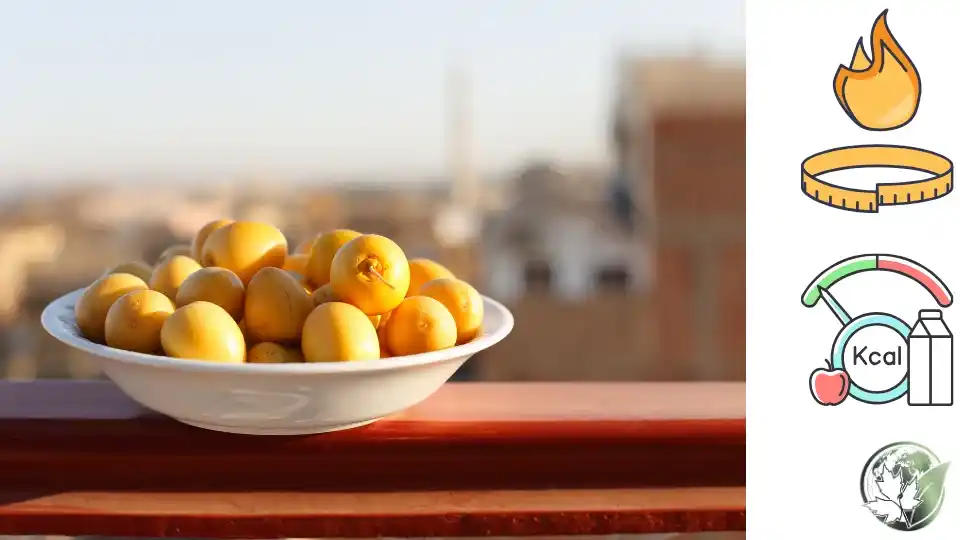
A Medjool date is about twice the size and calories of a ripe Barhi date
How Many Calories Are in a Barhi Date?
A ripe, soft, brown Barhi date has about 30 calories. The weight of the edible flesh is about 11 grams, and ripe dates provide about 275 calories per 100 grams. Fresh yellow Barhi dates weigh 12 to 20 grams each and have fewer calories per gram because of their water content: a typical 15 gram fresh date has about 25 calories.
| Barhi date | Weight (without pit) | Calories | Sugar |
|---|---|---|---|
| Fresh yellow (khalal) | 15 g | 25 kcal | 5 g |
| Ripe brown, soft (rutab) | 11 g | 30 kcal | 7.3 g |
| Dried, semi-dry | 9 g | 26 kcal | 6.5 g |
| Per 100 g, fresh | 100 g | 165 kcal | 33 g |
| Per 100 g, ripe | 100 g | 275 kcal | 66 g |
How Many Calories Are in a Medjool Date?
A Medjool date weighs 20 to 28 grams without the pit, with an average of 24 grams, and has about 66 calories. Some jumbo Medjool dates weigh 30 grams or more and reach 83 calories, while smaller ones of 18 grams have around 50.
| Medjool size | Weight (without pit) | Calories | Sugar |
|---|---|---|---|
| Small | 18 g | 50 kcal | 12 g |
| Medium | 24 g | 66 kcal | 16 g |
| Large | 28 g | 78 kcal | 19 g |
| Jumbo | 30 g | 83 kcal | 20 g |
| Per 100 g | 100 g | 277 kcal | 66 g |
Barhi vs Medjool Dates: Calories Compared
| Amount | Barhi (ripe) | Medjool |
|---|---|---|
| 1 date | 30 kcal | 66 kcal |
| 2 dates | 60 kcal | 132 kcal |
| 3 dates | 90 kcal | 198 kcal |
| 5 dates | 150 kcal | 330 kcal |
| 10 dates | 300 kcal | 660 kcal |
| 100 g | 275 kcal | 277 kcal |
| 30 g | 83 kcal | 83 kcal |
| 100 calories | 36 g (3.3 dates) | 36 g (1.5 dates) |
| 1 date | 11 g | 24 g |
Three Barhi dates have fewer calories than one and a half Medjool dates. If you count dates and not grams, Barhi is the lighter choice. If you weigh them, they are identical.
Barhi vs Medjool Dates: Nutrition Compared
| Per 100 g | Barhi (ripe) | Medjool |
|---|---|---|
| Calories | 275 kcal | 277 kcal |
| Carbohydrate | 73 g | 75 g |
| Sugar | 66 g | 66 g |
| Fiber | 7 g | 6.7 g |
| Protein | 2 g | 1.8 g |
| Fat | 0.2 g | 0.2 g |
| Potassium | 650 mg | 696 mg |
| Magnesium | 50 mg | 54 mg |
| Calcium | 60 mg | 64 mg |
| Iron | 1 mg | 0.9 mg |
| Per date | Barhi (11 g) | Medjool (24 g) |
|---|---|---|
| Calories | 30 kcal | 66 kcal |
| Sugar | 7.3 g | 16 g |
| Sugar cubes (4 g) | 1.8 | 4 |
| Fiber | 0.8 g | 1.6 g |
| Potassium | 72 mg | 167 mg |
One Medjool date carries about 4 sugar cubes' worth of sugar, and one Barhi about 1.8. The nutrient profile is nearly the same, so neither variety is meaningfully "healthier" per gram. What changes your intake is how many of each you reach for.

One Medjool date holds about 4 sugar cubes of sugar and a Barhi about 1.8
Which Has More Calories: Barhi or Medjool?
Per date, Medjool has more than twice the calories. Per 100 grams, they are equal within one percent. Whether Barhi or Medjool is "better" for your diet depends on whether you want a small, easy-to-count piece or a big, satisfying one. A Medjool date is filling, and many people stop at one or two. A Barhi is a small sweet bite, and it is easier to eat five without noticing, which would bring 150 calories, the same as 2.3 Medjool.
| Portion | Barhi | Medjool | Lower |
|---|---|---|---|
| 1 date | 30 | 66 | Barhi |
| 3 dates | 90 | 198 | Barhi |
| 100 calories | 3.3 dates | 1.5 dates | Same energy |
| 30 g | 83 | 83 | Equal |
| 100 g | 275 | 277 | Equal |
| Fresh yellow, 1 date | 25 | n/a | Barhi |
Why Do Barhi and Medjool Dates Differ in Size?
They are different varieties of the date palm fruit. Medjool, sometimes called the "king of dates", was originally grown in Morocco, and is now widely grown in Palestine, Jordan, California and Israel. It produces a big, soft, caramel-tasting fruit. Barhi, grown in Iraq, Saudi Arabia, Iran, Egypt and California, produces small to medium round fruits that taste of honey and butterscotch when ripe. Barhi are among the few varieties eaten at the khalal stage, which is why they are sold fresh in summer, while Medjool is nearly always sold at the soft ripe stage.
How Do Fresh Yellow Barhi Compare With Ripe Barhi and Medjool?
Fresh yellow Barhi dates are crunchy, a little like an apple, and contain 40 to 50 percent water. As they ripen, the sugars concentrate and the texture becomes soft and sticky. A fresh date is the lightest option.
| Date stage | Weight | Calories | Water | Sugar |
|---|---|---|---|---|
| Fresh yellow Barhi | 15 g | 25 kcal | 55% | 5 g |
| Ripe Barhi | 11 g | 30 kcal | 22% | 7.3 g |
| Medjool | 24 g | 66 kcal | 21% | 16 g |
| Dried Barhi | 9 g | 26 kcal | 15% | 6.5 g |
The fresh yellow version is a good choice if you want a sweet, crunchy bite for 25 calories. The ripe versions are better for baking, smoothies and stuffing.
How Many Dates Should You Eat a Day?
Most dietitians suggest 2 to 4 dates a day for a healthy adult, depending on size. That is 3 to 4 Barhi dates (90 to 120 calories) or 2 Medjool dates (132 calories). In either case you get about 15 grams of sugar from three Barhi or 32 grams from two Medjool, which counts as natural sugar from whole fruit, but still adds up. People with diabetes should check with their doctor and pair dates with protein, such as nuts or yogurt, to slow the rise in blood sugar.
| Daily serving | Calories | Sugar | Fiber |
|---|---|---|---|
| 3 ripe Barhi | 90 kcal | 22 g | 2.4 g |
| 5 ripe Barhi | 150 kcal | 37 g | 4 g |
| 1 Medjool | 66 kcal | 16 g | 1.6 g |
| 2 Medjool | 132 kcal | 32 g | 3.2 g |
| 3 Medjool | 198 kcal | 48 g | 4.8 g |
Two or three dates with a few almonds make a balanced snack of about 150 to 200 calories
Are Dates Healthier Than Sugar?
Dates contain the same kinds of sugar as table sugar, mostly glucose, fructose and sucrose, but they bring fiber, potassium, magnesium and polyphenols, so they are a better source of sweetness. Their glycemic index is moderate, around 42 to 55 depending on the variety and ripeness. One Medjool date has 66 calories and 16 grams of sugar, which is 4 sugar cubes' worth, but also 1.6 grams of fiber and 167 milligrams of potassium. They are not "free", but they are more nutritious than a candy of the same calories.
How Can You Use Dates in Cooking and Snacks?
Barhi dates are soft and honey-like, and work well chopped into porridge, yogurt or salads, or blended into date paste. Medjool dates, with their size, are ideal for stuffing with almonds, walnuts or peanut butter, and for smoothies. A stuffed Medjool with an almond adds 7 calories from the nut. Date paste can replace up to half the sugar in muffins and cakes, and cuts the added sugar while adding fiber. As date paste is concentrated, use 2 tablespoons per serving, about 80 calories.
| Snack | Calories |
|---|---|
| 1 Medjool + 1 almond | 73 kcal |
| 1 Medjool + 1 teaspoon peanut butter | 98 kcal |
| 3 Barhi + 6 almonds | 135 kcal |
| 2 Barhi + 1 walnut half | 78 kcal |
| 2 tbsp date paste | 80 kcal |
| Date smoothie with 2 Medjool and milk | 290 kcal |
How Do You Choose and Store Barhi and Medjool Dates?
Choose dates with smooth, glossy skin and no mold or crystallized patches. Medjool should feel plump and soft, and Barhi should be sticky and amber. Store in an airtight container in the refrigerator for up to six months, or in the freezer for a year. Fresh yellow Barhi should be eaten within a week and kept cold. Wash only just before eating, and remove the pit by pressing a finger through the side.
How Do You Weigh Dates for Accurate Counting?
Dates sold with pits weigh more than the edible part. Medjool with pit weighs about 27 grams and the flesh 24 grams, a loss of roughly 11 percent. Barhi with pit weighs about 13 grams, giving 11 grams of flesh, a loss of about 15 percent. If you use the calories per date on the label, check whether it refers to pitted dates.
How Do Barhi and Medjool Dates Compare With Other Date Varieties?
Dates are close to each other in energy per 100 grams, since all soft dates are about 65 to 75 percent sugar by weight. The difference is in the size of each fruit. Compared with Iranian varieties, a ripe Barhi at 30 calories is slightly larger than a Piarom at 25 and a Zahedi at 26, a Mazafati at 27, and smaller than a Kabkab at 33 or a Rabbi at 30. Medjool stands apart at 66 calories, more than double most of them.
| Variety | Weight per date | Calories per date | Calories per 100 g |
|---|---|---|---|
| Piarom | 9 g | 25 kcal | 277 kcal |
| Zahedi | 9 g | 26 kcal | 285 kcal |
| Mazafati | 10 g | 27 kcal | 270 kcal |
| Rabbi | 11 g | 30 kcal | 272 kcal |
| Barhi (ripe) | 11 g | 30 kcal | 275 kcal |
| Kabkab | 12 g | 33 kcal | 275 kcal |
| Deglet Noor | 7 g | 20 kcal | 282 kcal |
| Medjool | 24 g | 66 kcal | 277 kcal |
If you like to eat dates by the handful, the smaller varieties give you more room to count. A Medjool is closer to a snack on its own.
How Do Dates Compare With Other Sweet Snacks?
A Barhi date at 30 calories is lighter than a cookie, a chocolate square or a spoon of honey, and delivers some fiber. Two Medjool dates at 132 calories are similar to a small chocolate bar of 25 grams (134 calories), but with more potassium and fiber and no saturated fat. For a sweet craving, dates are a good option when eaten in measured amounts.
| Snack | Calories | Sugar | Fiber |
|---|---|---|---|
| 1 ripe Barhi date | 30 kcal | 7.3 g | 0.8 g |
| 1 Medjool date | 66 kcal | 16 g | 1.6 g |
| 1 sugar cube | 16 kcal | 4 g | 0 g |
| 1 plain biscuit | 32 kcal | 2.5 g | 0.2 g |
| 1 chocolate chip cookie | 145 kcal | 10.8 g | 0.8 g |
| 1 square milk chocolate (10 g) | 54 kcal | 5.5 g | 0.3 g |
| 1 teaspoon honey | 21 kcal | 5.7 g | 0 g |
| 1 small banana (100 g) | 89 kcal | 12 g | 2.6 g |
What Vitamins and Minerals Do Barhi and Medjool Dates Provide?
Dates are a good source of potassium, which supports muscle and nerve function and blood pressure. Three Medjool dates provide around 500 milligrams, or 11 percent of the daily need. They also supply magnesium, copper, manganese, vitamin B6 and small amounts of iron and calcium. Barhi dates are similar, and they are especially valued as a source of antioxidants such as carotenoids and phenolic acids. These help protect cells, though the amounts are modest and dates should be seen as one part of a varied diet.
| Nutrient (per 100 g) | Barhi | Medjool | Daily value met by 100 g |
|---|---|---|---|
| Potassium | 650 mg | 696 mg | 15% |
| Magnesium | 50 mg | 54 mg | 12% |
| Copper | 0.4 mg | 0.4 mg | 44% |
| Manganese | 0.3 mg | 0.3 mg | 13% |
| Vitamin B6 | 0.2 mg | 0.2 mg | 12% |
| Iron | 1 mg | 0.9 mg | 5% |
| Calcium | 60 mg | 64 mg | 5% |
Are Dates Safe for Diabetes and Weight Control?
Dates have a moderate glycemic index, between about 42 and 55, which is lower than white bread or table sugar. Even so, they are concentrated in sugar, with about 16 grams in a single Medjool date. People with diabetes can include them in small portions, preferably one or two small dates with a source of protein or fat, such as almonds or yogurt, and should watch blood glucose. For weight control, the key is portion: three Barhi dates at 90 calories are a modest snack, whereas a handful of ten Medjool dates is 660 calories. Dates are filling because of the fiber, but it is easy to overeat them because they are sweet and sticky.
How Do Dates Fit Into Ramadan and Daily Life?
In many countries, dates are the traditional food for breaking the fast, usually three dates at sunset. Three Medjool dates provide 198 calories and 48 grams of sugar, and three Barhi dates provide 90 calories and 22 grams of sugar. Both give a quick source of energy, potassium and fluid-balancing minerals. After the dates and water, a balanced meal with protein, vegetables and whole grains helps keep energy steady. Outside Ramadan, dates are a natural pre-workout snack: two Medjool dates 30 to 45 minutes before exercise give around 130 calories of fast carbohydrates.
| Occasion | Dates | Calories |
|---|---|---|
| Breaking the fast, light | 3 Barhi | 90 kcal |
| Breaking the fast, traditional | 3 Medjool | 198 kcal |
| Pre-workout | 2 Medjool | 132 kcal |
| Afternoon snack | 3 Barhi + 6 almonds | 135 kcal |
| Breakfast topping | 2 Barhi in oatmeal | 60 kcal |
| Dessert | 1 stuffed Medjool | 73 kcal |
What Is the Difference Between Date Syrup, Date Paste and Whole Dates?
Whole dates are the fruit with fiber intact. Date paste is blended whole dates, with the same calories per gram (about 277 per 100 grams), and is a good sugar substitute for baking. Date syrup (dibs) is the cooked, filtered juice, with about 300 calories per 100 grams and 60 calories per tablespoon, but with little fiber. Using paste or whole dates is preferable to syrup if you want to keep the fiber. When measuring, 1 tablespoon of paste has about 20 grams and 55 calories.
| Form | Amount | Calories |
|---|---|---|
| Whole Barhi | 1 date (11 g) | 30 kcal |
| Whole Medjool | 1 date (24 g) | 66 kcal |
| Date paste | 1 tbsp (20 g) | 55 kcal |
| Date syrup | 1 tbsp (20 g) | 60 kcal |
| Chopped dates | 1/4 cup (40 g) | 110 kcal |
| Date sugar | 1 tsp (4 g) | 14 kcal |
How Do You Count Dates Without a Scale?
If you do not have a kitchen scale, a simple rule can help: count a Barhi as 30 calories, a Medjool as 66, and a small Iranian date such as Zahedi or Piarom as 25. A cup of pitted, chopped dates weighs about 150 grams and has around 415 calories. A tablespoon of chopped dates has about 25 calories. To avoid overeating, put the dates you plan to eat on a plate and put the box away.
How Do Barhi and Medjool Dates Differ in Taste and Texture?
Barhi dates taste of caramel and honey with a thin, delicate skin that melts when ripe. At the yellow stage, they are crisp and mildly sweet, with a slight astringency from tannins that fades as they ripen. Medjool dates are meatier, with a deep caramel, almost toffee-like flavor and a chewy flesh. Because of this, Barhi is often preferred for eating plain, while Medjool is preferred for stuffing and cooking. Taste does not change the calories, but it affects how many you want. A rich Medjool is satisfying after one, whereas lighter Barhi dates can invite a second and a third.
Which Is Better for Kids, Athletes and Older Adults?
For children, small Barhi dates are easier to chew and portion, and two or three are a suitable snack of 60 to 90 calories. For athletes, Medjool dates are a convenient source of carbohydrate: two give around 130 calories and 32 grams of sugar, similar to an energy gel but with minerals. For older adults, soft ripe dates are easy to eat and supply potassium and fiber, which can help digestion, as long as the sugar is balanced with the rest of the diet. Anyone with diabetes, kidney disease or on a potassium-restricted diet should check portions with their doctor.
| Group | Suggested serving | Calories |
|---|---|---|
| Child (4-8 years) | 2 Barhi | 60 kcal |
| Teen or active adult | 3 Barhi or 1-2 Medjool | 90-132 kcal |
| Athlete before training | 2 Medjool | 132 kcal |
| Older adult | 2-3 Barhi with yogurt | 60-90 kcal + yogurt |
| Weight loss plan | 1-2 Barhi | 30-60 kcal |
What Is the Price and Availability of Barhi vs Medjool?
Medjool dates are usually the more expensive of the two because of their size and the labor needed to harvest them, and they are sold in boxes by weight, often 500 grams or 1 kilogram. Barhi dates are available seasonally in late summer when fresh, and year-round in packaged ripe or dried form. When comparing the price, divide by edible weight, since pits are a larger share in small dates. The calories per dollar are practically equal, because the energy per 100 grams is the same, so choose on taste, convenience and budget.
Key Takeaways: Barhi Dates vs Medjool Dates Calories
A ripe Barhi date has about 30 calories and a Medjool about 66, but per 100 grams both have 275 to 277, so the difference is size. Fresh yellow Barhi is the lightest at about 25 calories. Count by date or by weight, aim for 2 to 4 dates a day, and pair them with nuts or yogurt for a balanced snack.
Frequently Asked Questions
6 questions answered
Which has more calories, Barhi or Medjool dates?
A Medjool date has about 66 calories and a ripe Barhi about 30.
Are Barhi and Medjool dates equal per 100 grams?
Yes, about 275 and 277 calories per 100 grams.
How many Barhi dates equal one Medjool?
About two Barhi dates equal one Medjool in calories.
How many calories are in a fresh yellow Barhi date?
About 25 calories.
How many dates can I eat a day?
Two to four dates, depending on size, is a common guideline.
Are dates better than sugar?
They contain similar sugars but add fiber and minerals.