How Many Calories Are in Watermelon vs a Sugar Cube? The Quick Answer
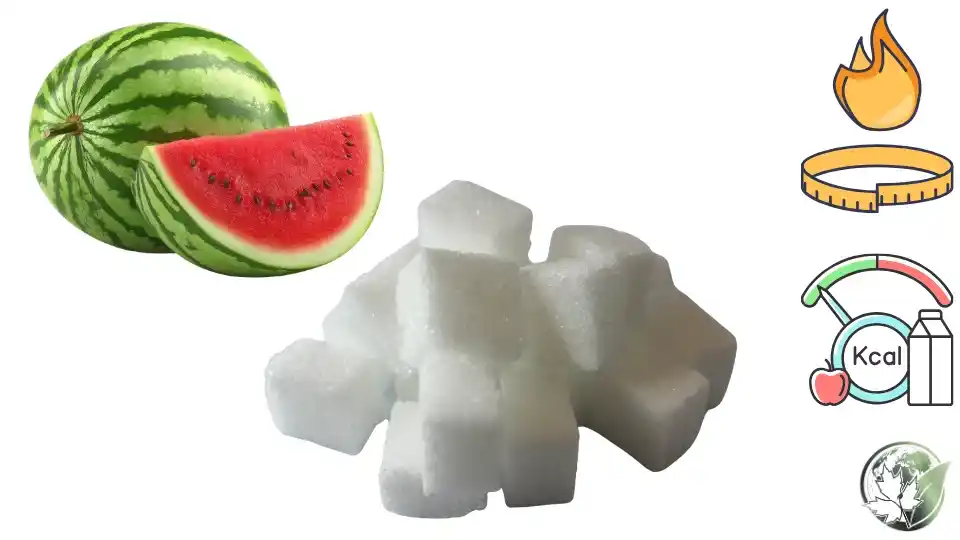
Watermelon has about 30 calories per 100 grams. A standard sugar cube weighs 4 grams and has about 16 calories. Per gram, a sugar cube has 3.9 calories and watermelon only 0.3, so sugar is about 13 times more calorie dense. One sugar cube has the calories of about 53 grams of watermelon, roughly two bite-size cubes of the fruit. A cup of diced watermelon (152 grams) has about 46 calories and 9.4 grams of sugar, which equals about three sugar cubes in calories and 2.4 in sugar. A large wedge (286 grams, one sixteenth of a medium melon) has about 86 calories.
This explains why watermelon tastes sweet but does not feel heavy. It is 91 percent water, with only 6 grams of sugar per 100 grams. A sugar cube is pure sucrose with no water at all. This guide compares watermelon and sugar cubes by 100 grams, by cup, by slice and by whole melon, shows how many cubes of sugar are hidden in a serving of watermelon, and looks at water content, glycemic index and glycemic load, nutrients such as lycopene and vitamin C, and ways to enjoy watermelon without worry. It includes three comparison tables and an FAQ.
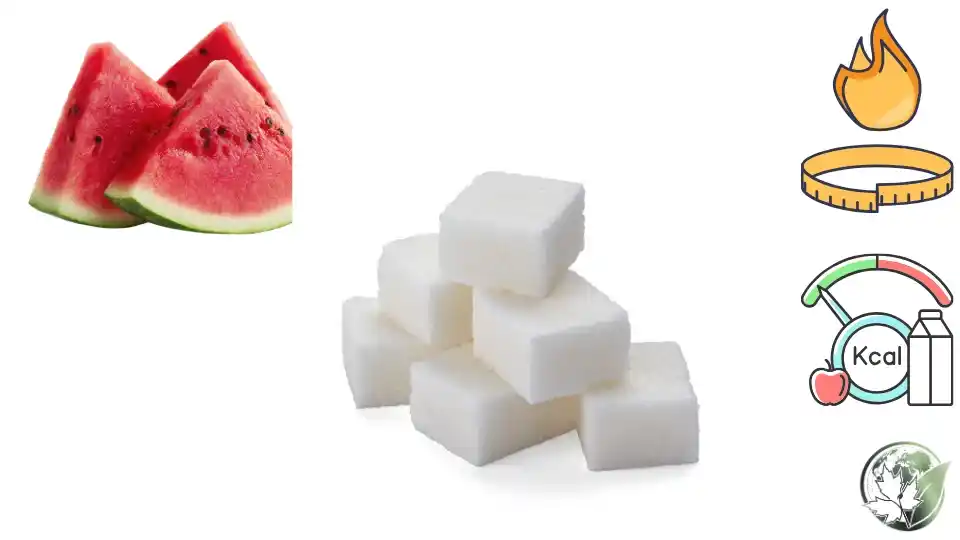
A cup of diced watermelon has about the same calories as three sugar cubes, but weighs 152 grams instead of 12
How Many Calories Are in Watermelon?
Watermelon is among the lowest-calorie fruits. Most of its weight is water, and its sugar is diluted. Calories vary slightly with ripeness and variety, but 30 per 100 grams is a standard figure.
| Watermelon | Weight | Calories | Sugar | Water |
|---|---|---|---|---|
| 1 bite-size cube | 10 g | 3 kcal | 0.6 g | 9 g |
| 1 cup, diced | 152 g | 46 kcal | 9.4 g | 139 g |
| 1 cup, balled | 154 g | 46 kcal | 9.5 g | 141 g |
| 2 cups, diced | 304 g | 91 kcal | 18.8 g | 278 g |
| 1 small wedge (1/32 melon) | 140 g | 42 kcal | 8.7 g | 128 g |
| 1 standard wedge (1/16 melon) | 286 g | 86 kcal | 17.7 g | 261 g |
| 1 large slice (1/8 melon) | 572 g | 172 kcal | 35.5 g | 523 g |
| 100 g | 100 g | 30 kcal | 6.2 g | 91.4 g |
| 1 cup watermelon juice | 240 g | 72 kcal | 15 g | 219 g |
How Many Calories Are in a Sugar Cube?
| Sugar | Weight | Calories | Sugar |
|---|---|---|---|
| 1 small cube | 3 g | 12 kcal | 3 g |
| 1 standard cube | 4 g | 16 kcal | 4 g |
| 1 large cube | 5 g | 19 kcal | 5 g |
| 2 cubes | 8 g | 31 kcal | 8 g |
| 3 cubes | 12 g | 46 kcal | 12 g |
| 5 cubes | 20 g | 77 kcal | 20 g |
| 10 cubes | 40 g | 155 kcal | 40 g |
| 100 g | 100 g | 387 kcal | 100 g |
Watermelon vs Sugar Cube: Calories Compared
| Amount | Watermelon | Sugar | Difference |
|---|---|---|---|
| 100 g | 30 kcal | 387 kcal | Watermelon -357 |
| 4 g (one cube weight) | 1.2 kcal | 16 kcal | Watermelon -14.8 |
| 53 g watermelon vs 1 cube | 16 kcal | 16 kcal | Equal calories |
| 64 g watermelon vs 1 cube | 19 kcal | 16 kcal | Equal sugar (4 g) |
| 1 cup vs 3 cubes | 46 kcal | 46 kcal | Equal |
| 1 standard wedge vs 5.5 cubes | 86 kcal | 85 kcal | Equal |
| Sugar per 100 g | 6.2 g | 100 g | Watermelon -93.8 g |
| Weight for 100 kcal | 333 g | 26 g | Watermelon 307 g more |
For 100 calories, you can eat 333 grams of watermelon (about two cups) or just 26 grams of sugar (six and a half cubes). That is a thirteenfold difference in volume.
Why Is Watermelon So Much Lower in Calories Than Sugar?
Water is the main reason. Watermelon is 91.4 percent water, 7.6 percent carbohydrate (of which 6.2 percent is sugar), 0.6 percent protein, 0.4 percent fiber and 0.2 percent fat. Water has no calories. A sugar cube is 100 percent carbohydrate without any water or fiber. So 100 grams of watermelon contain only 6.2 grams of sugar, against 100 grams in the same weight of sugar cubes.
| Component (per 100 g) | Watermelon | Sugar cube |
|---|---|---|
| Water | 91.4 g | 0 g |
| Sugar | 6.2 g | 100 g |
| Other carbohydrate | 1.4 g | 0 g |
| Fiber | 0.4 g | 0 g |
| Protein | 0.6 g | 0 g |
| Fat | 0.2 g | 0 g |
| Calories | 30 | 387 |
| Sugar cubes equivalent (4 g each) | 1.55 | 25 |
A 100-gram slice of watermelon contains the sugar of about 1.5 cubes, but a full cup (152 grams) contains the sugar of 2.4 cubes. A large wedge (286 grams) contains the sugar of about 4.4 cubes.
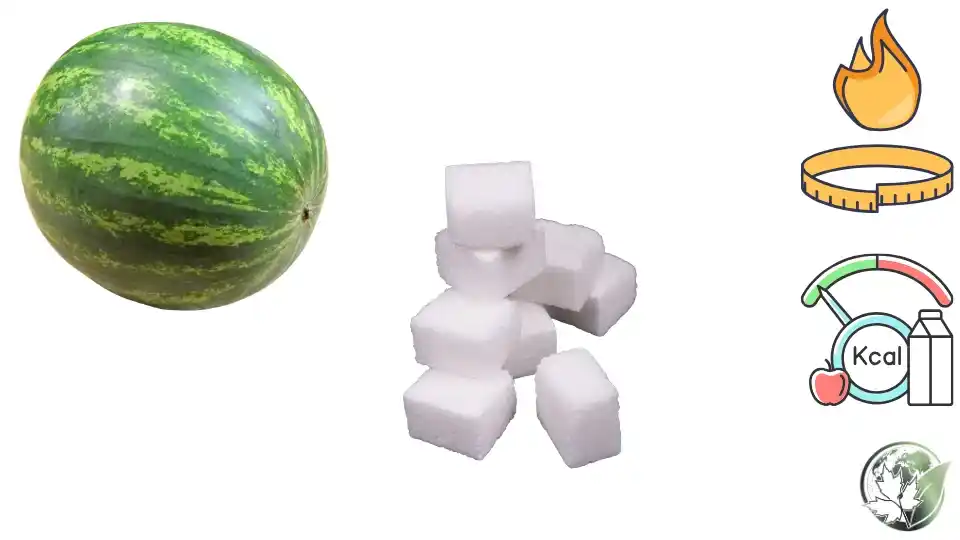
Watermelon is more than 91 percent water, which is why its sugar is diluted and its calories are low
How Many Sugar Cubes Are in a Serving of Watermelon?
The table below translates common watermelon servings into sugar cubes, to give a sense of how sweet the fruit really is. This is helpful when someone is counting sugar or comparing with sweet drinks.
| Watermelon serving | Sugar | Sugar cubes (4 g) | Calories |
|---|---|---|---|
| 1 cube (10 g) | 0.6 g | 0.15 | 3 |
| 1 cup (152 g) | 9.4 g | 2.4 | 46 |
| 2 cups (304 g) | 18.8 g | 4.7 | 91 |
| Standard wedge (286 g) | 17.7 g | 4.4 | 86 |
| Large slice (572 g) | 35.5 g | 8.9 | 172 |
| 1 cup juice (240 g) | 15 g | 3.8 | 72 |
| 1 can of cola (355 ml) | 39 g | 9.8 | 140 |
| 1 glass of orange juice (240 ml) | 21 g | 5.2 | 112 |
A cup of watermelon has less than a quarter of the sugar of a can of cola and about one-third of the calories. A large slice of 572 grams has 172 calories and 35 grams of sugar, about the same sugar as a can of cola, but it brings water, vitamins and fiber and takes far longer to eat.
Watermelon vs Sugar Cube: Nutrition Compared
| Per 100 g | Watermelon | Sugar cube |
|---|---|---|
| Calories | 30 kcal | 387 kcal |
| Carbohydrate | 7.6 g | 100 g |
| Sugar | 6.2 g | 100 g |
| Fiber | 0.4 g | 0 g |
| Protein | 0.6 g | 0 g |
| Fat | 0.2 g | 0 g |
| Potassium | 112 mg | 2 mg |
| Magnesium | 10 mg | 0 mg |
| Vitamin C | 8.1 mg | 0 mg |
| Vitamin A | 28 mcg | 0 mcg |
| Lycopene | 4,532 mcg | 0 mcg |
| Citrulline | About 250 mg | 0 mg |
Watermelon is one of the richest dietary sources of lycopene, the red pigment that also colors tomatoes. It also provides vitamin C, potassium and citrulline, an amino acid that the body can convert to arginine and which is being studied for blood flow and exercise recovery. A sugar cube provides energy only.
Which Has More Calories: Watermelon or a Sugar Cube?
Per gram, a sugar cube has about 13 times more calories than watermelon. Per piece, one sugar cube (16 calories) has the same energy as about two cubes of fruit (53 grams). Per serving, a cup of watermelon (46 calories) equals about three sugar cubes but is a much bigger, more satisfying food. For anyone trying to limit calories, watermelon offers far more volume per calorie. For anyone worried about sugar, a cup has 2.4 cubes' worth, but diluted in water and fiber and accompanied by nutrients.
| Comparison | Watermelon | Sugar cube | Winner for fewer calories |
|---|---|---|---|
| Per gram | 0.3 kcal | 3.9 kcal | Watermelon |
| Per cup (152 g) vs 3 cubes | 46 kcal | 46 kcal | Equal |
| Volume for 100 kcal | 333 g | 26 g | Watermelon |
| Sugar per 100 kcal | 20.7 g | 25.8 g | Watermelon slightly |
| Fiber per 100 kcal | 1.3 g | 0 g | Watermelon |
| Vitamins and minerals | Several | None | Watermelon |
| Satisfaction | High (water, bulk) | Very low | Watermelon |
Does Watermelon Raise Blood Sugar?
Watermelon has a high glycemic index, about 72 to 80, which has led to confusion. But glycemic index measures the effect of 50 grams of available carbohydrate, and watermelon is so watery that you would need about 700 grams (nearly 4.5 cups) to reach that. The glycemic load, which accounts for a normal serving, is low: about 5 for a 120-gram serving. Table sugar has a glycemic index of 65 and a load of about 8 per tablespoon. So a cup of watermelon has a much smaller effect on blood sugar than a tablespoon of sugar, and a much smaller effect than the high index suggests.
| Food | Serving | Carbohydrate | Glycemic index | Glycemic load |
|---|---|---|---|---|
| Watermelon | 120 g (3/4 cup) | 9 g | 72-80 | 5-7 |
| Watermelon | 1 cup (152 g) | 11.5 g | 72-80 | 6-9 |
| Watermelon | Large wedge (286 g) | 21.6 g | 72-80 | 11-17 |
| Sugar | 1 cube (4 g) | 4 g | 65 | 2.6 |
| Sugar | 3 cubes (12 g) | 12 g | 65 | 7.8 |
| Sugar | 1 tbsp (12.5 g) | 12.5 g | 65 | 8 |
| Orange | 1 medium (131 g) | 15 g | 43 | 6 |
| Apple | 1 medium (182 g) | 25 g | 36 | 9 |
People with diabetes can usually fit a cup of watermelon into a meal plan, especially when paired with protein or fat such as cheese or nuts. Very large portions of fruit still count.
Is Watermelon Good for Weight Loss and Hydration?
Watermelon is an excellent snack for weight loss. A cup has just 46 calories and fills the stomach. Its high water content supports hydration, especially in hot weather, and it supplies potassium that is lost through sweat. Studies of foods with low energy density, such as watermelon, show that people feel full on fewer calories. One study of overweight adults who ate watermelon as a snack found they reported greater fullness than those who ate low-fat cookies of the same calories. Watermelon should not replace meals, because it lacks protein and fat, but as a dessert or snack it is difficult to beat.
| Snack of about 100 kcal | Amount | Volume |
|---|---|---|
| Watermelon | 333 g (2.2 cups) | Large bowl |
| Strawberries | 312 g | Large bowl |
| Grapes | 145 g | 1 cup |
| Apple | 190 g | 1 medium |
| Banana | 112 g | 1 medium |
| Sugar cubes | 26 g | 6.5 cubes |
| Chocolate | 19 g | 2 squares |
| Wafers | 19 g | 2 fingers |
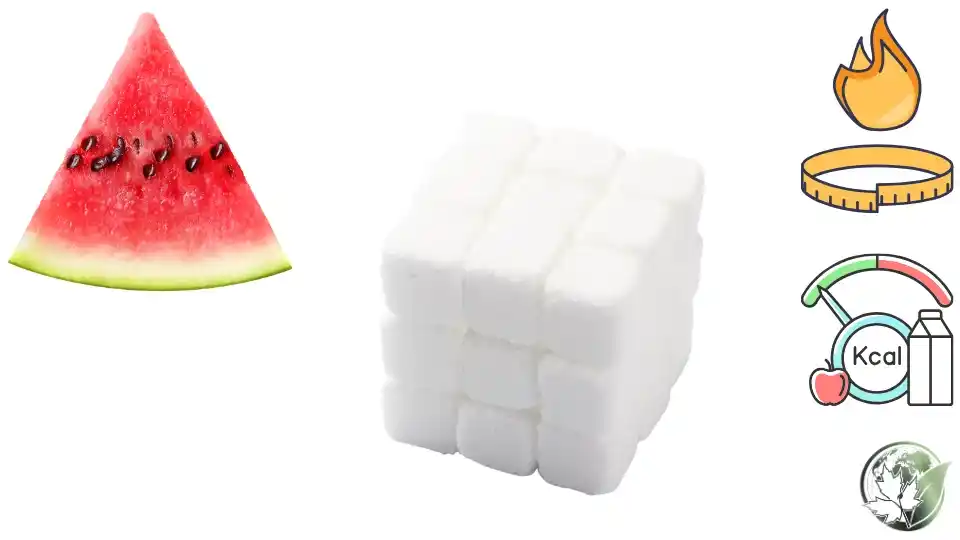
Two cups of diced watermelon have about 91 calories, with plenty of volume and water
Watermelon in Persian Culture: Hendevaneh and Yalda
Watermelon (hendevaneh) is a symbol of summer in Iran, and of Yalda night, the winter solstice festival, when families eat watermelon, pomegranates, nuts and dried fruit. It is commonly eaten with feta cheese and bread or walnuts, a combination that provides protein and fat and balances the sugar. A bowl of watermelon with a piece of feta and a bit of bread has around 250 calories. Dried watermelon seeds (tokhmeh hendevaneh) are a popular snack, but are far denser, with 557 calories per 100 grams.
| Watermelon item | Serving | Calories |
|---|---|---|
| Watermelon, plain | 1 cup | 46 |
| Watermelon with feta (40 g) | 1 cup + cheese | 152 |
| Watermelon, feta and lavash | 1 cup + 40 g feta + 1/2 lavash | 235 |
| Watermelon with walnuts | 1 cup + 3 halves | 85 |
| Watermelon juice | 1 cup | 72 |
| Hendevaneh sorbet (with sugar) | 1 cup | 150 |
| Roasted watermelon seeds | 1 oz (28 g) | 158 |
| Yalda mixed nuts | 30 g | 180 |
| Pomegranate arils | 1/2 cup | 72 |
The seeds should be eaten in small handfuls, since 28 grams contain more calories than a whole cup of the fruit.
Does Blending Watermelon Into Juice Change Anything?
Blending breaks down the flesh without removing much, and watermelon juice has nearly the same calories per cup (72) as the fruit it came from, though a cup of juice needs about 240 grams of fruit. Juice has less fiber and goes down faster, so it is less filling than eating the pieces. Watermelon juice with added sugar, syrups or ice cream, as in some shakes and sorbets, can reach 150 to 300 calories per glass. Drinking plain, unsweetened watermelon juice is a refreshing choice with just a few more calories than eating the fruit.
| Drink or dessert | Serving | Calories | Sugar |
|---|---|---|---|
| Fresh watermelon pieces | 240 g | 72 | 14.9 g |
| Plain watermelon juice | 240 ml | 72 | 15 g |
| Watermelon with lime and mint | 240 ml | 76 | 15 g |
| Watermelon juice with 2 tsp sugar | 240 ml | 104 | 23 g |
| Watermelon sorbet | 1/2 cup | 90 | 20 g |
| Watermelon smoothie with yogurt | 300 ml | 160 | 25 g |
| Watermelon slush with syrup | 350 ml | 220 | 50 g |
| Cola | 355 ml | 140 | 39 g |
Is the Sugar in Watermelon the Same as Sugar in a Cube?
The sugars are chemically similar: watermelon contains fructose, glucose and sucrose, in a ratio with more fructose than glucose. But they come packaged with water, fiber, vitamins and phytochemicals, and in a much lower concentration. Health guidance about added sugars targets sugars added to foods and drinks, not those naturally present in whole fruit. Eating a cup or two of watermelon is not equivalent to eating several sugar cubes, even though the sugar content may look similar on paper. The structure of the food slows digestion, fills the stomach and provides other nutrients.
| Feature | Watermelon sugar | Sugar cube |
|---|---|---|
| Source | Natural, in fruit | Refined sucrose |
| Concentration | 6.2% | 100% |
| Accompanied by | Water, fiber, vitamins | Nothing |
| Counts as added sugar | No | Yes |
| Satiety effect | Good | Poor |
| Dental effect | Lower risk | Higher risk |
| Typical portion | 150-300 g | 4-12 g |
Do Different Watermelon Varieties Have Different Calories?
Red-fleshed, seedless, yellow and orange watermelons all have similar calories, between 28 and 32 per 100 grams. Sweeter varieties may have slightly more sugar, and riper melons develop more sugar and more lycopene. Yellow and orange types contain less lycopene but more beta-carotene. Mini or personal watermelons have the same composition as larger ones. The rind, which is edible and used in pickles and preserves, contains fewer calories, about 20 per 100 grams, but is firm and fibrous.
| Variety | Calories per 100 g | Sugar per 100 g | Notes |
|---|---|---|---|
| Red, seeded | 30 | 6.2 g | Classic, high lycopene |
| Red, seedless | 30 | 6.2 g | Easy to eat |
| Yellow flesh | 28 | 6 g | Honey-like flavor |
| Orange flesh | 30 | 6.3 g | Rich in beta-carotene |
| Mini (personal) | 31 | 6.5 g | Often sweeter |
| Persian hendevaneh (Khorasan type) | 30 | 6.5 g | Very juicy |
| Watermelon rind | 20 | 2 g | Used in pickles |
| Candied watermelon rind | 330 | 80 g | Heavily sugared |
Candied or preserved watermelon rind, and watermelon candies and jams, are nothing like the fresh fruit. Syrup replaces the water, and calories jump tenfold.
How Do You Pick and Store Watermelon?
A ripe watermelon feels heavy for its size, has a dull rather than shiny skin, a creamy yellow patch where it rested on the ground, and a hollow sound when tapped. Whole melons keep for a week or two at room temperature. Once cut, store in the refrigerator, covered, and eat within three to five days. Chilled watermelon tastes sweeter to many people, though the sugar content is the same. Cutting a melon into cubes and storing it in a container makes it easy to portion a cup at a time.
| Tip | Why it helps |
|---|---|
| Choose a heavy melon | More juice and ripeness |
| Look for a creamy yellow field spot | Ripened on the vine |
| Store cut fruit covered | Prevents drying and odors |
| Keep cubes in a container | Easy 1-cup portions of 46 kcal |
| Freeze cubes | Cold snack, sorbet base |
| Wash rind before cutting | Prevents transferring bacteria |
How Much Watermelon Can You Eat in a Day?
There is no strict limit for healthy adults. Fruit is generally recommended at two or more servings a day, and a cup of watermelon counts as one. Eating a whole small melon in a day (about 1,500 grams edible) would provide around 450 calories and 93 grams of sugar, which is more than most people need, though still less energy than a restaurant meal. For people with diabetes or those on a low-carbohydrate diet, one to two cups at a time, spread through the day, is more practical. Very large amounts may cause loose stools in some people because of sugar alcohols and fructose in the fruit.
| Daily amount | Calories | Sugar | Comment |
|---|---|---|---|
| 1 cup | 46 | 9.4 g | One fruit serving |
| 2 cups | 91 | 18.8 g | Reasonable snack or dessert |
| 4 cups | 182 | 37.6 g | Large portion for hot days |
| 1/4 small melon (about 750 g) | 225 | 46.5 g | Heavy but acceptable occasionally |
| Whole small melon (1,500 g) | 450 | 93 g | Very large, may upset digestion |
Can Watermelon Help After Exercise?
Because watermelon is hydrating, provides potassium and contains citrulline, it is often suggested as a post-workout snack. Studies on watermelon juice and muscle soreness give mixed results, with some showing small benefits and others none. What is clear is that a cup or two of watermelon helps replace fluid, and when paired with a protein-rich food such as yogurt, cheese or nuts, it makes a refreshing recovery snack. It is less suitable as the only post-workout food after intense exercise, because it contains little protein and few calories.
| Post-exercise snack | Calories | Protein |
|---|---|---|
| 2 cups watermelon | 91 | 1.8 g |
| 2 cups watermelon + 1/2 cup Greek yogurt | 156 | 12 g |
| 2 cups watermelon + 40 g feta | 197 | 8 g |
| 1 banana + 1 tbsp peanut butter | 200 | 5 g |
| Chocolate milk, 1 cup | 190 | 8 g |
| Dates (3) + almonds (10) | 148 | 4 g |
A cup of watermelon is therefore a good starting point for rehydration, and it becomes a more complete snack when combined with a protein source and a little salt from cheese or nuts. For everyday life, the main message of this comparison is simple: sweet taste does not always mean high calories, and a juicy fruit that is mostly water can satisfy a sweet craving for a fraction of the energy found in sugar, sweets or sweet drinks.
Key Takeaways: Watermelon vs Sugar Cube Calories
Watermelon has about 30 calories per 100 grams, while a sugar cube has 16 calories in 4 grams and sugar has 387 per 100 grams. A cup of watermelon (46 calories) equals three sugar cubes in calories but is 91 percent water and contains vitamin C, potassium and lycopene. Its glycemic load per serving is low. Enjoy watermelon freely, but remember that juice, sorbet and seeds are denser and add up quickly.
Frequently Asked Questions
6 questions answered
How many calories are in a cup of watermelon?
About 46 for 152 grams of diced fruit.
How many calories are in a sugar cube?
About 16 for a standard 4-gram cube.
How much watermelon equals one sugar cube?
About 53 g for the calories, 64 g for the sugar.
Does watermelon have a lot of sugar?
About 9.4 g per cup, or roughly 2.4 sugar cubes.
Is watermelon good for weight loss?
Yes, it is low in calories and high in water.
Does watermelon spike blood sugar?
Its glycemic load is low in normal portions.