How Many Calories Are in Hazelnuts vs Almonds? The Quick Answer
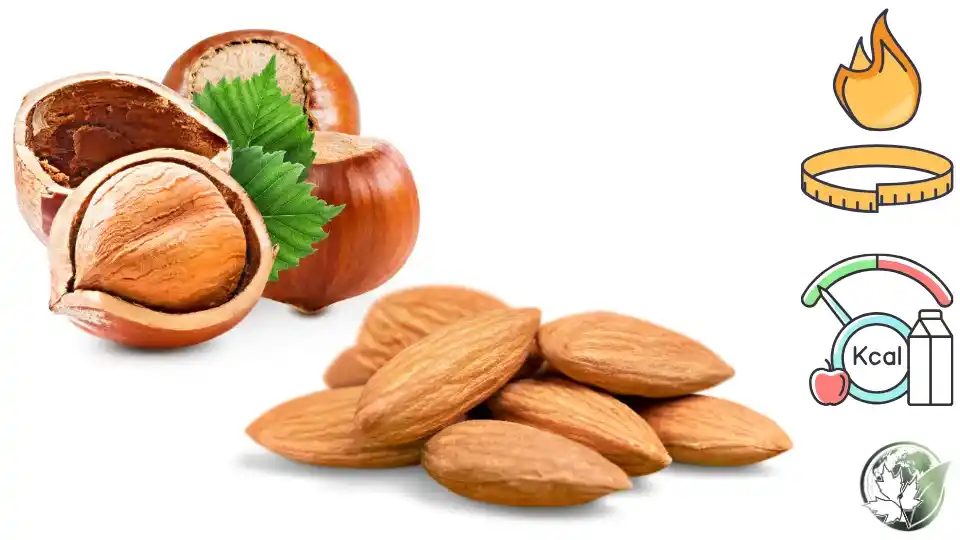
Hazelnuts have about 628 calories per 100 grams, and almonds have about 579. An ounce (28 grams) of hazelnuts, roughly 21 kernels, has 178 calories, and an ounce of almonds, roughly 23 kernels, has 164. So hazelnuts are higher in calories by about 8 percent per weight, mainly because they contain more fat (61 grams per 100 grams against 50 for almonds) and less protein (15 grams against 21). Per nut, a hazelnut kernel has about 8.5 calories and an almond about 7.
Both nuts are nutritious. Almonds lead for protein, fiber, calcium and vitamin E, while hazelnuts have more monounsaturated fat, manganese, copper and folate. In practice, they are close enough that portion size matters more than the choice of nut. This guide compares hazelnuts and almonds per nut, per ounce and per 100 grams, looks at fat types, protein, vitamins and minerals, and offers advice on roasting, spreads and portions, with three comparison tables and an FAQ.
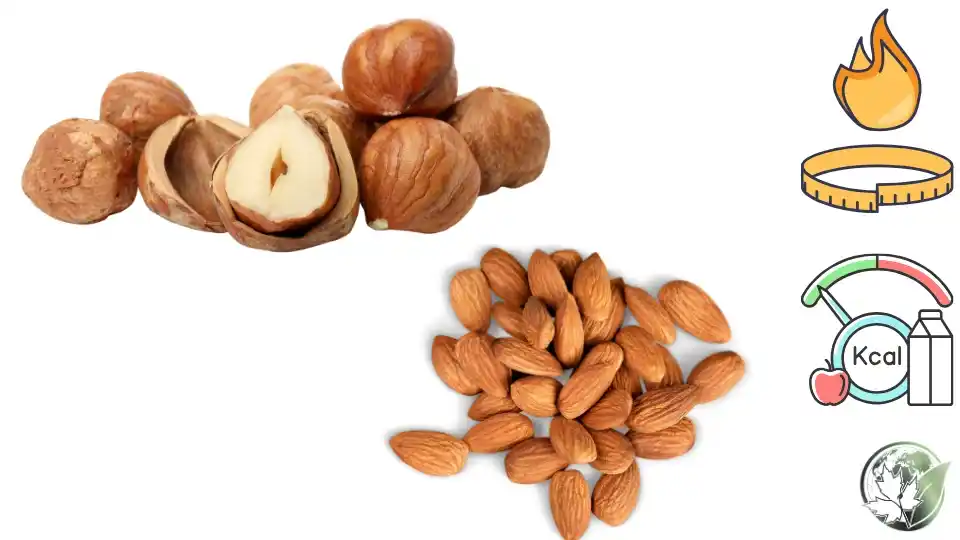
An ounce of hazelnuts has 21 kernels and 178 calories, while an ounce of almonds has 23 kernels and 164
How Many Calories Are in Hazelnuts?
| Hazelnuts | Weight | Calories | Fat | Protein |
|---|---|---|---|---|
| 1 kernel | 1.35 g | 8.5 kcal | 0.8 g | 0.2 g |
| 10 kernels | 13.5 g | 85 kcal | 8.3 g | 2 g |
| 1 ounce (21 kernels) | 28 g | 178 kcal | 17 g | 4.2 g |
| 1/4 cup, whole | 34 g | 214 kcal | 20.7 g | 5.1 g |
| 1/2 cup, chopped | 58 g | 364 kcal | 35 g | 8.7 g |
| 1 cup, whole | 135 g | 850 kcal | 82 g | 20 g |
| 100 g | 100 g | 628 kcal | 61 g | 15 g |
| Roasted, 1 ounce | 28 g | 183 kcal | 17.7 g | 4.2 g |
| Hazelnut butter, 1 tbsp | 16 g | 100 kcal | 9.5 g | 2.3 g |
How Many Calories Are in Almonds?
| Almonds | Weight | Calories | Fat | Protein |
|---|---|---|---|---|
| 1 kernel | 1.2 g | 7 kcal | 0.6 g | 0.3 g |
| 10 kernels | 12 g | 70 kcal | 6 g | 2.5 g |
| 1 ounce (23 kernels) | 28 g | 164 kcal | 14 g | 6 g |
| 1/4 cup, whole | 36 g | 207 kcal | 18 g | 7.6 g |
| 1/2 cup, sliced | 46 g | 267 kcal | 23 g | 9.7 g |
| 1 cup, whole | 143 g | 828 kcal | 72 g | 30 g |
| 100 g | 100 g | 579 kcal | 50 g | 21 g |
| Roasted, 1 ounce | 28 g | 170 kcal | 15 g | 6 g |
| Almond butter, 1 tbsp | 16 g | 98 kcal | 9 g | 3.4 g |
Hazelnuts vs Almonds: Calories Compared
| Amount | Hazelnuts | Almonds | Difference |
|---|---|---|---|
| 1 nut | 8.5 kcal | 7 kcal | +1.5 |
| 10 nuts | 85 kcal | 70 kcal | +15 |
| 1 ounce | 178 kcal | 164 kcal | +14 |
| 1/4 cup | 214 kcal | 207 kcal | +7 |
| 100 g | 628 kcal | 579 kcal | +49 |
| 100 kcal | 16 g (12 nuts) | 17 g (14 nuts) | - |
| Protein per 100 kcal | 2.4 g | 3.6 g | Almonds higher |
Hazelnuts have more calories per nut and per gram, but the gap per standard serving is just 14 calories. Almonds give about 50 percent more protein per calorie.
Hazelnuts vs Almonds: Nutrition Compared
| Per 100 g (raw) | Hazelnuts | Almonds |
|---|---|---|
| Calories | 628 kcal | 579 kcal |
| Total fat | 61 g | 50 g |
| Saturated fat | 4.5 g | 3.8 g |
| Monounsaturated fat | 46 g | 32 g |
| Polyunsaturated fat | 8 g | 12 g |
| Protein | 15 g | 21 g |
| Carbohydrate | 17 g | 22 g |
| Fiber | 9.7 g | 12.5 g |
| Sugar | 4.3 g | 4.4 g |
| Vitamin E | 15 mg | 25.6 mg |
| Calcium | 114 mg | 269 mg |
| Magnesium | 163 mg | 270 mg |
| Manganese | 6.2 mg | 2.2 mg |
| Folate | 113 mcg | 44 mcg |
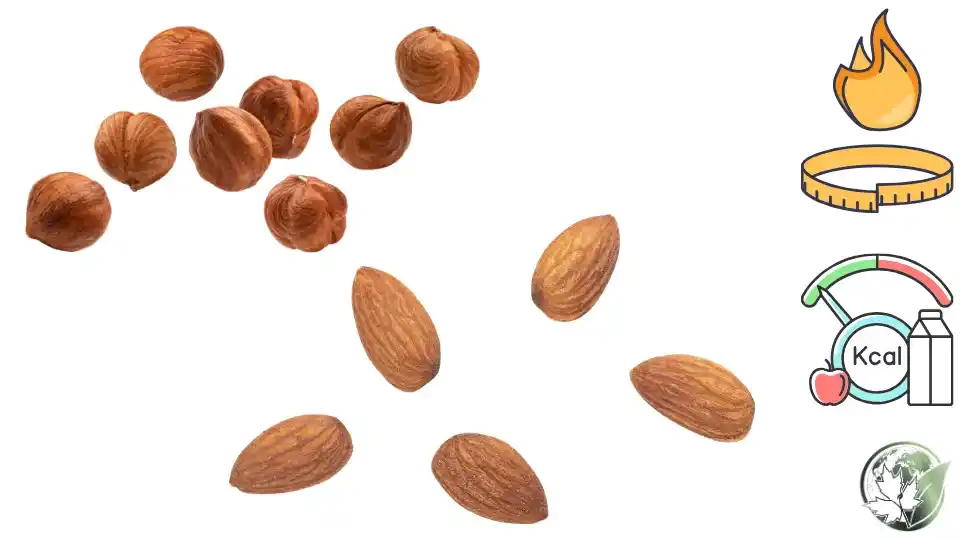
Almonds have more than twice the calcium of hazelnuts, while hazelnuts have almost three times the manganese
Which Has More Calories: Hazelnuts or Almonds?
Hazelnuts do, by about 8 percent per weight and 14 calories per ounce. The difference is small, and some other factors can make the gap bigger or smaller in practice. For example, whole almonds are bigger than hazelnuts in some varieties, so a handful of 25 almonds contains more calories than 25 hazelnuts in volume terms. Counting nuts is easier than weighing, but ounces are better for accuracy.
| Comparison | Hazelnuts | Almonds | Verdict |
|---|---|---|---|
| Calories per 100 g | 628 | 579 | Almonds lower |
| Calories per ounce | 178 | 164 | Almonds lower |
| Calories per nut | 8.5 | 7 | Almonds lower |
| Protein per ounce | 4.2 g | 6 g | Almonds higher |
| Fiber per ounce | 2.7 g | 3.5 g | Almonds higher |
| Monounsaturated fat | 46 g | 32 g | Hazelnuts higher |
Are Hazelnuts or Almonds Healthier?
Both are excellent choices. Almonds supply more protein, fiber, calcium, magnesium and vitamin E, which supports skin and immune health. Hazelnuts provide more monounsaturated fat, manganese, copper and folate, and are also a good source of proanthocyanidins. Clinical studies link regular nut consumption with lower LDL cholesterol and a lower risk of heart disease for both nuts. If you want to increase protein or calcium, choose almonds. If you want a creamier texture and richer flavor for desserts, choose hazelnuts.
| Factor | Hazelnuts | Almonds |
|---|---|---|
| Protein | Moderate | Higher |
| Fiber | High | Higher |
| Monounsaturated fat | Higher | High |
| Vitamin E | High | Very high |
| Calcium | Moderate | High |
| Folate | High | Moderate |
| Flavor | Sweet, buttery | Mild, slightly sweet |
Which Is Better for Weight Loss?
Almonds hold a slight edge because they have fewer calories, more protein and more fiber, which promote fullness. However, studies show that eating a daily handful of either nut does not lead to weight gain, partly because not all of the fat is absorbed from whole nuts and because they help people eat less at later meals. Portion control is the key: 23 almonds are 164 calories, and 21 hazelnuts are 178. The best nut for weight loss is the one you can limit to a handful.
| Strategy | Almonds | Hazelnuts |
|---|---|---|
| Handful (1 oz) | 164 kcal | 178 kcal |
| Calories per gram of protein | 27 kcal | 42 kcal |
| Fiber per 100 kcal | 2.1 g | 1.5 g |
| Chewing time | Longer (hard) | Medium |
| Best form | Whole, raw or dry roasted | Whole, dry roasted |
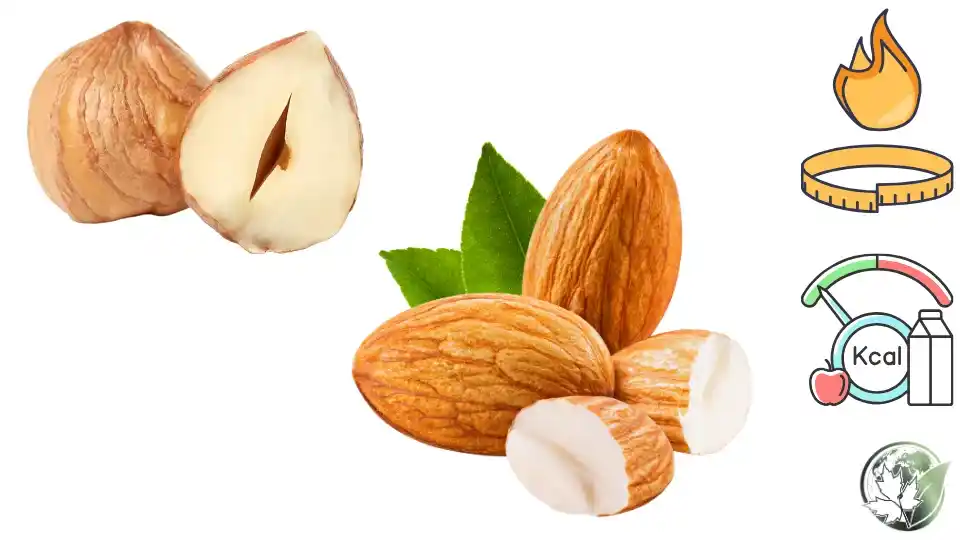
Chopped nuts spread flavor in a dish, so a smaller amount goes further
How Do Raw, Roasted and Blanched Nuts Compare?
Roasting changes calories only slightly, mainly by removing water. Dry roasted hazelnuts have 183 calories per ounce and dry roasted almonds 170. Oil roasted nuts have a few extra calories, usually 5 to 10 per ounce, and salted versions add 90 to 120 milligrams of sodium. Blanching removes the skin, which holds polyphenols, but does not change calories. Chocolate or honey coated nuts can double the calories per ounce.
| Form (1 oz) | Hazelnuts | Almonds |
|---|---|---|
| Raw | 178 kcal | 164 kcal |
| Dry roasted | 183 kcal | 170 kcal |
| Oil roasted, salted | 187 kcal | 175 kcal |
| Blanched | 178 kcal | 164 kcal |
| Chocolate coated | 150 kcal (15 g nuts) | 150 kcal (15 g nuts) |
| Honey roasted | 160 kcal | 150 kcal |
How Do Hazelnut and Almond Spreads Compare?
Hazelnut butter has about 100 calories per tablespoon and almond butter 98. Chocolate-hazelnut spread is a different product: two tablespoons (37 grams) contain around 200 calories and 21 grams of sugar, because it is mostly sugar and palm oil with only 13 percent hazelnuts. Natural hazelnut or almond butter with only nuts is a more nutritious choice, with 2 to 3 grams of protein per tablespoon and no added sugar.
| Spread | Serving | Calories | Sugar | Protein |
|---|---|---|---|---|
| Natural hazelnut butter | 1 tbsp (16 g) | 100 kcal | 0.6 g | 2.3 g |
| Natural almond butter | 1 tbsp (16 g) | 98 kcal | 0.7 g | 3.4 g |
| Chocolate-hazelnut spread | 2 tbsp (37 g) | 200 kcal | 21 g | 2 g |
| Peanut butter | 1 tbsp (16 g) | 94 kcal | 1.5 g | 4 g |
How Do the Fats in Hazelnuts and Almonds Differ?
Both nuts are rich in unsaturated fat and low in saturated fat. Hazelnuts are especially high in oleic acid, the monounsaturated fat that also dominates olive oil, with 46 grams per 100 grams. Almonds contain 32 grams of monounsaturated fat and more polyunsaturated fat, including linoleic acid. Neither contains cholesterol. The fat in whole nuts is partly trapped in the cell walls, so the body absorbs less than the label suggests: studies estimate that about 20 percent of the energy in whole almonds is not absorbed. Chewing well, and grinding into butter or flour, raises absorption.
| Fat (per 100 g) | Hazelnuts | Almonds |
|---|---|---|
| Total fat | 61 g | 50 g |
| Monounsaturated | 46 g | 32 g |
| Polyunsaturated | 8 g | 12 g |
| Saturated | 4.5 g | 3.8 g |
| Cholesterol | 0 mg | 0 mg |
| Omega-6 (linoleic) | 7.8 g | 12 g |
| Omega-3 | 0.1 g | 0 g |
How Do Vitamins and Minerals Compare in a Typical Serving?
An ounce of almonds supplies about 7.3 milligrams of vitamin E, or half the daily value, and 76 milligrams of calcium. An ounce of hazelnuts supplies 4.3 milligrams of vitamin E (29 percent), 1.7 milligrams of manganese (73 percent of the daily value) and 32 micrograms of folate. Both give about 45 to 77 milligrams of magnesium. If you rely on nuts for vitamin E, a handful of almonds does the job; for manganese, hazelnuts do. Eating a mixture covers both.
| Per ounce (28 g) | Hazelnuts | Almonds | Daily value |
|---|---|---|---|
| Vitamin E | 4.3 mg | 7.3 mg | 15 mg |
| Calcium | 32 mg | 76 mg | 1,000-1,300 mg |
| Magnesium | 46 mg | 76 mg | 400 mg |
| Manganese | 1.7 mg | 0.6 mg | 2.3 mg |
| Copper | 0.5 mg | 0.3 mg | 0.9 mg |
| Folate | 32 mcg | 12 mcg | 400 mcg |
| Potassium | 193 mg | 208 mg | 3,400 mg |
| Iron | 1.3 mg | 1.1 mg | 18 mg |
How Many Hazelnuts or Almonds Make a Serving?
A standard serving is 28 grams, about a small handful. That is 21 hazelnuts or 23 almonds. Small pre-packed snack bags often contain 30 to 40 grams, and trail mix containers may hold 60 to 100 grams. Using a measuring cup, a quarter cup holds roughly 34 grams of whole hazelnuts or 36 grams of almonds. Use a small bowl and put the bag away, as nuts are easy to overeat while watching TV or working.
| Serving | Hazelnut count | Almond count | Calories (hazelnut / almond) |
|---|---|---|---|
| Small (half handful) | 10 | 12 | 85 / 84 |
| Standard (1 oz) | 21 | 23 | 178 / 164 |
| Snack bag (40 g) | 30 | 33 | 251 / 232 |
| Quarter cup | 25 | 30 | 214 / 207 |
| Trail mix portion (60 g) | 44 | 50 | 377 / 347 |
What Are the Best Ways to Eat Hazelnuts and Almonds?
Eat them whole as a snack, chop them into oatmeal, yogurt and salads, or grind them into flour for baking. Hazelnuts pair well with chocolate, coffee and fruit such as pears, while almonds suit curries, rice dishes, granola and desserts. Toast nuts lightly at 160 degrees Celsius for 8 to 10 minutes to bring out flavor and rub off the hazelnut skins. Use sparingly in recipes: two tablespoons of chopped nuts (about 100 calories) add crunch to a whole serving.
| Use | Amount | Calories added |
|---|---|---|
| Oatmeal topping | 1 tbsp chopped | 50 kcal |
| Yogurt crunch | 2 tbsp chopped | 100 kcal |
| Salad | 1 tbsp slivered | 45 kcal |
| Baking (flour) | 1/4 cup ground | 160 kcal |
| Smoothie | 1 tbsp butter | 100 kcal |
Do Hazelnuts or Almonds Help Lower Cholesterol?
Both do. Clinical trials show that eating 30 to 60 grams of nuts a day lowers LDL cholesterol by about 5 to 10 percent, mainly through unsaturated fat, fiber and plant sterols. Almonds have been studied extensively: a daily 42 gram serving reduced LDL and kept HDL stable in several trials. Hazelnuts improved lipid profiles in trials of 30 to 50 grams a day and also provide plant sterols. The effect is greatest when nuts replace foods rich in saturated fat, such as pastries, processed meat and cheese. The US FDA allows a qualified health claim that 1.5 ounces of nuts a day may reduce heart disease risk.
| Study dose | Nut | Typical LDL change |
|---|---|---|
| 42 g a day | Almonds | -5 to -10% |
| 30-50 g a day | Hazelnuts | -5 to -8% |
| 30 g a day | Mixed nuts | -5% |
| 60 g a day | Almonds | -10% |
| Replace snack of cookies | Either | Greater effect |
How Do They Compare With Other Nuts?
Hazelnuts and almonds sit in the mid-range of calories. Macadamias and pecans are the most calorie-dense nuts at over 700 per 100 grams, while cashews and pistachios are lower at 553 and 560. Chestnuts are the lowest at about 213 because they are low in fat and high in starch. If you want to cut calories, switch to pistachios in their shells, since shelling slows you down, or to chestnuts. For protein, almonds, peanuts and pistachios come out ahead.
| Nut (per 100 g) | Calories | Protein | Fat |
|---|---|---|---|
| Macadamia | 718 | 8 g | 76 g |
| Pecans | 691 | 9 g | 72 g |
| Walnuts | 654 | 15 g | 65 g |
| Hazelnuts | 628 | 15 g | 61 g |
| Almonds | 579 | 21 g | 50 g |
| Pistachios | 560 | 20 g | 45 g |
| Cashews | 553 | 18 g | 44 g |
| Chestnuts | 213 | 2 g | 2 g |
Who Should Be Careful With Nuts?
Tree nut allergy is one of the most common food allergies, and people with a hazelnut allergy may also react to birch pollen (oral allergy syndrome). Almonds are also a frequent allergen. Whole nuts are a choking hazard for young children, who should be given nut butter spread thinly or ground nuts. People on a very low-fat diet or with gallbladder problems may need to limit portions. Hazelnuts and almonds contain phytic acid and oxalate in small amounts, and those prone to kidney stones may need to limit almonds, which are higher in oxalate.
| Group | Concern | Advice |
|---|---|---|
| Nut allergy | Anaphylaxis risk | Avoid completely |
| Birch pollen allergy | Cross-reaction with hazelnut | Test with doctor |
| Young children | Choking | Use nut butter, ground nuts |
| Kidney stones (oxalate) | Almonds high in oxalate | Limit portions |
| Weight watchers | Calorie density | Measure 1 oz |
How Should You Store Hazelnuts and Almonds?
Nuts are rich in unsaturated fats that turn rancid with heat, light and air. Keep shelled nuts in an airtight container in a cool, dark cupboard for three to four months, in the fridge for up to six months, or in the freezer for up to a year. Nuts in the shell last longer. A bitter or paint-like smell means they have gone off. Roasted nuts spoil faster than raw ones, and nut butters should be refrigerated once opened if they are natural, without stabilizers.
| Storage | Raw shelled | Roasted | In shell |
|---|---|---|---|
| Pantry | 3-4 months | 1-2 months | 6-12 months |
| Refrigerator | 6 months | 3-4 months | 12 months |
| Freezer | 12 months | 6 months | 24 months |
| Nut butter (natural) | 3 months | Not applicable | Not applicable |
How Do Hazelnut and Almond Milk Compare?
Plant milks made from these nuts are low in calories because they are mostly water. Unsweetened almond milk has about 30 to 40 calories per cup and 1 gram of protein. Unsweetened hazelnut milk has around 70 to 100 calories per cup, since many brands use more nuts, and often 1 to 3 grams of protein. Sweetened versions can reach 90 to 140 calories. Both contain much less protein and calcium than cow's milk unless fortified, so check the label if you rely on them as a milk replacement.
| Milk (1 cup, 240 ml) | Calories | Protein | Sugar |
|---|---|---|---|
| Almond milk, unsweetened | 35 kcal | 1 g | 0 g |
| Almond milk, sweetened | 90 kcal | 1 g | 13 g |
| Hazelnut milk, unsweetened | 80 kcal | 2 g | 0 g |
| Hazelnut milk, sweetened | 120 kcal | 2 g | 14 g |
| Cow's milk, 2% | 122 kcal | 8 g | 12 g |
| Soy milk, unsweetened | 80 kcal | 7 g | 1 g |
How Do Hazelnut and Almond Flour Compare in Baking?
Almond flour and hazelnut flour are used in low-carbohydrate and gluten-free baking. A quarter cup (28 grams) of almond flour has about 160 calories, 6 grams of protein and 3 grams of fiber. Hazelnut flour has about 180 calories, 4 grams of protein and 3 grams of fiber. Both contain more calories than wheat flour (100 per quarter cup), but far fewer carbohydrates. They produce moist, dense cakes and cookies, and are used in macarons and tarts. Because they are rich in fat, store them in the fridge.
| Flour (1/4 cup, 28 g) | Calories | Carbohydrate | Protein | Fiber |
|---|---|---|---|---|
| Almond flour | 160 kcal | 6 g | 6 g | 3 g |
| Hazelnut flour | 180 kcal | 5 g | 4 g | 3 g |
| Wheat flour | 100 kcal | 21 g | 3 g | 0.7 g |
| Coconut flour | 120 kcal | 16 g | 4 g | 10 g |
| Oat flour | 110 kcal | 19 g | 4 g | 3 g |
Can You Make a Healthy Hazelnut and Almond Snack Mix?
Combine equal parts raw almonds and hazelnuts with a few dried cranberries and a pinch of cinnamon for a balanced mix. A 30 gram portion of a half-and-half nut mix contains about 175 calories, 5 grams of protein and 3 grams of fiber. Add 10 grams of dark chocolate chips for a treat at 60 additional calories. Pre-portion the mix into small containers at the start of the week so a serving is easy to grab. Avoid candied or heavily salted versions, which can double the calories and sodium.
| Mix (30 g) | Calories | Protein | Fiber |
|---|---|---|---|
| Half hazelnuts, half almonds | 175 kcal | 5 g | 3 g |
| Nuts with 5 g cranberries | 190 kcal | 5 g | 3.2 g |
| Nuts with 10 g dark chocolate | 235 kcal | 5.5 g | 3.5 g |
| Candied nuts | 140 kcal (20 g nuts) | 3 g | 2 g |
| Salted roasted nuts | 180 kcal | 5 g | 3 g |
What Is the Verdict for Daily Eating?
For daily snacking, either nut works. If the goal is the fewest calories and the most protein per serving, choose almonds. If you want monounsaturated fat and a richer taste, choose hazelnuts. A mix of both gives variety and a broader range of nutrients. The principle that matters most is the portion: about a small handful of 21 to 23 nuts, which provides 164 to 178 calories and fits well in a day of 2,000 calories.
| Goal | Better choice | Reason |
|---|---|---|
| Fewest calories | Almonds | 164 vs 178 per oz |
| Most protein | Almonds | 6 g vs 4.2 g per oz |
| Most fiber | Almonds | 3.5 g vs 2.7 g per oz |
| Most monounsaturated fat | Hazelnuts | 46 g vs 32 g per 100 g |
| Best for desserts | Hazelnuts | Sweet, buttery flavor |
| Variety | Both | Broader nutrients |
Key Takeaways: Hazelnuts vs Almonds Calories
Hazelnuts have about 628 calories per 100 grams and almonds 579, so an ounce is 178 against 164. Almonds offer more protein, fiber and calcium, hazelnuts more monounsaturated fat and manganese. Either makes a healthy snack in a measured handful.
Frequently Asked Questions
6 questions answered
Do hazelnuts have more calories than almonds?
Yes, 628 against 579 per 100 grams.
How many calories are in 10 hazelnuts?
About 85.
How many calories are in 10 almonds?
About 70.
Which nut has more protein?
Almonds, 21 grams per 100 grams against 15.
Are hazelnuts good for weight loss?
In handfuls of about 21 nuts, yes.
Is chocolate-hazelnut spread the same as hazelnut butter?
No, it is mostly sugar and oil.