How Many Calories Are in Sunflower Oil vs Olive Oil? The Quick Answer
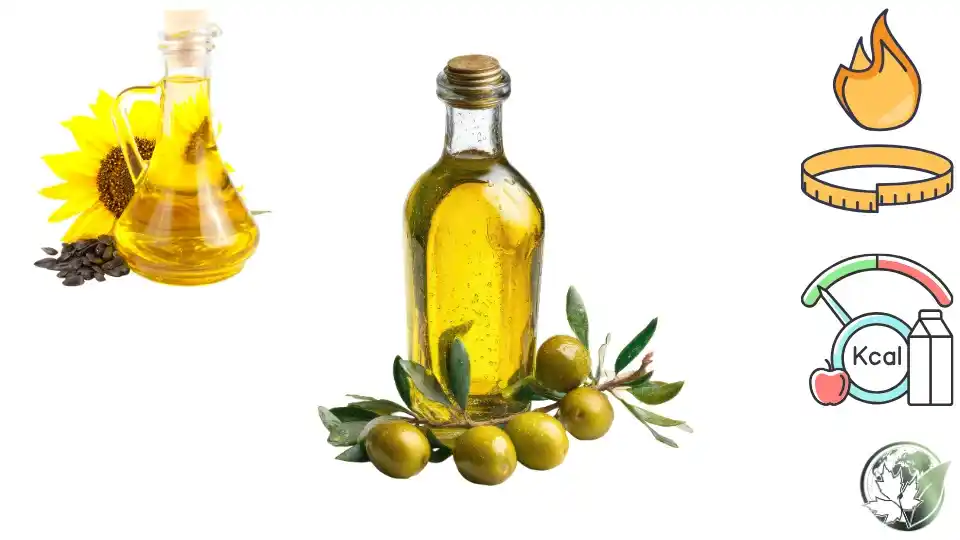
Sunflower oil and olive oil have almost identical calories. Sunflower oil has about 884 calories per 100 grams, 120 per tablespoon (13.6 grams) and 40 per teaspoon. Olive oil has about 884 calories per 100 grams, 119 per tablespoon (13.5 grams) and 40 per teaspoon. Like every pure oil, both are 100 percent fat, and fat provides about 9 calories per gram regardless of its source. So the answer to "which has fewer calories" is neither: they are the same.
Because the calories are equal, the useful comparison is about the type of fat, the vitamins, the smoke point, the flavor and the way each oil behaves during cooking. Sunflower oil is rich in polyunsaturated linoleic acid and vitamin E, with a neutral taste and a high smoke point when refined. Olive oil, particularly extra virgin, is rich in monounsaturated oleic acid and polyphenols, with a fruity taste. This guide compares them by spoon, cup and 100 grams, explains the fat profile, shows how much oil ends up in fried foods and salads, and gives practical ways to cut oil calories. It includes three comparison tables and an FAQ.
One tablespoon of either oil has about 120 calories
How Many Calories Are in Sunflower Oil?
| Sunflower oil | Weight | Calories | Fat |
|---|---|---|---|
| 1 teaspoon | 4.5 g | 40 kcal | 4.5 g |
| 1 tablespoon | 13.6 g | 120 kcal | 13.6 g |
| 2 tablespoons | 27 g | 239 kcal | 27 g |
| 1/4 cup | 54.5 g | 482 kcal | 54.5 g |
| 1/2 cup | 109 g | 964 kcal | 109 g |
| 1 cup | 218 g | 1,927 kcal | 218 g |
| 1 liter | 920 g | 8,133 kcal | 920 g |
| 100 g | 100 g | 884 kcal | 100 g |
How Many Calories Are in Olive Oil?
| Olive oil | Weight | Calories | Fat |
|---|---|---|---|
| 1 teaspoon | 4.5 g | 40 kcal | 4.5 g |
| 1 tablespoon | 13.5 g | 119 kcal | 13.5 g |
| 2 tablespoons | 27 g | 239 kcal | 27 g |
| 1/4 cup | 54 g | 477 kcal | 54 g |
| 1/2 cup | 108 g | 955 kcal | 108 g |
| 1 cup | 216 g | 1,909 kcal | 216 g |
| 1 liter | 916 g | 8,098 kcal | 916 g |
| 100 g | 100 g | 884 kcal | 100 g |
Sunflower Oil vs Olive Oil: Calories Compared
| Amount | Sunflower oil | Olive oil | Difference |
|---|---|---|---|
| 1 teaspoon | 40 kcal | 40 kcal | 0 |
| 1 tablespoon | 120 kcal | 119 kcal | 1 |
| 1/4 cup | 482 kcal | 477 kcal | 5 |
| 1 cup | 1,927 kcal | 1,909 kcal | 18 |
| 1 liter | 8,133 kcal | 8,098 kcal | 35 |
| 100 g | 884 kcal | 884 kcal | 0 |
| Fat per tablespoon | 13.6 g | 13.5 g | 0.1 g |
| Calories per gram | 8.84 | 8.84 | 0 |
The tiny differences come only from the density of each oil: a tablespoon of sunflower oil weighs 0.1 gram more. For all practical purposes, they are equal.
Why Are All Cooking Oils Equal in Calories?
Oils are pure fat, and a gram of fat provides about 9 calories (8.84 after accounting for glycerol and measurement). Differences between oils in fatty acid type, whether saturated, monounsaturated or polyunsaturated, change health effects but not energy. Butter, with 17 percent water, has fewer calories per gram (717) than oil. Coconut oil, palm oil, canola oil, avocado oil and sesame oil are also close to 884 per 100 grams.
| Oil | Calories per tablespoon | Calories per 100 g |
|---|---|---|
| Sunflower oil | 120 | 884 |
| Olive oil | 119 | 884 |
| Canola oil | 124 | 884 |
| Corn oil | 120 | 884 |
| Soybean oil | 120 | 884 |
| Sesame oil | 120 | 884 |
| Coconut oil | 121 | 862 |
| Avocado oil | 124 | 884 |
| Butter | 102 | 717 |
| Ghee (clarified butter) | 112 | 900 |
| Margarine | 100 | 717 |
| Cooking spray (1 second) | 0-2 | - |
Whichever oil you use, the main control is the amount, since each tablespoon adds about 120 calories to a dish.
Each tablespoon of oil poured over a salad adds about 120 calories, whatever the type of oil
Sunflower Oil vs Olive Oil: Fat Profile and Nutrition Compared
| Per 100 g | Sunflower oil (linoleic) | High-oleic sunflower oil | Extra virgin olive oil |
|---|---|---|---|
| Calories | 884 kcal | 884 kcal | 884 kcal |
| Total fat | 100 g | 100 g | 100 g |
| Saturated fat | 10.3 g | 9.2 g | 13.8 g |
| Monounsaturated fat | 19.5 g | 83.7 g | 73 g |
| Polyunsaturated fat | 65.7 g | 4 g | 10.5 g |
| Omega-6 (linoleic acid) | 65 g | 3.7 g | 9.8 g |
| Omega-3 (ALA) | 0 g | 0 g | 0.8 g |
| Vitamin E | 41 mg | 14 mg | 14.4 mg |
| Vitamin K | 5.4 mcg | 5.4 mcg | 60 mcg |
| Polyphenols | Very low | Very low | 100-300 mg |
| Smoke point (approx.) | 227 °C (refined) | 232 °C | 190-210 °C |
Regular sunflower oil is a rich source of vitamin E and linoleic acid, an essential omega-6 fat. High-oleic sunflower oil has a profile closer to olive oil. Extra virgin olive oil adds polyphenols, vitamin K and a small amount of omega-3. Both are cholesterol free.
Which Has More Calories: Sunflower Oil or Olive Oil?
Neither. They have the same calories. The right question is which fits your cooking and health goals best. Olive oil has a long record in studies of the Mediterranean diet linked to lower heart disease risk, mostly in the context of a diet rich in vegetables, legumes and fish. Sunflower oil, as a source of polyunsaturated fat, can also lower LDL cholesterol when it replaces saturated fat such as butter. Most dietary guidelines encourage replacing saturated fats with unsaturated oils and keeping total fat moderate.
| Question | Sunflower oil | Olive oil |
|---|---|---|
| Calories per tablespoon | 120 | 119 |
| Best for frying | Refined, neutral | Refined or light olive oil |
| Best for dressings | Mild | Extra virgin, fruity |
| Vitamin E | Higher | Lower |
| Polyphenols | Almost none | High in extra virgin |
| Cost | Lower | Higher |
| Flavor | Neutral | Fruity, peppery |
| Heart-healthy when replacing butter | Yes | Yes |
Does Frying Change the Calories of the Oil?
Frying does not change the calories in the oil you pour in, but the food absorbs some of it, and the amount absorbed determines how many calories are added to the food. Foods absorb between 5 and 25 percent of their weight in oil depending on the food, the batter, the temperature and the time. Frying at too low a temperature makes food greasy. Thin chips absorb more than thick ones. Most of the oil stays in the pan, so a deep fryer filled with 2 liters of oil does not mean you eat 16,000 calories.
| Fried food | Oil absorbed (approx.) | Calories before frying (100 g) | Calories after frying (100 g) |
|---|---|---|---|
| Potato chips (thin slices) | 30-35% | 77 (raw potato) | 536 |
| French fries | 12-15% | 77 | 312 |
| Fried chicken (breaded) | 10-12% | 165 | 246 |
| Fried fish fillet (battered) | 10-15% | 90 | 232 |
| Fried egg (1 tsp oil) | 4 g per egg | 72 per egg | 112 |
| Sauteed onions (1 tsp oil per 100 g) | 4% | 40 | 80 |
| Fried eggplant | 20-30% | 25 | 220 |
| Fried rice (1 tbsp oil per cup) | 7% | 205 per cup | 324 per cup |
| Doughnut | 20% | 280 (dough) | 452 |
Eggplant is famous for soaking up oil like a sponge: a slice of fried eggplant (50 grams) can absorb 2 teaspoons of oil, or 80 calories, which is why salting, baking or grilling it first helps.
How Much Oil Do You Really Use When Cooking?
People underestimate the oil they use. A generous pour into a pan is often 2 to 3 tablespoons, or 240 to 360 calories. A salad drizzled freely may carry 2 tablespoons, 240 calories, before you add anything else. Many restaurant dishes contain 2 to 4 tablespoons of oil per portion. Measuring with a spoon or using a spray bottle is the easiest way to see what you are actually adding.
| Cooking task | Typical oil amount | Calories |
|---|---|---|
| Saute vegetables for 2 | 1 tbsp | 120 |
| Pan-fry an egg | 1 tsp | 40 |
| Pan-fry chicken breast | 1 tbsp | 120 |
| Roast vegetables (tray for 4) | 2 tbsp | 240 |
| Stir-fry for 2 | 2 tbsp | 240 |
| Salad dressing for 2 | 1.5 tbsp | 180 |
| Fry fish fillet | 2 tbsp | 240 |
| Persian khoresh (stew for 4) | 3-4 tbsp | 360-480 |
| Cooking rice (polo, for 4) | 3 tbsp | 360 |
| Cooking spray (2 seconds) | - | 5-10 |
When dishes serve four, divide by four to find the calories per person: 4 tablespoons of oil in a stew for four is 120 calories per person.
Sunflower Oil and Olive Oil in Persian Cooking
In Iranian kitchens, liquid cooking oil (roghan-e mayeh) based on sunflower, soybean or blended oils is common for everyday frying and for stews, while olive oil is used raw on salads, bread with cheese, and in dishes of the north such as zeytoon parvardeh and mirza ghasemi. Roghan-e hayvani (animal ghee) and kermanshahi ghee are also traditional. A tablespoon of any of these oils has 112 to 124 calories. A typical khoresh made with 3 tablespoons of oil for four people has 90 calories of oil per person, in addition to the meat and other ingredients.
| Dish (per person) | Oil used | Calories from oil |
|---|---|---|
| Khoresh gheimeh | 2 tbsp for 4 | 60 |
| Fried onions for khoresh | 1.5 tbsp for 4 | 45 |
| Polo (rice with oil and tahdig) | 3 tbsp for 4 | 90 |
| Kuku sabzi | 2 tbsp for 6 | 40 |
| Kookoo sibzamini (potato) | 3 tbsp for 6 | 60 |
| Mirza ghasemi | 2 tbsp for 4 | 60 |
| Salad shirazi with olive oil | 1 tbsp for 4 | 30 |
| Fried eggplant slices | 3 tbsp for 4 | 90 |
Measuring cooking oil by the spoon makes it easy to control the calories in a pan
Which Oil Is Better for High-Heat Cooking?
Smoke point is the temperature at which oil starts to break down and produce smoke and unwanted compounds. Refined sunflower oil has a high smoke point of 227 degrees Celsius (440 Fahrenheit) and a neutral taste, so it is a common choice for deep frying and high-heat searing. Extra virgin olive oil has a smoke point near 190 to 210 degrees Celsius, but also contains antioxidants that make it relatively stable during cooking, and studies show it holds up well in home frying. Refined olive oil (light olive oil) tolerates higher heat. For regular sauteing, either works. For deep frying, a refined oil is practical, and reusing oil many times is not advised.
| Oil | Smoke point (approx.) | Best uses |
|---|---|---|
| Refined sunflower | 227 °C / 440 °F | Frying, searing, baking |
| High-oleic sunflower | 232 °C / 450 °F | Deep frying |
| Extra virgin olive oil | 190-210 °C / 375-410 °F | Sauteing, dressings, finishing |
| Refined (light) olive oil | 240 °C / 465 °F | Frying, roasting |
| Unrefined sunflower | 107 °C / 225 °F | Raw or low heat only |
| Butter | 150 °C / 300 °F | Low heat, baking |
| Ghee | 250 °C / 480 °F | Frying, sauteing |
Healthy Ways to Use Less Oil Without Losing Flavor
Since oil is so calorie dense, small reductions matter. Use a non-stick pan so you need only a teaspoon. Brush oil on vegetables instead of pouring. Measure with a spoon. Add a splash of water or broth to saute. Bake or air-fry foods instead of deep frying. In salads, mix a tablespoon of olive oil with lemon juice or vinegar, and use herbs and spices for flavor. In stews, brown onions in less oil and let the meat release its own fat. Save the extra virgin olive oil for dishes where you taste it, such as salads, dips and finishing.
| Tip | Oil saved | Calories saved |
|---|---|---|
| Use a spray instead of pouring | 2 tbsp | 240 |
| Bake potatoes instead of frying | 2 tbsp | 240 |
| Air-fry instead of deep-fry | 1-2 cups of oil in the pan | Absorbed oil reduced by 70-80% |
| Saute with water or broth | 1 tbsp | 120 |
| Dress salad with lemon plus 1 tsp oil | 2 tsp | 80 |
| Reduce oil in polo by 1 tbsp | 1 tbsp for 4 | 30 per person |
| Grill eggplant instead of frying | 3 tbsp for 4 | 90 per person |
Does "Light" Olive Oil Have Fewer Calories?
A common myth is that light or extra light olive oil has fewer calories. It does not. The word "light" on olive oil refers to a mild flavor and color, achieved by refining, not to calories or fat content. Light olive oil has the same 119 calories per tablespoon as extra virgin. The same applies to "pure" olive oil, which is a blend of refined and virgin oil. Only products with added water or air, such as cooking sprays and some low-fat spreads, have fewer calories per spoonful.
| Olive oil grade | Processing | Flavor | Calories per tablespoon | Polyphenols |
|---|---|---|---|---|
| Extra virgin | Cold-pressed, unrefined | Fruity, peppery | 119 | High |
| Virgin | Mechanical, slightly lower quality | Mild fruity | 119 | Moderate |
| Pure or classic | Refined plus virgin blend | Mild | 119 | Low |
| Light or extra light | Refined | Neutral | 119 | Very low |
| Olive pomace oil | Solvent extracted from pomace | Neutral | 119 | Low |
| Cooking spray (olive oil) | Oil with propellant | Neutral | 0-2 per spray | Very low |
When you are choosing between grades, think about taste, price and how you will use the oil, not calories.
Omega-6 and Omega-3: Does the Fat Balance Matter?
Typical sunflower oil is high in omega-6 linoleic acid (65 percent of the oil) and contains no omega-3. Olive oil has far less omega-6 (about 10 percent) and a small amount of omega-3. Humans need both fats, but many modern diets provide much more omega-6 than omega-3, and some researchers argue the balance matters for inflammation. Current evidence suggests that replacing saturated fat with polyunsaturated fat lowers heart disease risk, and omega-6 intake at normal levels is not harmful. Still, if most of your fat comes from sunflower oil and processed foods, adding fish, walnuts, flaxseed or chia for omega-3 can improve the balance.
| Fat source | Omega-6 per tbsp | Omega-3 per tbsp |
|---|---|---|
| Sunflower oil | 8.9 g | 0 g |
| High-oleic sunflower oil | 0.5 g | 0 g |
| Olive oil | 1.3 g | 0.1 g |
| Canola oil | 2.7 g | 1.3 g |
| Flaxseed oil | 1.7 g | 7.3 g |
| Walnut oil | 7.2 g | 1.4 g |
| Butter | 0.4 g | 0.1 g |
| Fish (salmon, 100 g) | 0.4 g | 2.3 g |
This does not mean you should avoid sunflower oil. It means that variety is useful: use olive oil for dressings and low-heat cooking, sunflower or canola for high-heat tasks, and include sources of omega-3 weekly.
How Long Do These Oils Last, and Does Storage Affect Calories?
Calories do not change as oil ages, but rancid oil tastes bad and may contain unwanted oxidation products. Oils high in polyunsaturated fat, such as regular sunflower oil, oxidize faster than monounsaturated oils such as olive oil, though olive oil is damaged by light and heat. Store both in a cool, dark cupboard in a sealed container, and buy sizes you will use within a few months. Never reuse frying oil many times, because repeated heating produces harmful compounds.
| Oil | Unopened shelf life | After opening | Storage tip |
|---|---|---|---|
| Sunflower oil (refined) | 12-18 months | 6-12 months | Dark, cool place |
| High-oleic sunflower oil | 18-24 months | 12 months | Dark, cool place |
| Extra virgin olive oil | 18-24 months | 3-6 months for best flavor | Dark glass or tin, away from stove |
| Light olive oil | 18-24 months | 6-12 months | Cool, dark |
| Frying oil (used) | - | 2-3 uses at most | Strain and keep sealed |
Signs of rancidity include a paint-like, crayon or stale-nut smell, a bitter taste and a sticky residue. If in doubt, throw it out.
How Do Oils Compare With Butter and Ghee?
Butter has fewer calories than oil per spoon (102 against 120) because it contains about 17 percent water and milk solids, but it has far more saturated fat. Ghee is pure butterfat with 112 calories per tablespoon. If you swap oil for butter in a recipe, the amount of butter needed for the same effect is usually higher, since part of it is water, and the flavor changes. Health guidelines suggest limiting saturated fat to around 10 percent of calories or less, and replacing it with unsaturated oils where possible.
| Fat | Calories per tbsp | Saturated fat per tbsp | Unsaturated fat per tbsp |
|---|---|---|---|
| Sunflower oil | 120 | 1.4 g | 11.7 g |
| Olive oil | 119 | 1.9 g | 11.3 g |
| Butter | 102 | 7.3 g | 3.5 g |
| Ghee | 112 | 7.9 g | 3.9 g |
| Coconut oil | 121 | 11.2 g | 1.3 g |
| Margarine (tub) | 70-100 | 1-2 g | 5-9 g |
| Mayonnaise | 94 | 1.6 g | 9.2 g |
| Tahini | 89 | 1.2 g | 6.7 g |
If you want to cut saturated fat, olive or sunflower oil is the better choice than butter or ghee, but there is no need to remove butter completely if you use it in small amounts.
How Much Fat Per Day Is Reasonable?
Most health guidelines recommend that 20 to 35 percent of daily calories come from fat. On a 2,000 calorie diet, that is 44 to 78 grams, or about 400 to 700 calories. Oil, nuts, dairy, meat and baked goods all contribute. Because a tablespoon of oil has 13.5 grams of fat, three tablespoons would use more than half of a 78-gram allowance before counting other foods. This is why measuring oil and relying on foods that already contain healthy fat, like fish, nuts and avocado, helps keep the total reasonable.
| Daily calories | Fat range (20-35%) | Fat grams | Tablespoons of oil equivalent |
|---|---|---|---|
| 1,500 | 300-525 kcal | 33-58 g | 2.5-4.3 |
| 1,800 | 360-630 kcal | 40-70 g | 3-5.2 |
| 2,000 | 400-700 kcal | 44-78 g | 3.3-5.8 |
| 2,500 | 500-875 kcal | 56-97 g | 4.1-7.2 |
Not all of this fat should come from added oil. If you eat nuts, cheese, eggs and meat, the fat from them counts toward the total, so you may need only one or two tablespoons of added oil a day. Keeping a small measuring spoon next to the stove is the simplest habit that makes this practical.
Key Takeaways: Sunflower Oil vs Olive Oil Calories
Sunflower oil and olive oil both have about 884 calories per 100 grams, 120 per tablespoon and 40 per teaspoon. The calories are identical, so choose by fat type, flavor and use. Sunflower oil provides more vitamin E and linoleic acid with a neutral taste. Olive oil provides monounsaturated fat and polyphenols. Whichever you pick, measure the amount, since each tablespoon adds about 120 calories.
Frequently Asked Questions
6 questions answered
How many calories are in a tablespoon of sunflower oil?
About 120 calories.
How many calories are in a tablespoon of olive oil?
About 119 calories.
Which oil is lower in calories?
Neither, they are essentially identical.
Which is healthier, sunflower or olive oil?
Olive oil has more polyphenols; sunflower has more vitamin E.
Does frying in olive oil add more calories than sunflower?
No, only the amount absorbed by the food matters.
How much oil should I use per day?
Most guidelines suggest 2 to 3 tablespoons in total.