How Many Calories Are in Rice vs White Bread? The Quick Answer
A cup of cooked white rice (158 grams) has about 205 calories. A standard slice of white sandwich bread (25 grams) has about 67 calories, so three slices (201 calories) match one cup of rice. Per 100 grams, cooked white rice has 130 calories and white bread has 265, which makes bread about twice as dense by weight, because bread contains only 36 percent water against rice's 68 percent. Per slice, bread looks light. Per meal, the two starches are very close.
The most useful way to compare them is by counting slices against cups. Two slices of bread (134 calories) are lighter than three quarters of a cup of rice (153), while four slices (265) are a little lighter than a cup and a half of rice (308). This guide counts slice equivalents for each rice portion, then builds a typical sandwich and a typical rice bowl so you can see which lunch is lighter. It also compares nutrition, sodium, sugar, glycemic index and fullness. It includes three comparison tables and an FAQ.
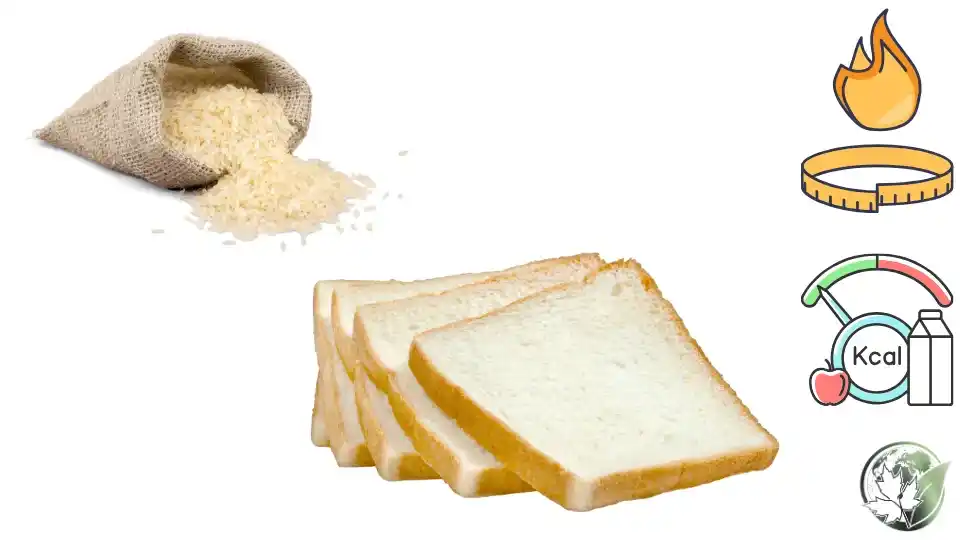
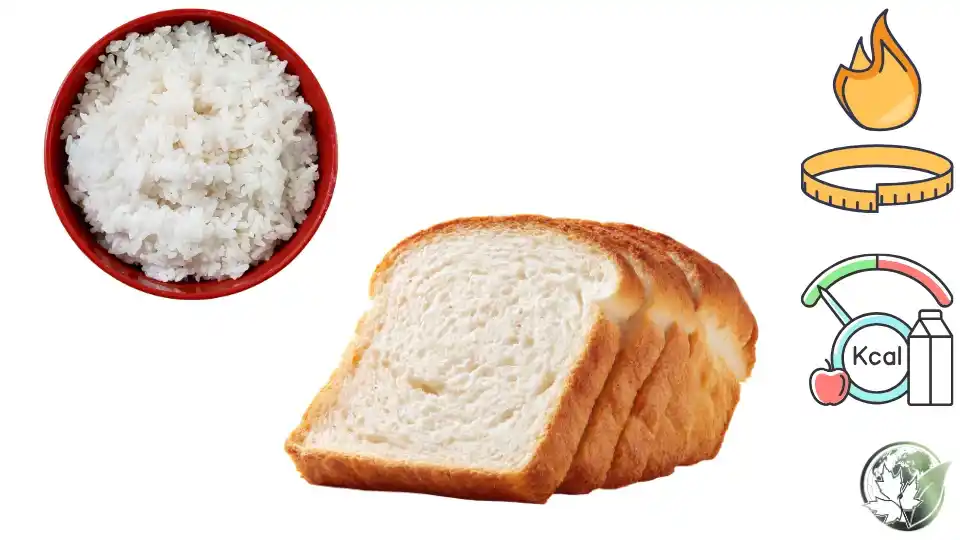
Two slices of white bread have about 134 calories, less than three quarters of a cup of rice
How Many Calories Are in White Rice?
| Cooked white rice | Weight | Calories | Carbohydrate | Protein |
|---|---|---|---|---|
| 1/4 cup | 40 g | 52 kcal | 11.2 g | 1.1 g |
| 1/2 cup | 79 g | 103 kcal | 22.3 g | 2.1 g |
| 3/4 cup | 118 g | 153 kcal | 33.4 g | 3.2 g |
| 1 cup | 158 g | 205 kcal | 44.5 g | 4.3 g |
| 1.5 cups | 237 g | 308 kcal | 67 g | 6.4 g |
| 2 cups | 316 g | 410 kcal | 89 g | 8.6 g |
| 1 restaurant bowl | 300 g | 390 kcal | 84 g | 8 g |
| 100 g | 100 g | 130 kcal | 28 g | 2.7 g |
How Many Calories Are in White Bread?
White bread slices vary by loaf. A thin sandwich slice weighs about 20 grams, a standard slice 25 to 28 grams, a large bakery slice 30 to 38 grams and a thick toast slice 40 grams or more. The calories scale with weight at about 2.65 calories per gram.
| White bread | Weight | Calories | Carbohydrate | Protein |
|---|---|---|---|---|
| 1 thin slice | 20 g | 53 kcal | 9.8 g | 1.8 g |
| 1 standard slice | 25 g | 67 kcal | 12.7 g | 2.2 g |
| 1 large slice | 30 g | 80 kcal | 15 g | 2.7 g |
| 1 thick slice (toast) | 38 g | 101 kcal | 18.6 g | 3.4 g |
| 2 standard slices | 50 g | 133 kcal | 25 g | 4.5 g |
| 3 standard slices | 75 g | 199 kcal | 37.5 g | 6.8 g |
| 4 standard slices | 100 g | 265 kcal | 50 g | 9 g |
| 100 g | 100 g | 265 kcal | 49 g | 9 g |
Rice vs White Bread: Calories Compared
| Amount | Cooked white rice | White bread | Difference |
|---|---|---|---|
| 100 g | 130 kcal | 265 kcal | Rice -135 |
| 1 cup vs 3 slices | 205 kcal | 199 kcal | Bread -6 |
| 3/4 cup vs 2 slices | 153 kcal | 133 kcal | Bread -20 |
| 1.5 cups vs 4 slices | 308 kcal | 265 kcal | Bread -43 |
| 2 cups vs 5 slices | 410 kcal | 332 kcal | Bread -78 |
| 1/2 cup vs 1 slice | 103 kcal | 67 kcal | Bread -36 |
| Weight for 200 kcal | 154 g | 75 g | Rice 79 g more |
| Carbohydrate per 100 kcal | 21.5 g | 18.5 g | Rice slightly higher |
Because bread is so compact, it feels like a small amount of food. If you eat the same weight of each, bread has twice the calories. If you eat the same number of calories, rice is a much bigger plate.
How Many Slices of White Bread Equal Your Rice Portion?
The table below converts rice portions you may serve at home or receive at a restaurant into slices of standard white bread. Use it to judge portions quickly without a scale.
| Rice portion | Calories | Equivalent slices of bread |
|---|---|---|
| 1/2 cup | 103 | 1.5 slices |
| 3/4 cup | 153 | 2.3 slices |
| 1 cup | 205 | 3 slices |
| 1.5 cups | 308 | 4.6 slices |
| 2 cups | 410 | 6.1 slices |
| 1 takeout bowl (300 g) | 390 | 5.8 slices |
| 1 plate of chelow (250 g) | 330 | 4.9 slices |
| 1 plate of kateh (250 g) | 310 | 4.6 slices |
A takeout rice bowl is therefore equal to almost six slices of bread, which is more than most people would eat as plain bread. This illustrates how rice portions often grow without being noticed.
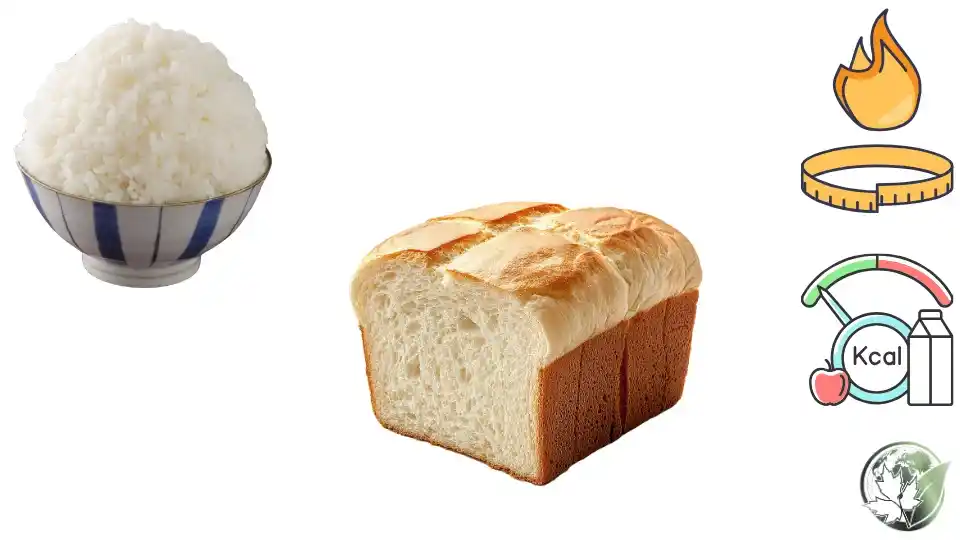
A simple sandwich and a rice bowl can have similar calories depending on the fillings
Sandwich vs Rice Bowl: Which Lunch Has Fewer Calories?
A sandwich and a rice bowl are the most common packed lunches. The starch is only part of the total. Fillings and sauces determine whether the meal is light or heavy. Below are three versions of each, built with common ingredients.
| Sandwich | Components | Calories |
|---|---|---|
| Light | 2 slices white bread (133), 2 slices turkey (50), lettuce and tomato (10), mustard (5) | 198 |
| Standard | 2 slices white bread (133), 2 slices turkey (50), 1 slice cheese (70), 1 tbsp mayo (94), lettuce (5) | 352 |
| Heavy | 2 thick slices (202), 3 slices salami (110), cheese (110), mayo (94), butter (34) | 550 |
| Egg | 2 slices (133), 1 fried egg (90), 1 tsp oil (40), tomato (5) | 268 |
| Peanut butter and jam | 2 slices (133), 2 tbsp peanut butter (190), 1 tbsp jam (56) | 379 |
| Rice bowl | Components | Calories |
|---|---|---|
| Light | 3/4 cup rice (153), grilled chicken 85 g (140), steamed vegetables (40), lemon (2) | 335 |
| Standard | 1 cup rice (205), chicken 100 g (165), vegetables (40), soy sauce (10), 1 tsp oil (40) | 460 |
| Heavy | 1.5 cups rice (308), fried chicken (300), sauce (70), mayo drizzle (94) | 772 |
| Egg fried rice | 1 cup rice (205), 1 egg (72), oil 1 tbsp (119), vegetables (30) | 426 |
| Rice and beans | 1 cup rice (205), 1/2 cup beans (110), salsa (10) | 325 |
A light sandwich is lighter than a light rice bowl, mostly because the starch portion is smaller. But a standard sandwich with cheese and mayo (352) is closer to a light rice bowl (335) than most people expect. The heavy versions of both exceed 550 calories, mostly due to meat, cheese, mayo and sauce.
Why Is White Bread So Much Denser Than Rice?
The explanation is water. After baking, bread retains about 36 percent water, but cooked rice absorbs water until it reaches 68 percent. Each 100 grams of bread therefore has about twice as much dry matter as the same weight of rice, and twice the calories. Bread also includes small amounts of fat, sugar and milk solids, which push the density slightly above the dry weight of plain flour. In terms of dry matter, the two are close, so you could think of bread as "rice with the water removed, plus a little oil and sugar."
| Property (per 100 g) | Cooked white rice | White sandwich bread |
|---|---|---|
| Water | 68 g | 36 g |
| Calories | 130 | 265 |
| Carbohydrate | 28 g | 49 g |
| Sugar | 0.1 g | 5 g |
| Protein | 2.7 g | 9 g |
| Fat | 0.3 g | 3.2 g |
| Fiber | 0.4 g | 2.7 g |
| Sodium | 1 mg | 491 mg |
| Dry matter | 32 g | 64 g |
| Calories per gram of dry matter | 4.1 | 4.1 |
Rice vs White Bread: Nutrition Compared
| Per 200 kcal | White rice (154 g) | White bread (75 g, 3 slices) |
|---|---|---|
| Carbohydrate | 33 g | 37 g |
| Protein | 4.2 g | 6.8 g |
| Fat | 0.5 g | 2.4 g |
| Fiber | 0.6 g | 2 g |
| Sugar | 0.2 g | 3.7 g |
| Sodium | 2 mg | 368 mg |
| Iron | 1.8 mg (enriched) | 2.7 mg (enriched) |
| Folate | 90 mcg (enriched) | 95 mcg (enriched) |
| Thiamin | 0.3 mg (enriched) | 0.4 mg (enriched) |
| Potassium | 54 mg | 85 mg |
For the same 200 calories, white bread has more protein, fiber, iron and potassium than white rice, but also far more sodium and about 3.7 grams of sugar. Rice has virtually no sodium. Neither is a nutrient powerhouse, but both are fortified in many countries.
Which Has More Calories: Rice or White Bread?
White bread has more calories per gram, while rice has more calories in a typical full-plate portion. The mistake to avoid is judging them by how heavy the food looks on the plate. A person eating two slices of toast takes in 133 calories, while a person eating a takeout bowl of rice takes in 390. But the same person can easily eat six slices of bread with a meal and reach 400. The question to ask is how much you tend to eat of each, and whether one of them is easier for you to stop at.
| Comparison | Rice | White bread | Lower calories |
|---|---|---|---|
| Per 100 g | 130 | 265 | Rice |
| Per typical serving | 205 (1 cup) | 133 (2 slices) | Bread |
| Per 200 kcal volume | 154 g | 75 g | Rice (more food) |
| Sodium | 2 mg | 368 mg per 200 kcal | Rice |
| Protein | 4.2 g | 6.8 g per 200 kcal | Bread |
| Fiber | 0.6 g | 2 g per 200 kcal | Bread |
Does White Bread Raise Blood Sugar More Than Rice?
Both have high glycemic indexes. White bread typically scores 70 to 75, and white rice 65 to 73, depending on variety. Basmati rice and parboiled rice score lower, at 50 to 58, which makes them gentler than white bread. Pairing either with protein, vegetables or fat lowers the spike. A sandwich with turkey, cheese and salad digests more slowly than plain toast, and rice with beans or chicken digests more slowly than rice alone. The glycemic load of three slices of bread is about 20, and a cup of rice is about 30.
| Food and portion | Carbohydrate | Glycemic index | Glycemic load |
|---|---|---|---|
| 3 slices white bread | 37.5 g | 70-75 | About 27 |
| 1 cup white rice | 44.5 g | 65-73 | About 30 |
| 1 cup basmati rice | 43.6 g | 50-58 | About 24 |
| 2 slices white bread | 25 g | 70-75 | About 18 |
| 2 slices bread + turkey + salad | 25 g | About 55 (mixed meal) | About 14 |
| 1 cup rice + chicken + vegetables | 44.5 g | About 50 (mixed meal) | About 22 |
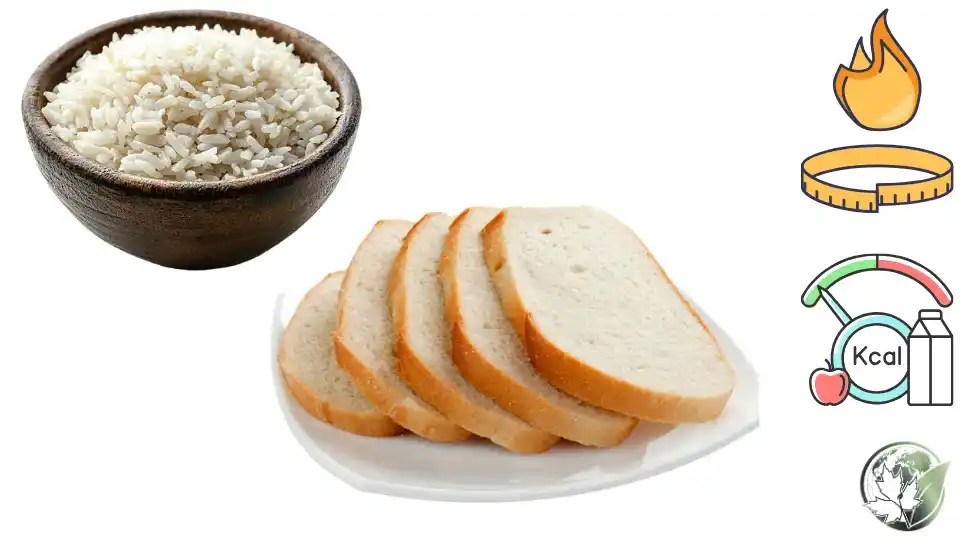
Adding chicken and vegetables lowers the blood sugar effect of both rice and bread meals
Which Is More Filling: White Bread or Rice?
White bread is the reference food in the satiety index and scores 100. White rice scores 138, so it is about 38 percent more filling per calorie. Soft bread is chewed quickly and digested fast, which is why it is easy to eat several slices. Rice is bulkier, with more water, and takes longer to eat. People often report that a rice meal keeps them full longer than a sandwich of equal calories, particularly when the sandwich is made with soft white bread and limited protein.
| Food | Satiety index | Calories per 100 g | Typical eating speed |
|---|---|---|---|
| White rice | 138 | 130 | Moderate |
| Brown rice | 132 | 123 | Moderate |
| White bread | 100 | 265 | Fast |
| Whole grain bread | 157 | 247 | Moderate |
| Toast with butter | About 90 | 340 | Fast |
How Does Toast Compare With Rice?
Toasting white bread removes water and makes slices crunchy, but the calories per slice remain nearly the same (about 66). Spreads are the issue. A teaspoon of butter adds 34 calories, a tablespoon of jam 56 and a tablespoon of honey 64. Two slices of toast with butter and jam reach 241 calories, similar to a cup of rice with a small side. If you add a fried egg or cheese, the breakfast easily surpasses 350 calories.
| Breakfast | Components | Calories |
|---|---|---|
| Plain toast | 2 slices | 132 |
| Toast with butter | 2 slices + 2 tsp butter | 200 |
| Toast with jam | 2 slices + 1 tbsp jam | 188 |
| Toast with butter and jam | 2 slices + 1 tsp butter + 1 tbsp jam | 222 |
| Toast with egg and cheese | 2 slices + egg + cheese slice | 330 |
| Rice with milk and sugar | 1 cup + 1/2 cup milk + 1 tsp sugar | 282 |
| Rice with yogurt | 3/4 cup + 1/2 cup yogurt | 228 |
Which Is Better for Kids' Lunchboxes and Daily Meals?
Both work well. Sandwiches are easy to pack and eat, and whole grain bread adds fiber. Rice bowls travel well if kept cool and are a good vehicle for vegetables and protein. For children, the balance of the whole meal matters more than the choice of starch: some protein, a fruit or vegetable, and a drink without added sugar. Younger children may eat less than a whole sandwich, so cut portions in halves or quarters.
| Lunchbox | Components | Calories |
|---|---|---|
| Mini sandwich | 1 slice bread, cheese, cucumber | 175 |
| Small sandwich | 2 slices, egg, tomato | 268 |
| Rice cup | 1/2 cup rice, chicken, carrot | 260 |
| Rice with beans | 3/4 cup rice, beans | 265 |
| Add-on fruit | Apple or mandarin | 50-95 |
| Add-on yogurt | 1/2 cup | 75 |
What Is in White Bread Besides Flour?
Unlike plain rice, which is a single ingredient, commercial white bread contains flour, water, yeast, salt, sugar or syrup, oil or fat, and often preservatives, emulsifiers and dough conditioners. These extras add small amounts of calories, sodium and sugar. A slice of packaged white bread has about 1 to 2 grams of added sugar and 120 to 150 milligrams of sodium. Artisan or home-baked breads may have less sugar and fat, but also less fortification. Reading the label is the best way to compare brands, because a loaf labeled "soft" or "extra soft" is often higher in sugar and fat.
| Ingredient | Role | Calories added per slice |
|---|---|---|
| Wheat flour | Main structure | 60-65 |
| Sugar or syrup | Flavor, browning | 3-8 |
| Oil or shortening | Softness | 4-10 |
| Milk solids | Flavor, softness | 1-3 |
| Salt | Flavor, dough control | 0 |
| Yeast | Rising | 0-1 |
| Preservatives and conditioners | Shelf life | 0 |
The practical lesson is that a soft, sweet, long-life sandwich bread is a bit denser than a basic baguette, which has only flour, water, yeast and salt. A baguette has about 270 calories per 100 grams but little added sugar.
How Do Different Slice Sizes Change the Count?
Standard slices in the United States weigh around 25 to 28 grams, but loaves in other countries are often larger. Bakery sandwich loaves in Iran may have slices of 35 to 40 grams, and artisan sourdough slices can reach 60 grams. If you assume 67 calories per slice for a large bakery slice, you are underestimating by 40 to 70 percent. Weighing your usual slice once removes this uncertainty.
| Slice weight | Calories | Slices to match 1 cup rice (205) |
|---|---|---|
| 20 g (thin) | 53 | 3.9 |
| 25 g (standard) | 67 | 3.1 |
| 30 g (large) | 80 | 2.6 |
| 38 g (thick) | 101 | 2.0 |
| 45 g (bakery) | 119 | 1.7 |
| 60 g (artisan) | 159 | 1.3 |
Two thick bakery slices can therefore equal a full cup of rice. If you like thick-cut bread, count each slice as 1.5 to 2 standard ones.
Which Starch Costs Less per 100 Calories?
Both rice and bread are among the cheapest sources of energy, although prices vary by country and by brand. Dry rice is usually the cheapest per calorie because it is dense and shelf-stable. White bread is cheap per loaf but spoils in a few days and includes more processing. The exact cost is less important than the pattern: bulk rice, bought dry, gives the most calories per unit of weight and money, while a loaf of bread gives about 40 percent of the calories per kilogram.
| Food as sold | Calories per kg | Kilograms for 2,000 kcal |
|---|---|---|
| Dry white rice | 3,650 | 0.55 |
| White sandwich bread | 2,650 | 0.75 |
| Baguette | 2,700 | 0.74 |
| Lavash | 2,750 | 0.73 |
| Dry pasta | 3,710 | 0.54 |
| Cooked rice | 1,300 | 1.54 |
Which Should You Choose for Different Meals?
Rice suits main meals with stews, grilled meat, legumes or vegetables. Bread suits breakfasts, sandwiches, dipping, and light meals. If you are managing calories, pick the option that works best with the foods that fill you most. A soup is better with a slice of bread to dip, while a stew is better with a modest portion of rice. Avoid combining large portions of both in one meal, such as rice with bread and a sweet drink.
| Meal | Better starch | Reason |
|---|---|---|
| Breakfast | Bread (whole grain if possible) | Quick, easy with eggs or cheese |
| Packed lunch | Sandwich or rice box | Both portable |
| Soup | 1 slice bread | Dipping, small portion |
| Stew | 3/4 cup rice | Absorbs sauce |
| Grilled meat | Rice or a single flatbread | Balanced plate |
| Light dinner | 2 slices bread with salad | Low volume, low calories |
| Heavy training day | Rice | Refuels glycogen quickly |
Simple Ways to Lighten Either Choice
A few small changes lower the calories of bread or rice meals without making them feel restrictive. For sandwiches, use one slice as an open-faced sandwich, choose mustard or hummus in place of mayonnaise, and add vegetables for volume. For rice, serve it on a smaller plate, mix half white rice with cauliflower or vegetables, and boil it in a large amount of water if you prefer the traditional drained style. In both cases, protein such as chicken, eggs, beans or yogurt improves fullness, and a glass of water before the meal slows eating.
| Change | Calories saved |
|---|---|
| Open-faced sandwich (1 slice instead of 2) | 67 |
| Mustard instead of mayo (1 tbsp) | 85 |
| Hummus instead of butter (1 tbsp vs 1 tbsp) | 60 |
| Smaller rice portion (3/4 cup instead of 1.5 cups) | 155 |
| Half rice, half steamed vegetables | 100 |
| Skip the second helping of rice | 205 |
| Grilled instead of fried chicken on a bowl | 130 |
Even one of these changes made at lunch five days a week saves over 20,000 calories a year, which shows how much small habits matter compared with the choice of rice or bread itself.
Key Takeaways: Rice vs White Bread Calories
Cooked white rice has 130 calories per 100 grams and white bread 265, but a cup of rice (205) equals three slices of bread (199). A standard slice has about 67 calories. A light sandwich is lighter than a rice bowl, but cheese, mayo and meat bring the two close. Rice has almost no sodium and is more filling per calorie, while bread has more protein and fiber per 200 calories. Count slices, measure rice and fill the rest of the plate with protein and vegetables.
Frequently Asked Questions
6 questions answered
How many calories are in a slice of white bread?
About 67 for a standard 25-gram slice.
How many slices of bread equal a cup of rice?
About three slices.
Which has more calories per 100 grams?
White bread, at 265 against 130.
Is a sandwich lighter than a rice bowl?
A light sandwich usually is, but fillings can reverse that.
Which is more filling?
Rice, according to the satiety index.
Does toast have fewer calories than bread?
No, a toasted slice has about the same calories.