How Many Calories Are in Rice vs Pasta? The Quick Answer
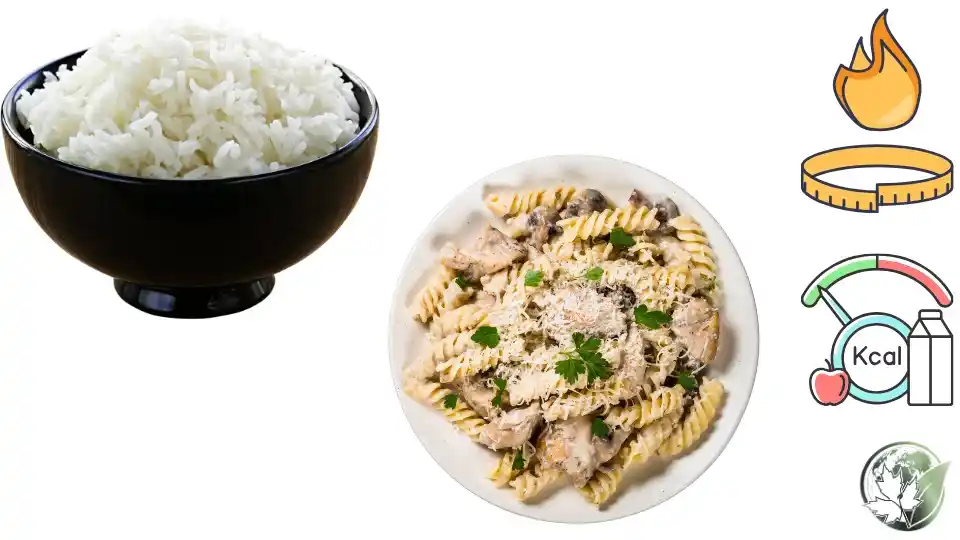
Cooked white rice has about 130 calories per 100 grams. Cooked white pasta has about 158. By weight, pasta is roughly 21 percent more calorie dense than rice. In cups, the gap narrows because pasta is lighter per cup: one cup of cooked white rice (158 grams) has about 205 calories, and one cup of cooked spaghetti (140 grams) has about 220, a difference of only 15 calories. Dry, the two are nearly identical: dry white rice has 365 calories per 100 grams, and dry pasta has about 371.
So rice and pasta are close cousins in calories, with pasta slightly higher cooked and a little higher in protein. The real differences show up in the details: how much dry food you cook, which sauce you pour on top, whether the pasta is whole wheat, and how filling each is. This guide compares rice and pasta by 100 grams, by cup and by dry weight, looks at white, brown and whole wheat versions, and covers protein, fiber, glycemic index and sauces. It includes three comparison tables and an FAQ.
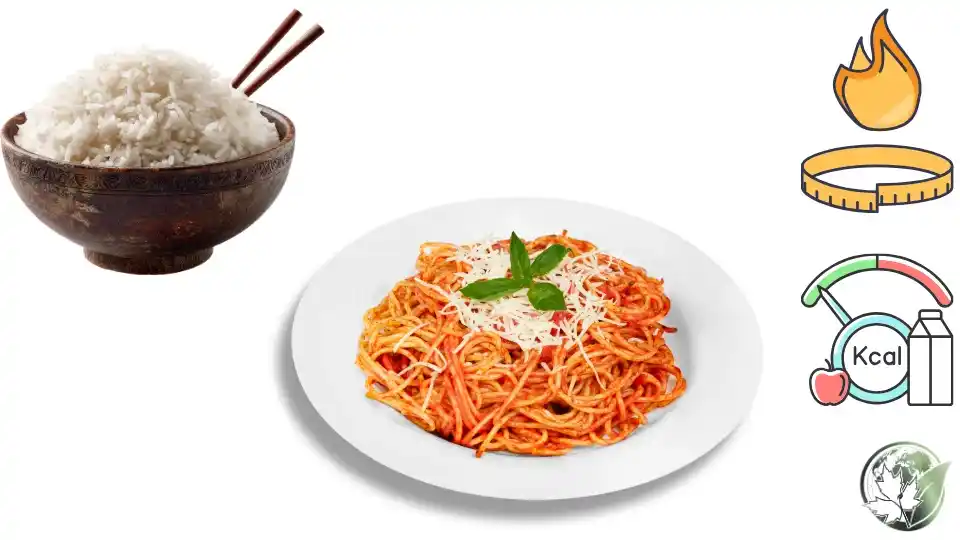
A cup of cooked rice has 205 calories, and a cup of cooked spaghetti has about 220
How Many Calories Are in Rice?
| Cooked rice | Weight | Calories | Carbohydrate | Protein |
|---|---|---|---|---|
| 1/2 cup white | 79 g | 103 kcal | 22.3 g | 2.1 g |
| 3/4 cup white | 118 g | 153 kcal | 33.4 g | 3.2 g |
| 1 cup white | 158 g | 205 kcal | 44.5 g | 4.3 g |
| 1.5 cups white | 237 g | 308 kcal | 67 g | 6.4 g |
| 2 cups white | 316 g | 410 kcal | 89 g | 8.6 g |
| 1 cup brown | 195 g | 216 kcal | 44.8 g | 5 g |
| 1 cup basmati | 163 g | 197 kcal | 43.6 g | 4.7 g |
| 100 g white | 100 g | 130 kcal | 28 g | 2.7 g |
How Many Calories Are in Pasta?
| Cooked pasta | Weight | Calories | Carbohydrate | Protein |
|---|---|---|---|---|
| 1/2 cup spaghetti | 70 g | 110 kcal | 21.9 g | 4 g |
| 1 cup spaghetti | 140 g | 220 kcal | 43.2 g | 8.1 g |
| 1.5 cups spaghetti | 210 g | 331 kcal | 65 g | 12 g |
| 2 cups spaghetti | 280 g | 442 kcal | 86 g | 16 g |
| 1 cup whole wheat spaghetti | 140 g | 174 kcal | 37.2 g | 7.5 g |
| 1 cup penne | 107 g | 169 kcal | 33 g | 6 g |
| 1 cup fresh egg pasta | 124 g | 190 kcal | 36 g | 7.5 g |
| 100 g white spaghetti | 100 g | 158 kcal | 30.9 g | 5.8 g |
Rice vs Pasta: Calories Compared
| Amount | Cooked white rice | Cooked white pasta | Difference |
|---|---|---|---|
| 100 g | 130 kcal | 158 kcal | Rice -28 |
| 150 g | 195 kcal | 237 kcal | Rice -42 |
| 200 g | 260 kcal | 316 kcal | Rice -56 |
| 1 cup | 205 kcal | 220 kcal | Rice -15 |
| 1.5 cups | 308 kcal | 331 kcal | Rice -23 |
| 2 cups | 410 kcal | 442 kcal | Rice -32 |
| Dry, 100 g | 365 kcal | 371 kcal | Rice -6 |
| Weight for 200 kcal | 154 g | 127 g | Rice 27 g more |
Per cup, the difference is small enough to ignore. Per gram, rice wins because it holds more water, but pasta keeps its shape and eats well in smaller amounts.
Why Do Rice and Pasta Have Different Calories When Cooked?
Both are about 365 to 371 calories per 100 grams dry, so the difference arises during cooking. Rice absorbs roughly 2.5 to 3 times its weight in water and ends up at 68 percent water. Pasta absorbs about 1.25 to 1.5 times its weight and ends up at about 62 percent water. That is why 100 grams of dry rice makes about 280 grams cooked, while 100 grams of dry pasta makes about 225 grams cooked. Each gram of cooked pasta carries more starch, so more calories.
| Dry portion | Dry calories | Cooked rice yield | Cooked pasta yield |
|---|---|---|---|
| 50 g | 183 kcal (rice) / 186 kcal (pasta) | 140 g | 112 g |
| 56 g (2 oz) | 204 kcal / 208 kcal | 157 g | 126 g |
| 75 g | 274 kcal / 278 kcal | 210 g | 169 g |
| 100 g | 365 kcal / 371 kcal | 280 g | 225 g |
| 125 g | 456 kcal / 464 kcal | 350 g | 281 g |
A standard serving of dry pasta on a package is 56 grams (2 ounces), about 208 calories, which cooks up to a bit more than a cup. A person who cooks 100 grams dry pasta for dinner eats 371 calories before the sauce, which is why measuring the dry weight matters.
A standard 56-gram serving of dry pasta has about 208 calories and cooks to roughly one cup
Rice vs Pasta: Nutrition Compared
| Per 100 g cooked | White rice | Brown rice | White pasta | Whole wheat pasta |
|---|---|---|---|---|
| Calories | 130 kcal | 123 kcal | 158 kcal | 124 kcal |
| Carbohydrate | 28 g | 25.6 g | 30.9 g | 26.5 g |
| Protein | 2.7 g | 2.7 g | 5.8 g | 5.3 g |
| Fat | 0.3 g | 1 g | 0.9 g | 0.5 g |
| Fiber | 0.4 g | 1.6 g | 1.8 g | 4.5 g |
| Sodium | 1 mg | 4 mg | 1 mg | 3 mg |
| Iron | 0.2 mg | 0.5 mg | 1.3 mg | 1.5 mg |
| Magnesium | 12 mg | 44 mg | 18 mg | 43 mg |
| Selenium | 7.5 mcg | 9.8 mcg | 26 mcg | 31 mcg |
| Glycemic index | 65-73 | 50-55 | 40-50 | 37-45 |
Pasta has about twice the protein of rice per 100 grams, more iron and a lot more selenium. Whole wheat pasta has the lowest calories per 100 grams of the four, the most fiber, and a low glycemic index. Brown rice is close to whole wheat pasta in calories, but with less fiber and protein.
Which Has More Calories: Rice or Pasta?
Cooked pasta has more calories than cooked rice by weight (158 against 130) and slightly more per cup (220 against 205). But the difference is small enough that the type of rice or pasta, the portion and the sauce matter far more. Whole wheat pasta (124 per 100 g) is lower than white rice, and white pasta (158) is higher than brown rice (123). Neither food is far from the other, so choosing between them should be based on taste, nutrition and how you feel after eating.
| Pair | Per 100 g | Per cup | Lower calories |
|---|---|---|---|
| White rice vs white pasta | 130 vs 158 | 205 vs 220 | Rice |
| Brown rice vs white pasta | 123 vs 158 | 216 vs 220 | Brown rice |
| White rice vs whole wheat pasta | 130 vs 124 | 205 vs 174 | Whole wheat pasta |
| Brown rice vs whole wheat pasta | 123 vs 124 | 216 vs 174 | Whole wheat pasta by cup |
| Basmati vs egg pasta | 121 vs 153 | 197 vs 190 | Egg pasta by cup |
Is Pasta or Rice Better for Blood Sugar?
Pasta usually has a lower glycemic index than rice. Al dente white pasta scores 40 to 50, while white rice scores 65 to 73. The dense structure of pasta, made from semolina wheat and extruded, slows digestion. Overcooking raises the index to about 55 to 60. Whole wheat pasta is lower still, and chilled pasta salad produces more resistant starch. White rice is digested faster, though basmati, parboiled and brown rice are slower. For people with diabetes, pasta in a controlled portion is often easier on blood sugar than the same portion of white rice, as long as the sauce and sides are sensible.
| Food (1 cup cooked) | Carbohydrate | Glycemic index | Glycemic load |
|---|---|---|---|
| White rice | 44.5 g | 65-73 | About 30 |
| Basmati rice | 43.6 g | 50-58 | About 24 |
| Brown rice | 44.8 g | 50-55 | About 23 |
| White spaghetti, al dente | 43.2 g | 40-50 | About 19 |
| Whole wheat spaghetti | 37.2 g | 37-45 | About 15 |
| Overcooked white pasta | 43.2 g | 55-60 | About 25 |
| Cooled pasta salad | 43.2 g | 35-45 | About 17 |
Which Is More Filling: Rice or Pasta?
In satiety research, pasta ranks well. The satiety index ranks white pasta at 119, white rice at 138 and brown rice at 132, relative to white bread at 100, while whole wheat pasta scored 188, among the highest of the starches. Pasta delivers more protein, which promotes fullness, and whole wheat versions add more fiber. White rice is also filling due to its volume and water content, but with less protein.
| Food | Satiety index (white bread = 100) | Protein per 200 kcal | Fiber per 200 kcal |
|---|---|---|---|
| Whole wheat pasta | 188 | 8.5 g | 7.3 g |
| White rice | 138 | 4.2 g | 0.6 g |
| Brown rice | 132 | 4.4 g | 2.6 g |
| White pasta | 119 | 7.3 g | 2.3 g |
| White bread | 100 | 6.8 g | 2 g |
Whole wheat pasta with vegetables is filling and has fewer calories per 100 grams than white rice
How Do Pasta Sauces Change the Comparison?
Sauce usually adds more calories than the starch difference. A half cup of marinara adds 70 calories, a half cup of meat sauce 140, two tablespoons of pesto 160 and a half cup of alfredo about 220. Rice is typically eaten with stews, which are also variable. The cleanest comparison puts both with similar toppings. Pasta with marinara (1 cup pasta plus half a cup of sauce) has about 290 calories. Rice with a vegetable stew of the same volume has about 280.
| Topping | Calories | 1 cup rice + topping | 1 cup pasta + topping |
|---|---|---|---|
| Marinara, 1/2 cup | 70 | 275 | 290 |
| Meat sauce, 1/2 cup | 140 | 345 | 360 |
| Pesto, 2 tbsp | 160 | 365 | 380 |
| Alfredo, 1/2 cup | 220 | 425 | 440 |
| Olive oil, 1 tbsp | 119 | 324 | 339 |
| Parmesan, 2 tbsp | 43 | 248 | 263 |
| Butter, 1 tbsp | 102 | 307 | 322 |
| Plain yogurt and herbs, 1/4 cup | 38 | 243 | 258 |
For lighter meals, tomato-based sauces, vegetables and herbs add flavor with fewer calories than cream, cheese or oil-based toppings.
Rice vs Pasta in Persian Home Cooking
In Iran, pasta (makaroni) is a common family dinner, served with tomato and meat sauce or as a baked dish. Reshteh polo mixes noodles and rice. Macaroni with tomato sauce and minced meat has about 160 calories per 100 grams, and a typical plate (300 g) holds 480 calories. A plate of plain chelow (250 g) has 330 calories, but with khoresh or kabab, the totals rise to 600 to 800. The two are roughly equal in everyday terms, so portion and accompaniments decide.
| Dish | Serving | Calories |
|---|---|---|
| Plain chelow | 1 plate (250 g) | 330 |
| Kateh | 1 plate (250 g) | 310 |
| Macaroni with tomato sauce | 1 plate (300 g) | 400 |
| Macaroni with meat sauce | 1 plate (300 g) | 480 |
| Reshteh polo | 1 plate (250 g) | 420 |
| Plain spaghetti, boiled | 1 plate (250 g) | 395 |
| Baked macaroni with cheese | 1 serving (250 g) | 520 |
| Rice with lentils (adas polo) | 1 plate (250 g) | 400 |
Which Is Better for Weight Loss: Rice or Pasta?
Neither is inherently better. Studies of pasta eaten as part of a Mediterranean-style diet found no weight gain and sometimes small weight loss, likely because of pasta's low glycemic index and satiety. Rice also works in many cultures where lean populations eat it daily. What matters is portion size, sauce and how often you eat the dish. Using 56 grams of dry pasta or 1/3 cup dry rice per person, adding vegetables and lean protein, and choosing whole grain versions makes either an excellent base.
| Tip | Rice | Pasta |
|---|---|---|
| Portion (dry) | 1/4 cup per person | 56 g per person |
| Cooked amount | 3/4 cup (153 kcal) | 1 cup (220 kcal) |
| Add vegetables | Stir-fried or in stew | Roasted or in sauce |
| Pick whole grain | Brown rice or mix | Whole wheat pasta |
| Add protein | Chicken, lentils, egg | Chicken, beans, fish |
| Cool and reheat | Resistant starch | Resistant starch |
| Watch sauce | Skip heavy butter | Prefer tomato over cream |
Gluten, Allergies and Special Diets
Rice is naturally gluten free and is the base for many special diets. Regular pasta contains wheat gluten, so it is not suitable for people with celiac disease or gluten sensitivity. Gluten-free pastas, made from rice, corn, quinoa or legumes, have 160 to 190 calories per 100 grams cooked, so they are usually somewhat higher than wheat pasta. Chickpea and lentil pastas offer much more protein (up to 12 grams per 100 grams cooked) and fiber but similar calories.
| Product (100 g cooked) | Calories | Protein | Fiber |
|---|---|---|---|
| White rice | 130 | 2.7 g | 0.4 g |
| White pasta | 158 | 5.8 g | 1.8 g |
| Whole wheat pasta | 124 | 5.3 g | 4.5 g |
| Brown rice pasta | 150 | 3.1 g | 1.4 g |
| Corn pasta | 155 | 3.5 g | 2.5 g |
| Chickpea pasta | 160 | 10 g | 5 g |
| Lentil pasta | 150 | 11 g | 5.5 g |
| Konjac noodles | 10 | 0 g | 3 g |
How Does Cooking Style Change Rice and Pasta Calories?
How you cook both foods affects texture, glycemic response and sometimes calories. Pasta cooked al dente (firm to the bite) digests more slowly than soft pasta. Rice cooked by absorption keeps all its starch, while boiled and drained rice loses a little. Frying either in oil, as in stir-fried rice or fried noodles, adds 40 to 120 calories per cup depending on the amount of oil. Baking pasta with cheese and cream, or making rice pilaf with butter, can double the energy of the plain starch. The simplest preparations keep calories closest to the base values.
| Preparation (1 cup) | Rice calories | Pasta calories |
|---|---|---|
| Plain boiled | 205 | 220 |
| Cooked al dente | 205 | 215 |
| Cooked soft | 205 | 225 |
| Stir-fried with 1 tbsp oil | 324 | 339 |
| Baked with cheese | 360 | 400 |
| Cooked with butter | 307 | 322 |
| Chilled and made into a salad with dressing | 280 | 300 |
| Reheated leftovers | 205 | 220 |
Reheating does not change calories, but chilling and reheating can increase resistant starch slightly in both foods, giving a small drop in available calories and a lower blood sugar response.
How Much Should You Cook Per Person?
Portion planning avoids both waste and overeating. For rice, 1/4 to 1/3 cup dry (45 to 62 grams) per person gives 3/4 to 1 cup cooked. For pasta, 56 to 85 grams dry per person is a normal range, depending on whether it is a side or a main dish. A family of four therefore needs about 1 cup of dry rice or 225 grams of dry pasta for a side-dish portion. Restaurants usually serve 2 to 3 cups of cooked starch, which is 400 to 700 calories before sauce.
| Meal type | Dry rice per person | Cooked rice | Dry pasta per person | Cooked pasta |
|---|---|---|---|---|
| Small side | 1/4 cup (45 g) | 3/4 cup | 40 g | 3/4 cup |
| Standard side | 1/3 cup (62 g) | 1 cup | 56 g | 1 cup |
| Main dish | 1/2 cup (92 g) | 1.5 cups | 85 g | 1.5 cups |
| Large main | 3/4 cup (140 g) | 2.25 cups | 110 g | 2 cups |
| Calories (standard side) | 226 | 205 | 208 | 220 |
| Calories (main dish) | 336 | 308 | 315 | 331 |
A measuring cup or a small kitchen scale takes the guesswork out. Many people discover they were cooking twice as much as they thought.
Which Is Easier to Digest and Better for Sports?
Both rice and pasta are used by athletes as pre-event carbohydrate sources. Rice is low in fiber and fat, so it digests easily, which is why white rice is common before races or when recovering from stomach upset. Pasta is traditional the night before endurance events because it provides a dense, familiar carbohydrate load. Whole wheat pasta can be too heavy right before exercise. For daily training, a mix of white and whole grain versions balances digestion and nutrition.
| Situation | Better choice | Why |
|---|---|---|
| Night before a race | Pasta with tomato sauce | Dense carbohydrate, familiar |
| Morning of a race | White rice with honey | Easy to digest, low fiber |
| Recovery meal | Rice with protein | Quick glycogen refill |
| Upset stomach | Plain white rice | Gentle, binding |
| Daily training | Whole wheat pasta or brown rice | Fiber and minerals |
| Gluten sensitivity | Rice | Gluten free |
Common Mistakes When Comparing Rice and Pasta
Most calorie errors with these two foods come from mixing dry and cooked weights. A recipe that calls for 100 grams of pasta means dry, which is 371 calories, while a plate described as 100 grams of pasta might mean cooked, which is 158. The second mistake is ignoring sauces and oils, which can double the energy of the plate. The third is assuming that whole wheat or gluten-free automatically means lower in calories, when many gluten-free pastas are slightly higher. The fourth is eating from the pot and losing track of portions. The fifth is skipping vegetables, which add volume and fiber for few calories.
| Mistake | Effect on calories | Fix |
|---|---|---|
| Mixing dry and cooked grams | Error of 2-3 times | Use the matching entry |
| Ignoring sauce and oil | +100 to +300 kcal | Measure toppings |
| Assuming gluten free is lighter | +10 to +30 kcal per 100 g | Check the label |
| Cooking by eye | +100 to +200 kcal | Use a measuring cup |
| Eating straight from the pot | Unlimited | Plate the portion |
| Leaving out vegetables | Less fullness | Fill half the plate |
A useful habit is to decide the starch portion before you start cooking, write it down once, and reuse it. If you cook for several people, divide the pot into plates in the kitchen and leave the remainder in the refrigerator rather than on the table. Studies of eating behavior consistently show that people eat more when serving dishes are within reach, and less when seconds require getting up. Combined with a measured dry portion, this simple routine does more for your calorie balance than switching from rice to pasta or the other way around. In short, treat the two as equals in calories, and let taste, nutrition goals and the rest of the plate decide.
Key Takeaways: Rice vs Pasta Calories
Cooked white rice has about 130 calories per 100 grams, and white pasta about 158. A cup has 205 for rice and 220 for pasta. Dry weights are nearly equal at 365 and 371. Pasta offers more protein and a lower glycemic index, while rice is lighter per gram and gluten free. Whole wheat pasta (124 per 100 g) is the lightest of the four common options. Sauces and portions matter more than the starch itself.
Frequently Asked Questions
6 questions answered
How many calories are in a cup of cooked rice?
About 205 for white rice.
How many calories are in a cup of cooked pasta?
About 220 for white spaghetti.
Is pasta higher in calories than rice?
Slightly, by weight and by cup.
Which has more protein?
Pasta, about 5.8 g against 2.7 g per 100 g cooked.
Which is better for blood sugar?
Al dente pasta usually has a lower glycemic index.
How much dry pasta is one serving?
About 56 grams, which has 208 calories.