How Many Calories Are in Rice vs Bread? The Quick Answer
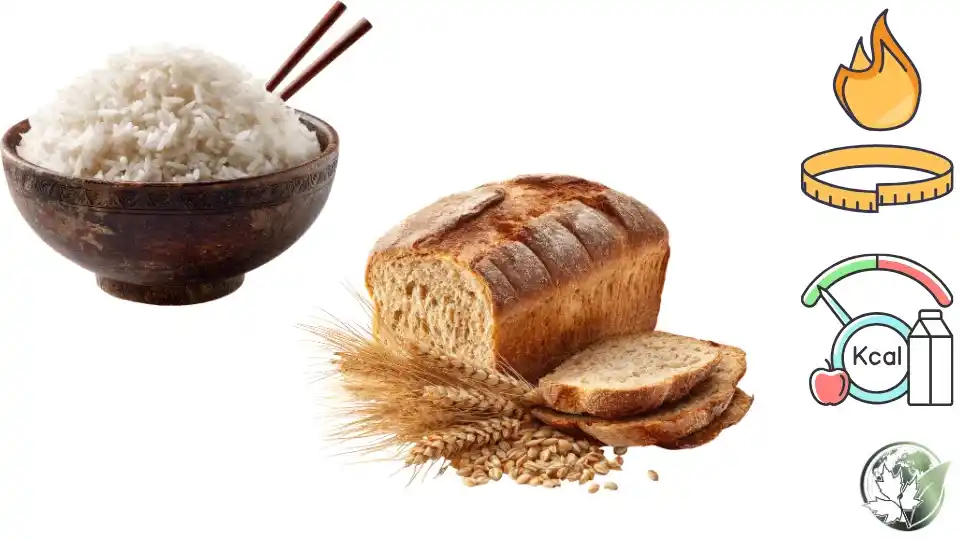
Cooked white rice has about 130 calories per 100 grams. White bread has about 265, and whole grain bread about 250. By weight, bread is roughly twice as calorie dense as cooked rice, because rice is 68 percent water while bread is only about 36 percent water. But nobody eats rice and bread by the same weight. A cup of cooked rice (158 grams) has 205 calories, and a typical slice of white bread (25 grams) has about 67, so a cup of rice equals about three slices. A piece of lavash (60 grams) has about 165 calories, which equals about 80 percent of a cup of rice.
So which is lower? It depends on the unit. Per 100 grams, rice wins. Per slice or per piece, bread usually wins. Per meal, they are similar: a plate of rice (1.5 cups, 308 calories) is close to four slices of white bread (268) or two lavash pieces (330). This guide compares rice and bread by 100 grams, by piece and by meal, covering white, whole grain, lavash, sangak, barbari, taftoon, pita and baguette. It also looks at fiber, protein, glycemic index and fullness. It includes three comparison tables and an FAQ.
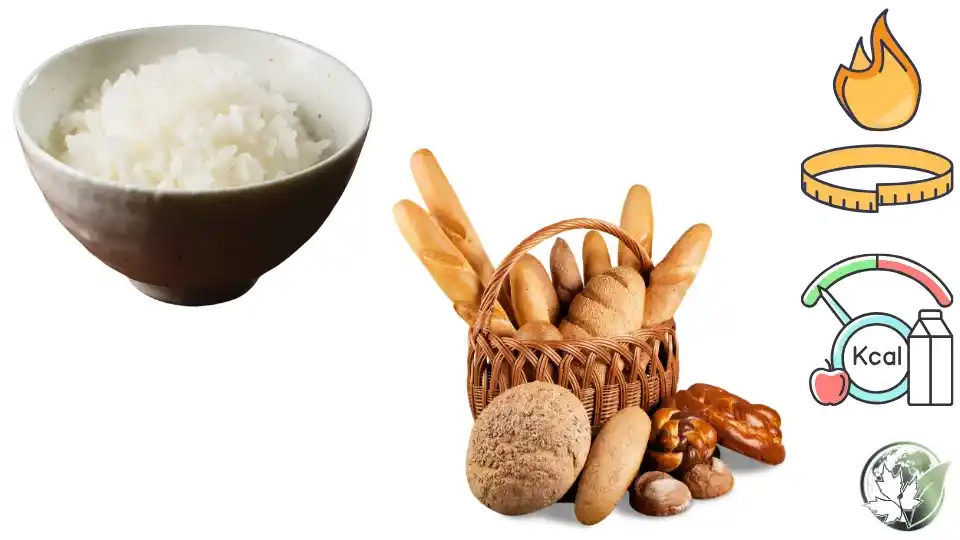
A cup of cooked rice has about the same calories as three slices of white bread
How Many Calories Are in Rice?
| Cooked rice | Weight | Calories | Carbohydrate | Fiber |
|---|---|---|---|---|
| 1/2 cup white | 79 g | 103 kcal | 22.3 g | 0.3 g |
| 3/4 cup white | 118 g | 153 kcal | 33.4 g | 0.4 g |
| 1 cup white | 158 g | 205 kcal | 44.5 g | 0.6 g |
| 1.5 cups white | 237 g | 308 kcal | 67 g | 0.9 g |
| 2 cups white | 316 g | 410 kcal | 89 g | 1.3 g |
| 1 cup brown | 195 g | 216 kcal | 44.8 g | 3.5 g |
| 1 cup basmati | 163 g | 197 kcal | 43.6 g | 0.7 g |
| 100 g white | 100 g | 130 kcal | 28 g | 0.4 g |
How Many Calories Are in Bread?
| Bread | Weight | Calories | Carbohydrate | Fiber |
|---|---|---|---|---|
| 1 slice white sandwich bread | 25 g | 67 kcal | 12.7 g | 0.7 g |
| 1 slice whole wheat | 28 g | 69 kcal | 12 g | 1.9 g |
| 1 slice sourdough | 32 g | 93 kcal | 18 g | 0.8 g |
| 1 slice rye | 32 g | 83 kcal | 15.5 g | 1.9 g |
| 1 piece pita (6.5 inch) | 60 g | 165 kcal | 33 g | 1.3 g |
| 1 slice baguette (thick) | 30 g | 81 kcal | 15.8 g | 0.7 g |
| 1 dinner roll | 28 g | 84 kcal | 14 g | 0.8 g |
| 100 g white bread | 100 g | 265 kcal | 49 g | 2.7 g |
Rice vs Bread: Calories Compared
| Amount | Cooked white rice | White bread | Difference |
|---|---|---|---|
| 100 g | 130 kcal | 265 kcal | Rice -135 |
| 50 g | 65 kcal | 133 kcal | Rice -68 |
| 150 g | 195 kcal | 398 kcal | Rice -203 |
| 1 cup rice vs 3 slices | 205 kcal | 201 kcal | About equal |
| 1.5 cups rice vs 4 slices | 308 kcal | 268 kcal | Bread -40 |
| 2 cups rice vs 6 slices | 410 kcal | 402 kcal | About equal |
| Weight for 200 kcal | 154 g | 75 g | Rice 79 g more |
| Carbohydrate per 100 kcal | 21.5 g | 18.5 g | Rice slightly higher |
For a 200-calorie portion, you can eat 154 grams of cooked rice but only 75 grams of white bread, about three slices. Rice offers more volume, while bread offers more convenience and fewer dishes to wash.
Why Does Bread Have More Calories per 100 Grams?
The difference is water. Cooked rice is 68 percent water, so each 100 grams contains only 32 grams of dry food. Bread, after baking, is about 36 percent water, so each 100 grams contains 64 grams of flour, starch and a little fat and sugar. Comparing dry matter, they are almost identical: dry rice has 365 calories per 100 grams, and the dry matter of bread works out to about 410. Bread often includes some oil, sugar, milk or salt, which raises its density a little.
| Property (per 100 g) | Cooked white rice | White sandwich bread | Whole wheat bread | Lavash |
|---|---|---|---|---|
| Calories | 130 | 265 | 247 | 275 |
| Water | 68 g | 36 g | 38 g | 30 g |
| Carbohydrate | 28 g | 49 g | 41 g | 57 g |
| Protein | 2.7 g | 9 g | 13 g | 9 g |
| Fat | 0.3 g | 3.2 g | 3.4 g | 1.2 g |
| Fiber | 0.4 g | 2.7 g | 6.0 g | 2.2 g |
| Sodium | 1 mg | 491 mg | 450 mg | 540 mg |
| Calories per gram of dry matter | 4.1 | 4.1 | 4.0 | 3.9 |
The last row makes the point: once water is removed, rice and bread are practically the same food in energy terms. This is why the choice rarely changes calories as much as the portion does.
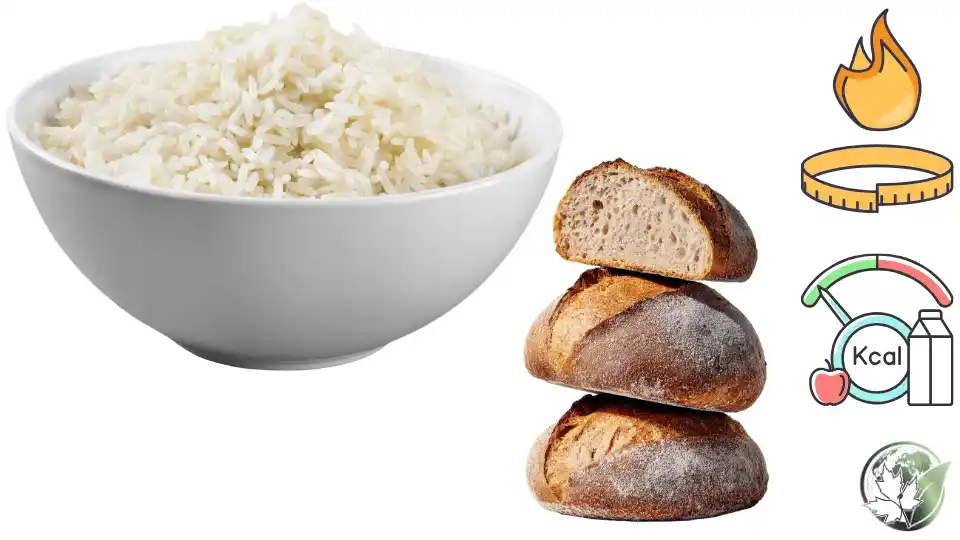
One piece of lavash has about 165 calories, about as much as 3/4 cup of rice
How Many Calories Are in Persian Breads?
Iranian meals often feature flatbreads rather than sliced bread. The calories depend on the weight and thickness of each piece. Lavash is thin and light, taftoon is slightly thicker, barbari is dense and oily, and sangak is whole wheat baked on pebbles. A piece of barbari can weigh 200 to 300 grams, so it is far more calorie rich than a single slice of sandwich bread. The table gives typical values, but real pieces vary by bakery, so use them as a guide.
| Persian bread | Typical piece weight | Calories per 100 g | Calories per piece |
|---|---|---|---|
| Lavash | 60 g | 275 | 165 |
| Taftoon | 100 g | 270 | 270 |
| Sangak | 250 g | 245 | 610 |
| Barbari | 250 g | 275 | 690 |
| Whole wheat taftoon | 100 g | 250 | 250 |
| Bread with seeds (non-white) | 40 g | 280 | 112 |
| Baguette (Iranian "nan-e fantezi") | 100 g | 270 | 270 |
| Pita (small) | 60 g | 275 | 165 |
A portion of sangak that is a quarter of a piece (about 60 grams) has 150 calories, which is more than 3/4 cup of rice (153). A meal of two lavash pieces with cheese and herbs can reach 330 calories before the cheese.
Which Has More Calories: Rice or Bread?
Bread has more calories per gram. Rice has more calories per usual serving, if you eat a standard plate of 1.5 to 2 cups. A sandwich with two slices (134 calories) is lighter than a cup of rice (205), but adding fillings changes the equation. For weight control, both are fine in moderate amounts. The key is to avoid doubling up, for example eating rice with a full flatbread, which is common in some meals. A plate of chelow kabab with a piece of lavash on the side can pass 900 calories.
| Situation | Rice meal | Bread meal | Lower calories |
|---|---|---|---|
| Light lunch | 1 cup rice (205) + salad | 2 slices (134) + salad | Bread |
| Hearty dinner | 2 cups rice (410) | 1 sangak quarter + 1 lavash (315) | Bread |
| By weight (100 g) | 130 | 265 | Rice |
| Breakfast | - | 2 slices toast (134) | Bread |
| Sauces and stews | 1.5 cups with stew (308) | 2 lavash with stew (330) | About equal |
Rice vs Bread: Nutrition Compared
| Per typical serving | 1 cup white rice | 3 slices white bread | 3 slices whole wheat | 1 lavash |
|---|---|---|---|---|
| Calories | 205 | 201 | 207 | 165 |
| Carbohydrate | 44.5 g | 38 g | 36 g | 34 g |
| Protein | 4.3 g | 6 g | 11 g | 5.4 g |
| Fat | 0.4 g | 2.4 g | 2.9 g | 0.7 g |
| Fiber | 0.6 g | 2 g | 5.7 g | 1.3 g |
| Sodium | 2 mg | 368 mg | 380 mg | 324 mg |
| Iron | 1.9 mg (enriched) | 2.7 mg | 2.8 mg | 1.7 mg |
| B vitamins | Enriched | Enriched | Natural | Varies |
| Glycemic index | 65-73 | 70-75 | 51-54 | 55-65 |
At equal calories, bread gives more protein and fiber than white rice, and whole grain bread gives much more. Bread also brings sodium, which can matter for people watching blood pressure. Rice is naturally low in sodium.
Is Whole Grain Bread Better Than Rice?
Whole grain bread is generally the better choice nutritionally than white rice or white bread, since it provides about three times the fiber and more protein, minerals and B vitamins for the same calories. Its glycemic index of about 51 to 54 is lower than that of white rice. But whole grain bread still has about 247 calories per 100 grams, and a large slice can be 100 calories. Brown rice and whole grain bread are similar in calories and fiber per serving, so the choice depends on what you are eating them with.
| Per 200 kcal | White rice | Brown rice | White bread | Whole wheat bread | Lavash |
|---|---|---|---|---|---|
| Weight | 154 g | 163 g | 75 g | 81 g | 73 g |
| Fiber | 0.6 g | 2.6 g | 2 g | 4.9 g | 1.6 g |
| Protein | 4.2 g | 4.4 g | 6.8 g | 10.5 g | 6.5 g |
| Magnesium | 18 mg | 72 mg | 18 mg | 49 mg | 15 mg |
| Glycemic index | 65-73 | 50-55 | 70-75 | 51-54 | 55-65 |
| Fullness | Moderate | Moderate to high | Low to moderate | High | Moderate |
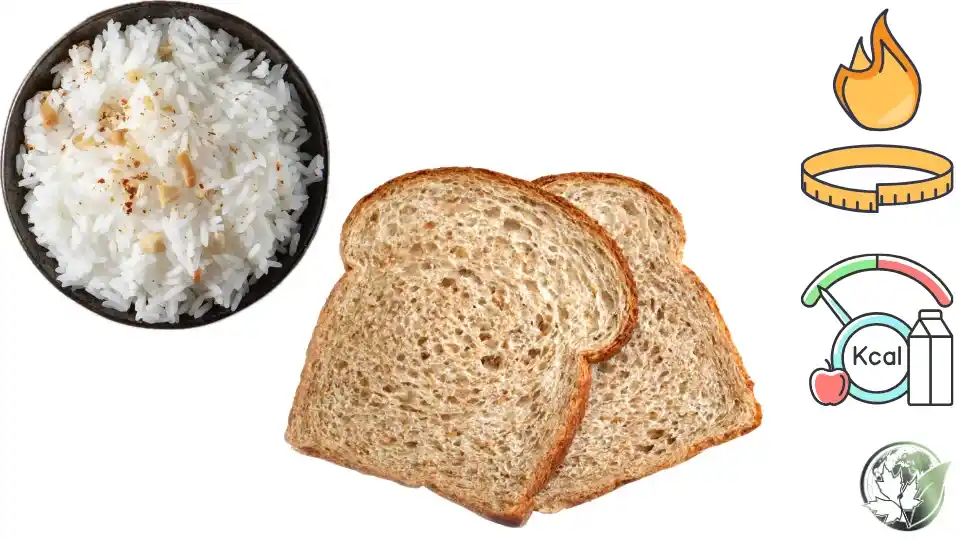
Whole grain bread and brown rice offer more fiber for the same calories as their white versions
Which Is More Filling: Rice or Bread?
In the satiety index study, white bread was the reference at 100, white rice scored 138 and brown rice 132, while whole grain bread scored 157. Rice offers more volume and water, and whole grain bread offers fiber and protein. White bread is the least filling, as it is soft, quickly digested and easy to eat in large amounts. Combining either with protein, vegetables and healthy fat improves fullness more than changing the starch.
| Food | Satiety index (white bread = 100) | Calories per 100 g |
|---|---|---|
| Whole grain bread | 157 | 247 |
| White rice | 138 | 130 |
| Brown rice | 132 | 123 |
| Pasta, whole wheat | 188 | 124 |
| White bread | 100 | 265 |
| Croissant | 47 | 406 |
How Do Toppings and Sides Change the Comparison?
Rice and bread are rarely eaten alone. Bread is usually served with butter, cheese, jam, eggs or fillings, while rice comes with stew, kabab, butter and saffron. The additions often exceed the calories of the starch itself. Two slices of toast with butter and jam reach 250 calories. A plate of rice with a spoon of butter and a piece of tahdig reaches 450. Looking at the whole meal matters more than comparing the starches.
| Meal | Components | Calories |
|---|---|---|
| Toast with butter and jam | 2 slices + 1 tsp butter + 1 tbsp jam | 241 |
| Bread with cheese and walnut | 1 lavash + 40 g feta + 2 walnut halves | 270 |
| Egg sandwich | 2 slices + 1 egg + 1 tsp oil | 275 |
| Rice with stew | 1.5 cups rice + 1 cup stew | 640 |
| Chelow kabab | 2 cups rice + 1 skewer + butter | 800 |
| Plain rice with yogurt | 1 cup + 1/2 cup yogurt | 275 |
| Rice and lentils (adas polo) | 1.5 cups | 400 |
Which Is Better for Weight Loss: Rice or Bread?
Neither is a villain, and neither is magic. Weight loss depends on your daily calorie balance. If you like rice, 3/4 cup (153 calories) with vegetables and protein is a sound portion. If you like bread, one or two slices of whole grain bread or one thin lavash (165) can fit. Small tweaks help: use a smaller plate, measure rice, tear lavash in half, choose whole grain, and fill half the plate with vegetables. If you tend to overeat bread because it is soft and quick to eat, switching to rice or to whole grain bread may help.
| Strategy | Rice | Bread |
|---|---|---|
| Measure the portion | 3/4 cup (153) | 2 slices (134) |
| Increase fiber | Brown rice or mix with lentils | Whole grain or seed bread |
| Fill the plate with vegetables | Half the plate | Open sandwich with salad |
| Avoid add-ons | Skip extra butter | Skip jam and butter |
| Cooling trick | Cool rice for resistant starch | Toast bread to lower GI slightly |
| Swap for a day | Replace dinner bread with rice | Replace rice with lavash |
Does Toasting Bread Change Calories?
Toasting does not change calories in any meaningful way, though it removes some water, so a toasted slice weighs a bit less while retaining nearly all of its energy. Per 100 grams, toast shows a higher number (about 313) because of the lost water. Toasting can slightly lower the glycemic index, and cooling cooked rice can do the same.
| Preparation | Calories per slice or cup | Calories per 100 g |
|---|---|---|
| White bread, fresh | 67 | 265 |
| White bread, toasted | 66 | 313 |
| Rice, hot | 205 | 130 |
| Rice, cooled then reheated | 205 | 130 |
| Fried bread (in oil) | 130-150 | 370 |
| Fried rice | 270 (1 cup) | 163 |
How Do Rice and Bread Affect Blood Sugar?
Both white rice and white bread are high-glycemic foods that raise blood sugar quickly, with white bread typically at 70 to 75 and white rice at 65 to 73. Whole grain bread, sourdough and brown rice produce a slower rise, with indexes from 50 to 55. Sourdough fermentation and the acids it produces can lower the response compared with ordinary yeast bread. Cooling cooked rice increases resistant starch, and eating either food with protein, vinegar, vegetables or healthy fat reduces the spike. Glycemic load, which includes portion size, shows that a large plate of rice can push blood sugar more than two slices of bread.
| Food and portion | Carbohydrate | Glycemic index | Glycemic load |
|---|---|---|---|
| 1 cup white rice | 44.5 g | 65-73 | About 30 |
| 1 cup brown rice | 44.8 g | 50-55 | About 23 |
| 1 cup basmati rice | 43.6 g | 50-58 | About 24 |
| 2 slices white bread | 25 g | 70-75 | About 18 |
| 2 slices whole wheat bread | 24 g | 51-54 | About 12 |
| 2 slices sourdough | 36 g | 54 | About 19 |
| 1 lavash (60 g) | 34 g | 55-65 | About 20 |
| 1 sangak quarter (60 g) | 29 g | 50-55 | About 15 |
People with diabetes can eat both, but should favor whole grain forms, keep portions measured and combine them with protein and vegetables. Sangak, made from whole wheat dough and baked on hot stones, has a lower glycemic effect than refined white flatbreads, although its salt content is often high.
How Much Sodium Do Rice and Bread Contain?
Sodium is one place where the two starches differ sharply. Plain cooked rice has almost no sodium, unless you add salt in cooking. Bread is one of the largest sources of sodium in many diets, because salt is needed for flavor and dough structure. A slice of white bread has about 120 to 150 milligrams, and a piece of lavash or barbari can contain 300 to 600 milligrams. For people with high blood pressure, this can matter more than the small calorie difference.
| Food | Serving | Sodium |
|---|---|---|
| Cooked white rice (unsalted) | 1 cup | 2 mg |
| Cooked rice with 1/2 tsp salt in the pot | 1 cup | About 200 mg |
| White bread | 1 slice | 130 mg |
| Whole wheat bread | 1 slice | 135 mg |
| Lavash | 1 piece (60 g) | 324 mg |
| Barbari | 1 piece (250 g) | 1,350 mg |
| Sangak | 1/4 piece (60 g) | 330 mg |
| Restaurant chelow | 1 plate | 400-700 mg |
If you watch sodium, plain rice is a safer base, and you can choose lower-sodium breads or enjoy flatbread in smaller pieces.
How Do Rice and Bread Compare for Kids, Athletes and Older Adults?
Different people have different needs. Children enjoy both and need enough carbohydrate for growth. Athletes use rice and bread to refuel after training, and white versions are often preferred around exercise because they digest quickly. Older adults may prefer soft bread or rice that is easy to chew, and may need to watch sodium and total energy. People with celiac disease must avoid wheat bread and use rice or certified gluten-free breads instead. People with wheat allergy can also use rice as a safe base.
| Group | Better everyday choice | Reason |
|---|---|---|
| Young children | Mix of both, whole grain bread | Fiber and variety |
| Endurance athletes | White rice or white bread | Fast digestion |
| Strength athletes | Rice, whole grain bread | Sustained energy, protein |
| Older adults | Soft bread, rice with stew | Easy to chew, familiar |
| Celiac disease | Rice, gluten-free bread | Wheat-free |
| High blood pressure | Rice (unsalted) | Low sodium |
| Weight loss | Measured whole grain options | Fiber and fullness |
How to Build a Balanced Plate With Rice or Bread
A balanced meal fills half the plate with vegetables or salad, a quarter with protein such as chicken, fish, beans, eggs or yogurt, and a quarter with starch, either rice or bread. For a typical lunch, that might be 3/4 cup of rice (153 calories), a grilled chicken breast (165), and a large salad with olive oil (100), for a total of 418 calories. Switching rice for two lavash pieces (330) would raise the total to 595, so the portion of flatbread should be small when the meal is rich. When bread is the main item, as in a sandwich, loading it with vegetables and lean protein works well.
| Balanced plate | Starch | Protein | Vegetables | Total calories |
|---|---|---|---|---|
| Rice plate | 3/4 cup rice (153) | Grilled chicken (165) | Salad with oil (100) | 418 |
| Bread plate | 1 lavash (165) | Grilled chicken (165) | Salad with oil (100) | 430 |
| Sandwich | 2 slices whole wheat (138) | Egg and cheese (150) | Tomato, cucumber (20) | 308 |
| Bean and rice | 1 cup rice (205) | 1/2 cup lentils (115) | Herbs and onions (30) | 350 |
| Sangak with cheese | 1/4 sangak (150) | Feta and walnuts (140) | Fresh herbs (10) | 300 |
| Yogurt bowl | 1/2 cup rice (103) | 1 cup yogurt (150) | Cucumber (15) | 268 |
The goal is not to ban either starch but to keep them in proportion and combine them with foods that add protein, fiber and flavor. If you find yourself wanting both rice and bread in the same meal, pick the one you enjoy more and halve the other, so the total starch stays near one serving. This simple habit can save 100 to 200 calories at a meal without making the plate feel empty.
Key Takeaways: Rice vs Bread Calories
Cooked white rice has about 130 calories per 100 grams, and bread about 265, because bread contains much less water. A cup of rice (205 calories) equals about three slices of bread (201). Lavash has about 165 calories per piece, and large Persian breads like sangak and barbari reach 600 to 700. For weight control, choose whole grain bread or brown rice, measure portions and avoid combining several starches in one meal.
Frequently Asked Questions
6 questions answered
How many calories are in a cup of cooked rice?
About 205 for white rice.
How many calories are in a slice of bread?
About 67 for white and 69 for whole wheat.
How many slices of bread equal one cup of rice?
About three slices.
How many calories are in lavash?
About 165 for a 60-gram piece.
Which is more filling?
Whole grain bread and rice both beat white bread.
Which is better for weight loss?
Either one, in measured portions with vegetables and protein.