How Many Calories Are in a Potato vs Rice? The Quick Answer
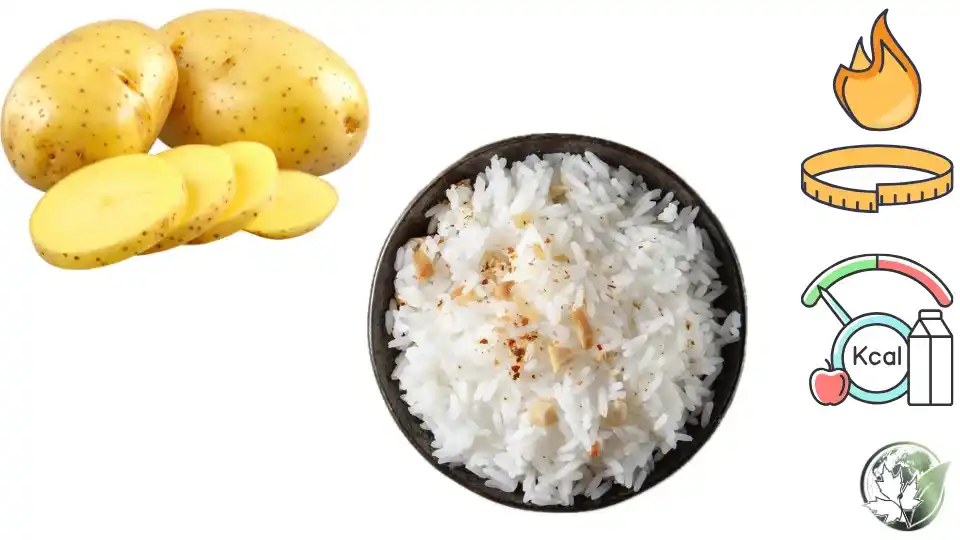
Raw potato has 77 calories per 100 grams. Dry white rice has 365 calories per 100 grams and dry brown rice 370, which makes uncooked rice nearly five times more calorie dense than raw potato by weight. That headline gap is real, but it is also the most misleading number in food comparisons, because rice is never eaten dry. When cooked, rice absorbs about two to three times its weight in water and falls to 130 calories per 100 grams (white) or 123 (brown), while a boiled potato sits at 87. So the correct answer depends on which weight you use: raw, dry or cooked.
This matters when you read labels, follow recipes or log food in a calorie app. Packaged rice lists its calories for the dry grain, and packaged frozen potatoes may list the raw weight, while a plate of food is measured cooked. A mismatch of this kind is one of the most common causes of wrong calorie counts. This guide compares potato and rice per 100 grams raw, dry and cooked, compares white and brown rice, shows how much dry rice makes a cup of cooked rice, and explains which is lighter on your plate. It includes three comparison tables and an FAQ.
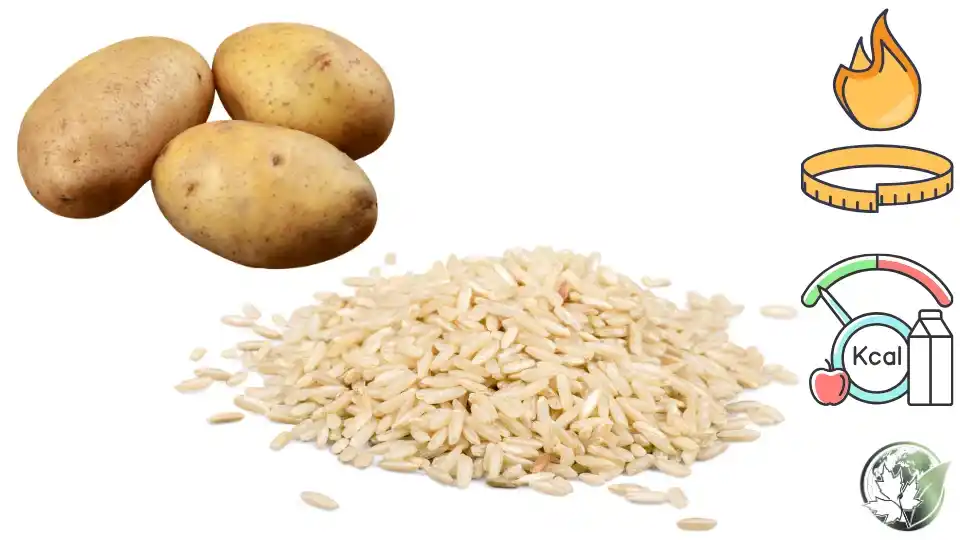
Raw potato has 77 calories per 100 grams and dry rice 365, but rice triples in weight when cooked
How Many Calories Are in Potato and Rice by Raw and Dry Weight?
| Per 100 g | Calories | Carbohydrate | Protein | Fat | Fiber |
|---|---|---|---|---|---|
| Raw potato, with skin | 77 kcal | 17.5 g | 2 g | 0.1 g | 2.2 g |
| Raw potato, peeled | 69 kcal | 15.7 g | 1.7 g | 0.1 g | 2.4 g |
| Dry white rice, long grain | 365 kcal | 80 g | 7.1 g | 0.7 g | 1.3 g |
| Dry brown rice, long grain | 370 kcal | 77 g | 7.9 g | 2.9 g | 3.5 g |
| Dry basmati rice | 349 kcal | 78 g | 8.4 g | 0.6 g | 1.4 g |
| Dry jasmine rice | 360 kcal | 80 g | 7 g | 0.6 g | 1 g |
| Dry wild rice | 357 kcal | 75 g | 14.7 g | 1.1 g | 6.2 g |
By raw and dry weight, rice is far denser than potato. A potato is about 79 percent water before cooking, while dry rice holds only 10 to 12 percent water. That means 100 grams of dry rice has roughly five times the starch of 100 grams of raw potato. The comparison only makes sense when both foods are placed in the same cooked state.
How Many Calories Are in Cooked Potato and Rice per 100 Grams?
| Per 100 g cooked | Calories | Carbohydrate | Protein | Fat | Water |
|---|---|---|---|---|---|
| Boiled potato, with skin | 87 kcal | 20 g | 1.9 g | 0.1 g | 77 g |
| Baked potato, with skin | 93 kcal | 21 g | 2.5 g | 0.1 g | 75 g |
| Mashed potato, with milk and butter | 113 kcal | 17 g | 2 g | 4.2 g | 78 g |
| Cooked white rice | 130 kcal | 28 g | 2.7 g | 0.3 g | 68 g |
| Cooked brown rice | 123 kcal | 25.6 g | 2.7 g | 1 g | 70 g |
| Cooked basmati rice | 121 kcal | 25 g | 3.5 g | 0.4 g | 71 g |
| Cooked wild rice | 101 kcal | 21 g | 4 g | 0.3 g | 74 g |
After cooking, rice drops to roughly one third of its dry calorie density, while potato barely changes. Boiled potato is still the lighter food, but only by 43 calories per 100 grams, not by 288.
Potato vs Rice: Raw, Dry and Cooked Calories Compared
| State | Potato | White rice | Brown rice | Gap (white rice minus potato) |
|---|---|---|---|---|
| Raw / dry, 100 g | 77 kcal | 365 kcal | 370 kcal | +288 kcal |
| Cooked, 100 g | 87 kcal | 130 kcal | 123 kcal | +43 kcal |
| Cooked, 200 g | 174 kcal | 260 kcal | 246 kcal | +86 kcal |
| Cooked, 300 g | 261 kcal | 390 kcal | 369 kcal | +129 kcal |
| Weight for 200 kcal, cooked | 230 g | 154 g | 163 g | Potato 76 g more |
| Calories per cooked cup | 136 (cubed, 156 g) | 205 (158 g) | 216 (195 g) | +69 vs potato |
The practical lesson is simple: always compare cooked with cooked, or raw with raw adjusted for water. If a recipe says "100 g rice" it almost certainly means dry weight, which equals about 280 to 300 grams cooked and around 365 calories. If it says "100 g potato" it means raw or boiled weight, and the calories stay near 77 to 87.
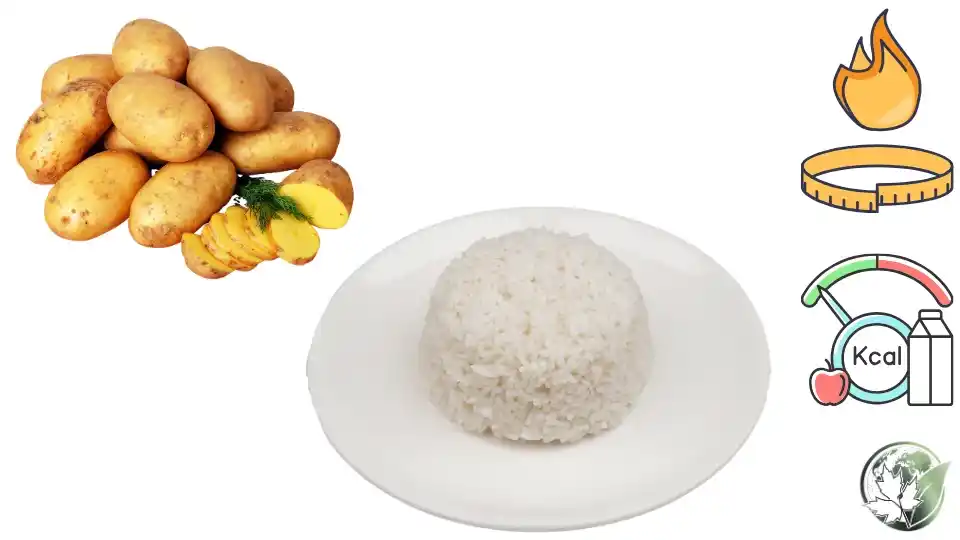
One quarter cup of dry rice makes about three quarters of a cup cooked
How Much Dry Rice Makes a Cup of Cooked Rice?
White rice expands to about 2.8 times its dry weight when boiled in the typical ratio of two parts water to one part rice, and brown rice expands to about 2.5 times. In volume, one cup of dry rice makes about three cups cooked. This conversion lets you log calories correctly either way.
| Dry rice | Dry weight | Calories (dry) | Cooked yield | Cooked weight |
|---|---|---|---|---|
| 1/4 cup white | 46 g | 168 kcal | About 3/4 cup | 130 g |
| 1/3 cup white | 62 g | 226 kcal | About 1 cup | 175 g |
| 1/2 cup white | 92 g | 336 kcal | About 1.5 cups | 260 g |
| 1 cup white | 185 g | 675 kcal | About 3 cups | 520 g |
| 1/4 cup brown | 47 g | 174 kcal | About 3/4 cup | 120 g |
| 1/3 cup brown | 63 g | 233 kcal | About 1 cup | 160 g |
| 1/2 cup brown | 95 g | 352 kcal | About 1.5 cups | 240 g |
A cup of cooked white rice at 205 calories therefore starts from roughly 56 grams (a bit under a third of a cup) of dry grain. A person who measures "one cup of rice" before cooking gets about 675 calories, not 205. This single error can add 470 calories to a meal.
Which Has More Calories: Potato or Rice?
Rice has more calories in every state: raw against dry, cooked against cooked, and cup against typical potato. The gap is largest by dry weight (365 against 77) and smallest in cooked form (130 against 87). By typical servings, a cup of cooked white rice (205) has about 38 percent more calories than a medium boiled potato (148). Rice does have more protein per 100 grams cooked, while potato has far more potassium and some vitamin C.
| Comparison | Potato | Rice | Winner for fewer calories |
|---|---|---|---|
| 100 g raw / dry | 77 | 365 | Potato |
| 100 g cooked | 87 | 130 | Potato |
| Typical serving | 148 (medium) | 205 (cup) | Potato |
| Per 100 calories | 115 g boiled | 77 g cooked | Potato (bigger portion) |
| Protein per 100 kcal | 2.2 g | 2.1 g | About equal |
| Fiber per 100 kcal | 2.1 g | 0.3 g | Potato |
| Potassium per 100 kcal | 435 mg | 27 mg | Potato |
Interestingly, when you compare nutrients per calorie instead of per gram, protein is about equal, because potato protein is concentrated in a low calorie food. Potatoes give you more fiber, potassium and vitamin C for every calorie.
White Rice vs Brown Rice: Is Brown Really Lighter?
Many people assume brown rice has far fewer calories. It does not. Dry brown rice has 370 calories per 100 grams against 365 for white. Cooked, brown rice has 123 against 130, a gap of only 7 calories per 100 grams, because brown rice absorbs a bit more water. What brown rice offers is more fiber (1.6 g against 0.4 g per 100 g cooked), more magnesium and manganese, and a lower glycemic index. For weight control, the calorie difference is negligible, but the extra fiber may help fullness.
| Per 100 g cooked | White rice | Brown rice | Wild rice | Boiled potato |
|---|---|---|---|---|
| Calories | 130 | 123 | 101 | 87 |
| Fiber | 0.4 g | 1.6 g | 1.8 g | 1.8 g |
| Magnesium | 12 mg | 44 mg | 32 mg | 22 mg |
| Potassium | 35 mg | 86 mg | 101 mg | 379 mg |
| Glycemic index | 65-73 | 50-55 | 45 | 78 |
| Cost | Low | Medium | High | Low |
If your main goal is calories, wild rice and potato are the lightest choices, white and brown rice are about the same, and portion size matters more than the type.
Which Is More Filling per Calorie?
Because potato has fewer calories per gram, you get a larger plate for the same energy. 200 calories of boiled potato weighs 230 grams, about one large potato, while 200 calories of cooked white rice weighs 154 grams, roughly one cup. Satiety research found that boiled potatoes scored about 323 on an index where white bread is 100, compared with 138 for white rice and 132 for brown rice. In other words, potatoes tend to leave people fuller on fewer calories.
| Food | Weight for 200 kcal | Satiety index (white bread = 100) |
|---|---|---|
| Boiled potato | 230 g | 323 |
| Cooked wild rice | 198 g | Not ranked |
| Cooked brown rice | 163 g | 132 |
| Cooked white rice | 154 g | 138 |
| Pasta, white, cooked | 127 g | 119 |
| White bread | 75 g | 100 |
Pairing rice or potato with protein and vegetables builds a balanced and filling plate
How Do Fried Forms Change the Comparison?
Fried potato products and fried rice reverse the picture. French fries have 312 calories per 100 grams and potato chips 536, which exceeds the calorie density of dry rice. Fried rice made with oil and egg has about 163 calories per 100 grams, and restaurant versions can reach 190. A medium order of fries (117 g) has 365 calories, while a plate of fried rice (250 g) holds around 410. So frying matters more than the choice between the two starches.
| Prepared form (100 g) | Calories | Compared with boiled potato (87) |
|---|---|---|
| Boiled potato | 87 | Baseline |
| Baked potato | 93 | +6 |
| Plain cooked white rice | 130 | +43 |
| Fried rice | 163 | +76 |
| Oven roasted potato with oil | 150 | +63 |
| Mashed potato with butter | 113 | +26 |
| Hash browns | 265 | +178 |
| French fries | 312 | +225 |
| Potato chips | 536 | +449 |
| Rice cakes (puffed) | 387 | +300 |
If you want the lowest calories, boil, bake or steam either food and flavor it with herbs, lemon, spices or a little yogurt, instead of frying.
Should You Weigh Potatoes and Rice Raw or Cooked?
For accurate tracking, weigh rice dry before cooking if you cook one batch for one person, and weigh potato raw or boiled using the matching database entry. If you cook a large batch of rice and eat part of it later, weigh the cooked portion and use the cooked value of 130 calories per 100 grams. Never mix a dry-weight entry with a cooked-weight amount. Many apps list "rice" without saying which state it covers, so check the grams of carbohydrate. Dry rice shows about 80 grams of carbohydrate per 100 grams, and cooked rice about 28.
| Situation | Best method | Entry to use |
|---|---|---|
| Cooking one portion of rice | Weigh dry rice | 365 kcal/100 g dry |
| Eating from a family pot of rice | Weigh cooked portion | 130 kcal/100 g cooked |
| Boiled potatoes | Weigh cooked or raw | 87 or 77 kcal/100 g |
| Restaurant rice | Estimate in cups | About 205 kcal per cup |
| Meal prep containers | Weigh cooked | Match the cooked entry |
| Packaged microwave rice | Read the label | Often cooked weight |
Does the Way You Cook Rice Change Its Calories?
Yes, slightly. Rice cooked by absorption (the kateh method, or a rice cooker) keeps all of its starch, so the cooked value of about 130 calories per 100 grams applies. Rice that is boiled in a large pot of water and drained (the method used for Persian chelow, called abkesh) loses a small amount of starch to the cooking water. Research on rice boiled in excess water and drained suggests a loss of some starch and also some water-soluble minerals, but the calorie difference is small, usually 5 to 10 percent. Rinsing rice before cooking removes surface starch, which changes the texture more than the calories.
| Cooking method | Approximate calories per 100 g cooked | Notes |
|---|---|---|
| Absorption (rice cooker, kateh) | 130 | All starch retained |
| Boiled in excess water and drained | 120-128 | Small starch loss |
| Rinsed, then absorption | 128-130 | Texture is less sticky |
| Cooked with 1 tsp oil per cup | 143-150 | Adds about 40 kcal per cup |
| Cooked with butter and saffron (chelow) | 150-165 | Depends on the butter |
| Cooked, cooled, then reheated | 125-130 | Some starch becomes resistant |
| Pilaf with oil and onions | 160-180 | Fat raises density |
Potatoes behave differently. Boiling leaches a little potassium and vitamin C into the water, but the calories stay about the same. Baking concentrates the potato slightly as water evaporates, which is why a baked potato has 93 calories per 100 grams against 87 for boiled.
What Do Potatoes and Rice Cost per 100 Calories?
Both foods are among the cheapest sources of energy, which is part of why they are staples in so many cuisines. Per calorie, rice is usually cheaper than potato, because dry rice is dense and stores for years. Potatoes are cheaper per kilogram but heavy and watery, so the cost per calorie is higher. Prices vary widely by country, season and brand, so use the table below only as a rough guide to the pattern: dry rice delivers the most calories per unit of weight, and potato the fewest.
| Food | Calories per 1 kg (as sold) | Weight needed for 2,000 kcal |
|---|---|---|
| Dry white rice | 3,650 | About 550 g |
| Dry brown rice | 3,700 | About 540 g |
| Raw potato | 770 | About 2.6 kg |
| Pasta, dry | 3,710 | About 540 g |
| Bread, white | 2,650 | About 755 g |
| Oats, dry | 3,890 | About 515 g |
This weight difference is why rice is easier to transport and store, and why potatoes, though cheaper to grow per acre in terms of total calories produced, are bulkier to eat. It also explains why potatoes feel more filling: you have to eat more of them to reach the same energy.
How Do Potatoes and Rice Compare in Vitamins and Minerals?
Potatoes with skin are a surprisingly nutrient-rich food. A medium baked potato supplies about 28 percent of the daily value of vitamin C, 27 percent of vitamin B6 and 26 percent of potassium (more than a banana). Cooked white rice is often enriched with iron and B vitamins, such as folic acid, thiamin and niacin, depending on the country, but it provides little potassium or vitamin C. Brown rice contributes more magnesium, phosphorus, manganese and selenium. Neither is a complete food, but both fit well into a balanced diet alongside vegetables and protein.
| Per 1 cup cooked (or medium potato) | Medium baked potato (173 g) | White rice (158 g) | Brown rice (195 g) |
|---|---|---|---|
| Calories | 161 | 205 | 216 |
| Potassium | 926 mg | 55 mg | 84 mg |
| Vitamin C | 17 mg | 0 mg | 0 mg |
| Vitamin B6 | 0.5 mg | 0.1 mg | 0.3 mg |
| Magnesium | 48 mg | 19 mg | 86 mg |
| Folate | 48 mcg | 91 mcg (enriched) | 8 mcg |
| Iron | 1.9 mg | 1.9 mg (enriched) | 0.8 mg |
| Fiber | 3.8 g | 0.6 g | 3.5 g |
| Protein | 4.3 g | 4.3 g | 5 g |
Per serving, the baked potato gives 161 calories with the highest potassium and vitamin C. Brown rice supplies the most magnesium. White rice, if enriched, gives the most folate. The best strategy for micronutrients is variety rather than a single winner.
Which Is Better for Athletes, Children and Older Adults?
Different life stages value different qualities. Endurance athletes often prefer white rice before and during long efforts because it is easy to digest, low in fiber and compact in calories. Strength athletes in a bulking phase use rice to reach calorie targets without feeling overly full. Athletes cutting weight often prefer potatoes for volume and fullness. Children can eat either, but should get whole grains and vegetables as part of the day. Older adults who struggle to eat enough may benefit from the compact calories of rice or mashed potato made with milk, while those managing weight or blood pressure may prefer potatoes with skin for the potassium.
| Group | Suggested choice | Reason |
|---|---|---|
| Endurance athlete | White rice | Quick energy, easy digestion |
| Athlete cutting weight | Boiled potato | Fullness at low calories |
| Bulking athlete | Rice, 1.5 to 2 cups cooked | Compact calories |
| Child (3-10 years) | Either, 1/3 to 1/2 cup rice or small potato | Gentle on digestion |
| Older adult with low appetite | Mashed potato or rice with oil | Calorie dense, soft |
| Person with high blood pressure | Potato with skin | Potassium supports blood pressure |
| Person with diabetes | Cooled potato or basmati, small portion | Lower glycemic response |
Sample Day: Swapping Rice for Potato in a 1,800 Calorie Plan
Suppose a person eats rice at both lunch and dinner, one cup each, for 410 calories. Replacing one meal with a medium boiled potato and a half cup of rice at the other cuts the starch to 148 + 103 = 251 calories, saving 159 calories a day. Over a week, that is 1,113 calories, and over a year more than 58,000. It would not be wise to cut starch entirely, since both foods supply energy and nutrients, but a smart rotation keeps meals interesting and calories in check.
| Meal plan | Lunch starch | Dinner starch | Daily starch calories |
|---|---|---|---|
| Rice at both meals | 1 cup rice (205) | 1 cup rice (205) | 410 |
| One potato, one rice | 1 medium potato (148) | 1/2 cup rice (103) | 251 |
| Two potatoes | 1 medium potato (148) | 1 medium potato (148) | 296 |
| Rice and brown rice mix | 1/2 cup white (103) | 1/2 cup brown (108) | 211 |
| Cooled potato salad (no mayo) and rice | 1 cup cubed potato (136) | 3/4 cup rice (153) | 289 |
These examples assume the starches are boiled or steamed. A swap that adds fries or butter would erase the saving.
Key Takeaways: Potato vs Rice Calories
Raw potato has 77 calories per 100 grams, while dry white rice has 365 and dry brown rice 370. Cooked, boiled potato has 87 and cooked rice 130 (white) or 123 (brown). Rice multiplies its weight by two to three times when cooked, so always compare like with like. Potato is lighter and more filling per calorie, and brown rice is no lower in calories than white. Frying changes everything: fries have 312 calories per 100 grams.
Frequently Asked Questions
6 questions answered
How many calories are in 100 grams of raw potato?
About 77 calories with skin and 69 peeled.
How many calories are in 100 grams of dry rice?
About 365 for white and 370 for brown.
How much dry rice makes one cup cooked?
About 56 grams, or roughly a third of a cup.
Is brown rice lower in calories than white rice?
Barely: 123 against 130 per 100 g cooked.
Which is better for weight loss, potato or rice?
Boiled potato, thanks to lower calorie density and higher fullness.
Should I weigh rice before or after cooking?
Either, as long as you use the matching calorie entry.