How Many Calories Are in Mazafati Dates vs Sugar? The Quick Answer
One Mazafati date weighs about 10 grams and has around 27 calories. One level teaspoon of granulated sugar weighs 4 grams and has 16 calories. By weight, dates are lower: 100 grams of Mazafati dates have about 270 calories, while 100 grams of white sugar has 387. That is roughly 30 percent fewer calories in dates for the same weight. But the comparison depends on how you use them. Dates are only about 60 percent sugar, and the rest is fiber, water and minerals, so a date is less concentrated than a spoon of sugar. A date is also not as sweet per gram as sugar, so it often takes more dates than spoons to sweeten a recipe.
People compare dates and sugar because dates are promoted as a natural sweetener. In tea, in baking, in smoothies, in energy balls and in desserts, date paste is used in place of granulated sugar. This guide compares the two by the piece, by the spoon and by 100 grams, looks at fiber, minerals and glycemic index, explains how much date paste replaces a cup of sugar, and finishes with an FAQ. Three comparison tables help you decide when dates are truly the better pick and when they are only a different way to eat sugar.
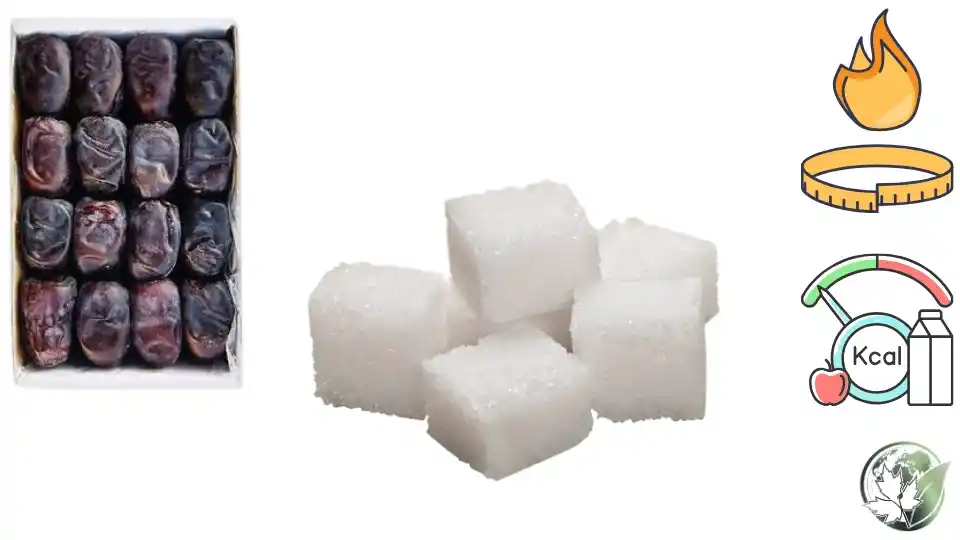
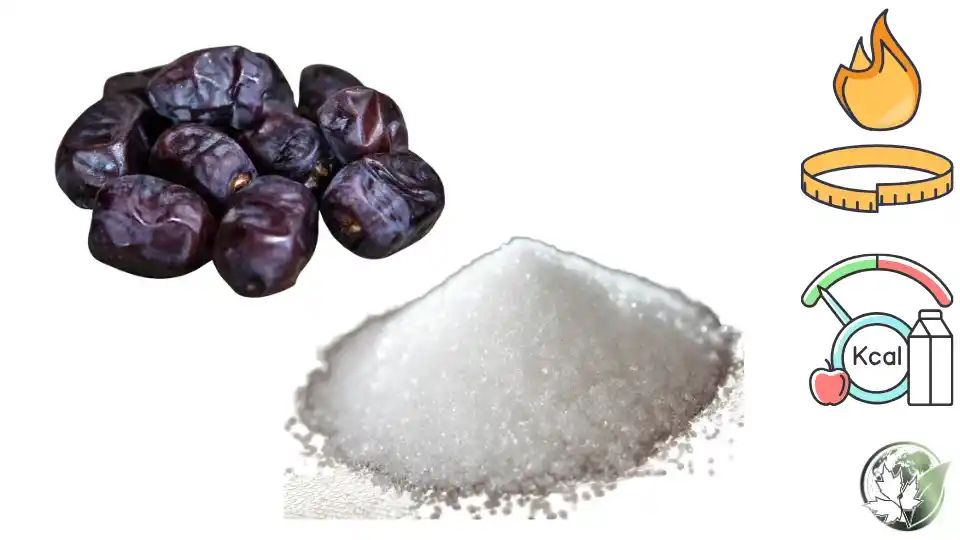
A teaspoon of sugar has 16 calories, and one Mazafati date has about 27
How Many Calories Are in Mazafati Dates?
| Mazafati dates | Weight | Calories | Sugar | Fiber |
|---|---|---|---|---|
| 1 date | 10 g | 27 kcal | 6 g | 0.7 g |
| 2 dates | 20 g | 54 kcal | 12 g | 1.4 g |
| 3 dates | 30 g | 81 kcal | 18 g | 2.1 g |
| 5 dates | 50 g | 135 kcal | 30 g | 3.5 g |
| 7 dates | 70 g | 189 kcal | 42 g | 4.9 g |
| 10 dates | 100 g | 270 kcal | 60 g | 7 g |
| 1/2 cup pitted | 74 g | 200 kcal | 44 g | 5.2 g |
| 1 cup date paste | 270 g | 730 kcal | 162 g | 19 g |
How Many Calories Are in Granulated Sugar?
| Granulated sugar | Weight | Calories | Sugar |
|---|---|---|---|
| 1 teaspoon | 4 g | 16 kcal | 4 g |
| 2 teaspoons | 8 g | 31 kcal | 8 g |
| 1 tablespoon | 12.6 g | 49 kcal | 12.6 g |
| 1 sugar cube | 4 g | 16 kcal | 4 g |
| 1/4 cup | 50 g | 194 kcal | 50 g |
| 1/2 cup | 100 g | 387 kcal | 100 g |
| 1 cup | 200 g | 774 kcal | 200 g |
| 1 kg | 1,000 g | 3,870 kcal | 1,000 g |
Mazafati Dates vs Sugar: Calories Compared
| Amount | Mazafati dates | Granulated sugar | Difference |
|---|---|---|---|
| 1 piece / spoon | 27 kcal (1 date) | 16 kcal (1 tsp) | Different sizes |
| 4 g | 11 kcal | 16 kcal | Dates -5 |
| 10 g | 27 kcal | 39 kcal | Dates -12 |
| 30 g | 81 kcal | 116 kcal | Dates -35 |
| 50 g | 135 kcal | 194 kcal | Dates -59 |
| 100 g | 270 kcal | 387 kcal | Dates -117 |
| Sugar grams per 100 g | 60 g | 100 g | Dates -40% |
| Calories per 1 g sugar | 4.5 kcal | 3.9 kcal | Sugar lower |
Per gram of food, dates are clearly lighter. Per gram of sugar contained, they are slightly higher, because the rest of the date adds some fiber and protein calories. The practical meaning is that replacing 1 teaspoon of sugar (16 calories) with a date (27 calories) usually adds calories unless you cut the amount of sweetener.
Mazafati Dates vs Sugar: Nutrition Compared
| Per 100 g | Mazafati dates | Granulated sugar |
|---|---|---|
| Calories | 270 kcal | 387 kcal |
| Carbohydrate | 71 g | 100 g |
| Sugar | 60 g | 100 g |
| Fiber | 7 g | 0 g |
| Protein | 2.1 g | 0 g |
| Fat | 0.2 g | 0 g |
| Potassium | 650 mg | 2 mg |
| Magnesium | 54 mg | 0 mg |
| Calcium | 60 mg | 1 mg |
| Iron | 1 mg | 0.1 mg |
| Antioxidants | Polyphenols, carotenoids | None |
| Glycemic index | 42-55 | 65 |
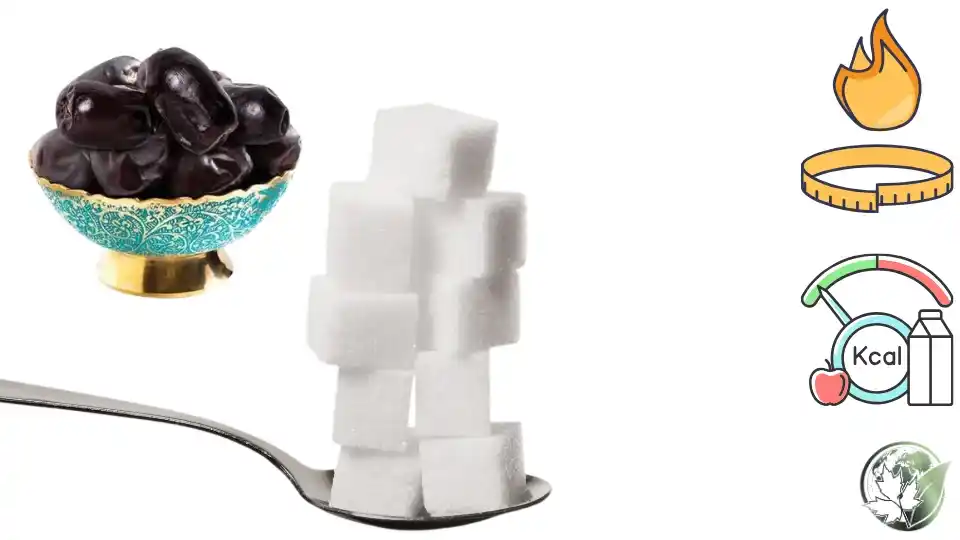
Dates provide fiber, potassium, magnesium and antioxidants, while sugar provides only calories
Which Has More Calories: Mazafati Dates or Sugar?
Sugar has more calories per gram: 3.87 per gram versus 2.7 for dates. Yet a single date has more than a teaspoon of sugar, because a date weighs more. If you sweeten tea with a sugar cube (16 calories) and switch to half a date (13 calories), you save 3 calories. If you switch to one whole date (27 calories), you add 11. The fair comparison is by sweetness, not weight, and dates are less sweet than refined sugar.
| Sweetness equivalent | Sugar | Dates | Calories |
|---|---|---|---|
| Sweeten 1 cup of tea | 1 tsp (4 g), 16 kcal | 1/2 date (5 g), 13 kcal | Dates -3 |
| Sweeten 1 cup of coffee | 2 tsp (8 g), 31 kcal | 1 date (10 g), 27 kcal | Dates -4 |
| Sweeten oatmeal | 1 tbsp (12.6 g), 49 kcal | 2 dates (20 g), 54 kcal | Dates +5 |
| Sweeten a smoothie | 1 tbsp, 49 kcal | 2 dates, 54 kcal | Dates +5 |
| 1 cup in baking | 774 kcal | 1 cup paste, 730 kcal | Dates -44 |
Are Mazafati Dates Really Better Than Sugar?
Nutritionally, yes, in most respects. Dates provide fiber, which slows digestion, plus potassium, magnesium, calcium, iron, vitamin B6 and antioxidants such as phenolic acids and flavonoids. Sugar offers none of these. Dates also have a lower glycemic index (42 to 55 versus 65 for table sugar), so they raise blood sugar more slowly. But dates are still concentrated sugar, mostly fructose and glucose, and they stick to teeth. They are better than sugar, not a free food, and eating many dates adds up to as much sugar as a sweet treat.
| Factor | Mazafati dates | White sugar |
|---|---|---|
| Fiber | 7 g per 100 g | None |
| Minerals | Potassium, magnesium, calcium | Almost none |
| Glycemic index | 42-55 | 65 |
| Sweetness | Medium-high | Highest |
| Processing | Whole fruit | Refined |
| Tooth stickiness | High | Moderate |
| Calories per gram | 2.7 | 3.9 |
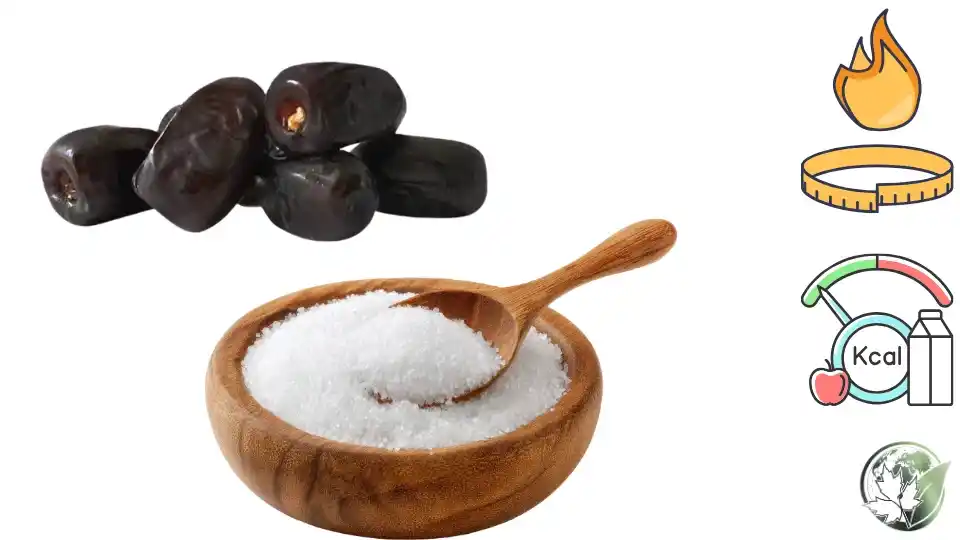
Date paste replaces sugar in baking at about 1 to 1, but adds moisture and fiber
How Much Date Paste Replaces Sugar in a Recipe?
Date paste is made by blending pitted dates with warm water until smooth. A common swap is to use the same amount of date paste as sugar, then reduce another liquid in the recipe by a quarter, since paste contains water. Because dates are about 60 percent sugar, a cup of paste is less sweet than a cup of sugar, so some cooks use 3/4 as much sugar-equivalent and accept a milder sweetness. Date paste also adds a brown color and a caramel flavor, making it best for brownies, muffins, oatmeal cookies and sauces.
| Sugar in recipe | Date paste to use | Calories saved |
|---|---|---|
| 1 tbsp (49 kcal) | 1 tbsp paste (45 kcal) | 4 |
| 1/4 cup (194 kcal) | 1/4 cup paste (183 kcal) | 11 |
| 1/2 cup (387 kcal) | 1/2 cup paste (365 kcal) | 22 |
| 1 cup (774 kcal) | 1 cup paste (730 kcal) | 44 |
| 1 cup (774 kcal) | 3/4 cup paste (548 kcal) | 226 |
How Do Dates and Sugar Affect Blood Sugar?
Table sugar is half glucose and half fructose and has a glycemic index of about 65. Dates have a glycemic index between 42 and 55 depending on the variety, ripeness and study, which places them in the low to medium range. A 30 gram serving of Mazafati dates has a glycemic load of about 9, while a 30 gram portion of sugar has a glycemic load of 19. The fiber and polyphenols in dates slow absorption. For people with diabetes, a small number of dates eaten with nuts is a better choice than sugar, but portions still need to be limited.
| Measure (30 g) | Mazafati dates | Sugar |
|---|---|---|
| Glycemic index | 42-55 | 65 |
| Glycemic load | About 9 | About 19 |
| Carbohydrate | 21 g | 30 g |
| Blood sugar peak | Slower | Faster |
| Fullness | Moderate (fiber) | None |
Do Dates Count as Added Sugar?
Whole dates are not classified as added sugar because the sugar is naturally part of the fruit. Date paste, date syrup and date sugar made from blended or processed dates, when added to foods, are counted as added sugar on the Nutrition Facts label in the United States. The American Heart Association recommends no more than 25 grams of added sugar per day for women and 36 grams for men. Eating three whole dates gives you 18 grams of natural sugar, which does not count toward that limit, but the body processes the sugar in a similar way.
| Form | Added sugar label? | Sugar per tbsp |
|---|---|---|
| Whole dates | No | About 8 g (1.5 dates) |
| Date paste | Yes, in recipes | 10 g |
| Date syrup | Yes | 14 g |
| Date sugar (ground) | Yes | 12 g |
| White sugar | Yes | 12.6 g |
How Many Dates Equal a Teaspoon of Sugar?
To match the sweetness of 1 teaspoon of granulated sugar (4 grams of sugar), you need around 7 grams of Mazafati dates, which is 0.7 of a date, because a date is 60 percent sugar. In practice, that is a little more than half a date. Two teaspoons are equivalent to one and a half dates. This is a handy way to cut the quantity of sweetener while gaining fiber.
| Sugar | Dates for the same sugar | Calories (dates) | Calories (sugar) |
|---|---|---|---|
| 1 tsp (4 g) | 0.7 date (7 g) | 19 kcal | 16 kcal |
| 2 tsp (8 g) | 1.3 dates (13 g) | 36 kcal | 31 kcal |
| 1 tbsp (12.6 g) | 2.1 dates (21 g) | 57 kcal | 49 kcal |
| 1/4 cup (50 g) | 8.3 dates (83 g) | 224 kcal | 194 kcal |
Matching the sugar content therefore costs slightly more calories with dates, as dates contain additional carbohydrate and protein. The benefit lies in fiber and minerals, not in lower calories.
What About Dates in Tea and Coffee?
In Iranian tradition, tea is often taken with a date or a sugar cube held between the teeth. Eating one Mazafati date with a cup of unsweetened tea gives about 27 calories and 6 grams of sugar, which is about 1.5 sugar cubes. Many people use one or two cubes per cup (16 to 32 calories) and add more through the day. Switching to a date lowers the sugar a little, adds fiber and slows the sweet hit.
| Habit | Calories | Sugar | Notes |
|---|---|---|---|
| Tea with 2 sugar cubes | 32 kcal | 8 g | No fiber |
| Tea with 1 date | 27 kcal | 6 g | 0.7 g fiber |
| Tea with half a date + 1 cube | 29 kcal | 7 g | Mixed |
| 4 cups tea with 2 cubes each | 128 kcal | 32 g | Adds up |
| 4 cups tea with 1 date each | 108 kcal | 24 g | Lower |
Which Should You Choose?
Choose dates when you want sweetness along with fiber, minerals and a lower glycemic impact, such as in oatmeal, smoothies, energy bars and baking. Choose sugar in small amounts when you need pure sweetness, a neutral color or a specific texture, such as in meringue or clear syrups. The healthiest approach is to reduce overall sweetener, not just swap sources. A single date at the end of a meal can satisfy a sweet craving with about 27 calories.
| Goal | Better choice | Reason |
|---|---|---|
| Fewest calories per weight | Dates | 270 vs 387 per 100 g |
| Fiber and minerals | Dates | 7 g fiber, potassium |
| Lowest glycemic impact | Dates | GI 42-55 vs 65 |
| Neutral flavor | Sugar | No color or taste |
| Strongest sweetness per gram | Sugar | 100% sugar |
| Baking moisture | Dates | Paste holds water |
| Tooth health | Neither | Both are sticky or sugary |
How Many Calories Do You Save by Replacing Sugar With Dates Over a Year?
Small daily swaps add up over time, but only if the replacement is smaller than the original. Take a person who adds two teaspoons of sugar (31 calories) to three cups of tea a day. That is 93 calories and 24 grams of sugar daily, or roughly 34,000 calories a year, equal to about 4.4 kilograms of body fat. If the same person drinks the tea unsweetened and eats one date (27 calories) after dinner, the yearly total falls to about 9,800 calories. The saving comes from using less sweetener overall, not from the date itself being magic.
| Daily habit | Calories per day | Calories per year | Sugar per day |
|---|---|---|---|
| 3 cups tea, 2 tsp sugar each | 93 kcal | 33,900 kcal | 24 g |
| 3 cups tea, 1 tsp sugar each | 48 kcal | 17,500 kcal | 12 g |
| 3 cups tea, 1 date total | 27 kcal | 9,900 kcal | 6 g |
| 3 cups tea, 1 date in each | 81 kcal | 29,600 kcal | 18 g |
| 3 cups unsweetened tea | 0 kcal | 0 kcal | 0 g |
The table shows why the best result comes from cutting the quantity. Putting a date in every cup saves little compared with one teaspoon of sugar, because each date is bigger than a spoon.
How Does Sugar Compare With Other Sweeteners Used in Persian Cooking?
Sugar sits at the top of the calorie range for sweeteners, with honey, date syrup (rob-e khorma), grape molasses and sugar cubes close behind. Date syrup is made by boiling dates and straining them, and it is more concentrated than whole dates, with about 300 calories per 100 grams. Because it is syrup, it has no fiber. Whole dates are the only form in this list that keeps the fruit's fiber intact.
| Sweetener | Calories per tbsp | Calories per 100 g | Sugar per tbsp |
|---|---|---|---|
| Granulated sugar | 49 | 387 | 12.6 g |
| Honey | 64 | 304 | 17 g |
| Date syrup | 62 | 300 | 15 g |
| Grape molasses | 58 | 290 | 14 g |
| Date paste | 45 | 270 | 10 g |
| Brown sugar (packed) | 52 | 380 | 13.4 g |
| Maple syrup | 52 | 260 | 12.1 g |
Can Dates Be Used in Place of Sugar in Persian Desserts?
Many traditional sweets already use dates: ranginak (dates stuffed into pastry and covered with walnuts), halva made with date paste, and date and walnut rolls. Sugar-based sweets such as sohan, gaz and sugar syrup in zoolbia and bamieh can be made with dates only in modified versions. Dates work best where a brown color and soft texture are fine. They do not work in clear syrups, in candy that needs crystallizing, or in light batters where a dark color would show.
| Dessert | Sugar version | Date version | Calories saved |
|---|---|---|---|
| Ranginak (1 piece) | 210 kcal | 190 kcal | 20 |
| Halva (1 serving) | 260 kcal | 230 kcal | 30 |
| Oatmeal cookie | 120 kcal | 105 kcal | 15 |
| Brownie | 240 kcal | 215 kcal | 25 |
| Tea cake slice | 190 kcal | 175 kcal | 15 |
| Zoolbia (3 pieces) | 280 kcal | Not suitable | - |
What Are the Dental Effects of Dates and Sugar?
Both dates and sugar feed the bacteria that produce acid and cause cavities. Dates are sticky and stay on the teeth longer than granulated sugar, which dissolves quickly in the mouth or in tea. Rinsing with water after eating dates and brushing within an hour reduces the risk. A sugar cube held in the mouth during tea sipping bathes the teeth in sugar for a long time. Neither is better for teeth, so frequency matters more than the source.
| Factor | Dates | Sugar |
|---|---|---|
| Stickiness | High | Low to moderate |
| Time on teeth | Long | Short (dissolves) |
| Fiber (cleaning effect) | Slight | None |
| Acid production | High | High |
| Best habit | Eat with a meal, rinse | Limit tea sipping with cubes |
Which Is Better for Children?
Children over one year can eat dates, cut into small pieces and pitted to avoid choking. A single date gives 27 calories and some fiber, potassium and magnesium, while a spoon of sugar gives only calories. For toddlers, health organizations advise limiting added sugars; whole dates can be part of a balanced snack when offered with milk or nuts (for older children). Avoid giving a whole sticky date to a toddler, and teach children to brush after sweet snacks.
| Age | Dates per day | Calories | Notes |
|---|---|---|---|
| 1-3 years | 1 (chopped, pitted) | 27 kcal | Risk of choking if whole |
| 4-8 years | 1-2 | 27-54 kcal | Brush after eating |
| 9-13 years | 2-3 | 54-81 kcal | Snack with nuts |
| Teenagers | 3-4 | 81-108 kcal | Pre-sport energy |
| Adults | 2-3 | 54-81 kcal | Usual serving |
How Can You Reduce Sugar Without Losing Sweetness?
Sweetness is a habit, and taste buds adapt in two to three weeks. Reduce the sugar in tea by a quarter each week. Use ripe fruit, cinnamon, cardamom or vanilla to give the impression of sweetness. Pair a date with a bitter or salty food such as walnuts or cheese, which makes it taste sweeter, so you need less. In baking, cut the recipe's sugar by a third; most cakes and cookies work fine. Switch drinks like soft drinks (a 330 milliliter can contains 35 grams of sugar, which equals 9 sugar cubes) to water, sparkling water or unsweetened tea.
| Step | Calories saved per day | Sugar saved |
|---|---|---|
| Cut tea sugar by half (3 cups) | 46 kcal | 12 g |
| Replace one soft drink with water | 140 kcal | 35 g |
| Reduce baking sugar by a third | 25 kcal per serving | 6 g |
| Use 1 date instead of 2 cubes | 5 kcal | 2 g |
| Skip sugar in coffee (2 cups) | 62 kcal | 16 g |
How Do You Store Dates and Sugar So They Stay Fresh?
Sugar keeps almost forever when stored in a dry, sealed container, because it has no water for microbes to use. Mazafati dates are different. They are soft and moist, with about 23 percent water, so they ferment or mold if kept warm. Store them in an airtight container in the refrigerator, where they stay good for six months to a year, or freeze them for longer. White crystals on the surface are usually sugar that has risen to the skin and are harmless, but a sour smell means the dates have spoiled.
| Storage | Dates | Sugar |
|---|---|---|
| Room temperature | 1-2 months | Years |
| Refrigerator | 6-12 months | Not needed |
| Freezer | 12+ months | Not needed |
| Main risk | Fermentation, mold, insects | Clumping from moisture |
| Sign of spoilage | Sour smell, bubbles | Hard lumps (still safe) |
What Should You Remember When Counting Calories?
When logging food, weigh dates without the pit, because the pit is inedible and adds about 1 gram per date. A date listed at 10 grams with the pit has about 9 grams of flesh and 24 calories. Level spoons of sugar are more accurate than heaped ones: a heaped teaspoon can hold 6 grams (23 calories) instead of 4 grams. Using a kitchen scale removes the guesswork for both foods.
| Measuring tip | Why it matters | Calorie difference |
|---|---|---|
| Remove the pit | Pit has no calories | 3 kcal per date |
| Level the teaspoon | Heaped holds 50% more | 7 kcal per spoon |
| Weigh paste | Cup size varies | Up to 50 kcal |
| Count cubes | Cube is a fixed 4 g | None |
Final Comparison: Dates vs Sugar at a Glance
| Question | Mazafati dates | Sugar |
|---|---|---|
| Calories per 100 g | 270 | 387 |
| Calories per piece or spoon | 27 per date | 16 per tsp |
| Fiber | 7 g per 100 g | 0 |
| Glycemic index | 42-55 | 65 |
| Minerals | Yes | No |
| Best use | Snacks, baking, smoothies | Precise sweetness |
| Overall | Better quality, same caution | Calories only |
Key Takeaways: Mazafati Dates vs Sugar Calories
One Mazafati date has about 27 calories and a teaspoon of sugar about 16. Per 100 grams, dates have 270 calories and sugar 387. Dates add fiber, potassium and magnesium and have a lower glycemic index, but they are still concentrated sugar, so keep to two or three a day.
Frequently Asked Questions
6 questions answered
How many calories are in one Mazafati date?
About 27.
Do dates have fewer calories than sugar?
Yes by weight, 270 against 387 per 100 grams.
How many dates equal a teaspoon of sugar?
About 0.7 of a date.
Are dates healthier than sugar?
Mostly, thanks to fiber and minerals.
Can diabetics eat dates instead of sugar?
In small portions with protein, after medical advice.
Does date paste count as added sugar?
Yes, when added to foods.