How Many Calories Are in Honey vs Sugar? The Quick Answer
One teaspoon of honey (7 grams) has about 21 calories, and one teaspoon of white sugar (4.2 grams) has about 16. One tablespoon of honey (21 grams) has 64 calories and one tablespoon of sugar (12.5 grams) has 48. So by spoon, honey has about 30 percent more calories than sugar. By weight, though, honey is lower: 304 calories per 100 grams against 387 for sugar, because honey contains about 17 percent water. The reason for the spoon difference is that honey is dense and heavy, so a spoonful weighs far more than a spoonful of sugar crystals.
Honey is also sweeter than sugar, mainly due to its high fructose content, so you can use a little less. In practice, replacing one tablespoon of sugar (48 calories) with two teaspoons of honey (42 calories) gives similar sweetness for slightly fewer calories. Honey has traces of antioxidants, enzymes and minerals, but its nutritional advantage is small. This guide compares honey and sugar by teaspoon, tablespoon, cup and 100 grams, looks at glycemic index, nutrients and uses, and explains how to substitute one for the other, with three comparison tables and an FAQ.
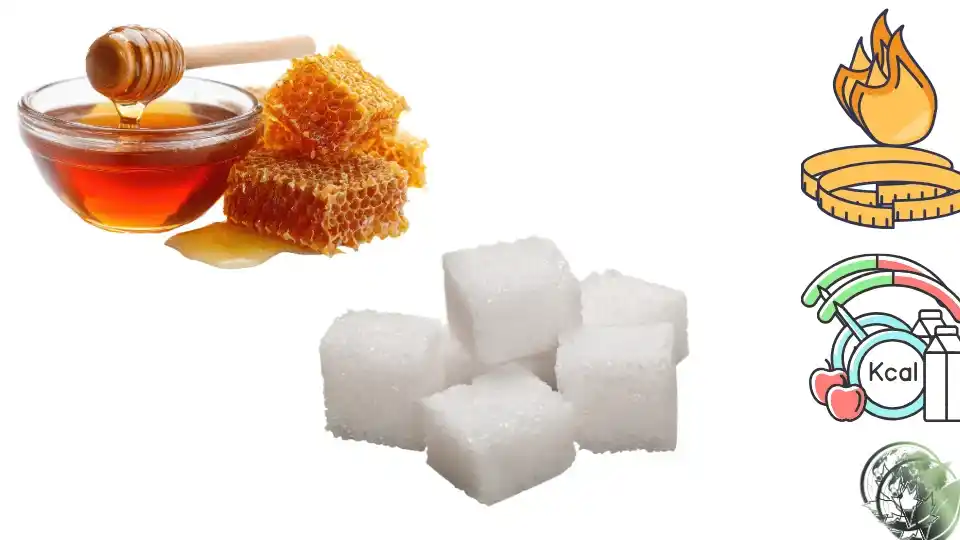
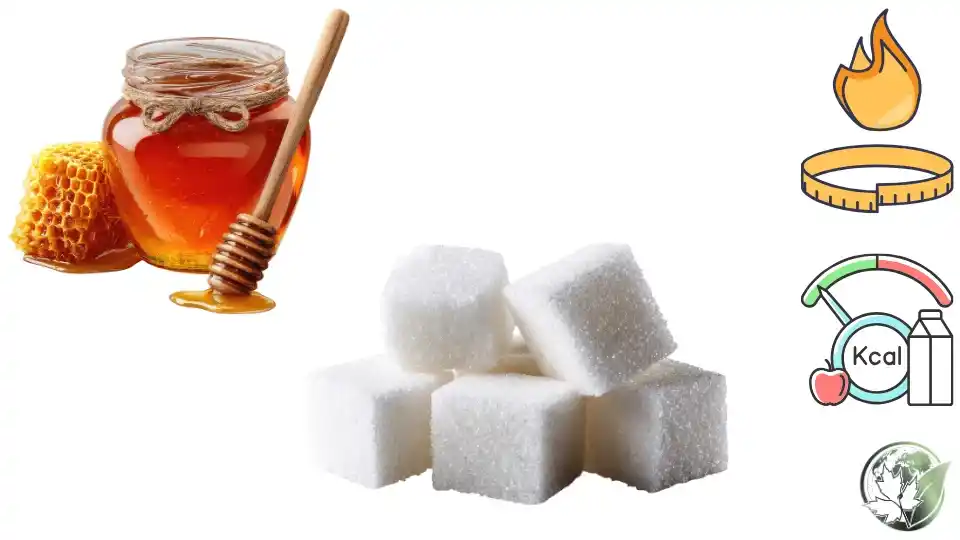
A teaspoon of honey weighs 7 grams and has 21 calories, a teaspoon of sugar weighs 4 grams and has 16
How Many Calories Are in Honey?
| Honey | Weight | Calories | Sugar |
|---|---|---|---|
| 1 teaspoon | 7 g | 21 kcal | 5.7 g |
| 1 tablespoon | 21 g | 64 kcal | 17.3 g |
| 2 tablespoons | 42 g | 128 kcal | 34.6 g |
| 1/4 cup | 84 g | 255 kcal | 69 g |
| 1/2 cup | 170 g | 515 kcal | 140 g |
| 1 cup | 339 g | 1,031 kcal | 280 g |
| 100 g | 100 g | 304 kcal | 82 g |
| 1 honey stick | 5 g | 15 kcal | 4 g |
| Honey in tea (1 tsp) | 7 g | 21 kcal | 5.7 g |
How Many Calories Are in Sugar?
| Sugar | Weight | Calories | Sugar |
|---|---|---|---|
| 1 teaspoon | 4.2 g | 16 kcal | 4.2 g |
| 1 tablespoon | 12.5 g | 48 kcal | 12.5 g |
| 2 tablespoons | 25 g | 97 kcal | 25 g |
| 1/4 cup | 50 g | 194 kcal | 50 g |
| 1/2 cup | 100 g | 387 kcal | 100 g |
| 1 cup | 200 g | 774 kcal | 200 g |
| 100 g | 100 g | 387 kcal | 100 g |
| 1 sugar cube | 4 g | 16 kcal | 4 g |
| Brown sugar, 1 tsp (packed) | 4.6 g | 17 kcal | 4.5 g |
Honey vs Sugar: Calories Compared
| Amount | Honey | Sugar | Difference |
|---|---|---|---|
| 1 teaspoon | 21 kcal | 16 kcal | Honey +5 |
| 1 tablespoon | 64 kcal | 48 kcal | Honey +16 |
| 1/4 cup | 255 kcal | 194 kcal | Honey +61 |
| 1 cup | 1,031 kcal | 774 kcal | Honey +257 |
| 10 g | 30 kcal | 39 kcal | Honey -9 |
| 100 g | 304 kcal | 387 kcal | Honey -83 |
| 100 calories | 33 g (1.6 tbsp) | 26 g (2 tbsp) | - |
| Sugar content per 100 g | 82 g | 100 g | Honey lower |
The conclusion depends on how you measure. By spoon, honey is higher. By weight, sugar is higher. When used for sweetness, honey is about 25 to 50 percent sweeter, so 3/4 of the amount can replace sugar.
Honey vs Sugar: Nutrition Compared
| Per 100 g | Honey | White sugar |
|---|---|---|
| Calories | 304 kcal | 387 kcal |
| Carbohydrate | 82 g | 100 g |
| Sugar | 82 g | 100 g |
| Fructose | 38 g | 50 g (as sucrose) |
| Glucose | 31 g | 50 g (as sucrose) |
| Water | 17 g | 0 g |
| Protein | 0.3 g | 0 g |
| Fiber | 0.2 g | 0 g |
| Potassium | 52 mg | 2 mg |
| Calcium | 6 mg | 1 mg |
| Iron | 0.4 mg | 0 mg |
| Glycemic index | 58 | 65 |
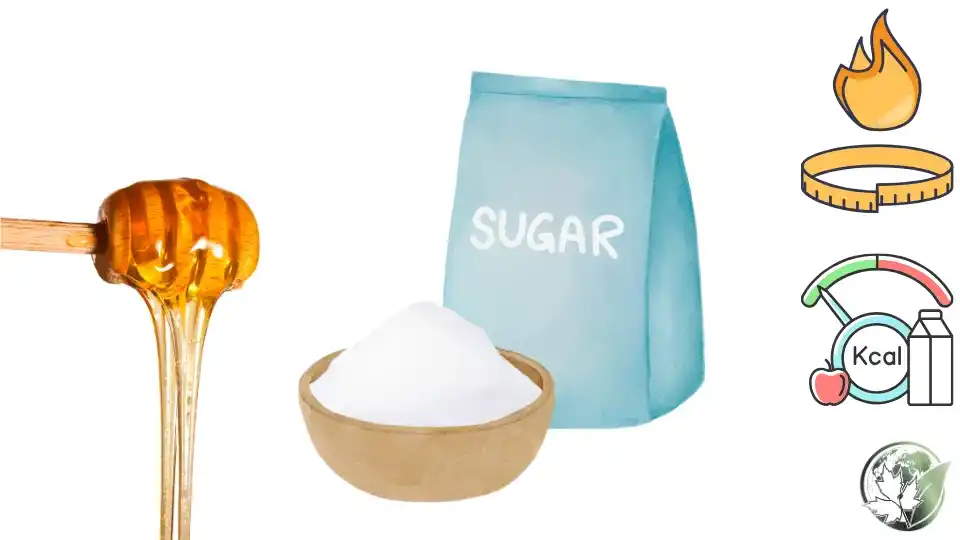
Honey is 82 percent sugar and 17 percent water, with traces of minerals and antioxidants
Which Has More Calories: Honey or Sugar?
Honey has more calories per teaspoon and per tablespoon (21 vs 16 and 64 vs 48) because it is denser, while sugar has more per gram (387 vs 304). People measure sweeteners by spoon, so honey adds more calories for the same volume. However, because honey is sweeter, the calories per unit of sweetness are close. Neither is a low-calorie sweetener, and both should be used in small amounts.
| Comparison | Honey | Sugar | Verdict |
|---|---|---|---|
| Per teaspoon | 21 kcal | 16 kcal | Sugar lower |
| Per tablespoon | 64 kcal | 48 kcal | Sugar lower |
| Per 100 g | 304 kcal | 387 kcal | Honey lower |
| Per unit of sweetness | About 0.75 as much needed | 1 | Honey slightly lower |
| Water content | 17% | 0% | - |
Why Does a Spoon of Honey Have More Calories Than a Spoon of Sugar?
Honey has a density of about 1.4 grams per millilitre, while granulated sugar has a bulk density of about 0.85, because of the air between crystals. A level teaspoon (5 millilitres) of honey weighs about 7 grams, and a teaspoon of sugar about 4.2 grams. Honey's 3.04 calories per gram times 7 grams gives 21, and sugar's 3.87 times 4.2 gives 16. So, volume measures mislead, and it helps to weigh both when you are counting calories.
| Property | Honey | Granulated sugar |
|---|---|---|
| Density | 1.4 g/ml | 0.85 g/ml (bulk) |
| 1 tsp weight | 7 g | 4.2 g |
| Calories per gram | 3.04 | 3.87 |
| Calories per tsp | 21 | 16 |
| Calories per tbsp | 64 | 48 |
| Relative sweetness | 1.25-1.5 | 1 |
Is Honey Healthier Than Sugar?
Honey is slightly better but not a health food. It contains trace antioxidants such as flavonoids and phenolic acids, small amounts of minerals, and has a lower glycemic index (about 58 versus 65), though it still raises blood glucose. Raw honey also has enzymes and, in some varieties like manuka or thyme honey, antibacterial compounds. But the amounts in a spoonful are too small to affect health substantially. Health organizations treat honey as a free sugar, to be limited to less than 10 percent of daily calories, or 5 percent for added benefit.
| Factor | Honey | Sugar |
|---|---|---|
| Antioxidants | Small amounts | None |
| Minerals | Trace | Trace |
| Glycemic index | 58 | 65 |
| Counts as free sugar | Yes | Yes |
| Antibacterial effect | In some types | No |
| Dental risk | High | High |
| Safe for infants | No (botulism risk) | Yes (but unnecessary) |
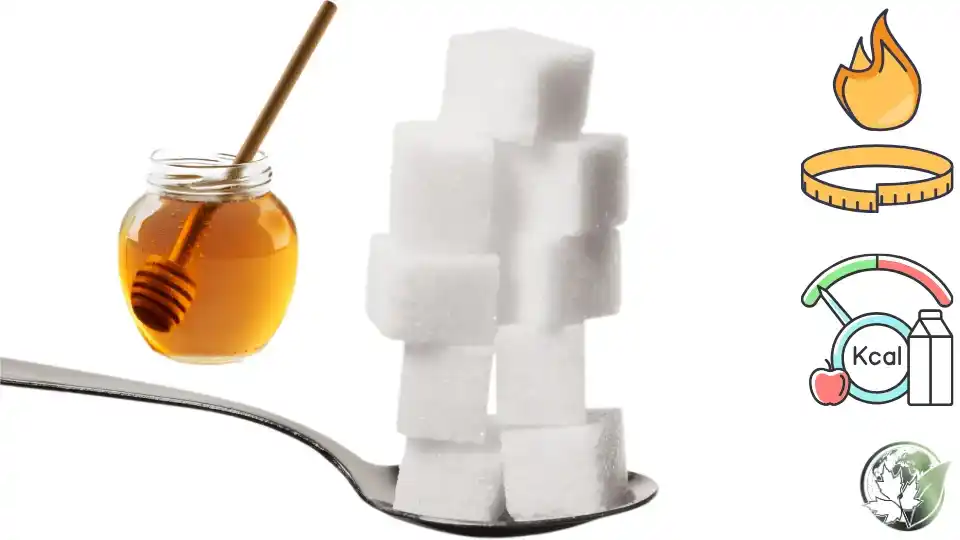
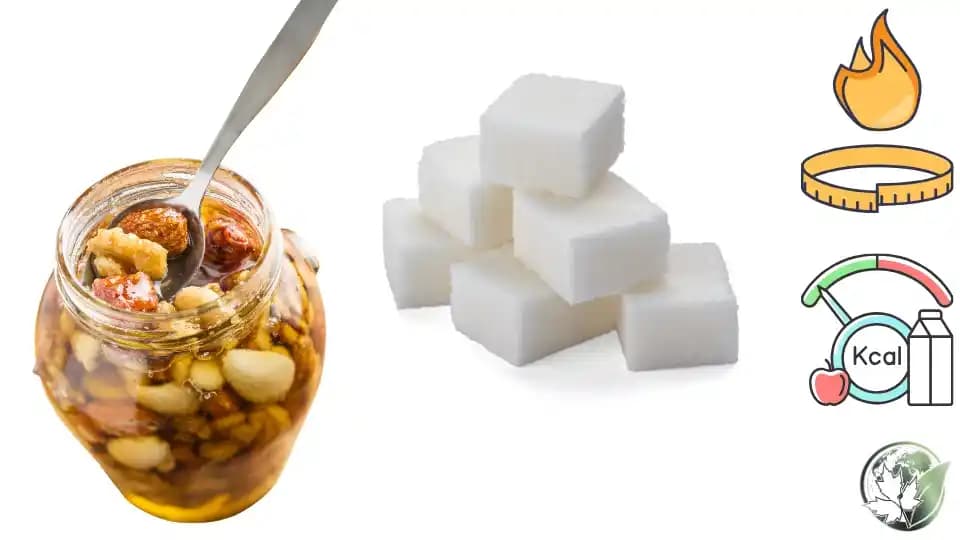
A teaspoon of honey in tea adds 21 calories, while a sugar cube adds 16
Which Is Better in Tea and Coffee?
For one cup, a teaspoon of honey adds 21 calories and a teaspoon of sugar 16. Honey is sweeter, so a half teaspoon (10 calories) can match a full teaspoon of sugar. It dissolves well in warm drinks but should not be added to boiling water if you want to keep its aroma. Sugar dissolves faster and has a neutral taste. Both contribute free sugars, so using less of either is the real way to cut calories.
| Drink | With sugar | With honey | With less honey |
|---|---|---|---|
| Cup of tea | 2 tsp: 32 kcal | 2 tsp: 42 kcal | 1 tsp: 21 kcal |
| Cup of coffee | 1 tsp: 16 kcal | 1 tsp: 21 kcal | 1/2 tsp: 10 kcal |
| Herbal tea | 1 cube: 16 kcal | 1 tsp: 21 kcal | 1/2 tsp: 10 kcal |
| Lemon water | 1 tsp: 16 kcal | 1 tsp: 21 kcal | 1/2 tsp: 10 kcal |
How Do You Substitute Honey for Sugar in Baking?
Use about 3/4 cup of honey for each cup of sugar, reduce other liquids by a quarter cup, add 1/4 teaspoon of baking soda, and lower the oven temperature by 25 degrees Fahrenheit (about 15 degrees Celsius), since honey browns faster. One cup of sugar (774 calories) replaced by 3/4 cup of honey (773 calories) gives the same energy, so you do not save calories, but you may get a moister texture and more flavor. For lower calories, reduce the sweetener by a quarter.
| Recipe step | Sugar version | Honey version |
|---|---|---|
| Sweetener | 1 cup (774 kcal) | 3/4 cup (773 kcal) |
| Liquid | As written | Reduce by 1/4 cup |
| Baking soda | As written | Add 1/4 tsp |
| Oven temperature | As written | Lower by 25 F |
| Browning | Normal | Faster |
How Do Different Types of Honey Compare in Calories?
All honey has roughly the same calories, 300 to 310 per 100 grams, since it is about 80 percent sugar. Differences come from water content and the ratio of fructose to glucose. Acacia honey has more fructose, stays liquid and tastes mild. Clover and wildflower honey are the common supermarket types. Manuka honey is prized for methylglyoxal content and costs many times more, but its calories are the same. Creamed honey, with fine crystals, has the same energy per gram, though it can seem thicker. Comb honey, eaten with the wax, has about the same calories per gram of honey.
| Honey type | Calories per tbsp | Water | Note |
|---|---|---|---|
| Clover | 64 kcal | 17% | Mild, common |
| Wildflower | 64 kcal | 17-18% | Varies by season |
| Acacia | 62 kcal | 16% | High fructose, liquid |
| Manuka | 64 kcal | 17% | Antibacterial reputation |
| Buckwheat | 64 kcal | 17% | Dark, rich in antioxidants |
| Mountain or thyme | 64 kcal | 16-17% | Strong flavor |
| Creamed honey | 64 kcal | 17% | Spreadable |
| Honey powder | 70 kcal per 18 g | 3% | Dried form |
How Do Honey and Sugar Affect Blood Sugar?
Honey has a glycemic index of about 58 and sugar about 65, which means honey causes a slightly slower rise in blood glucose. The difference varies by honey type: acacia honey, rich in fructose, can have an index as low as 32, whereas some clover honeys reach 70. At the typical dose of a teaspoon, the glycemic load is 3 for honey and 3.3 for sugar. Neither is suitable in large amounts for people with diabetes, who should count both as carbohydrate. A teaspoon of honey contains about 6 grams of carbohydrate.
| Sweetener | Glycemic index | Carbohydrate per tsp | Glycemic load per tsp |
|---|---|---|---|
| White sugar | 65 | 4.2 g | 2.7 |
| Honey (average) | 58 | 5.7 g | 3.3 |
| Acacia honey | 32-45 | 5.5 g | 2 |
| Maple syrup | 54 | 3.5 g | 1.9 |
| Agave nectar | 15-30 | 5 g | 1.2 |
| Date syrup | 50 | 4 g | 2 |
Does Honey Have Any Real Nutritional Advantages?
Honey provides tiny quantities of calcium, iron, potassium, zinc and B vitamins, but you would need to eat hundreds of grams to meet a meaningful share of the daily value, and that would mean 600 or more calories. It contains polyphenols, with darker honeys (buckwheat) containing the most. Studies show honey may soothe a cough in children over one year, better than no treatment, and has been used on wounds in medical-grade forms. But those uses do not make honey a replacement for fruit and vegetables as a source of nutrients.
| Nutrient (1 tbsp, 21 g) | Amount | Daily value |
|---|---|---|
| Potassium | 11 mg | 0.3% |
| Calcium | 1 mg | 0.1% |
| Iron | 0.1 mg | 0.5% |
| Zinc | 0.05 mg | 0.5% |
| Riboflavin | 0.01 mg | 0.8% |
| Polyphenols | Small amount | Not established |
How Do Honey and Sugar Compare With Other Sweeteners?
Alternatives vary widely. Maple syrup has 52 calories per tablespoon, agave nectar 60, molasses 58 and date syrup 56. Stevia and monk fruit have zero calories, and sugar alcohols such as erythritol have 0.2 calories per gram. Brown sugar and raw sugar have the same calories as white. For calorie control, the non-nutritive sweeteners are the lowest option, but many people prefer to use a small amount of real sugar or honey and train their palate to like less sweetness.
| Sweetener | Per tbsp | Calories | Sugar |
|---|---|---|---|
| White sugar | 12.5 g | 48 kcal | 12.5 g |
| Brown sugar (packed) | 13.8 g | 52 kcal | 13.4 g |
| Honey | 21 g | 64 kcal | 17.3 g |
| Maple syrup | 20 g | 52 kcal | 13.4 g |
| Agave nectar | 21 g | 60 kcal | 16 g |
| Molasses | 20 g | 58 kcal | 15 g |
| Date syrup | 20 g | 56 kcal | 14 g |
| Stevia | 1 g packet | 0 kcal | 0 g |
| Erythritol | 12.5 g | 3 kcal | 0 g |
How Much Honey or Sugar Is Safe Per Day?
The World Health Organization recommends that free sugars, which include honey and sugar, stay under 10 percent of total energy, or about 50 grams (12 teaspoons) for a 2,000 calorie diet, with further benefit below 5 percent, or 25 grams (6 teaspoons). The American Heart Association suggests 25 grams for women and 36 grams for men. These amounts include sugar in drinks, sauces and desserts, so the room left for the sugar bowl or honey jar is small. In practice, one or two teaspoons a day in tea or on toast fit comfortably.
| Guideline | Limit (grams) | Teaspoons of sugar | Teaspoons of honey |
|---|---|---|---|
| WHO (10% of energy) | 50 g | 12 | 8.8 |
| WHO (5% of energy) | 25 g | 6 | 4.4 |
| AHA women | 25 g | 6 | 4.4 |
| AHA men | 36 g | 8.6 | 6.3 |
| AHA children | 25 g | 6 | 4.4 |
Is Honey Safe for Everyone?
Honey should never be given to infants under 12 months, as it may contain Clostridium botulinum spores that can cause infant botulism. It is safe for older children and adults. People with diabetes should count its carbohydrates and people with pollen allergies may react to raw, local honey, although this is uncommon. Honey is also acidic and sticky, so it can contribute to tooth decay. Heating honey to very high temperatures reduces its enzymes, but it does not make it harmful.
| Group | Concern | Advice |
|---|---|---|
| Infants under 12 months | Botulism | Avoid |
| Diabetes | Carbohydrate | Count, limit |
| Pollen allergy | Possible reaction | Test with small amount |
| Dental risk | Sticky sugar | Rinse after |
| Weight loss | Calorie dense | Measure level teaspoons |
How Can You Use Less Honey or Sugar Without Losing Sweetness?
Reduce the amount in steps: cut a quarter teaspoon every few days, and your taste adapts within two to four weeks. Add cinnamon, vanilla or a pinch of salt to enhance perceived sweetness. Use ripe fruit, such as mashed banana or grated apple, in oatmeal and baking. Measure with a level spoon instead of pouring from the jar. Choose strong-flavored honey, such as buckwheat or thyme, because a little goes further. Drizzling honey on top of food, rather than mixing it in, gives a sharper sweet taste with less volume.
| Strategy | Example | Calories saved |
|---|---|---|
| Halve the spoon | 1 tsp to 1/2 tsp honey in tea | 10 kcal per cup |
| Add cinnamon | Oatmeal with 1/2 tsp honey | 10 kcal |
| Use fruit | Mashed banana instead of 1 tbsp sugar | 0, but adds fiber |
| Drizzle on top | 1 tsp honey on yogurt | 21 kcal vs 64 stirred in |
| Strong-flavored honey | Buckwheat, 1/2 tsp | 10 kcal |
What Are the Best Uses for Honey and for Sugar?
Honey suits cold and warm drinks, yogurt, oatmeal, marinades, glazes, salad dressings and baking where moisture is wanted. Its flavor adds depth to sauces and meat glazes. Sugar is better where crystals or structure are needed, such as caramel, meringue, cookies with crisp edges and candy, and where a neutral flavor is preferred, such as in coffee. Both caramelize and brown. A mixture of both can balance flavor and texture in recipes.
| Use | Better choice | Reason |
|---|---|---|
| Tea with lemon | Honey | Flavor, dissolves well |
| Coffee | Sugar | Neutral flavor |
| Marinades and glazes | Honey | Browns, sticks |
| Meringue, caramel | Sugar | Crystal structure |
| Crisp cookies | Sugar | Dry texture |
| Moist cakes | Honey | Holds moisture |
| Yogurt, oatmeal | Honey | Flavor |
How Should You Store Honey and Sugar?
Honey keeps for years in a sealed jar at room temperature because of its low water content and acidity. It may crystallize over time, which is harmless: warm the jar gently in a bowl of hot water to restore it, without boiling. Do not refrigerate, as that speeds crystallization. Sugar also lasts indefinitely if kept dry and sealed, but it clumps when exposed to moisture. Brown sugar hardens and should be kept in an airtight container with a slice of bread or a terracotta disc to retain moisture.
| Product | Shelf life | Best storage |
|---|---|---|
| Honey | Years | Sealed jar, room temperature |
| Crystallized honey | Still safe | Warm in hot water bath |
| White sugar | Indefinite | Dry, airtight |
| Brown sugar | 2 years | Airtight with moisture source |
| Powdered sugar | 2 years | Dry, sealed |
How Many Calories Do Honey and Sugar Add to Everyday Foods?
Small spoonfuls accumulate through the day. Two teaspoons of honey on toast and one in tea total 63 calories. A tablespoon of honey on a bowl of oatmeal adds 64 calories, while the same amount of sugar adds 48. A honey-glazed salmon fillet with two tablespoons of glaze adds 128 calories. A lemon-honey drink twice a day adds 42 calories. Tracking the sweetener separately from the base food makes it easier to see where the extra energy comes from.
| Food | Sweetener added | Calories added |
|---|---|---|
| Toast | 2 tsp honey | 42 kcal |
| Oatmeal | 1 tbsp honey | 64 kcal |
| Yogurt | 1 tsp honey | 21 kcal |
| Tea (2 cups) | 2 tsp sugar | 32 kcal |
| Salmon glaze | 2 tbsp honey | 128 kcal |
| Pancakes | 2 tbsp honey | 128 kcal |
| Smoothie | 1 tbsp honey | 64 kcal |
| Coffee | 1 tsp sugar | 16 kcal |
How Can Weight Watchers Compare Honey and Sugar Per Serving?
For calorie counting, weigh the sweetener on a kitchen scale: 10 grams of honey is 30 calories and 10 grams of sugar is 39. If you use a measuring spoon, use the level measure and count one teaspoon of honey as 21 calories. Calorie tracking apps list honey per tablespoon at 64 calories, so match your amount to the app's unit. If you reduce your daily sweetener by two teaspoons, you save roughly 32 to 42 calories a day, or about 3.5 pounds of body fat over a year.
| Sweetener amount | Honey | Sugar |
|---|---|---|
| 5 g | 15 kcal | 19 kcal |
| 10 g | 30 kcal | 39 kcal |
| 20 g | 61 kcal | 77 kcal |
| 1 tsp | 21 kcal | 16 kcal |
| 2 tsp daily for a year | 15,300 kcal | 11,700 kcal |
Are Raw Honey and Processed Honey Different in Calories?
Raw honey is unheated and unfiltered, and may contain pollen and bits of wax, while processed honey is pasteurized and filtered for clarity and a longer liquid life. The calories are the same, about 64 per tablespoon. Some cheap products labeled honey are blended with syrups; the label "pure honey" and a known origin are a better guide. Pasteurization slightly reduces enzymes and some antioxidants, but does not alter the sugars. Choose based on taste, price and trust in the producer.
| Type | Processing | Calories per tbsp | Notes |
|---|---|---|---|
| Raw honey | Strained only | 64 kcal | Cloudy, may crystallize |
| Pasteurized honey | Heated, filtered | 64 kcal | Clear, stays liquid |
| Creamed honey | Controlled crystals | 64 kcal | Spreadable |
| Blended honey syrup | Mixed with syrup | 60-64 kcal | Check label |
Key Takeaways: Honey vs Sugar Calories
Honey has 21 calories per teaspoon and 304 per 100 grams, sugar 16 and 387. Honey is higher by spoon, lower by weight and sweeter, so you can use less. The health difference is small, so use either in moderation.
Frequently Asked Questions
6 questions answered
Does honey have more calories than sugar?
By spoon yes (21 vs 16), by weight no (304 vs 387).
How many calories are in a tablespoon of honey?
About 64.
Is honey healthier than sugar?
Slightly, but it is still a free sugar.
Is honey sweeter than sugar?
Yes, about 25 to 50 percent.
Can babies have honey?
No, not under 12 months.
How do I replace sugar with honey?
Use 3/4 cup honey per cup of sugar.