Grapes Calories at a Glance
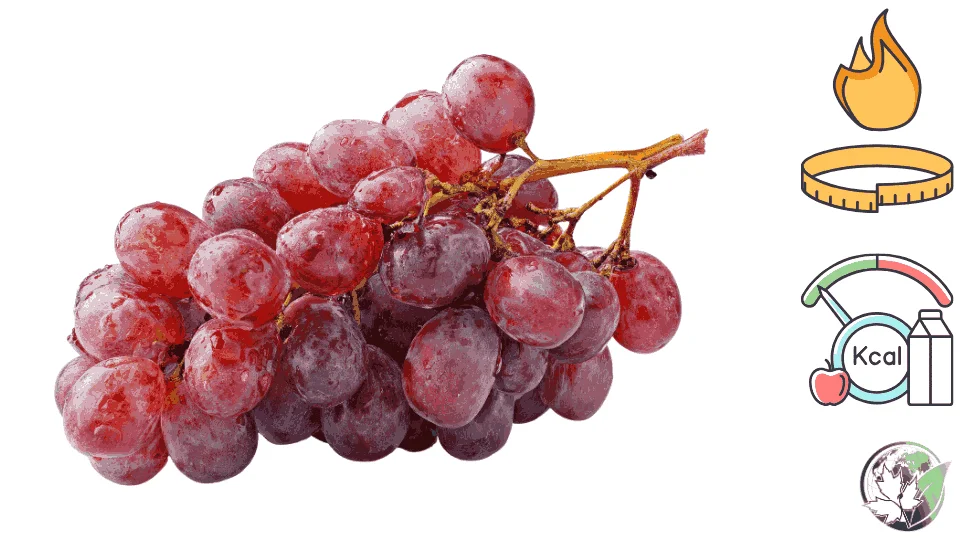
For a quick answer, 10 average grapes provide roughly 34 calories when they weigh about 49 grams. One hundred grams of grapes is about 69 calories, and one cup of whole grapes, around 151 grams, is about 104 calories. A small handful can be close to 50 to 70 calories depending on how tightly it is packed and the size of the grapes.
These numbers explain why grapes can feel very light while still contributing meaningful carbohydrate when eaten by the bowlful. They contain a large amount of water and almost no fat, but they also contain natural glucose and fructose. The result is a fruit with moderate calories compared with very watery fruits such as watermelon, but far fewer calories per gram than dried fruit, chocolate, cookies, or nuts.
- 10 grapes (about 49 g): approximately 34 calories
- 100 g grapes: approximately 69 calories
- 1 cup whole grapes (about 151 g): approximately 104 calories
- 1/2 cup grapes (about 75 g): approximately 52 calories
- 150 g bowl: approximately 104 calories
How Many Calories Are in 10 Grapes?
Ten grapes is a useful serving because it is easy to count and close to 50 grams for many medium-sized seedless grapes. Using 69 calories per 100 grams, 49 grams of grapes works out to about 34 calories. If your grapes are very large, ten pieces can weigh considerably more; if they are small, ten may weigh less. The calorie value therefore follows total weight, not the number of individual grapes.
For snacking, counting pieces can still be practical. Ten grapes gives sweetness and volume for a relatively small calorie total, while 20 grapes would be roughly double if the pieces are similar in size. This becomes useful when you are building a snack with yogurt, cheese, nuts, or a sandwich and want the fruit portion to stay predictable.
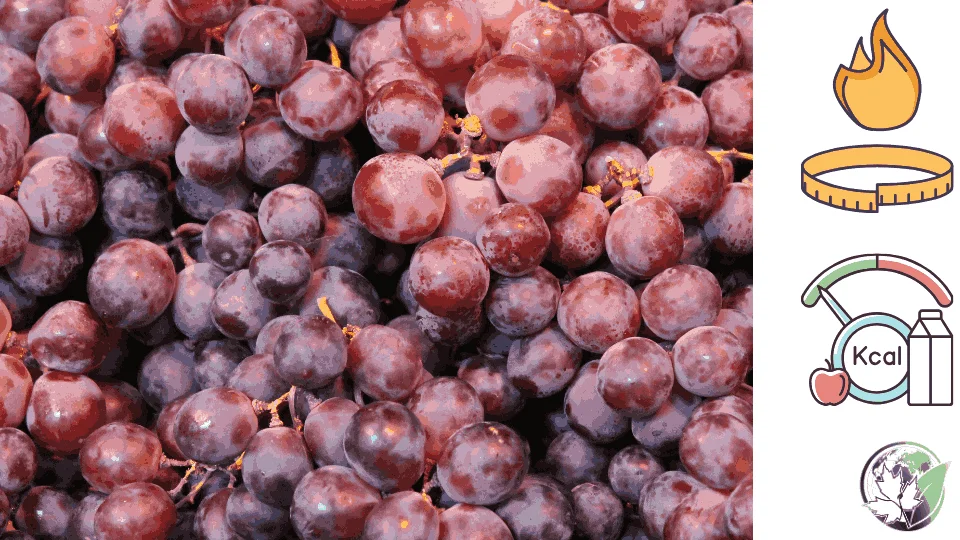
One reason people misjudge grape calories is that grapes invite continuous eating. With an apple or orange, one fruit usually defines the serving. With grapes, the boundary is the size of the bowl or bag. Pre-portioning a serving into a cup, small bowl, or container can make the calorie estimate much more realistic than eating directly from a large bunch.
How Many Calories Are in 100g of Grapes?
One hundred grams of raw red or green grapes contains about 69 calories in the standard reference used here. It also provides roughly 18.1 grams of carbohydrate, 15.5 grams of naturally occurring sugars, 0.9 gram of fiber, 0.7 gram of protein, and very little fat. Water makes up about four-fifths of the fruit by weight.
The 100-gram figure is useful for comparing grapes with other foods because it removes confusion about fruit size. Per 100 grams, grapes have more calories than oranges, strawberries, watermelon, and many melons, but fewer than bananas and dramatically fewer than raisins. That does not make grapes a poor choice; it simply shows that different fruits have different amounts of water and carbohydrate.
If you weigh your portion, the calculation is simple: multiply the grams of grapes by 0.69 to estimate calories. A 120-gram serving is about 83 calories, 150 grams is about 104 calories, and 200 grams is about 138 calories. Exact nutrient values vary slightly by cultivar and database entry, so rounding to the nearest five calories is usually more practical than pretending the number is exact.
Grape Calorie Portion Table
| Portion | Approx. weight | Approx. calories |
|---|---|---|
| 10 grapes | 49 g | 34 kcal |
| 1/2 cup | 75 g | 52 kcal |
| 100 g | 100 g | 69 kcal |
| 1 cup | 151 g | 104 kcal |
| 2 cups | 302 g | 208 kcal |
A portion table is often more useful than one headline number because the amount eaten changes the result quickly. The values below use a standard estimate of 69 calories per 100 grams for raw red or green grapes.
How Many Calories Are in 1 Cup of Grapes?
One cup of whole grapes is commonly estimated at around 151 grams, which equals about 104 calories using the 69-calorie-per-100-gram reference. A cup is a generous snack portion and is more reliable than the word handful because hand sizes differ widely.
If the grapes are cut in half, the same measuring cup may hold more fruit because the pieces pack more tightly. That is why cup measurements are always approximate. Weight gives the best precision, but for everyday eating, a level cup of whole grapes is a convenient visual serving.
A cup of grapes also provides roughly 27 grams of carbohydrate and more than 23 grams of natural sugars. Those sugars come packaged with water, small amounts of fiber, and micronutrients rather than added sugar. Still, people who count carbohydrate for a specific nutrition plan may find the cup value more useful than simply labeling grapes as a low-calorie food.
Grapes Nutrition Facts: More Than Calories
Calories tell you how much energy a food provides, but they do not explain its complete nutritional profile. Grapes are primarily water and carbohydrate, with very little protein or fat. They contribute potassium, copper, vitamin K, and a small amount of vitamin C, and colored grape skins contain various plant compounds.
The fiber content of grapes is modest compared with raspberries, pears, or apples with skin. That means a grape serving can be easy to eat quickly. Pairing grapes with a protein- or fat-containing food such as plain yogurt, cottage cheese, a small portion of nuts, or cheese can make a snack more substantial without changing the fruit itself.
Red, black, and purple grapes are often discussed for their polyphenol content, while green grapes have a different flavor profile. From a basic calorie perspective, however, color is not the main factor. Variety, sugar concentration, berry size, and water content can create small differences, but serving size remains the dominant variable.
Grapes Nutrition Table per 100g
| Nutrient | Approx. amount per 100 g |
|---|---|
| Calories | 69 kcal |
| Water | 80.5 g |
| Carbohydrate | 18.1 g |
| Total sugars | 15.5 g |
| Fiber | 0.9 g |
| Protein | 0.72 g |
| Fat | 0.16 g |
| Potassium | 191 mg |
| Vitamin K | 15 mcg |
| Vitamin C | 3.2 mg |
The following values are rounded reference figures for raw red or green grapes. They are intended for practical nutrition comparison rather than product labeling.
Red Grapes vs Green Grapes: Which Has More Calories?
Red and green table grapes are nutritionally similar enough that most people do not need separate calorie targets for each color. Standard databases often group red and green European-type grapes together at about 69 calories per 100 grams. Individual cultivars can differ in sweetness and water content, so a particularly sweet variety may contain somewhat more carbohydrate than another.
The more useful distinction is not red versus green but fresh versus dried, whole fruit versus juice, and small serving versus large bowl. A 100-gram serving of either red or green grapes will generally fit within the same practical calorie estimate. Choosing one color over another is therefore more about taste, texture, availability, and variety than calorie control.
Dark-colored grapes may contain different concentrations of anthocyanins and other polyphenols in the skin, but those differences should not be translated into exaggerated health claims. For an SEO nutrition article, it is safer and more accurate to say that grape varieties differ in plant compounds while their basic energy values remain broadly comparable.
Grapes vs Raisins: The Big Calorie Difference
The contrast between fresh grapes and raisins is one of the clearest examples of how water changes calorie density. Fresh grapes are around 80 percent water. Raisins have had most of that water removed, so the same weight contains much more fruit material, carbohydrate, and calories.
Fresh grapes provide about 69 calories per 100 grams in the reference used here. Seedless raisins are close to 300 calories per 100 grams in standard nutrition databases. That means raisins can deliver more than four times the calories by weight. The difference does not come from added fat; it comes primarily from concentrating the grape's natural carbohydrate as water disappears.
Visually, this matters a great deal. One cup of fresh grapes is a large bowl of juicy fruit. A similar calorie amount of raisins is a much smaller volume. Raisins can be useful in cereal, baking, trail mix, or portable snacks, but portion awareness matters because a few extra spoonfuls add energy quickly.
Grapes vs Raisins Nutrition Comparison
| Nutrient / 100 g | Fresh grapes | Seedless raisins (approx.) |
|---|---|---|
| Calories | 69 kcal | ~299 kcal |
| Carbohydrate | 18.1 g | ~79 g |
| Sugars | 15.5 g | ~59 g |
| Fiber | 0.9 g | ~3.7 g |
| Water | 80.5 g | ~15 g |
| Main difference | High water, large volume | Water removed, concentrated |
The table below uses approximate per-100-gram values to show how dehydration changes the food. Raisin values can vary slightly by type and processing.
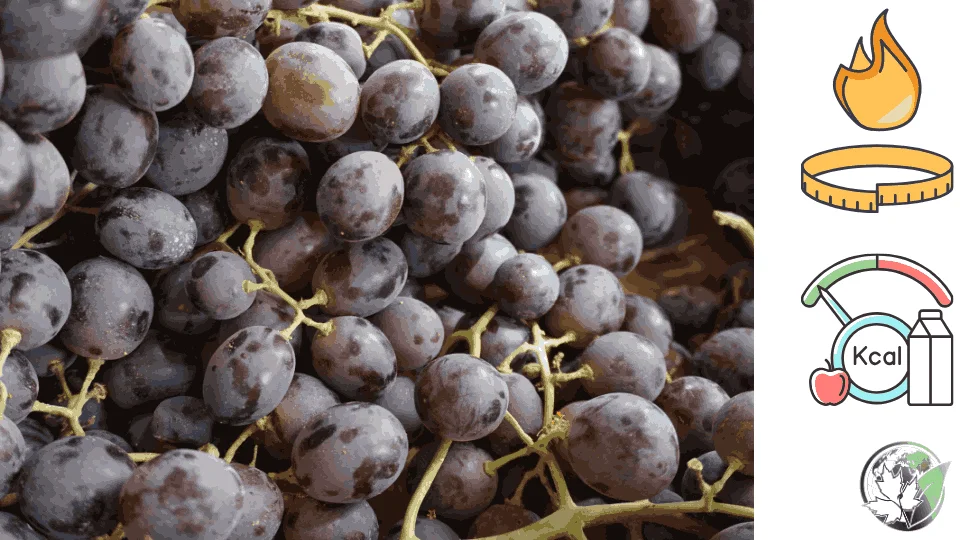
Why Raisins Have So Many More Calories
Drying does not magically create calories. It removes water. Imagine starting with a large quantity of grapes and shrinking them until most of the water is gone. The remaining raisins occupy far less space, so 100 grams of raisins represents much more original fruit than 100 grams of fresh grapes.
This concentration also affects sugar. A handful of raisins can contain the natural sugars from many more grapes than the same-sized handful of fresh fruit. That is why dried fruit is better thought of as concentrated fruit rather than as a direct volume-for-volume substitute for fresh fruit.
The same principle applies to other dried fruits such as dates, dried apricots, figs, and cranberries. Some commercial dried fruits may also contain added sugar or oil, which can change the nutrition profile further. For raisins, checking the ingredient list is useful if you want to know whether anything besides grapes has been added.
Grapes vs Other Fruits: Calories per 100g
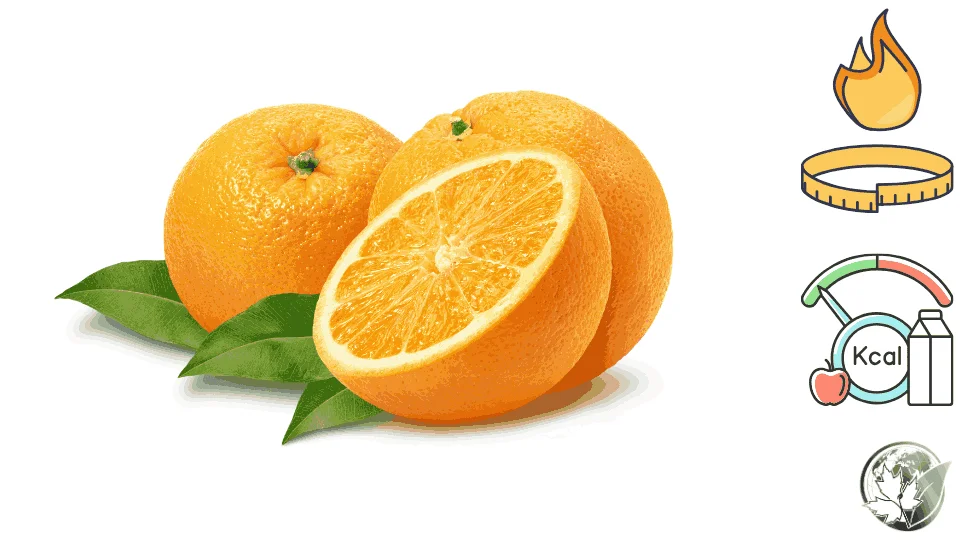
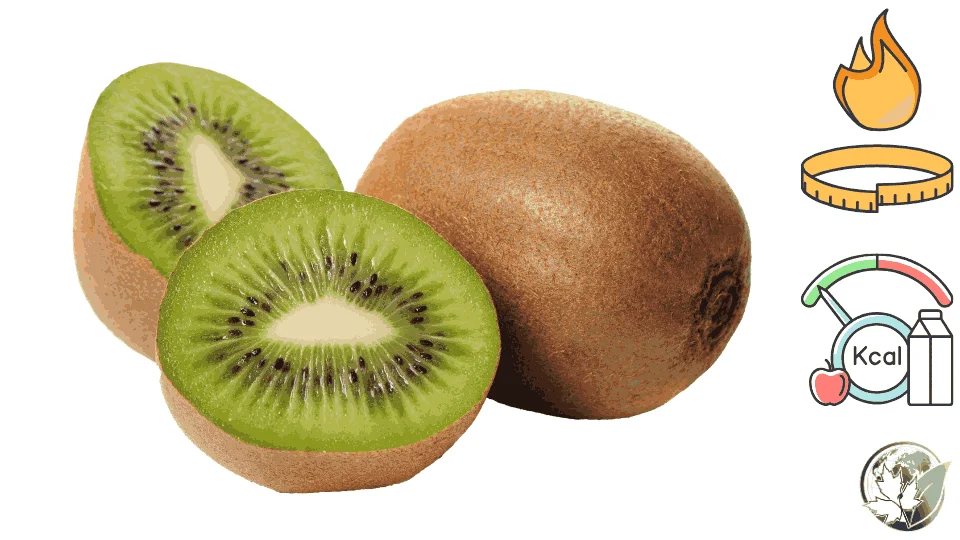
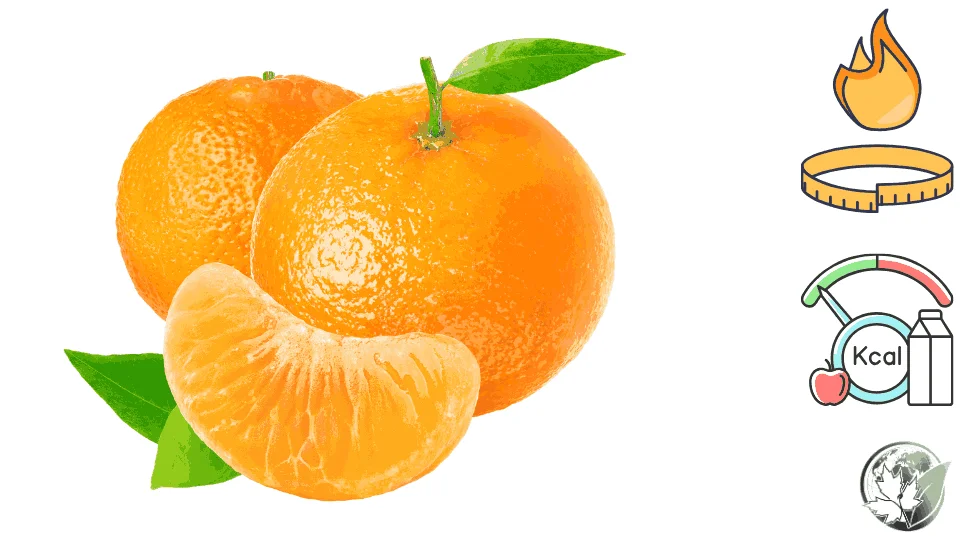
Grapes sit in the middle of the calorie range for common fresh fruits. Watermelon is around 30 calories per 100 grams, oranges about 47, apples roughly 52, mandarins around 53, grapes about 69, and bananas around the high 80s. These figures are approximate and depend on the database entry and variety.
This comparison can help answer a common search question: are grapes high in calories? Compared with fresh produce generally, they are not high-calorie. Compared with very watery fruits, however, they are more energy-dense because they contain more natural sugar per 100 grams. Calling grapes either high-calorie or low-calorie without a comparison is therefore oversimplified.
For most people, the better question is whether the portion fits the meal or snack. A 100-calorie bowl of grapes is still a large amount of food relative to many packaged snacks. At the same time, two or three cups eaten casually can become a 200- to 300-calorie portion, which may matter if someone is tracking total intake.
Are Grapes High in Sugar?
Grapes taste sweet because they naturally contain glucose and fructose. A 100-gram serving provides about 15.5 grams of total sugars in the standard reference. One cup can therefore contain more than 20 grams of natural sugar, depending on the exact weight and variety.
Natural sugar is not identical to added sugar in a soft drink or candy because whole grapes also contain water, micronutrients, and some fiber. The physical structure of whole fruit also influences how quickly it is eaten. Still, the grams of carbohydrate are real, so people who use carbohydrate exchanges or who have been advised to monitor carbohydrate should count the actual serving rather than assume fruit is unrestricted.
Whole grapes are generally a more filling choice than grape juice because chewing and fruit structure slow the pace of intake. Juice also makes it easy to consume the equivalent of many grapes in a short time. If the goal is portion awareness, whole fruit usually makes the serving more visible.
Fiber, Water and Micronutrients in Grapes
Grapes are mostly water, which explains their crisp texture and moderate calorie density. Their fiber content is relatively modest at about 0.9 gram per 100 grams, so grapes should not be your only fruit choice if maximizing fiber is a priority. Rotating them with berries, pears, apples, citrus, and other fruits can create a broader nutrient pattern.
Potassium is one useful mineral in grapes, and the fruit also provides copper and vitamin K. The exact micronutrient profile varies by cultivar and growing conditions. Rather than presenting grapes as a miracle food, a more evidence-aligned approach is to view them as one colorful component of a varied diet.
The skins and seeds of some grape varieties contain polyphenols. Seedless table grapes still contain skin compounds, but concentrations differ. Processing can also affect these compounds, which is another reason why fresh grapes, raisins, and juice should not be treated as nutritionally identical even though they come from the same fruit.
Are Grapes Good for Weight Loss?
No single fruit causes weight loss, but grapes can fit well into an eating pattern designed around calorie awareness because they provide sweetness and volume without the calorie density of many desserts or snack foods. A cup around 100 calories can be satisfying when eaten slowly, especially when combined with a source of protein.
The potential challenge is passive overeating. Grapes are small, sweet, and easy to eat one after another. If weight management is a goal, placing a measured portion in a bowl can be more effective than keeping a large bag within reach. Frozen grapes can also slow the eating pace and make a small portion feel more deliberate.
Comparing grapes with raisins is especially relevant in this context. Both are fruit, yet 100 calories of fresh grapes occupies much more volume than 100 calories of raisins. If a person values large portions for relatively few calories, fresh grapes usually have the advantage. If compact energy is useful, such as during hiking or travel, raisins may be more convenient.
How to Estimate Grape Calories Without a Scale
A food scale is the most precise tool, but it is not necessary for everyday eating. Start with a visual anchor: 10 medium grapes are about 34 calories, 1/2 cup is about 50 calories, and 1 cup is about 100 calories. From there you can estimate larger or smaller portions.
Another method is to use the nutrition label when grapes are sold in a prepacked container. Retail labels may list a serving by grams. If the package uses a different calorie figure from the reference in this article, use the product-specific label because the supplier may be using a different database entry or measured variety.
For recipes, weighing the entire grape amount before dividing the dish can be useful. For example, 300 grams of grapes contains roughly 207 calories. If that fruit salad makes three equal portions, each portion contributes about 69 calories from the grapes before accounting for the other ingredients.
Fresh, Frozen and Cooked Grapes
Freezing grapes without adding anything does not meaningfully change their calories. The water is still present; it has simply changed state. Frozen grapes can therefore be counted similarly by weight to fresh grapes. Their firmer texture may make them feel more like a dessert and can slow the rate of eating.
Cooking grapes can reduce some water and make sweetness more concentrated, especially if they are roasted for a long time. If honey, sugar, syrup, oil, or cheese is added, the calorie total belongs to the whole recipe rather than the grapes alone. The same is true for grape sauces, jams, and preserves, which may contain significant added sugar.
Grape juice is another separate category. Juice removes much of the chewing and usually much of the fiber, while making it easy to drink the equivalent of many grapes at once. For that reason, calorie comparisons should be made using an actual measured serving rather than assuming a glass of juice is nutritionally equivalent to a cup of whole grapes.
Smart Ways to Serve Grapes
Grapes work well because they can move between breakfast, snacks, salads, and desserts without much preparation. The best serving method depends on whether you are prioritizing volume, portability, carbohydrate control, or total calories.
- Use 1/2 to 1 cup as a simple fruit portion beside breakfast or lunch.
- Pair grapes with plain Greek yogurt or cottage cheese for a more substantial snack.
- Freeze individual grapes for a slower-eating summer snack.
- Add a measured amount to salads instead of pouring in dried fruit by the handful.
- When using raisins, measure tablespoons or grams because the calorie density is much higher.
- For children, cut grapes appropriately to reduce choking risk and follow age-specific safety guidance.
The goal is not to turn fruit into a mathematical exercise. Portion numbers are most useful when they answer a specific question, such as how many calories are in a snack, how fresh grapes compare with raisins, or how to fit fruit into a meal plan. For everyone else, a varied pattern of whole fruits is more important than small differences between grape varieties.
Grape Portion Planning: Real-World Examples
Portion numbers become most useful when they are connected to real meals. Imagine breakfast includes plain yogurt, oats, and grapes. If you add 75 grams of grapes, the fruit contributes about 52 calories. If you add a full 151-gram cup, it contributes about 104. Both are reasonable choices; they simply create different totals. The same logic works at lunch when grapes are served beside a sandwich or at dinner when they appear in a salad.
For a 100-calorie grape portion, you need roughly 145 grams, which is close to one cup. For a 50-calorie portion, around 72 grams is a practical target, roughly half a cup. These visual anchors are easier to remember than a long nutrition table and can help readers estimate quickly when they do not have a scale.
Now compare the same snack budget with raisins. Around 100 calories of raisins may be only about 33 grams, a small compact portion. This is why trail mix can become calorie-dense: raisins, nuts, seeds, and chocolate are all concentrated foods. A cup of fresh grapes beside a small portion of nuts may provide more visual volume than a similar-calorie handful of trail mix.
Children and adults also perceive portions differently. A child's handful is smaller, and grapes require age-appropriate preparation because whole grapes can be a choking hazard for young children. Calorie information should never replace basic food-safety guidance. For adults, the main issue is usually not safety but mindless eating from a large bag. Dividing grapes into containers when groceries are unpacked can make later snacks automatic and predictable.
For entertaining, a platter can contain several hundred grams of grapes. If five people share 500 grams, the average portion is 100 grams and about 69 calories each. If two people eat the same platter, the average is 250 grams and about 173 calories each. Shared dishes demonstrate why individual calorie intake cannot be determined from the food on the table alone; the portion actually eaten is what matters.
Finally, remember that fruit is often part of a recipe. A chicken salad with grapes, mayonnaise, nuts, and celery may sound fruit-forward, but most of its calories may come from mayonnaise and nuts. A dessert with grapes and sweetened cream may be much higher in calories than a bowl of plain fruit. Good SEO nutrition content separates the base ingredient from the finished dish so readers are not misled by a healthy-sounding ingredient name.
Common Mistakes When Counting Grapes
The first mistake is assuming that every grape weighs the same. Large premium seedless grapes can be much heavier than small grapes, so a piece count is only an estimate. The second is confusing fresh and dried fruit. A cup of raisins and a cup of grapes are not remotely similar in calories.
A third mistake is counting only the fruit when the snack includes extras. Grapes served with a large amount of cheese, nuts, chocolate, or sweetened yogurt can become a high-calorie snack even though the grapes themselves are moderate. The correct calculation includes the entire plate.
Finally, avoid false precision. Fruit composition changes with variety and ripeness, and standard nutrition databases are averages. Writing that a bowl contains exactly 103.7 calories may look scientific, but rounding to about 100 or 105 calories is usually more honest and useful.
Frequently Asked Questions
How many calories are in 10 grapes?
Ten medium grapes weighing about 49 grams provide roughly 34 calories when calculated from a 69-calorie-per-100-gram reference. Very large or very small grapes can change the total, so weight is more accurate than piece count.
How many calories are in 1 cup of grapes?
One cup of whole grapes is commonly about 151 grams and provides roughly 104 calories. Cut grapes may pack more tightly into a cup, so the actual weight can be higher.
Are red grapes higher in calories than green grapes?
Not in a meaningful way for everyday tracking. Standard references commonly group red and green table grapes together. Variety, ripeness, sugar concentration, and portion size matter more than color.
Why do raisins have more calories than grapes?
Raisins have most of the grape's water removed. This concentrates the fruit solids and natural sugars, so 100 grams of raisins contains far more original fruit and therefore far more calories than 100 grams of fresh grapes.
Are grapes high in sugar compared with other fruit?
Grapes are naturally sweet and contain about 15.5 grams of sugar per 100 grams in a common reference entry. That is higher than very watery fruits such as watermelon, but the sugar is naturally occurring within whole fruit. Portion size still determines total carbohydrate.
Conclusion: Grapes Are Moderate in Calories, but Portion Size Matters
Grapes are a refreshing, low-fat fruit with about 69 calories per 100 grams. Ten medium grapes are roughly 34 calories, while a full cup is around 104 calories. Those numbers make grapes easy to include in meals and snacks, but their small size can make it easy to eat several servings without noticing.
The most useful comparison is fresh grapes versus raisins. Drying removes water and concentrates the grape, pushing raisins to roughly 300 calories per 100 grams. Fresh grapes therefore provide much more volume for the same calorie amount, while raisins provide compact energy in a much smaller portion.
For practical tracking, use 10 grapes, 1/2 cup, 1 cup, or a weighed serving as your reference. Choose red, green, or black grapes based on preference rather than chasing tiny calorie differences, and remember that overall diet quality matters more than exact calorie variation between fruit cultivars.
Nutrition Data Note
Nutrition values are rounded estimates based on standard raw fruit reference data commonly used in USDA FoodData Central-style databases. Exact values vary by grape variety, size, ripeness, growing conditions, and preparation. Raisin values vary by type and brand. This article is general nutrition information and is not a substitute for individualized medical or dietary advice.