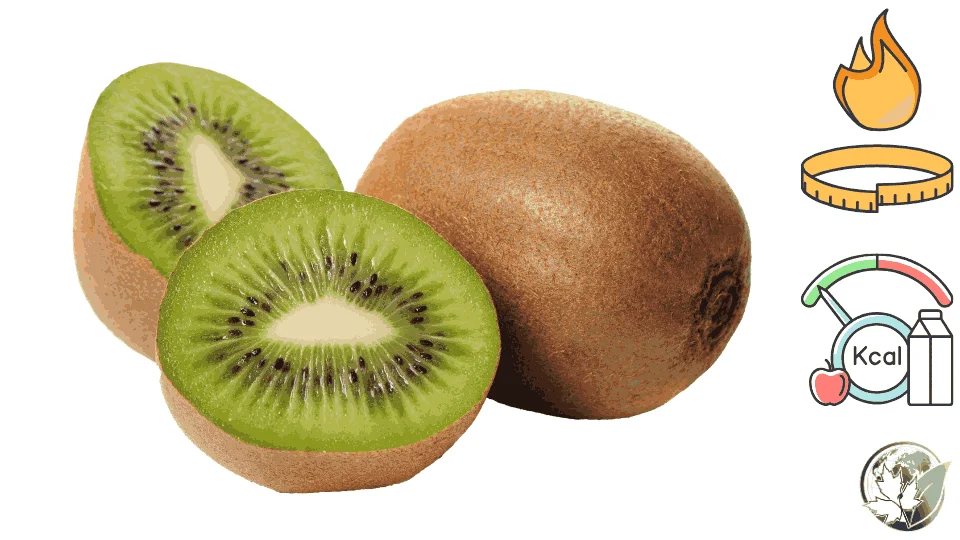
Kiwi Calories at a Glance
If you only need the numbers, here is the simplest calorie guide for raw green kiwifruit:
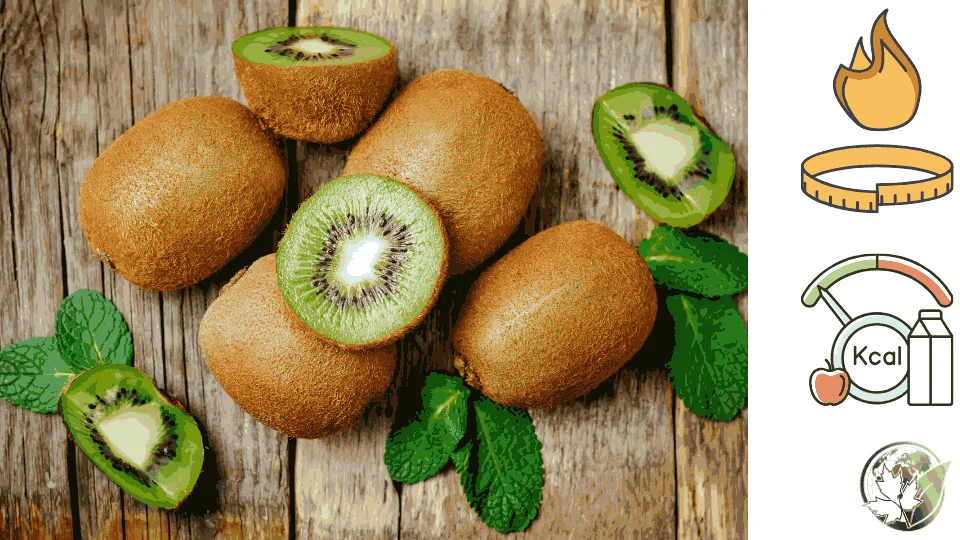
- 1 kiwi (about 69 g edible portion): about 42 calories
- 100 g kiwi: about 61 calories
- 1 cup sliced kiwi (about 180 g): about 110 calories
This means kiwi is not “zero calorie,” but it is a relatively low-energy-density food. Most of its weight is water, while its calories come primarily from naturally occurring carbohydrates. It contains very little fat and only a small amount of protein.
For comparison, 100 grams of raw apple with skin contains about 52 calories. Apple is therefore slightly lower in calories by equal weight, but kiwi provides a much larger amount of vitamin C and more potassium and fiber per 100 grams.
| Portion | Approx. weight | Calories |
|---|---|---|
| 1 kiwi | 69 g | 42 kcal |
| 100 g kiwi | 100 g | 61 kcal |
| 1 cup sliced | 180 g | 110 kcal |
How Many Calories Are in One Kiwi?
A standard reference serving of one green kiwi, approximately 2 inches in diameter and about 69 grams of edible fruit, contains roughly 42 calories. In everyday life, however, not every kiwi weighs 69 grams. Small fruits may contain fewer calories, while large kiwis may contain more.
A useful way to estimate the calories in any kiwi is to start with the 100-gram value. Raw green kiwi provides about 61 calories per 100 grams, which is approximately 0.61 calorie per gram. If a peeled or edible portion weighs 80 grams, for example, the estimated calorie count is about 49 calories. A 100-gram kiwi would be about 61 calories, and a 120-gram portion would be roughly 73 calories.
The key point is that “one kiwi” is a size-based serving, not a fixed nutritional unit. Two fruits that look similar can differ noticeably in weight. For casual eating, about 40 to 50 calories for an average kiwi is a practical estimate. For precise food logging, weighing the edible portion is more accurate.
Kiwi is also easy to portion because the fruit is naturally individual. Unlike grapes, berries, or chopped melon, you do not need to count many pieces or fill a measuring cup to estimate a serving. That makes one whole kiwi a convenient snack when you want a naturally sweet food with a fairly modest calorie load.
How Many Calories Are in 100g of Kiwi?
One hundred grams of raw green kiwifruit contains about 61 calories. The 100-gram figure is especially useful for nutrition comparisons because it removes the size differences between individual fruits. When people ask whether kiwi is “higher” or “lower” in calories than apple, orange, grapes, or melon, comparing the same 100-gram weight gives the fairest answer.
At about 61 calories per 100 grams, kiwi falls into the general range of lower-calorie fresh fruits. It is more calorie-dense than watermelon, which contains far more water, but substantially less calorie-dense than dried fruit, nuts, chocolate, pastries, or many snack bars.
The 100-gram portion also contains about 14.7 grams of carbohydrate, 9 grams of naturally occurring sugar, 3 grams of fiber, 1.1 grams of protein, and about 0.5 gram of fat. Because fiber is included in total carbohydrate but is not digested in the same way as sugar and starch, the carbohydrate number alone does not tell the full nutritional story.
For someone tracking food by weight, the calculation is straightforward: multiply the number of grams of kiwi by 0.61. This will not be laboratory-perfect because fruit composition naturally varies, but it is accurate enough for normal meal planning and calorie tracking.
How Many Calories Are in 1 Cup of Kiwi?
One cup of sliced green kiwifruit weighs approximately 180 grams and provides about 110 calories. The same cup contains roughly 26.4 grams of carbohydrate, 16.2 grams of natural sugar, 5.4 grams of dietary fiber, about 2 grams of protein, and less than 1 gram of fat.
A cup of kiwi can look like a generous serving because sliced fruit occupies more visual space than one whole kiwi. That can be useful in breakfast bowls, yogurt, oatmeal, fruit salads, and desserts. If you are comparing serving sizes, however, remember that one cup is more than twice the weight of the standard 69-gram single-fruit reference. It therefore makes sense that the calorie count rises from about 42 calories for one fruit to around 110 calories for a cup.
This is also a good example of why “healthy” and “unlimited” are not the same thing. Kiwi is nutrient-dense and relatively low in calories, but portions still matter if you are following a specific energy target. A half-cup of sliced kiwi would be roughly half the calories of a full cup, while two cups would be roughly double.
For most people, there is no need to treat fruit calories with anxiety. The practical benefit of knowing the cup value is simply that it allows you to build meals more accurately, especially when kiwi is one ingredient among granola, yogurt, seeds, honey, or other calorie-containing foods.
Kiwi Nutrition Facts: More Than Just Calories
Kiwi earns much of its nutritional reputation from micronutrients rather than from its calorie count. Per 100 grams, raw green kiwi contains approximately 61 calories, 14.7 grams of carbohydrate, 3 grams of fiber, 1.1 grams of protein, and 0.5 gram of fat. It also provides around 92.7 milligrams of vitamin C and about 312 milligrams of potassium.
Vitamin C is one of the standout nutrients. A 100-gram portion of green kiwi provides around the current adult Daily Value for vitamin C, while a one-cup serving provides well above it. Vitamin C contributes to normal immune function, collagen formation, and protection of cells from oxidative stress. It also helps the body absorb non-heme iron from plant foods.
Kiwi also supplies dietary fiber. Three grams of fiber per 100 grams is not exceptionally high compared with legumes or bran, but it is meaningful for a fresh fruit. Fiber contributes to digestive health and can make a serving more satisfying than its calorie count alone might suggest.
Potassium is another useful nutrient in kiwi. Potassium is an essential mineral involved in normal nerve signaling, muscle function, and fluid balance. Kiwi is not the only good source, but its potassium content is substantially higher than that of apple on an equal-weight basis.
Green kiwi also contributes vitamin K, vitamin E, folate, magnesium, calcium, and various plant compounds. The exact quantities can vary with variety and growing conditions. From a practical diet perspective, its strength is that a relatively small serving brings a combination of vitamin C, fiber, potassium, water, and natural sweetness for relatively few calories.
| Nutrient | 1 kiwi (69 g) | 100 g | 1 cup (180 g) |
|---|---|---|---|
| Calories | 42 kcal | 61 kcal | 110 kcal |
| Carbohydrate | 10.1 g | 14.7 g | 26.4 g |
| Natural sugars | 6.2 g | 9.0 g | 16.2 g |
| Fiber | 2.1 g | 3.0 g | 5.4 g |
| Protein | 0.8 g | 1.1 g | 2.1 g |
| Fat | 0.4 g | 0.5 g | 0.9 g |
| Vitamin C | 64 mg | 92.7 mg | 166.9 mg |
| Potassium | 215 mg | 312 mg | 562 mg |
Kiwi Macronutrients per 100g
Most of the calories in kiwi come from carbohydrate. Per 100 grams, approximately 14.7 grams are carbohydrate, of which around 9 grams are naturally occurring sugars and 3 grams are dietary fiber. Protein is modest at about 1.1 grams, and fat is very low at about 0.5 gram.
That macronutrient profile explains why kiwi works best as a fruit rather than as a stand-alone high-protein or high-fat snack. If you want a more filling snack, kiwi can be paired with plain yogurt, cottage cheese, nuts, seeds, or another protein-rich food. The kiwi contributes freshness, vitamin C, fiber, and sweetness; the companion food can contribute more protein or fat.
It is also important to distinguish natural fruit sugar from added sugar. Raw kiwi does not need added sugar to taste sweet. Candied kiwi, sweetened dried kiwi, kiwi syrup, and some kiwi-flavored products may contain added sugar and can have a very different calorie profile. When searching for “kiwi calories,” make sure the database entry matches the form of kiwi you are actually eating.
Kiwi vs Apple: Calories and Nutrition Compared
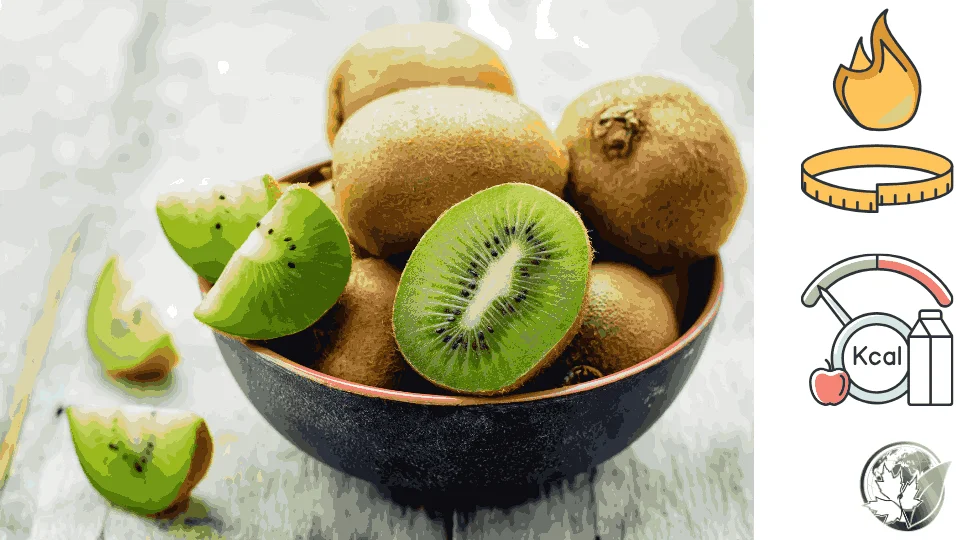
Kiwi and apple are both popular fruits, but their nutritional strengths are different. On an equal 100-gram basis, raw green kiwi contains about 61 calories, while raw apple with skin contains about 52 calories. Apple therefore wins the narrow calorie comparison by roughly 9 calories per 100 grams.
The difference is small in real-world terms. Nine calories is less than the energy difference created by modest variation in fruit size. If your goal is simply to choose the lower-calorie option, apple is slightly lower by weight. If your goal is to compare overall nutrient density, however, kiwi has several advantages.
Kiwi contains around 3 grams of fiber per 100 grams compared with about 2.4 grams in apple. Kiwi also provides roughly 92.7 milligrams of vitamin C per 100 grams compared with around 4.6 milligrams in apple. Potassium is about 312 milligrams in kiwi versus roughly 107 milligrams in apple. Protein remains low in both fruits, but kiwi contains more—around 1.1 grams per 100 grams versus about 0.3 gram in apple.
Apple has its own strengths. It is widely available, highly portable, can be eaten without peeling, and provides fiber and polyphenols. Its lower energy density by weight may also be attractive to people who want a larger quantity of fruit for slightly fewer calories.
The best choice depends on what you value. For fewer calories per 100 grams, apple has the edge. For vitamin C, potassium, and somewhat more fiber, kiwi is stronger. There is no nutritional reason to treat the decision as either/or; both can fit easily into a balanced diet, and variety across fruits is usually more useful than repeatedly choosing one fruit because of a small calorie difference.
Kiwi vs Apple Nutrition Table (Per 100g)
Use this table as a quick standardized comparison. Values are approximate and can vary by fruit variety, maturity, and data source.
| Nutrient | Green kiwi | Apple with skin |
|---|---|---|
| Calories | 61 kcal | 52 kcal |
| Carbohydrate | 14.7 g | 13.8 g |
| Natural sugars | 9.0 g | 10.4 g |
| Fiber | 3.0 g | 2.4 g |
| Protein | 1.14 g | 0.26 g |
| Fat | 0.52 g | 0.17 g |
| Vitamin C | 92.7 mg | 4.6 mg |
| Potassium | 312 mg | 107 mg |
Is Kiwi High in Sugar?
Raw green kiwi contains about 9 grams of naturally occurring sugar per 100 grams. A standard 69-gram kiwi contains roughly 6.2 grams, while a cup of sliced kiwi contains about 16.2 grams. Those numbers may sound different depending on the portion, which is why serving size matters.
Calling a fruit “high in sugar” based only on grams of sugar can be misleading. Whole kiwi comes packaged with water, fiber, vitamins, minerals, and plant compounds. That is nutritionally different from a sweetened beverage or candy in which a similar amount of sugar may be delivered with little fiber and very little chewing.
For people who monitor carbohydrate intake closely, such as those following a prescribed diabetes meal plan, the grams still matter. In that case, portion size and total meal composition should guide the choice. Pairing fruit with protein or fat may also change how satisfying the meal feels. Individual glucose responses vary, so personal medical advice should come from a qualified health professional.
For the general population, one kiwi is a modest-sugar portion of fruit. The bigger calorie jumps usually occur when kiwi is dried, candied, coated, sweetened, or blended into drinks with additional ingredients.
Is Kiwi Good for Weight Loss?
No single food causes weight loss, but kiwi can fit well into a calorie-controlled eating pattern. The reason is simple: it offers sweetness, volume, water, fiber, and micronutrients at a relatively modest calorie cost. An average kiwi at around 42 calories can replace a much more calorie-dense dessert or snack, although the overall diet determines weight change.
The fruit is especially useful when it helps you build meals you actually enjoy. Sliced kiwi over plain yogurt can provide sweetness without adding syrup. Kiwi can add flavor to oatmeal without large amounts of sugar. It can be paired with other fruit in a bowl that feels substantial because of its volume and water content.
Still, “low calorie” does not mean portions are irrelevant. A large smoothie containing several kiwis, banana, juice, nut butter, and sweetened yogurt can be quite calorie-dense even though every ingredient may be considered nutritious. When weight loss is the goal, the total recipe matters more than the reputation of any single ingredient.
Kiwi is best viewed as a helpful ingredient rather than a weight-loss trick. Its main advantages are portion control, nutrient density, fiber, and strong flavor for relatively few calories.
Does Kiwi Skin Change the Calories?
Kiwi skin is edible, although many people prefer to peel it because of its fuzzy texture. The skin itself contributes only a small amount to the total calorie count of a whole fruit. The more important difference is that eating the skin can increase the amount of fiber and plant compounds you consume compared with eating only the flesh.
If you choose to eat the skin, wash the fruit thoroughly under running water and rub the surface gently. Some people prefer smoother-skinned kiwi varieties or slice green kiwi thinly so the texture is less noticeable.
For calorie tracking, the easiest approach is consistency. If a nutrition database specifies “edible portion,” use the weight of the portion you actually eat. If you weigh a whole fruit and discard the skin, the whole-fruit weight will slightly overestimate the edible amount. For casual tracking, the difference is usually small; for precision, weigh the edible portion.
Green Kiwi vs Gold Kiwi: Are the Calories the Same?
Green and gold kiwi are similar fruits but are not nutritionally identical. Their calorie, sugar, fiber, and vitamin C values can differ by cultivar and database entry. Gold kiwi is often perceived as sweeter, while green kiwi is typically more tart and commonly cited for higher fiber. Some gold varieties can provide very high vitamin C.
Because the exact nutrition profile depends on the variety, it is better not to assume that every kiwi has exactly 61 calories per 100 grams. The figures in this article are based on a standard raw green kiwifruit reference. If you buy a branded gold kiwi and need precise tracking, use the nutrition information provided for that specific product or a database entry that names the cultivar.
The practical calorie difference between varieties is generally much less important than the difference between fresh kiwi and processed kiwi products. A fresh kiwi has no added sugar. Sweetened dried kiwi, candied slices, jams, and fruit snacks may contain concentrated sugar and much more energy per bite.
Fresh Kiwi vs Dried Kiwi: Why the Calories Change
Fresh fruit contains a large amount of water. Drying removes much of that water, which concentrates the naturally occurring carbohydrate and calories into a smaller weight and volume. This is why 100 grams of dried fruit usually contains far more calories than 100 grams of the corresponding fresh fruit.
Dried kiwi can be especially variable because many commercial products are sweetened or candied. If sugar is added during processing, the calorie density increases further. A small bag can therefore provide several times the calories of a single fresh kiwi even though the pieces look small.
The same caution applies to kiwi jam, kiwi syrup, smoothie concentrates, and fruit snacks. They may contain kiwi, but they should not be logged with the calorie value for raw fresh kiwifruit. Always match the nutrition entry to the form of the product.
How to Calculate Kiwi Calories by Weight
If you have a kitchen scale, calculating kiwi calories is simple. Using the standard value of 61 calories per 100 grams, divide 61 by 100 to get approximately 0.61 calorie per gram. Then multiply the edible weight by 0.61.
Examples:
- 50 g kiwi × 0.61 = about 31 calories
- 75 g kiwi × 0.61 = about 46 calories
- 100 g kiwi × 0.61 = about 61 calories
- 125 g kiwi × 0.61 = about 76 calories
- 150 g kiwi × 0.61 = about 92 calories
- 180 g kiwi × 0.61 = about 110 calories
This method is more reliable than assuming every fruit is the same size. It is particularly useful for meal-prep businesses, dietitians, recipe developers, or anyone who logs food by gram weight.
Remember that nutrition data for fresh produce is an average. Two kiwis of the same weight can have small differences in sugar and water content. For normal calorie tracking, those biological differences are not large enough to require concern.
What Does 100 Calories of Kiwi Look Like?
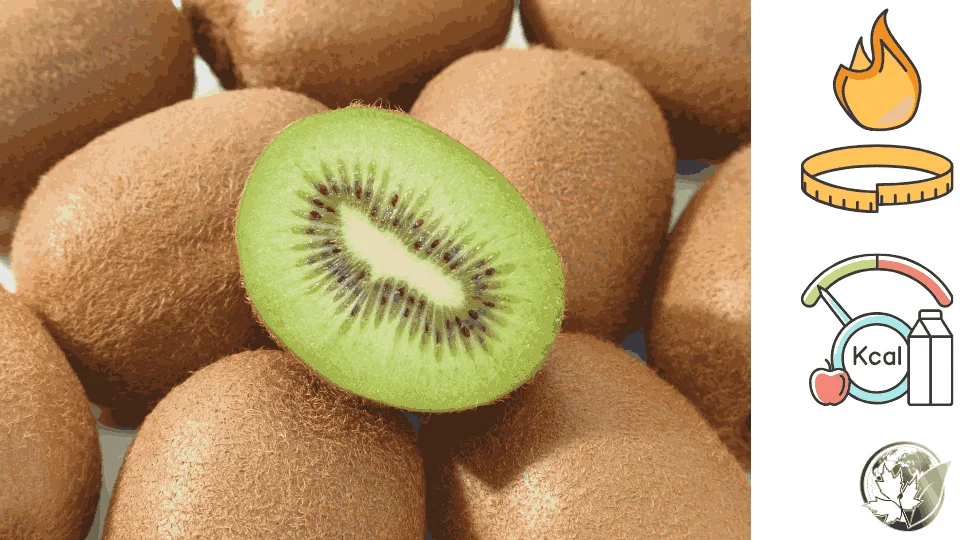
At approximately 61 calories per 100 grams, 100 calories of green kiwi is about 164 grams of edible fruit. That is a little less than the standard one-cup sliced serving of 180 grams. Depending on the size of the fruit, it may be around two to three kiwis.
This is useful when comparing snack volume. One hundred calories of kiwi occupies a relatively large physical volume because the fruit contains a lot of water. That does not automatically make it more filling than every other food—satiety also depends on protein, fat, fiber, texture, and the rest of the meal—but it explains why fresh fruit can provide a generous-looking portion for a modest number of calories.
If you want a snack close to 100 calories, you could simply eat about a cup minus a few slices. If you prefer a more balanced snack, one kiwi paired with a protein-rich food may be more satisfying than eating the entire calorie allowance as fruit alone.
Best Ways to Eat Kiwi Without Adding Many Calories
Kiwi is naturally flavorful, so it does not need much added sugar. The simplest low-calorie option is to halve the fruit and scoop out the flesh with a spoon. You can also peel and slice it, or wash and eat it with the skin if you enjoy the texture.
For breakfast, add kiwi to unsweetened oatmeal or plain high-protein yogurt. In fruit salad, combine it with berries, orange, melon, or apple for color and a mix of textures. Kiwi can also be blended into a smoothie, but remember that liquid calories are easy to increase when juice, sweetened yogurt, honey, syrups, or nut butter are added.
For dessert, chilled kiwi slices can provide a sweet-tart finish to a meal. If you are tracking calories, the toppings often matter more than the kiwi. Chocolate sauce, granola, coconut cream, sweetened condensed milk, and large portions of nuts can quickly turn a 40-calorie fruit into a much higher-calorie dish.
The practical rule is simple: use kiwi as the flavor and fruit component, then be intentional with the extras.
When Kiwi Calories Can Be Misleading
Calorie databases can show different answers for kiwi for several reasons. First, the serving sizes may not match. “One fruit,” “one NLEA serving,” “one cup,” and “100 grams” are different amounts. Second, the database may refer to green kiwi, gold kiwi, or a branded cultivar. Third, the entry may describe raw fruit, dried fruit, sweetened fruit, or a prepared product.
Another source of confusion is the edible portion. A whole kiwi weighed with skin may not equal the weight of the flesh you actually eat. The size of the fruit can also vary widely.
When you see conflicting calorie numbers, check the weight in grams before assuming one source is wrong. Grams are the common language that makes serving sizes comparable. If two sources report about 61 calories per 100 grams of raw green kiwi but one says 42 calories per fruit and another says 50, the difference may simply be that their “one fruit” weights are different.
Who Might Benefit From Tracking Kiwi Portions?
Most people do not need to weigh every piece of fruit. However, portion information can be useful in several situations. People following a calorie target may want consistent logging. Athletes may track carbohydrate intake around training. People on structured medical nutrition plans may need to count carbohydrate exchanges or potassium. Recipe developers need dependable gram-based values for nutrition labels and menu calculations.
The same data can also be useful for people who simply want perspective. Knowing that one kiwi is around 42 calories may make it easier to choose a snack without overthinking it. At the same time, understanding that one cup is about 110 calories prevents undercounting when a recipe uses several fruits.
If you have kidney disease, diabetes, food allergies, or another condition that changes your dietary needs, generic nutrition articles should not replace individualized medical advice. Kiwi contains potassium and can also cause allergic reactions in some people, particularly those with certain pollen or latex-related cross-reactivities. In those cases, consult an appropriate clinician or dietitian.
Practical Portion Guide
For everyday use, you can think about kiwi portions in three simple levels. One fruit is the light-snack portion at around 42 calories. One hundred grams is the comparison portion at about 61 calories. One cup sliced is the recipe or fruit-bowl portion at about 110 calories.
If you are building a breakfast, one kiwi may be enough to add flavor and vitamin C. If kiwi is the main fruit in a bowl, a cup may make more sense. If you are comparing labels or deciding between kiwi and apple, use the 100-gram value so the comparison is fair.
This three-level approach is more useful than memorizing many numbers because it covers the most common real-life situations: grabbing a fruit, weighing food, and measuring a recipe.
Frequently Asked Questions
How many calories are in one kiwi?
A typical raw green kiwi weighing about 69 grams of edible portion contains approximately 42 calories. Larger or smaller fruits will have proportionally more or fewer calories.
How many calories are in 100 grams of kiwi?
Raw green kiwifruit contains about 61 calories per 100 grams. This is the best serving size for comparing kiwi with other fruits because the weight is standardized.
How many calories are in one cup of sliced kiwi?
One cup of sliced green kiwi weighs about 180 grams and provides approximately 110 calories. It also contains around 5.4 grams of fiber and 16.2 grams of naturally occurring sugar.
Is kiwi lower in calories than apple?
Not by equal weight. One hundred grams of raw green kiwi has about 61 calories, while 100 grams of raw apple with skin has about 52 calories. Apple is slightly lower in calories, but kiwi provides much more vitamin C and more potassium and fiber per 100 grams.
Is kiwi a good fruit for a low-calorie diet?
Yes, kiwi can fit easily into a low-calorie eating pattern because a typical fruit contains only about 42 calories while providing fiber, vitamin C, potassium, and water. Weight management still depends on the overall diet and total energy intake rather than on any single food.
Conclusion: Kiwi Is Low in Calories and High in Nutritional Value
Kiwi is a useful example of why calorie counting works best when serving size and nutritional quality are considered together. One average green kiwi contains about 42 calories, 100 grams contains about 61 calories, and one cup of sliced kiwi contains about 110 calories. Those portions also provide fiber, potassium, and an especially strong amount of vitamin C.
Compared with apple, kiwi is slightly higher in calories by equal weight—about 61 versus 52 calories per 100 grams—but the difference is small. Kiwi provides more fiber, much more vitamin C, more potassium, and more protein, while apple remains an excellent low-calorie fruit with its own nutritional benefits. The most useful conclusion is not that one fruit “wins,” but that each offers a different nutrient profile.
For calorie tracking, use grams whenever possible. For a quick snack estimate, count roughly 40 to 50 calories for an average kiwi. For recipes, remember that a cup of sliced kiwi is closer to 110 calories. And when comparing fresh fruit with dried, candied, or sweetened products, always check the specific label because processing can change the calorie density dramatically.
If you want a naturally sweet fruit that is easy to portion, rich in vitamin C, and relatively low in calories, kiwi is an excellent option to rotate into breakfasts, snacks, fruit bowls, and desserts.
Nutrition Data Note
Nutrition values are approximate and based on standard reference data for raw green kiwifruit and raw apple with skin. Fresh produce varies naturally by size, cultivar, ripeness, growing conditions, and edible portion. For packaged or branded products, use the product label when available.
Editorial note: This article is general nutrition information and is not a substitute for individualized medical or dietetic advice.